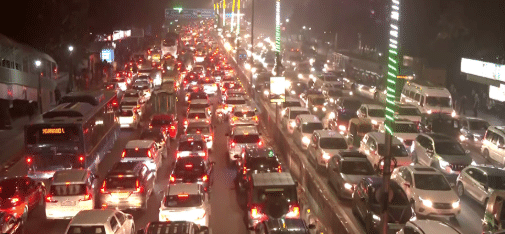
Srinagar: The traffic management infrastructure in India-administered Jammu and Kashmir is hemorrhaging. What appears on surface as a routine administrative challenge has metastasized into a full-blown institutional crisis—one where enforcement mechanisms have overtaken capacity, where penalties pile higher than compliance, and where the human cost is measured in body bags on mountain highways.
The numbers tell a story of exponential dysfunction. In 2025 alone, authorities issued 624,168 vehicle challans—a staggering figure that would overwhelm judicial systems in far more resourced jurisdictions. Yet this enforcement tsunami crashes against a courtroom wall: 104,815 cases languish pending, trapped in procedural limbo while violators drive on, unencumbered by consequence.
This is not governance. This is institutional theater—performance without resolution, punishment without rehabilitation, revenue extraction without safety returns.
The trajectory of traffic penalties in Jammu and Kashmir reveals not growing order, but proliferating chaos. Official documentation traces an enforcement curve that has nearly quadrupled in five years:
| Year | Challans Issued | Revenue Generated |
|---|---|---|
| 2020 | 141,249 | $934,000 |
| 2022 | 261,092 | Not disclosed |
| 2023 | 332,221 | Not disclosed |
| 2024 | 445,748 | Not disclosed |
| 2025 | 624,168 | Not disclosed |
The $934,000 collected in 2020 represents the only revenue figure authorities have made public—a transparency gap that itself raises accountability questions. What happened to the millions presumably generated in subsequent years? Why does a system generating such volume lack resources to process its own enforcement?
The 104,815 pending challans represent more than administrative backlog. They embody a broken social contract: citizens penalized without adjudication, courts paralyzed by volume, and a deterrent effect eroded by impunity. When violation and consequence are severed by years of delay, law becomes suggestion.
The Rising Death Toll
Here is the cruel paradox: as enforcement surged, safety collapsed. The roadways of Kashmir have grown more lethal even as penalties multiplied—a correlation that exposes the hollowness of punishment-centric approaches.
| Year | Accidents | Fatalities |
|---|---|---|
| 2020 | 974 | 92 |
| 2021 | 1,038 | 107 |
| 2023 | Not specified | 252 |
| 2025 | 768 | 172 |
The 2023 spike—252 deaths, a 135% increase from 2021—should have triggered emergency intervention. Instead, the trajectory continues: 172 fatalities in 2025, despite reduced accident volume, suggests crashes have grown more violent. Speed, vehicle density, and inadequate emergency response are converting routine incidents into fatalities.
Kashmir’s topography amplifies every failure. The winding mountain roads, carved through Himalayan terrain, forgive no error. A moment’s inattention on the Srinagar-Jammu highway—a corridor essential for the region’s economic survival—can send vehicles plunging into ravines. Winter ice, summer landslides, and perpetual “shooting stones” create conditions where minor violations become fatal errors.
The victims are not statistics. They are vegetable vendors crushed on their way to dawn markets, students returning from tuition centers, truck drivers earning livelihoods on perilous routes—ordinary Kashmiris navigating infrastructure that development rhetoric celebrates but safety standards betray.
The most damning data point reveals institutional contradiction: enforcement has intensified while capacity has evaporated.
| Year | Traffic Personnel |
|---|---|
| 2020 | 324 |
| 2025 | 276 |
This 15% workforce reduction—occurring alongside record enforcement volumes—has created impossible operational conditions. Multiple retirements without corresponding recruitment have depleted ranks. Currently, 271 officers struggle to manage a system generating nearly 2,300 violations per officer annually—approximately 200 monthly cases requiring documentation, court preparation, and procedural follow-up.
The response? Borrowed personnel—temporary deployments from other police formations pressed into traffic duty without specialized training. This is not resource optimization; it is institutional triage, substituting quantity for expertise while the professional traffic police corps withers.
What does it mean for enforcement quality when officers process violations as assembly-line output? When court preparation is rushed? When the distinction between genuine safety threats and technical infractions blurs under volume pressure?
The Traffic Department’s operational resources mock its enforcement ambitions. The entire fleet: 112 vehicles, including 22 cranes—insufficient for territorial coverage across mountainous terrain spanning hundreds of kilometers. Road safety campaigns continue at schools and public venues, but their impact remains unmeasured, their budgets microscopic.
Financial allocations reveal not strategic investment but erratic, declining commitment:
| Fiscal Year | Allocation |
|---|---|
| 2020-21 | $101,000 |
| 2021-22 | $83,000 |
| 2022-23 | $86,000 |
| 2023-24 | $122,000 |
| April 2024–December 2025 | $73,000 |
The 40% budget contraction in the current period, coinciding with peak enforcement activity, defies administrative logic. Additionally, $470 (₹0.40 lakh) was allocated under the Civil Action Program in 2022-23—a token gesture toward community engagement that suggests institutional priorities lie elsewhere.
The revenue-enforcement gap is stark: if 2020’s penalty rates generated $934,000 from 141,249 challans, 2025’s 624,168 challans imply potential collections exceeding $4 million. Yet the department operates on $73,000—less than 2% of probable revenue. This is not resource constraint; it is fiscal architecture that extracts from violators while starving the enforcement apparatus.
Technological Fixes, Structural Failures
Authorities emphasize modernization: checkpoints, signal installations, road markings, automated detection systems. The “smart traffic” narrative follows national trends, promising efficiency through technology.
But Kashmir’s reality resists technological solutionism. Internet restrictions—periodically imposed across the Union Territory—disable cloud-based enforcement systems. Harsh winters destroy road electronics. Mountainous terrain limits camera network viability. And technology cannot compensate for absent personnel, overwhelmed courts, or infrastructure designed for vehicle throughput rather than human survival.
The interventions that might matter—segregated pedestrian pathways, protected cycling lanes, emergency medical corridors, speed-calming engineering—receive less attention than automated penalty generation. The system prioritizes violation detection over injury prevention, revenue over rehabilitation.
This crisis unfolds within Kashmir’s contested political landscape. Since August 2019’s revocation of Article 370, India-administered Jammu and Kashmir has experienced accelerated infrastructure expansion—tunnels, highways, bypasses—presented as integration and development.
The Z-Morh and Zojila tunnels promise year-round connectivity. The Srinagar-Jammu highway widening continues. Yet this physical transformation has outpaced safety infrastructure. Roads designed for speed lack barriers, lighting, or emergency response stations. Vehicle volumes surge while driver training, vehicle inspection, and road maintenance lag.
The 100,000+ pending challans suggest a system more proficient at punishment than resolution, extending legal uncertainty rather than delivering justice.
In a region where political expression faces restriction, traffic stops become moments of state-citizen encounter loaded with tension. The enforcement officer with a challan book exercises power that feels less like safety provision than surveillance—a perception that undermines compliance culture however rational it might be.
Behind every statistic is grief that official documents cannot capture.
The 252 fatalities of 2023 included families returning from weddings, pilgrims to mountain shrines, laborers commuting to construction sites. The 172 deaths of 2025 represent children who will not complete schooling, parents who will not see grandchildren, households plunged into economic crisis by lost breadwinners.
Each pending challan represents a citizen trapped in bureaucratic purgatory—unable to renew licenses, register vehicles, or clear records while cases stagnate. The judicial backlog is not merely administrative inconvenience; it is daily lived stress for thousands of Kashmiris navigating a system that penalizes promptly then forgets.
The 276 traffic officers work under conditions their superiors rarely experience: exposed to weather extremes, confronting hostile violators, processing violations they know will not reach resolution. Morale deteriorates as institutional contradictions intensify—asked to generate volume without capacity, enforce without authority, protect without resources.