
Hazrat Syed Sain Sakhi Saheli Sarkar holds a distinguished place among the great Sufi saints of the subcontinent, remembered for his spiritual devotion, ascetic life, and enduring influence on the religious and cultural landscape of Azad Jammu and Kashmir.
Ancestry and Early Life
According to established historical traditions, the ancestors of Hazrat Syed Sain Sakhi Saheli Sarkar migrated from Multan to Gujarat, and later from Gujarat to Gujar Khan, eventually settling in a locality known as Syed Kasri. He was born in 1857 CE (1273 Hijri), as referenced by Allama Murid Ahmad Chishti. Authentic traditions confirm his original name as Syed Zulfiqar Shah, although some narrators have referred to him as Syed Ghulam Muhammad Shah. However, scholarly consensus supports Syed Zulfiqar Shah as his verified name.
He received his early religious education, including Qur’anic recitation (Nazira) and foundational Islamic teachings, directly from his revered father. From an early age, clear signs of spiritual distinction were evident. Accounts of his life indicate that he was a born saint (Madar-zad Wali), with manifestations of spiritual absorption appearing during childhood. Even while studying, he would enter states of deep spiritual ecstasy, seemingly detached from worldly desires. His temperament reflected profound humility and asceticism, embodying the true spirit of a wandering dervish.
Spiritual Journey and Ascetic Practices
Inspired by the divine command, “Travel through the earth” (Qur’an 29:20), Hazrat Sain Sakhi Saheli Sarkar embarked on a lifelong journey of spiritual exploration. Driven by a deep yearning to observe divine signs in nature, he withdrew into forests, deserts, and uninhabited lands. He spent extended periods in spiritual retreats (Chilla Kashi), rigorously engaging in Jihad al-Nafs—the inner struggle against the commanding self (Nafs-e-Ammarah)—seeking closeness to the Divine through self-discipline and renunciation.
His spiritual retreats took him across various regions, including Rawalpindi, Murree, Abbottabad, and Haripur, where he devoted himself to worship and meditation. In Haripur, his life took a decisive turn when he met Hazrat Pir Syed Fatah Haider Shah (RA). Through his companionship, he attained inner peace and spiritual clarity and formally pledged allegiance as his disciple.
Under his mentor’s guidance, Hazrat Saheli Sarkar traversed the stations of spiritual realization. Upon completion of his training, he once again responded to the divine call to wander. He visited Sehwan Sharif, where he spent time in solitude at the shrine of Hazrat Lal Shahbaz Qalandar (RA). He later passed through Hassan Abdal and reached Court Najibullah, where a site known today as Bohar Wala Takiya remains associated with his presence.
Spiritual Lineage and Recognition
Renowned scholar Allama Syed Zahid Hussain Naeemi, in his authoritative work Tazkira Auliya-e-Kashmir (Volume II), citing Allama Murid Ahmad Chishti, records that Hazrat Sain Sakhi Saheli Sarkar was widely believed to be a Khalifa (spiritual successor) of Khwaja Shams-ul-Arifeen Sialvi (RA), also known as Pir Sial Sharif.
Allama Naeemi further documents his inquiry with Khwaja Ghulam Fakhr-ud-Din Sialvi, who confirmed through reliable sources that Hazrat Saheli Sarkar was indeed a Khalifa of Pir Sial Ghareeb Nawaz. Initially, he was a disciplined spiritual traveler (Salik), fully adhering to religious law and the path of mysticism, before entering a state of divine absorption (Majzoobiyat).
Multiple testimonies reinforce this lineage. Qazi Ghulam Nabi Mansehravi, a devoted disciple of Pir Sial in Mansehra, frequently affirmed Hazrat Saheli Sarkar’s status as a Khalifa. Syed Ghulam Hussain Shah Bukhari, a devoted attendant who lived in a cave near present-day Farooqia Factory, and Qazi Muhammad Shamsuddin Darvesh of Haripur also confirmed his spiritual affiliation with Pir Sial.
Mystical Insight and Symbolic Legacy
Long before urban settlements emerged in the region, Hazrat Saheli Sarkar was known to gesture and symbolically outline future marketplaces and crossroads in Abbottabad and Mansehra, reportedly using ropes to mark paths while instructing others in Urdu, “Draw a market here, and another here.” Remarkably, as time passed, these towns developed markets and intersections closely aligned with his symbolic gestures, which devotees interpret as manifestations of spiritual foresight.
Reflecting on such saints, Allama Muhammad Iqbal, quoting Qalandar Lahori, beautifully captured their hidden spiritual power:
“Do not question the devotion of these wearers of patched cloaks;
If you seek to see them, behold—
They sit with radiant hands concealed within their sleeves.”
The Name “Saheli” and Its Meaning
According to Syed Mahmood Azad, as cited by Allama Naeemi, Hazrat Saheli Sarkar often addressed men as “Uriya” and women as “Saheli” (friend or companion). Over time, people began referring to him by these affectionate terms. Gradually, his original name faded from common memory, and he became universally known as Sain Sakhi Saheli Sarkar. This naming, many believe, reflects a deeper spiritual philosophy rooted in brotherhood, compassion, tolerance, and harmony, values consistently emphasized by Sufi traditions.
Shrine and Annual Urs
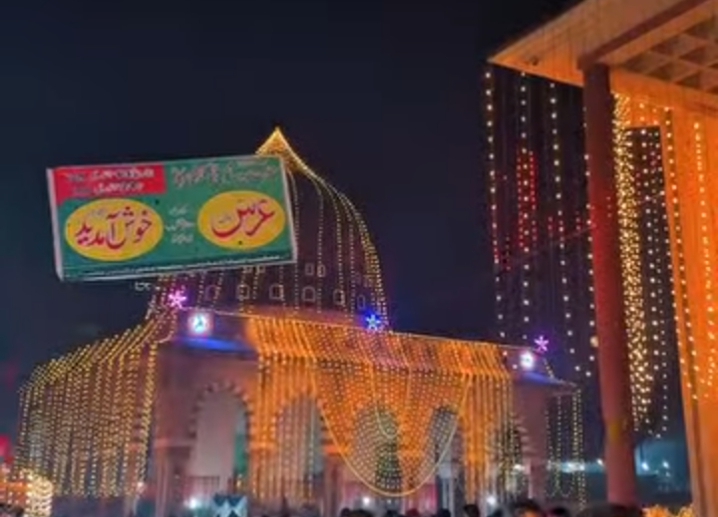
The illuminated shrine of Hazrat Syed Sain Sakhi Saheli Sarkar is located in Muzaffarabad, the capital of Azad Jammu and Kashmir, and is administered by the Auqaf Department of the Government of Azad Kashmir. The shrine is an architectural landmark, featuring a majestic dome, expansive courtyards, a beautifully constructed mosque, and modern facilities including lighting, carpets, and seasonal amenities. Arrangements for Langar (free meals) and accommodation for pilgrims are also provided. A Madrasah for Qur’anic education operates within the complex for local children.
Every year, from 13 January to 21 January, the Urs Mubarak is observed with great devotion and reverence. Thousands of devotees from across the region and beyond gather to participate in Qur’anic recitations, Hamd and Naat gatherings, sermons, and spiritual discourses. Renowned scholars, religious thinkers, and celebrated Qawwals from across Pakistan perform during the Sama gatherings. The final day of the Urs is observed as a public holiday in Muzaffarabad, with the President of the State and the Prime Minister attending the concluding ceremonies.
The Urs culminates in collective prayers for peace, prosperity, and stability in Pakistan, the freedom of occupied Kashmir, and unity within the Muslim world. The atmosphere across the city resembles a festive occasion, reflecting the deep-rooted spiritual and cultural significance of Hazrat Sain Sakhi Saheli Sarkar’s legacy.
Hazrat Syed Sain Sakhi Saheli Sarkar: A Revered Sufi Saint and Spiritual Legacy of Kashmir