No state backing. No paywalls. Just truth. Support Kashmir's independent voice. Join 2,400+ patrons who fund independent voices.
Zero Paywalls
Reader Funded
Award Winning
Secure Payment
Encrypted
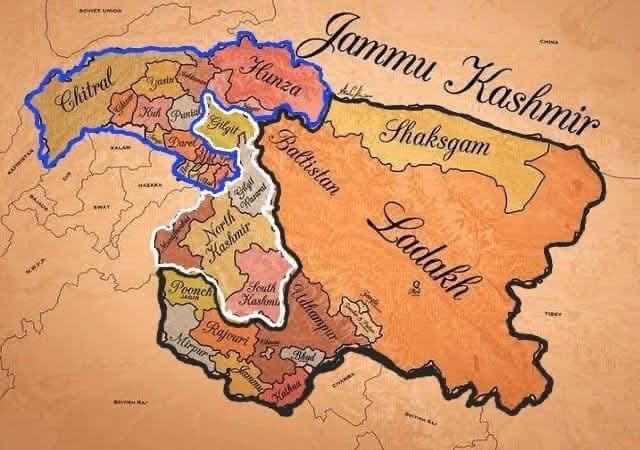
The Treaty of Amritsar, signed on March 16, 1846, is often misrepresented in the discourse surrounding the history of Jammu and Kashmir. A closer look at the historical facts reveals a more nuanced reality, one that has been distorted over the years for political narratives.
The map in the black circle represents the territories before March 16, 1846, which included Baltistan, Ladakh, Jammu, Rajouri, Bhimber, Mirpur, Kotli, and Poonch. These areas were already under the rule of Gulab Singh, the Dogra ruler, and had no connection to the Treaty of Amritsar.
The blue circle highlights regions such as Hunza, Nagar, Punial, Ishkoman, Gupis, Yasin, Darail, Tangir, and Chilas. These areas were forcibly occupied by Dogra forces after 1860, with only the Raja of Punial willingly joining the Dogra state. The rest were annexed through military force. These territories, too, have no link to the Treaty of Amritsar.
No state backing. No paywalls. Just truth. Support Kashmir's independent voice. Join 2,400+ patrons who fund independent voices.
The white circle represents the territories that became part of the Jammu and Kashmir state through the Treaty of Amritsar. These included the Kashmir Valley, Muzaffarabad, Astore, and the Gilgit district. These areas were under Sikh control before the treaty. Gulab Singh acquired them by paying war indemnities to the Sikhs, as stipulated in the treaty. Notably, rebellions in Gilgit and Astore in 1852 were crushed by Dogra forces, who reasserted control by 1860.
The question arises: What does the Treaty of Amritsar have to do with the people of Bhimber, Mirpur, Kotli, Poonch, Jammu, Punial, Yasin, Diamer, Hunza, Nagar, Baltistan, and Ladakh? Their ancestors were already living under Gulab Singh’s rule before the treaty. For 77 years, a false narrative has been propagated that “we Kashmiris were sold by the Dogras.” The truth is that Gulab Singh also liberated Kashmiris from the oppression of the Sikhs and the British.
It is essential to remember the truth and not become ungrateful. The essence of Islam lies in truthfulness, and it is our duty to uphold it. The distorted narrative surrounding the Treaty of Amritsar must be corrected to reflect historical realities accurately.
By Iftikhar Rajput, Poonch, Pakistan-Administered Kashmir
Trending Topics


The Azadi Times is an independent digital news platform based in Muzaffarabad, Kashmir, dedicated to credible journalism, in-depth reporting, and global analysis. We cover Kashmir, South Asia, and international affairs with a commitment to truth, editorial integrity, and public accountability.
Get important news delivered directly to your inbox and stay connected!
© 2026 The Azadi Times. All Rights Reserved.