
Muzaffarabad, PaJK – In a discovery poised to reshape South and East Asian historical narratives, an archaeological excavation in Pakistan-administered Jammu and Kashmir (PaJK) has revealed a possible ancient link between Kashmir and the Korean Peninsula.
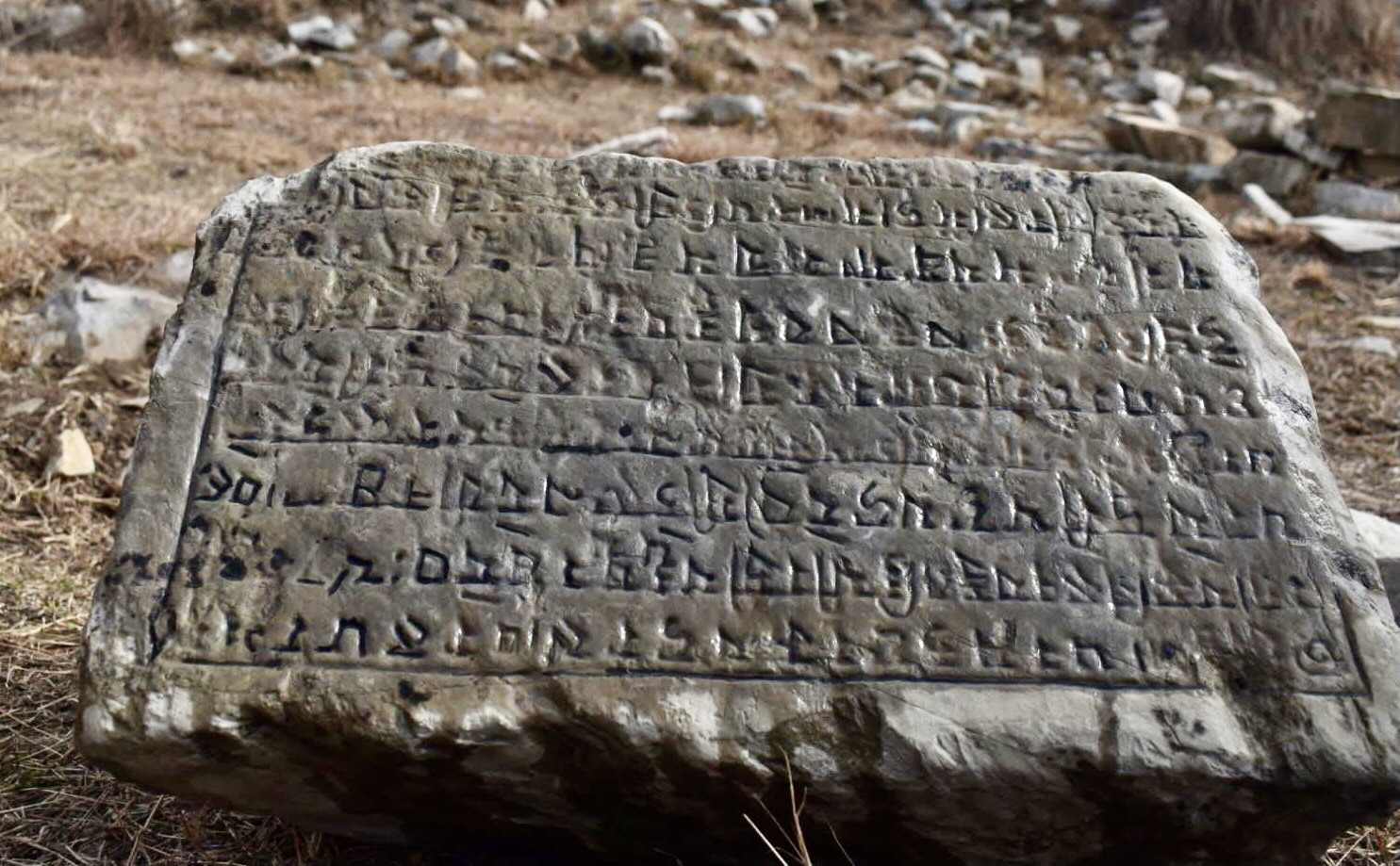
Dr. Rukhsana Khan, a leading archaeologist and associate professor at the University of AJK, has uncovered a rare stone inscription in the highlands of southern Kotli district—an area strategically situated near the Rajouri-Mendhar belt. The inscription is carved in a mixture of Korean alphabets and Proto-Sharda script, pointing to an unexpected but significant historical interaction between the two distant regions.
“This is a major breakthrough,” said Dr. Khan, who also heads the Sharda Centre of Learning at the university. “Preliminary analysis suggests cultural or religious exchange, potentially dating back to the early spread of Buddhism along the ancient Silk Routes connecting Kashmir with China, Korea, and beyond.”

The newly discovered site, nestled amid Kotli’s rugged terrain, also yielded a range of archaeological materials: prehistoric rock shelters, rock-cut caves, partially defaced anthropomorphic stone carvings, ancient water reservoirs, earthen mounds, and pottery fragments. Collectively, these suggest a long continuum of human settlement and cultural development stretching from the 4th millennium BCE to the late medieval period.
Strategic Cultural Corridor
The Kotli site is geographically and historically significant, lying at a vital axis linking the Kashmir Valley and the Jammu region. Scholars believe it may have functioned as a key religious and cultural corridor for centuries. The presence of Proto-Sharda script—once the literary vehicle of Kashmir’s ancient Sharda civilisation—underscores the region’s past as a center of learning and spirituality.
“The convergence of Proto-Sharda and Korean scripts in a single inscription is unprecedented,” noted Dr. Khan. “It suggests a deeper, more complex pattern of cultural and possibly diplomatic ties that warrants serious international academic attention.”



Call for International Collaboration
Dr. Khan, a PhD graduate from the prestigious Taxila Institute of Asian Civilisations and a noted authority on ancient Sharda heritage, has called for global scholarly collaboration, particularly with Korean historians, epigraphists, and Buddhist scholars.
“We are at the threshold of uncovering a forgotten chapter of inter-Asian relations,” she said. “Such finds could help reconstruct historical ties between Kashmir and East Asia, offering new insights into the movements of people, faiths, and ideas along the Silk Routes.”
The Sharda Centre of Learning is now coordinating with leading universities across Pakistan to deepen the investigation. Plans are underway to invite Korean research institutions to jointly examine the inscription and associated artefacts.


Boost to Heritage Tourism and Research
Local authorities and academic institutions are optimistic that the discovery will enhance Kashmir’s profile as a promising destination for archaeological research and cultural heritage tourism. Experts believe that such findings can transform the region into a hub for academic diplomacy and cross-border cultural collaboration.
“This is not just a discovery for academia,” said a spokesperson from the University of AJK. “It’s a chance to present Kashmir’s ancient legacy on a global stage, reaffirming its historic role in the exchange of knowledge, faith, and culture.”
The archaeological team continues to secure and document the Kotli site under challenging terrain and limited resources. Yet, the momentum of the discovery has already energized interest from national and international heritage bodies.
As efforts to decode the inscription progress, scholars and observers alike await what could become a landmark turning point in understanding Kashmir’s ancient global connections—particularly its ties to East Asia and the spread of early Buddhism.