
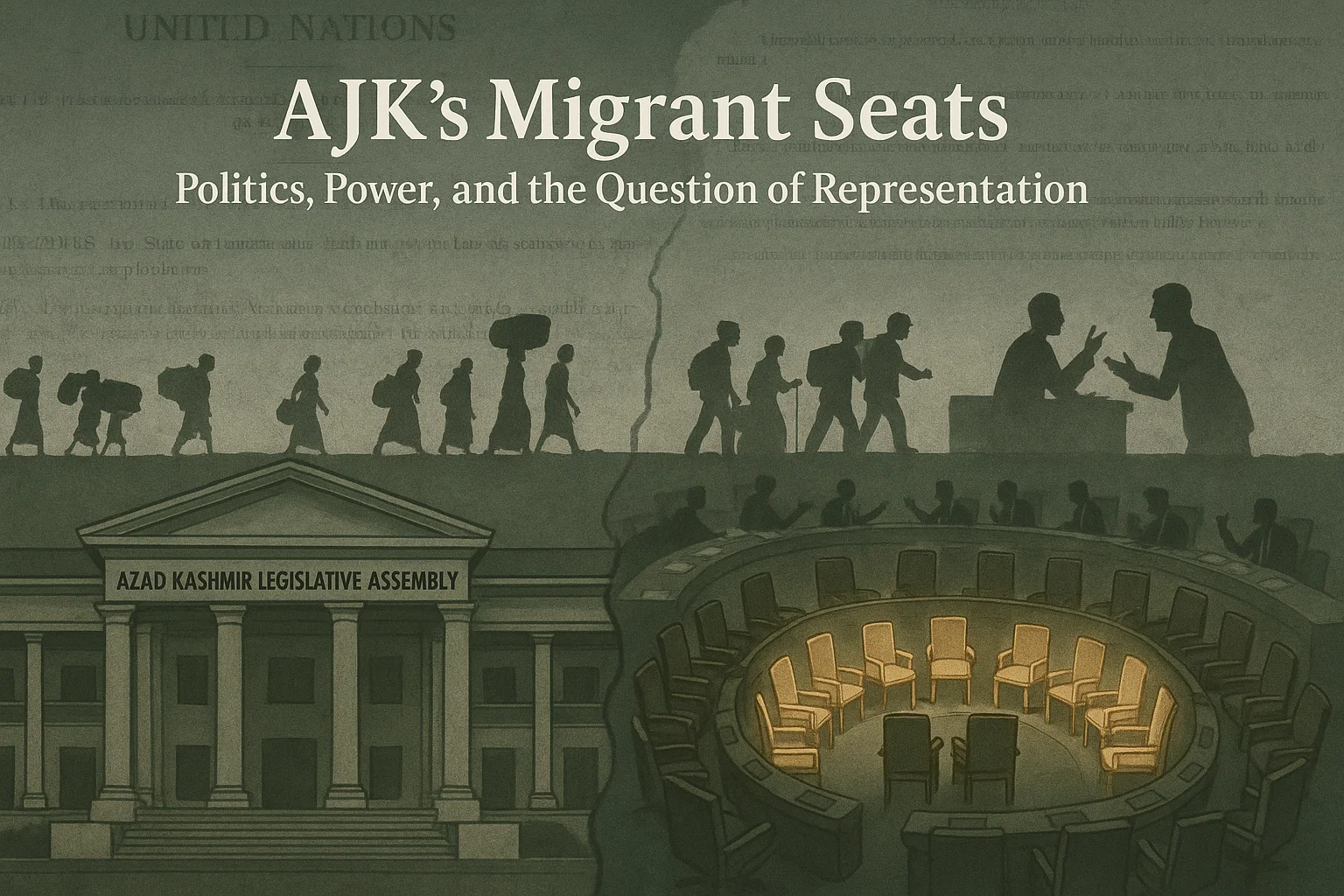
Muzaffarabad, AJK, August 6, 2025 — The Azadi Investigation Desk: In Pakistan-administered Azad Jammu and Kashmir (AJK), the political landscape has shifted dramatically following the Jammu Kashmir Joint Awami Action Committee’s (JKJAAC) call for abolishing 12 reserved seats for Kashmiri migrants in the Legislative Assembly. From the Prime Minister’s tours to Assembly debates, government figures have lined up to defend these seats while criticising the JKJAAC.
But at the heart of the storm lies a fundamental question:
Where did these 12 seats for migrants from Indian-administered Jammu and Kashmir originate? And do United Nations resolutions on Kashmir make any reference to them?
The answer touches not only constitutional law but also Kashmir’s political identity. Yet, strikingly, nearly three-quarters of AJK’s 4.5 million residents admit they do not even know what the UN resolutions actually say. This investigation traces the origins of the migrant seats, their legal framework, and the controversies surrounding them.
UN Resolutions on Kashmir (1947–1950)
Kashmir has long been debated at the United Nations. But the earliest resolutions, from 1947 to 1950, remain foundational. AJK politicians frequently cite them, especially now when almost every Assembly member links the migrant seats to the “freedom struggle.” But do the resolutions really mention them?
Resolution 38 (January 17, 1948): Called on India and Pakistan to reduce tensions and avoid steps that would worsen the conflict.
Resolution 39 (January 20, 1948): Established the UN Commission for India and Pakistan (UNCIP) to investigate and mediate.
Resolution 47 (April 21, 1948): Demanded Pakistan withdraw tribesmen and troops; urged India to reduce its forces. Called for a UN-supervised plebiscite to determine Kashmir’s future and recommended an interim administration with representation from all parties.
Resolution S/1196/Rev.1 (August 13, 1948): Proposed a complete ceasefire, Pakistani withdrawal, Indian troop reduction, and UN-supervised plebiscite.
Resolution S/1430/Rev.2 (January 5, 1949): Accepted by both India and Pakistan, affirming that the future of Jammu and Kashmir would be determined by “the will of the people.”
Resolution 80 / S/1469 (March 14, 1950): Reaffirmed earlier pledges, appointed Sir Owen Dixon as mediator, and once again stressed a plebiscite.
Across all these documents, there is no mention of reserved legislative seats for migrants. Migrants are only indirectly included as part of “the people” whose will must be determined through a plebiscite.
Constitutional Origins: From Interim Rules to 1974
For more than two decades after 1947, Azad Jammu and Kashmir (AJK) functioned without a formal constitution. Governance ran through executive councils and ad hoc arrangements, reflecting the uncertainty of Kashmir’s unresolved status.
In 1970, the AJK Interim Constitution Act introduced a basic structure, and by 1974, the Interim Constitution was formally enacted. It was here that 12 reserved seats for Kashmiri migrants were written into law.
The seats were divided equally:
-
6 for Jammu migrants, settled mainly in Punjab and other parts of Pakistan.
-
6 for Kashmir Valley migrants, residing in Khyber Pakhtunkhwa and nearby regions.
The intent was to give a political voice to those displaced during the 1947–48 war. On paper, it looked like a gesture of inclusion. In practice, however, these seats soon became decisive in AJK politics — often determining the survival or fall of governments.
What began as representation for refugees gradually turned into a power lever, shaping political dynamics in ways far beyond their original purpose.
Before the Migrant Seats
Between 1947 and 1970, Azad Jammu and Kashmir (AJK) was governed through a State Council, composed exclusively of representatives from areas physically under AJK’s control. During this period, migrants from Indian‑administered Jammu and Kashmir had no reserved political representation.
That changed with the constitutional reforms of the early 1970s. The introduction of 12 reserved migrant seats in 1970 — and their formal entrenchment in the 1974 Interim Constitution — permanently altered AJK’s political landscape.
From that point onward, migrants were no longer outside the system. Their votes and representatives became pivotal players, shifting the balance of power in ways that continue to shape AJK politics today.
The UN and Representation
Do the UN resolutions permit or require migrant seats?
The clear answer is no. The UN never prescribed a political structure for AJK. It simply demanded that the “will of the people of Jammu and Kashmir from all parts of the state” be ascertained.
Resolutions such as S/1196 and S/1430 mention this principle, but they do not explain whether it should be through assemblies, constituencies, or direct plebiscite.
Thus, the 12 migrant seats are a purely local constitutional invention — not an international requirement.
Political Controversy
Over the decades, the 12 migrant seats have become a lightning rod for political debate in Azad Jammu and Kashmir.
Electoral imbalance: Migrant constituencies often contain far larger pools of voters than many AJK constituencies, producing serious questions about whether the system respects the principle of “one person, one vote.”
State Subject Rule: The criteria for who qualifies as a “state subject” — and thus eligible to vote on these seats — has been applied inconsistently, fueling accusations of manipulation.
Power politics: In practice, the 12 seats frequently serve as kingmakers. With AJK’s slim parliamentary margins, migrant representatives have often determined whether governments stand or fall.
Beyond technical concerns, the debate is also deeply political. Several AJK-based parties and activists refuse to even recognise these representatives as “genuine migrants.” They argue that many families have long since settled into permanent lives in Pakistan, far from refugee conditions. As a result, the seats, they claim, function less as a voice for displaced Kashmiris and more as instruments of electoral engineering — detached from the lived struggles of actual displacement.
Local Mechanism, Not Freedom Struggle
If examined neutrally, the migrant seats have no direct link to the freedom struggle or UN resolutions. They are a domestic political arrangement born of the 1970 and 1974 laws.
They were designed to represent displaced populations but have since become entangled in local power struggles. Until a UN-supervised plebiscite resolves the status of Jammu and Kashmir, these seats remain a temporary political device. Their future — abolition, reform, or continuation — depends on political consensus or judicial interpretation within AJK.
The 12 migrant seats in AJK’s Assembly are not grounded in UN resolutions, nor in international law. They are a local constitutional arrangement, introduced decades after partition to accommodate refugees but later co-opted into the power politics of Muzaffarabad.
As the Joint Awami Action Committee revives debate around their legitimacy, the migrant seats are once again at the centre of controversy. But the evidence is clear: they are not a pillar of the freedom struggle, but rather a domestic political mechanism whose relevance is being increasingly questioned.
Submit Your Story
Let your voice be heard with The Azadi Times

