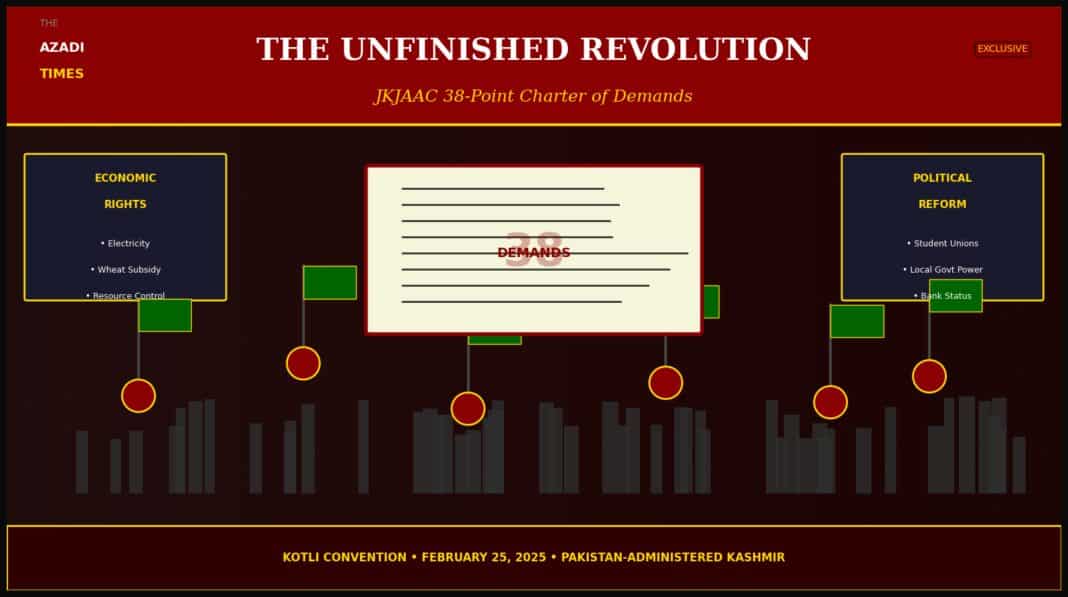

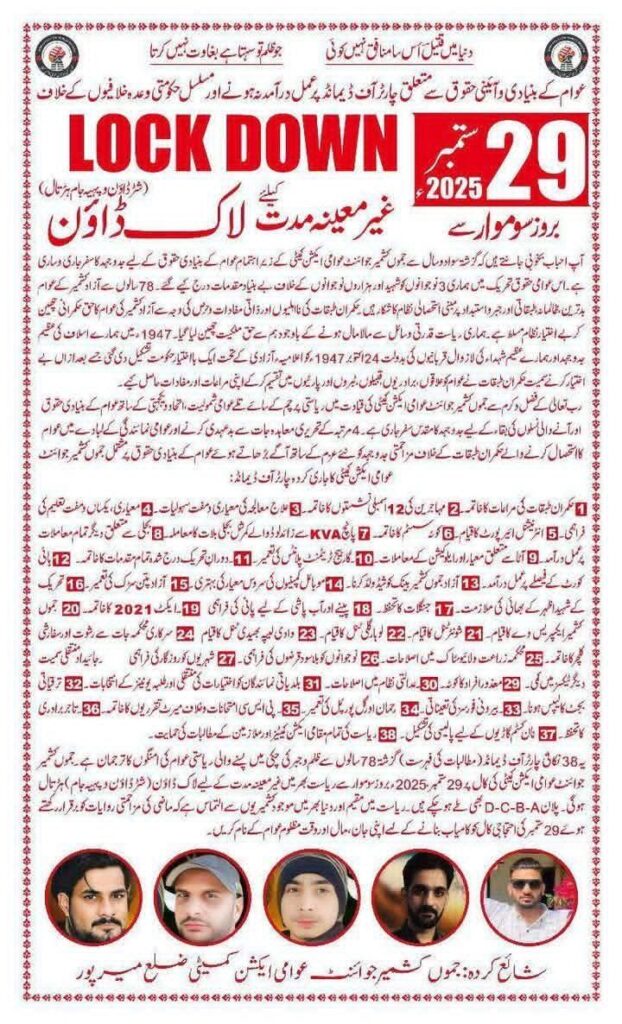
Muzaffarabad — When thousands of protesters from across Pakistan-administered Kashmir converged on Kohala on 29 September 2025, they carried more than just banners and slogans. They bore a meticulously crafted document that would fundamentally alter the region’s political discourse the 38-point Charter of Demands presented by the Jammu Kashmir Joint Awami Action Committee (JKJAAC).
Four months later, as the Core Committee prepares to convene in Kotli on 25 February, the movement stands at a critical crossroads between negotiated reform and renewed confrontation.
From Economic Grievances to Structural Transformation
The Azadi Times
No state grants. No corporate lobby. Just ground‑truth reporting from Kashmir & beyond
You make this possible.
The JKJAAC’s emergence represents one of the most significant grassroots mobilizations in Pakistan-administered Kashmir’s recent history. What began in May 2023 as localized protests against inflated electricity bills and wheat prices has evolved into a comprehensive reform movement challenging the very foundations of governance in the region .
The 38-point Charter of Demands subsequently expanded to 42 accepted points following the October 4, 2025 agreement addresses a spectrum of issues ranging from immediate economic relief to long-term structural reforms.
At its core, the movement seeks to address what activists describe as decades of “economic exploitation and administrative neglect” perpetrated by both the AJK administration and the Pakistani government in Islamabad .

The 38-Point Agenda: A Blueprint for Reform
The Charter of Demands encompasses several transformative proposals that strike at the heart of established power structures in Pakistan-administered Kashmir:
Economic and Resource Rights
Chief among the demands is the call for electricity tariffs calculated based on production costs from local hydro-projects like the Mangla Dam, rather than market rates. This demand moves beyond simple subsidy requests toward a constitutional debate concerning resource ownership and royalty rights—a position that implies the AJK populace possesses inherent ownership rights over resources within its territory .
The movement also demands subsidized wheat flour prices equivalent to those offered in neighboring Gilgit-Baltistan, highlighting the disparity in federal treatment of different regions .
Anti-Corruption and Governance Reforms
The Charter calls for the abolition of special allowances and privileges for government officials, including restrictions on vehicle entitlements to 1300cc capacity and the elimination of post-retirement benefits beyond pensions . Perhaps most controversially, it demands the termination of 12 reserved seats in the AJK Legislative Assembly for Kashmiri migrants settled in Pakistan—a provision that critics argue artificially boosts Islamabad’s influence in local politics .
Institutional Development
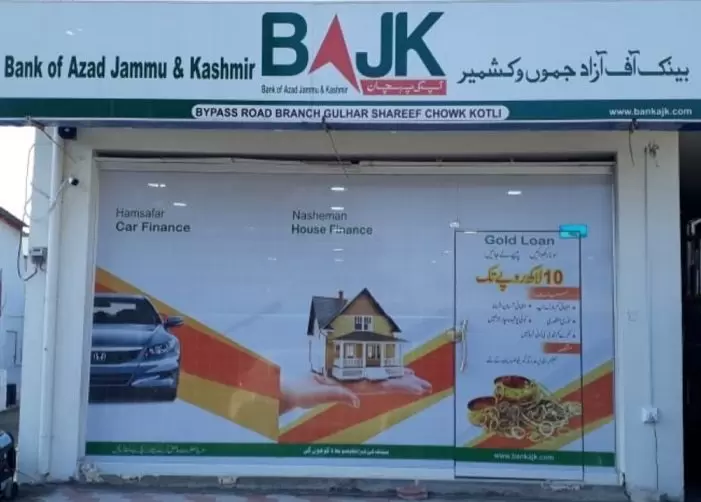
Key demands include granting scheduled bank status to the Bank of Azad Jammu and Kashmir, which would elevate the institution to national banking standards and expand its operational scope. The government has allocated Rs 10 billion toward meeting State Bank of Pakistan requirements, with officials claiming the bank’s capital adequacy ratio already exceeds regulatory thresholds at 47.6% against the required 13.5% .
The Charter also demands the restoration of student unions—long banned in the region’s educational institutions—and the empowerment of local government representatives with genuine administrative and financial authority .
Infrastructure and Social Services
Among the 38 points are provisions for establishing two additional Boards of Intermediate and Secondary Education in Muzaffarabad and Poonch divisions, the construction of an international airport at Mirpur, feasibility studies for tunnels in Neelum Valley, and the provision of MRI and CT scan machines to all district hospitals .
JKJAAC 38-Point Charter of Demand
(Pakistan-administered Kashmir)
The Jammu Kashmir Joint Awami Action Committee (JKJAAC) has presented a 38-point Charter of Demand, covering economic relief, governance reforms, judicial accountability, and democratic rights in Pakistan-administered Kashmir.”
Wheat flour subsidy must be restored and its price fixed permanently.
Electricity tariffs should be reduced in accordance with local hydropower production costs.
Full hydel power royalty (hydel profit) must be granted to Pakistan-administered Kashmir.
Unjustified electricity taxes and surcharges should be abolished.
Fuel prices must be rationalized to provide relief to the public.
Heavy fines and penalties imposed on non-custom-paid vehicles must be withdrawn.
Transporters should be exempted from excessive fines and arbitrary enforcement.
Harassment of traders, transporters, and small business owners must end.
All unnecessary checkpoints restricting public movement should be removed.
Price control mechanisms must be enforced to curb inflation of essential commodities.
Judicial reforms should be introduced to ensure affordable and timely justice.
Corruption, bribery, and nepotism in government departments must be eliminated.
Transparent accountability mechanisms should be established across public institutions.
Recruitment in government departments must be merit-based and transparent.
Contract and ad-hoc employees should be regularized as per policy.
Vacant government posts must be filled without delay.
Health facilities must be upgraded, including availability of medicines and doctors.
Educational institutions should be strengthened and properly funded.
Fees in public educational institutions should be reduced.
Scholarships for deserving students must be expanded.
Student union elections should be restored immediately.
Local government representatives must be granted full administrative and financial powers.
The local government system should be strengthened and protected from interference.
Development funds must be allocated transparently and utilized fairly.
The Azad Jammu & Kashmir Bank should be granted scheduled bank status.
Banking facilities must be expanded in rural and remote areas.
Public sector institutions should be protected from privatization without public consent.
Workers’ rights and minimum wage laws must be enforced.
Pension and salary issues of government employees should be resolved promptly.
Retired employees’ dues must be cleared without delay.
Land acquisition for development projects must follow legal and compensation procedures.
Environmental protection laws should be strictly implemented.
Local residents must be prioritized in employment for development projects.
Disaster management systems should be improved and adequately funded.
Freedom of peaceful protest must be ensured.
No cases should be registered against peaceful protesters.
Previously accepted demands must be implemented without delay.
A clear implementation timeline for all agreed demands must be announced publicly.
The October Agreement: Promise and Peril
Following five days of violent unrest that left at least 10 people dead and over 200 injured, the federal government, AJK administration, and JKJAAC signed a landmark agreement on October 4, 2025. The pact included commitments to judicial commissions investigating protester deaths, compensation for victims, cabinet downsizing to 20 members, and the establishment of a Monitoring and Implementation Committee comprising representatives from all three parties .
However, the agreement’s implementation has been fraught with delays and mutual recriminations. By January 2026, with the 90-day implementation period expired, the JKJAAC announced a boycott of further negotiations, citing “blatant violations” of the agreement terms .
Shaukat Nawaz Mir, a core committee member, articulated the movement’s frustration: “Under the current circumstances, further negotiations with the federal or Azad government are not possible, because government actions are giving rise to doubts and suspicions rather than restoring confidence” .
The Boycott and the Road Ahead
The JKJAAC’s decision to boycott implementation committee meetings represents a significant escalation in the movement’s tactics. The committee has rejected the government’s proposal for additional meetings, insisting that “discussions would resume only after the demands are fully met” .
Specific grievances driving the boycott include the government’s appointment of a Pakistani refugee assembly member as chairman of the Public Accounts Committee—a move the JKJAAC considers a clear violation of the agreement to suspend refugee seat allocations pending committee review . Additionally, activists allege that prominent committee members remain on Exit Control Lists, FIRs against protesters have not been fully withdrawn, and issues related to refugee seats remain unresolved .
The Kotli Convention:
As the Core Committee of JKJAAC prepares to convene in Kotli on 25 February, the movement faces strategic decisions that will determine its future trajectory. The meeting comes at a moment when the October agreement hangs in the balance, and the region’s political landscape continues to shift.
The AJK government, now led by Prime Minister Faisal Mumtaz Rathore following a November 2025 political shakeup, claims “over 90% progress” on pact implementation. Officials cite the withdrawal of 177 of 192 FIRs, payment of compensation to affected families, reinstatement of suspended employees, and approval of two new education boards as evidence of compliance .
Yet the JKJAAC maintains that structural demands—particularly those challenging elite privileges and the refugee seat system—remain unaddressed. The committee has indicated preparations to launch renewed protests if demands continue to remain unmet .
Regional and International Dimensions
The unrest in Pakistan-administered Kashmir has drawn international attention, with observers noting the irony of Islamabad imposing communications blackouts and using paramilitary forces while simultaneously criticizing similar tactics across the Line of Control. The movement has complicated Pakistan’s narrative of being a responsible caretaker of Kashmiri interests, drawing comparisons to conditions in Indian-administered Kashmir .
The Unfinished Revolution
The 38-point Charter of Demands represents more than a list of grievances—it embodies a fundamental challenge to the governance model in Pakistan-administered Kashmir. As the JKJAAC Core Committee convenes in Kotli, the movement stands at a pivotal moment.
Whether the October agreement becomes “a genuine charter for justice or merely another list on paper,” as the Kashmir Welfare Foundation observed, depends on the sincerity of implementation and the willingness of both federal and local authorities to cede privileges and power .
For the thousands who marched in September and October 2025, and for the families of those who lost their lives, the question remains whether their sacrifice will translate into lasting reform. As one activist noted, “True progress will come when promises reach every home—when the child in Neelum Valley studies under a working lightbulb, when the widow in Kotli can afford medicine, and when the youth of Mirpur find honest employment without bribery or despair” .
The Kotli convention will determine whether the movement continues down the path of negotiated reform or returns to the streets in pursuit of its revolutionary agenda. Either way, the JKJAAC has already succeeded in placing questions of resource rights, governance accountability, and democratic representation at the center of Pakistan-administered Kashmir’s political discourse—a achievement that cannot be easily reversed.
The Azadi Times is committed to covering developments in the Kashmir region with editorial independence and factual rigor.