In a region where silence is enforced, independent voices are an act of resistance. The Azadi Times operates without state backing or corporate influence—powered entirely by readers like you.
Equip Kashmiri youth with investigative journalism skills, creating the next generation of truth-tellers.
Choose Your Support
Join the Circle of Guardians
Select a tier that reflects your commitment to independent Kashmir journalism
100% secure via SSL encryption. We never store your full card details.
Radical Transparency
We believe you deserve to know exactly how your money is spent. Every quarter, we publish detailed financial reports showing the breakdown between operational costs, reporter fees, and safety funds.
In a region where silence is enforced, independent voices are an act of resistance. The Azadi Times operates without state backing or corporate influence—powered entirely by readers like you.
Equip Kashmiri youth with investigative journalism skills, creating the next generation of truth-tellers.
Choose Your Support
Join the Circle of Guardians
Select a tier that reflects your commitment to independent Kashmir journalism
100% secure via SSL encryption. We never store your full card details.
Radical Transparency
We believe you deserve to know exactly how your money is spent. Every quarter, we publish detailed financial reports showing the breakdown between operational costs, reporter fees, and safety funds.
In a region where silence is enforced, independent voices are an act of resistance. The Azadi Times operates without state backing or corporate influence—powered entirely by readers like you.
Equip Kashmiri youth with investigative journalism skills, creating the next generation of truth-tellers.
Choose Your Support
Join the Circle of Guardians
Select a tier that reflects your commitment to independent Kashmir journalism
100% secure via SSL encryption. We never store your full card details.
Radical Transparency
We believe you deserve to know exactly how your money is spent. Every quarter, we publish detailed financial reports showing the breakdown between operational costs, reporter fees, and safety funds.
As the sun rose over the misty valley of Kashmir on October 27, 1947, its light cut through the morning haze when a Dakota aircraft took off from Delhi’s Willingdon Airfield. After a three-and-a-half-hour flight, it landed at Budgam airbase, near Srinagar, carrying 15 armed soldiers on board.
At 9:30 a.m., the arrival of these troops from the 1st Battalion of the Sikh Regiment marked a historic turning point — it was the moment India officially deployed its army into the princely state of Jammu and Kashmir.
Historian Alastair Lamb, in his book Birth of a Tragedy: Kashmir 1947, writes that this was the formal beginning of the conflict between India and Pakistan, a dispute that remains unresolved to this day.
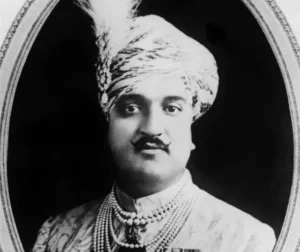
For more than two months after the August 15 deadline, Maharaja Hari Singh had failed to make a decision about the future of his state — whether to join India, Pakistan, or remain independent.
The Invasion and the Accession: How the Kashmir Conflict Began
According to historian Alexander Rose, given its Muslim-majority population and its geographical proximity to Pakistan, there were strong reasons to believe that Kashmir would naturally become a part of Pakistan after the partition of British India.
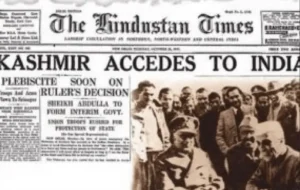
However, India maintains that it only sent troops into Kashmir on October 27, 1947, in response to the invasion by Pakistani tribal fighters on October 22 and following the formal request for military assistance from the then Maharaja of Jammu and Kashmir, Hari Singh, after he had signed the Instrument of Accession with India.
At that time, Sardar Vallabhbhai Patel, India’s Deputy Prime Minister and Home Minister, had assigned the task of integrating princely states into India to Vappala Pangunni Menon (V.P. Menon).
In his book The Story of the Integration of the Indian States, V.P. Menon claims that the main attacking force consisted of “between 5,000 and 6,000 Afridis, Wazirs, Mehsuds, Swatis, and other frontier tribesmen, along with a number of ‘on-leave’ Pakistani soldiers.”
He further writes that these forces, traveling in “200 to 300 trucks,” were “led by a few regular military officers familiar with the terrain of Kashmir” and advanced from Abbottabad in Pakistan’s North-West Frontier Province (now Khyber Pakhtunkhwa) along the Jhelum Valley Road toward Kashmir.
Andrew Whitehead, in his extensively researched book A Mission in Kashmir, also details this tribal invasion, describing the chaos, violence, and the rapid advance toward Muzaffarabad and Baramulla. However, he notes that there is no direct evidence of the formal involvement of the Pakistani Army in the operation at that stage — suggesting that the invasion was semi-organized, not a state-declared military intervention.
This tribal offensive ultimately became the triggering event that pulled both newly independent nations — India and Pakistan — into their first war over Kashmir, a conflict that continues to shape South Asia’s geopolitics to this day.
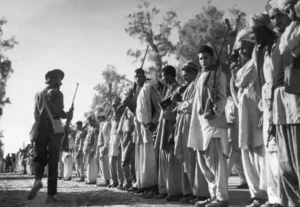
Tribal militias waiting for trucks and weapons to march toward Kashmir
When the tribal chief Fakir of Appi prevented his followers from going to Kashmir for “jihad,” the Pir of Wana offered the services of his followers, saying they would “act alongside Pakistan at this crucial moment in the history of Islam.”
The Pir of Wana — who was nicknamed the “Baghdadi Pir” — told Margaret Parton of the New York Herald Tribune in an interview that if Kashmir became part of India, “we will bring one million tribesmen to Kashmir for jihad.”
He also said that “if we are not allowed to pass through Pakistan, we will move north through the mountains of Chitral.”
“We will go with our rifles and guns and save our Muslim brethren from the whim of the Hindu Maharaja,” he said.
Similarly, the Pir of Manki Sharif also preached “jihad in Kashmir.” He was a local leader of the Muslim League and played a major role in campaigning for the NWFP’s (then Province of the Frontier) accession to Pakistan. He had about 200,000 followers, spread beyond any single locality.
Whitehead writes that the rebellion “was being linked to the territory of Pakistan but the leaders of the new nation could not give them support through their regular armed forces.”
Sir George Cunningham, the Governor of the Frontier Province, recorded in his diary (now in the British Library) the growing alarm: “I have warned everyone — Afridis and Mehmuds among them — that this could lead to a war between India and Pakistan.”
But Cunningham’s warning had no effect. The provincial Chief Minister Khan Abdul Qayyum Khan privately declared that he supported the armed men going to Kashmir, although he agreed that the police and other officials should not be involved in the operation.
A member of the Muslim National Guard, Khurshid Anwar, wrote that D-Day had been set for Tuesday, October 21, but was postponed until the following morning. In several historical accounts, Khurshid Anwar is described as the military commander of the attack on the Valley.
Maharaja Hari Singh, whose Dogra dynasty had ruled over Jammu and Kashmir for nearly a century.
Later, he told Dawn newspaper that he had four thousand men with him and that they faced no significant resistance as they advanced deep into Kashmiri territory.
On the other hand, the State Forces of Kashmir offered limited resistance, as a large number of Muslim soldiers from Poonch had already deserted their ranks.
However, Whitehead writes that the initial uprising against the Maharaja was local in nature and had no tribal involvement whatsoever.
“The Maharaja of Kashmir had gained a poor reputation because of his treatment of his Muslim subjects… The State Forces were accused of atrocities against Muslims in the Jammu region. Above all, his delay in deciding which dominion to join had intensified suspicions that Kashmir was leaning toward India — despite its geography and Muslim majority pointing toward Pakistan.”
He further writes:
“The region of Poonch, located northwest of Jammu but outside the Kashmir Valley, had its own grievances — particularly over loss of local authority and heavy taxation. Around 60,000 men from this area had served in the Second World War, and many of the Maharaja’s soldiers were recruited from here. By late August 1947, the rebellion against the Maharaja had already taken root.”
Quoting one of the leaders of this movement, Whitehead notes:
“By late September 1947, we had gained considerable territory. I was then administering it from my own district of Poonch. The State Forces were fighting against their own people. No one had yet come from across the border.”
In the nearby area of Rawalakot, Sardar Muhammad Ibrahim Khan, a lawyer in Srinagar and a prominent leader of the pro-Pakistan Muslim Conference, escaped from the state, settled in Murree, Pakistan, and — with the help of soldiers who had deserted the Maharaja’s army — launched an armed struggle against the Dogra regime.
According to Whitehead’s account, as early as September 1947, Brigadier Akbar Khan, who was then serving as the Director of Weapons and Equipment at the Pakistan Army Headquarters, established contact in Murree with Sardar Ibrahim Khan and several others.
“It appears,” writes Whitehead, “that Akbar Khan decided on his own initiative to support the pro-Pakistan uprising in Poonch. According to Akbar Khan himself, he assisted by providing four thousand military rifles that had originally been sanctioned for release to the Punjab Police. He also supplied a large consignment of old ammunition, which had been declared obsolete and was scheduled to be dumped at sea.”
By late October 1947, Sardar Ibrahim Khan was appointed as the President of the Provisional Government of the Pakistan-administered region of Jammu and Kashmir, marking the beginning of a new political and military phase in the unfolding Kashmir conflict.
Britain wanted the princely states themselves to decide whether they wished to join India, join Pakistan, or remain independent.
Whitehead notes that while both Abdul Qayyum Khan and Akbar Khan may have disagreed on who initiated the uprising, they shared the same opinion regarding the limited involvement of the tribal fighters.
According to Abdul Qayyum Khan, “The movement suffered greatly because those tribesmen were uncontrollable.”
“When they entered my area, an entire village was vacated to accommodate them, and guards were posted around it. I did not allow them to participate in the fighting. But elsewhere in the state, they caused considerable damage.”
“Because of their lack of discipline, they resorted to looting. Each tribe had its own commander. The Wazirs and Mehsuds, in particular, would not listen to anyone. In Muzaffarabad, I even exchanged fire with them myself.”
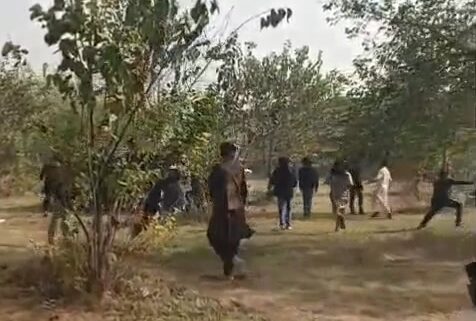
At first, the tribal forces may have believed that they would reach their objective — the Kashmiri capital, Srinagar, about 100 miles from Muzaffarabad — in time to celebrate Eid there on October 26, 1947.
Whitehead writes that their advance did not stop at Baramulla. Even after October 27, as hundreds of Indian troops arrived daily by air, the tribesmen managed to reach within a few miles of central Srinagar and the airstrip itself.
In his book Raiders in Kashmir, Akbar Khan wrote:
“They (the tribesmen) first appeared out of the deep fog that hung over the Kashmir Valley. They moved silently, cautiously, yet easily and in darkness. It was midnight on October 29, 1947. After entering the state with lightning speed, they covered 115 miles in five days, and were now only four miles away from the twinkling lights of Srinagar.”
“As the attackers advanced, they began to encounter the streams and waterways surrounding Srinagar. Eventually, it seemed the only way forward was to take the direct road.”
Sardar Ibrahim Khan later remarked that “they could not be expected to fight, capture, and then hold territory. When the tribal lashkars retreated from Srinagar, there were no troops to occupy and secure the evacuated areas.”
“The first Indian troops arrived by air,” he added, “and once war broke out with Pakistan, reinforcements began pouring in through Gurdaspur.”
According to historian Alexander Rose, Kashmir, with its population of 1.4 million Muslims, located at the southern crossroads between India and Pakistan, was destined — by both geography and religion — to be part of Pakistan.
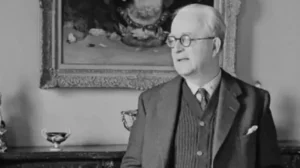
However, during the partition of India, Sir Cyril Radcliffe, who was responsible for demarcating the borders, awarded only the Shakargarh tehsil to Pakistan, while the rest went to India. By giving Pathankot tehsil to India, he effectively granted India a land route to Kashmir — a decision that would alter the subcontinent’s history forever.
The award named after Sir Cyril Radcliffe was made public only after August 15, 1947.
If you look at the wooden board in the courtroom of the Deputy Commissioner of India’s northeastern district of Gurdaspur, which lists the officers who served there from 1852 to 1947, you will find that the shortest tenure belongs to Mushtaq Ahmed Cheema, who served for only three days before Chunnilal became the Deputy Commissioner — that is, before Gurdaspur became part of India on August 17, 1947.
Explaining this brief posting, journalist Jupinderjit Singh wrote in The Tribune India that until August 17, 1947, it was widely believed that this Muslim-majority district of Punjab would fall within Pakistan’s borders.
During British rule, Gurdaspur district was part of the Lahore Division, consisting of its four tehsils — Gurdaspur, Batala, Shakargarh, and Pathankot.
Dominique Lapierre and Larry Collins, in their book Freedom at Midnight, wrote that without Gurdaspur, India would not have had a viable land access route to Kashmir.
In his article Paradise Lost: The Ordeal of Kashmir for The National Interest, Alexander Rose wrote that Radcliffe later explained that factors such as “disruption in railway, communication, and water systems” undermined the basic claims of contiguous majority areas.
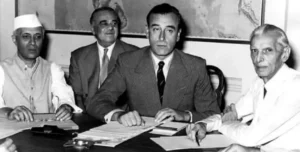
“But Pakistan believed that Nehru persuaded Mountbatten to pressure Radcliffe into altering the boundary.”
According to Rose, in 1992, Christopher Beaumont — the last surviving British official with deep knowledge of the partition process and Radcliffe’s private secretary — revealed that Radcliffe had originally awarded two contiguous tehsils to Pakistan, but during lunch, Mountbatten got the Radcliffe Award changed.
Rose further noted that India maintains its army did not mobilize until the Maharaja voluntarily signed the Instrument of Accession as the price of Delhi’s swift intervention. On October 27, as troops arrived at Srinagar airfield by air and moved forward to “defeat the raiders,” Mountbatten formally accepted the Maharaja’s decision, and Kashmir officially became part of India.
“But Pakistanis ask how Hari Singh could have signed the document on October 26 when it is known that he was traveling by motorcade from Srinagar to his winter capital Jammu that day, and thus was out of contact. Therefore, Indian troops were already advancing toward Kashmir before the document was signed or accepted, suggesting that the Maharaja’s consent was obtained under pressure.”
Wighthead and Prem Shankar Jha are among the writers who have expressed doubt about the legitimacy of the accession.
In Mountbatten’s letter accepting the Instrument of Accession, he wrote, “It is my Government’s wish that, as soon as law and order have been restored in Kashmir and its soil cleared of invaders, the question of the State’s accession should be settled by a reference to the people.”
Following the ceasefire, in addition to UN resolutions supporting Kashmiris’ right to self-determination, Nehru himself announced his intention for a plebiscite on multiple occasions.
Rose wrote that initially, India was willing to hold such a plebiscite but later abandoned the idea upon realizing that the non-Hindu majority was unlikely to vote in its favor.
Why Did the Tribal Fighters Fail?
In his book Understanding Kashmir and Kashmiris, Christopher Snedden writes that after October 26, 1947, Maharaja Hari Singh rapidly lost significance in the growing dispute between India, the Indian administration of Jammu and Kashmir, and his own former princely state.
A similar situation, Snedden notes, befell the tribal raiders. According to Andrew Whitehead, despite India flying in hundreds of troops daily after October 27, the tribal forces managed to advance to within a few miles of Srinagar’s city center and the airstrip.
About a month after these tribal fighters were driven out of the Kashmir Valley, Khurshid Anwar, a member of the Muslim National Guard, was being treated for his injuries at a hospital in Karachi. Speaking to Dawn newspaper, he complained that the Pakistani government’s inaction had been a major obstacle to their efforts in Kashmir.
Whitehead writes that Khurshid Anwar was “deeply bitter against the government of Pakistan for its failure to assist the tribesmen in their brave attempt to seize Srinagar.”
Later, in Karachi, Khurshid Anwar reportedly discussed the grave shortcomings of the tribal forces with a British expert on the North-West Frontier. “He was very harsh on the Mehsud tribesmen,” Whitehead notes, “whom he blamed for both the worst atrocities and the disastrous delay in the initial attack.”
Snedden further explains that “the Pashtuns were good fighters but were also extremely undisciplined.”
“Immediately after entering Jammu and Kashmir on October 22, 1947, instead of advancing directly toward Srinagar to capture it, the tribesmen became engaged in looting and killing. Many foreigners were also caught in the violence, which India effectively used in the international press to its advantage. By the time the Pashtuns finally reached the outskirts of Srinagar on October 27–28, 1947, the Indian Army had secured the city’s airport and taken up defensive positions to hold off the advancing tribesmen until reinforcements arrived.”
The Indian soldiers’ initial mission was to secure the Srinagar airfield and prevent it from falling into the hands of the Pashtun raiders. “They achieved both objectives,” Snedden writes. “The swift arrival of Indian troops in Srinagar and their success in securing the city ended the slow, looting-obsessed advance of the Pashtuns, whose chance to capture the summer capital was lost.”
In the following days, Snedden notes, India used aerial bombardment to drive the Pashtun fighters out of the Kashmir Valley.
However, he adds that west of Uri, in the Muzaffarabad tehsil, the more disciplined Azad forces successfully resisted the Indian Army. “It was because of the capabilities of these Azad troops,” he writes, “that some Indians came to believe that the Pakistani Army was already supporting them — but that was not the case.”
According to Snedden, “The Pakistan Army formally entered Jammu and Kashmir in May 1948 to assist the Azad forces — marking the beginning of the first war between Pakistan and India.”
Sources:
BBC Archives: The 1947 Tribal Invasion of Kashmir
“Freedom at Midnight” by Dominique Lapierre and Larry Collins
The National Interest – Paradise Lost: The Ordeal of Kashmir by Alexander Rose
“Raiders in Kashmir” by Brigadier Akbar Khan
W. G. Whitehead Papers, British Colonial Records
Tribune India Historical Reports
United Nations Resolutions on the Kashmir Dispute (1948–1949)
The Azadi Times is an independent Kashmir-based digital news platform covering politics, human rights, culture, tourism, and current affairs from across Jammu & Kashmir. The platform focuses on fact-based journalism, local voices, and in-depth reporting on regional and global issues affecting Kashmir.
Do you want to know the truth that state-controlled media won't show you? Across the ceasefire line, millions of Kashmiri voices are being silenced. The Azadi Times brings those voices to you — powered by 2,400+ patrons who refuse to look away.