
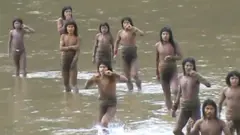

Deep in the dense Peruvian Amazon, Thomas Enes dos Santos was clearing a patch of land when he suddenly froze. From the shadows came the faint sound of footsteps.
“I realized I was surrounded,” he recalls. “A man stood a few meters away with a bow aimed directly at me. The moment I sensed danger, I started to run.”
Thomas had come face-to-face with members of the Mashco-Piro — one of the last remaining uncontacted tribes on Earth. For decades, he has lived in the small riverside village of Nueva Oceania, whose invisible neighbors dwell silently in the forest.

The Mashco-Piro have spent over a century avoiding contact with outsiders, surviving solely on the resources of the rainforest — hunting with longbows, gathering fruits, and fishing along the riverbanks.
“Once they saw me,” Thomas says, “they began circling around, whistling like birds, mimicking animals. It was both terrifying and mesmerizing. I kept repeating the word ‘Nomole’ — it means brother in their language — and then I escaped toward the river.”
For years, Thomas and other villagers have lived side by side — yet worlds apart — from the Mashco-Piro.


A new report by Survival International, a global indigenous rights organization, estimates that at least 196 isolated tribes still exist across the world, with the Mashco-Piro among the most significant. The report warns that half of these groups could vanish within the next decade if urgent action is not taken.
Their survival is threatened by a familiar enemy — industrial intrusion: logging, mining, oil exploration, and now, the growing reach of social media influencers who enter protected zones to film “first contact” videos.
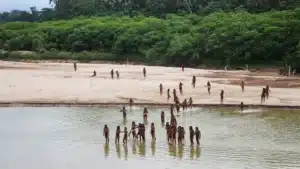


Nueva Oceania, Thomas’s village, is home to just seven or eight fishing families. Located along the Tahuhamano River — deep in the heart of the Amazon — the community is accessible only after a ten-hour boat journey from the nearest town.
Although the region is supposed to be a protected reserve, illegal logging operations are expanding rapidly. The constant hum of machinery echoes through the forest day and night.
“The Mashco-Piro can hear the chainsaws,” Thomas says. “Their forest is being destroyed, and they are scared. Sometimes, they come closer to our village, confused and desperate.”
Locals live in fear of arrows — but also in grief for what is happening to their silent neighbors.
“We keep our distance,” says Thomas, “because we don’t want to harm them. They deserve to live as they have always lived.”
Fear, survival, and fragile peace
In June 2024, villagers spotted a group of Mashco-Piro near the riverbanks — the first sighting in months.
“Leticia Rodríguez López,” a young mother, recalls hearing eerie shouts while picking fruit in the forest. “It sounded like dozens of people crying out,” she said. “I ran back to the village immediately.”
She wasn’t alone in her fear. Two years earlier, in 2022, the tribe had attacked two loggers fishing nearby — one man was killed by arrows.
Experts believe such incidents are not random acts of aggression but reactions of fear and territorial defense. “They see their homeland disappearing,” says an anthropologist from Lima University. “They don’t understand why the forest — their life — is being cut down.”
Under Peruvian law, contacting or approaching uncontacted tribes is illegal. The government’s “No Contact Policy”, modeled after Brazil’s, aims to prevent the spread of diseases to which isolated peoples have no immunity.
The policy was introduced after devastating episodes in the 1980s and 1990s. When the Nahua and Murunahua tribes first came into contact with outsiders, half of their populations died within years due to infections like influenza and measles.
“Uncontacted people are biologically and culturally vulnerable,” says Israel Akise of the indigenous rights group Fenamad. “Even a simple cold can wipe out entire communities. Every contact risks erasing centuries of heritage.”
At the same time, the no-contact rule has left border villages like Nueva Oceania in a difficult position.
Thomas says he sometimes plants banana trees near the forest edge for the Mashco-Piro to take. “It’s my way of saying — we mean no harm.”
He smiles faintly. “If I could speak their words, I’d tell them, ‘Take the bananas, my friends. It’s a gift. Please don’t harm us.’”
When Thomas whistles into the forest, waiting for an answer, only the birds reply.
“They’re not here today,” he says softly.
The government outpost: watching the unseen
Some 200 kilometers southeast of Nueva Oceania, near the Manu River, lies a government monitoring post — the Nomole Control Post. Established in 2013 after violent clashes, it is run by Peru’s Ministry of Culture in partnership with Fenamad.
Here, eight field officers keep watch over a section of the forest officially designated as a “Mashco-Piro Reserve.”
Their mission: prevent conflict and ensure that the tribe remains undisturbed.
“They come to the river almost every week,” says Antonio Trigoso Hidalgo, the head officer at the outpost. “We never cross to their side. We only communicate through shouts.”
He points across the wide river. “They ask for bananas, cassava, or sugarcane. If we don’t respond, they wait all day.”
Forty faces at the riverbank
Antonio estimates that about 40 individuals regularly approach the outpost — men, women, and children from different families.
“They have names based on animals,” he says. “The chief is Kamotolo, which means ‘Bee’. Another leader, Tokotoko, means ‘Vulture’ — he’s cheerful and often laughs with us. A young woman called Yumko means ‘Snake’. She’s curious about our clothes.”
Sometimes, they even offer small gifts — a handmade rattle crafted from a monkey bone, or a feathered ornament.
“But when we ask questions about their lives in the jungle,” Antonio adds, “they fall silent. They change the subject. They don’t want to tell us where they live.”
A delicate balance of curiosity and caution
The officers are careful not to wear new or colorful clothes — the tribe might try to take them. “We wear old shirts with missing buttons,” says officer Eduardo Pancho. “They seem fascinated by red and green fabric.”
Though some Mashco-Piro now wear T-shirts and shoes given by passing tourists, most still prefer their traditional attire made from plant fibers.
If a familiar face disappears for a while, officers ask about them. “When they say, ‘Don’t ask,’ we understand that person has died,” Antonio explains quietly.
Even after years of cautious interaction, the Peruvian authorities still know very little about their way of life. Scholars believe they are descendants of the Yine people, who fled deeper into the forest during the violent “rubber baron” era in the 19th century — when indigenous populations were enslaved or massacred.
Nomads of the lost forest
The Mashco-Piro appear to be semi-nomadic hunter-gatherers, moving every few months once the nearby area’s game and fruits are exhausted.
“They build temporary camps, hunt with bows, and gather wild honey,” Antonio says. “Once they’ve used up the area, they vanish — only to appear again somewhere else.”
According to Fenamad’s data, over 100 members have been sighted over the years. They often request food but disappear again for months or even years.
“They simply say, ‘I’ll return soon,’ and then they’re gone,” says Akise. “Some of them never do.”
While the Mashco-Piro of the Manu Reserve remain relatively safe, threats loom large. The Peruvian government has proposed a new road that would connect the reserve to a mining zone — a potential disaster for the tribe’s future.
“Roads bring outsiders, diseases, and deforestation,” says Akise. “For the Mashco-Piro, a road is not progress — it’s extinction.”
Do they want to join the modern world?
“They don’t want to be part of us,” Antonio admits. “They don’t want civilization.”
He pauses. “Maybe their children will — in ten or twenty years, when they see clothes or boats. But the elders? No. They want the forest, the silence, their way of life.”
In 2016, Peru’s Congress approved a bill to expand the Mashco-Piro protected zone to include Nueva Oceania. But the law has yet to be enacted.
For now, villagers like Thomas live between two worlds — modern enough to hear the hum of generators, yet close enough to sense the heartbeat of the forest.
“We just want them to live freely,” he says. “They were at peace for generations. Now the forest that kept them safe is being destroyed.”
A fragile coexistence
At dusk, Thomas walks to the same clearing where he first saw the Mashco-Piro. He whistles softly again.
“If they answer,” he says, “we leave. That’s our rule.”
But this time, the only response is the hum of insects and the distant rumble of chainsaws.
“The forest is changing,” Thomas murmurs. “And they — they are disappearing with it.”
Sources:
BBC World Service & BBC Mundo reports (2024–2025)
Survival International report on Uncontacted Tribes (2025)
Fenamad Indigenous Rights Organization
Peru Ministry of Culture archives
Freedom at Midnight by Dominique Lapierre and Larry Collins (contextual reference)
The National Interest, Paradise Lost: The Ordeal of the Amazon Tribes
Interviews compiled from Nueva Oceania residents and field reports