
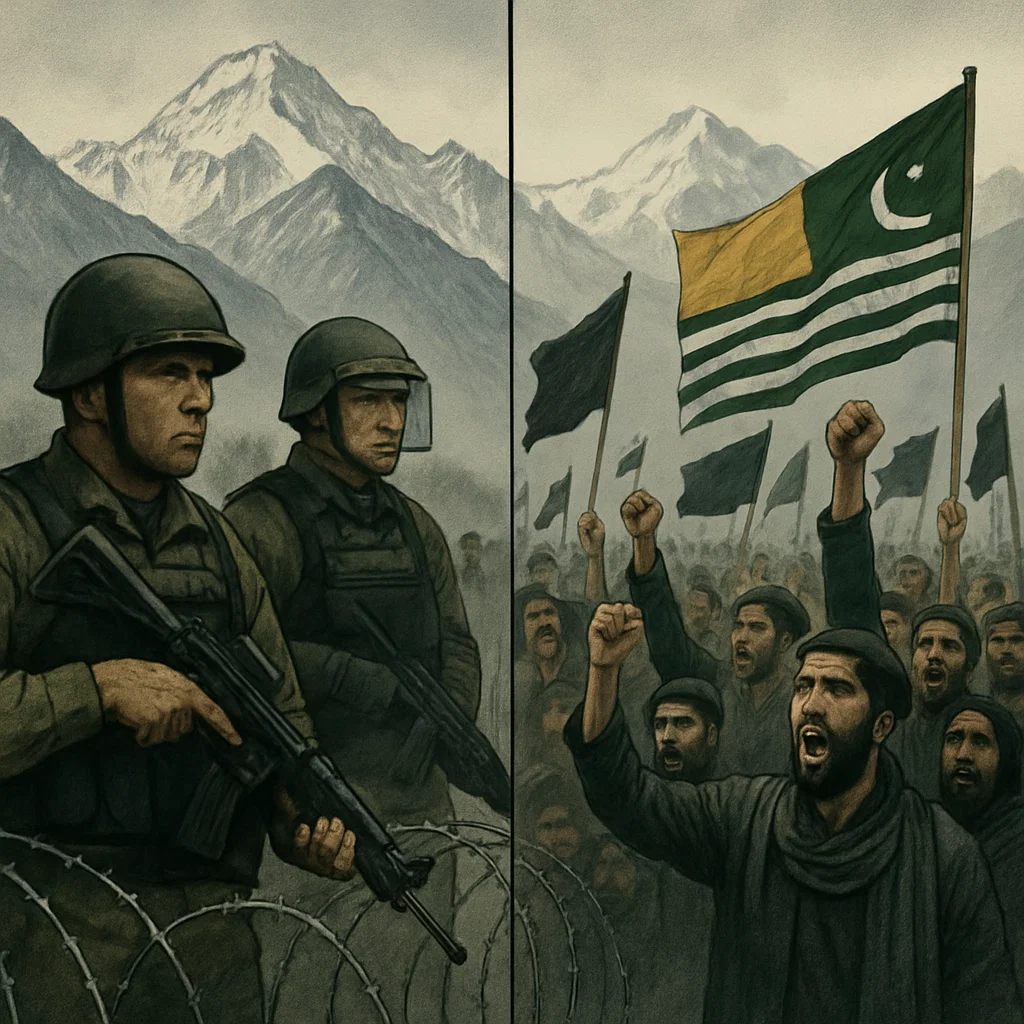
On August 5, 2019, the Government of India revoked Article 370 and 35A of its constitution, dissolving Jammu and Kashmir’s semi‑autonomous status and splitting the region into two federally governed union territories. The move was presented by New Delhi as an act of national integration.
For many Kashmiris, however, it was experienced as a rupture a unilateral decision that erased political identity and deepened a decades‑long conflict already shaped by wars, militarisation, and broken promises.
Six years on, August 5 remains one of the most contested dates in South Asia’s political calendar. While India celebrates it as a “new dawn,” Pakistan observes it as “Youm‑e‑Istehsal” — the “Day of Exploitation.” In between, ordinary Kashmiris remain caught in competing narratives, still waiting for the fulfilment of a promise made to them by the international community: the right to self‑determination under United Nations resolutions.
What Was Article 370 and 35A, and Why Did It Matter?
To understand the resonance of August 5, it is important to grasp what Article 370 and Article 35A represented.
Article 370 was written into the Indian constitution in 1949. It granted Jammu and Kashmir its own constitution, separate flag, and autonomy over all matters except defence, foreign affairs, finance, and communications. In practical terms, it meant that laws passed by the Indian parliament did not automatically apply to the region unless approved by the state legislature. The provision formalised the terms of Kashmir’s accession to India in 1947, which was described as temporary and conditional until a final settlement of the dispute.
Article 35A, introduced in 1954 through a presidential order, gave the J&K legislature the power to define who qualified as a “permanent resident.” This definition carried significant implications: only permanent residents could own property, secure government employment, or access certain scholarships and welfare benefits.
For many Kashmiris, these provisions were more than legal arrangements — they were seen as a fragile shield protecting the region’s demography, land ownership, and cultural identity from outside influence. Supporters viewed them as the minimum guarantee of political and social security within the Indian Union.
Critics in India, however, described them as outdated privileges that encouraged separatism, blocked investment, and hindered full integration. The ruling Bharatiya Janata Party (BJP) had long campaigned for their abrogation, calling Article 370 a “temporary” provision that needed to go.
On August 5, 2019, India’s parliament passed a resolution and presidential order that revoked both Article 370 and 35A. Jammu and Kashmir was reorganised into two federally governed union territories: Jammu & Kashmir, and Ladakh.
But for many Kashmiris, the decision carried consequences far beyond constitutional changes. Critics argue that the abrogation was not only a blow to autonomy, but also a deliberate tactic to divert attention from the real and unresolved issue: the right to self‑determination under United Nations resolutions.
Scholars and activists warn that by focusing the debate on special status, both India and Pakistan have managed to sideline the central question of Kashmir’s political future. As one Kashmiri historian put it: “Article 370 gave us autonomy, but it never gave us freedom. Its removal may have hurt us, but the larger denial remains the same — the denial of our right to decide.”
Political Reactions: Black Day vs. Celebration
The anniversary of August 5 continues to expose the stark political divide over Kashmir.
In Indian‑administered Kashmir, mainstream opposition parties such as the National Conference (NC), the Peoples Democratic Party (PDP), and the Communist Party of India (Marxist) observe the day as a “Black Day.” Their leaders argue that the 2019 decision to revoke Article 370 was carried out unconstitutionally and without the consent of the people of Jammu and Kashmir. They describe it as a “betrayal of trust” that violated the terms of accession agreed upon in 1947.
NC leader Omar Abdullah has repeatedly insisted that the abrogation stripped Kashmiris of dignity, while PDP’s Mehbooba Mufti has warned that the move has pushed the region into deeper political alienation. Smaller regional groups echo these concerns, calling the anniversary a painful reminder of broken promises.
Across the Line of Control, in Pakistan‑administered Kashmir and throughout Pakistan, the day is commemorated as “Youm‑e‑Istehsal” (Day of Exploitation). The government and civil society hold rallies, speeches, and seminars condemning India’s actions, with officials calling for international pressure on New Delhi to reverse its decision. Politicians in Islamabad describe August 5 as the day when “Kashmir was robbed of its identity,” and resolutions are passed in Pakistan’s parliament to reaffirm support for Kashmiri self‑determination.
Meanwhile, the Bharatiya Janata Party (BJP) government in New Delhi frames August 5 in starkly different terms. For the ruling party, the day marks the beginning of a “new Jammu and Kashmir” — one that is fully integrated into the Indian Union. The government highlights infrastructure projects, new business investments, and a boom in tourism as proof that abrogation has brought peace and development. Senior BJP leaders argue that removing Article 370 has ended a “temporary” provision that only fostered separatism.
But beneath these opposing commemorations lies a shared criticism from many ordinary Kashmiris: both narratives bypass their real aspirations. For them, August 5 is not simply about statehood or integration. It is about the absence of their own voice in decisions that shape their future.
The Silence on Self‑Determination
Since 1948, the United Nations Security Council has passed multiple resolutions affirming the right of the people of Jammu and Kashmir to decide their future through a plebiscite.
Seventy‑five years later, that vote has never been held.
Instead, the issue has been reframed through the lens of constitutional provisions like Article 370, bilateral agreements, or statehood debates. Yet, for many Kashmiris, these are side issues.
“Restoring Article 370 may bring autonomy,” explains a Kashmiri academic, “but it will not bring freedom of choice. The real issue is the right to self‑determination.”
Pakistan’s Own Contradictions
While Pakistan positions itself internationally as a defender of Kashmiri rights, pro‑self‑determination groups inside Kashmir argue that Islamabad’s own record is far from clean.
On March 2, 1949, Pakistan separated Gilgit‑Baltistan from the wider state of Jammu and Kashmir, placing it under a federal‑appointed administration. Over time, Gilgit‑Baltistan was treated as a de facto semi‑province, despite being part of the territory recognised under UN resolutions.
For critics, this mirrors the unilateralism Pakistan condemns in India. Both states, they argue, have altered the map of Kashmir without the consent of its people.
This is why independent Kashmiri voices stress: the conflict is not simply India versus Pakistan — it is Kashmir versus the denial of its people’s right to decide their own destiny.
Atmosphere on Both Sides of the Ceasefire Line
Every year on August 5, the contrast is visible across the ceasefire line.
In Srinagar, heavy security deployment blankets the city. Political leaders are often placed under house arrest, rallies are restricted, and commemorations take place indoors with black flags and press statements.
In Muzaffarabad, the capital of Pakistan‑administered Kashmir, thousands pour into the streets waving Kashmiri flags, chanting slogans, and calling for UN intervention.
Media coverage mirrors the divide. Indian media emphasises development projects, rising tourism numbers, and investment opportunities. Pakistani media highlights human rights concerns, militarisation, and demographic engineering.
For many ordinary Kashmiris, these narratives feel distant from daily realities of unemployment, restricted freedoms, and uncertainty about the future.
Will Restoring Article 370 Solve the Issue?
This question continues to dominate political debate inside Indian‑administered Kashmir. For mainstream opposition parties, including the National Conference and the PDP, the restoration of Article 370 and 35A has become the central demand. They argue that the 2019 move was unconstitutional, carried out without consultation, and represented the erosion of a political compact that existed between New Delhi and Srinagar since 1947. For them, bringing Article 370 back is the first step toward rebuilding trust and dignity.
But analysts caution that even if these provisions were reinstated, the larger dispute would remain unresolved. Autonomy within India does not address the central question that has haunted the region for more than seven decades: Do the people of Jammu and Kashmir get to decide their own political future?
“Article 370 is a constitutional issue, not a political solution,” says a Srinagar‑based lawyer. “The conflict is about whether Kashmiris get to decide their political future. Until that question is answered, constitutional fixes will only scratch the surface.”
Many young Kashmiris also share this view. For them, debates about 370 and 35A feel like distractions from the bigger picture — the right to self‑determination promised under United Nations resolutions. Restoring autonomy might restore limited protections, but it does not equate to freedom of choice.
As one university student in Muzaffarabad put it during a rally: “Whether it is Article 370, 35A, or even statehood, these are administrative matters. They do not answer our real question: who decides the future of Kashmir — India, Pakistan, or the Kashmiri people themselves?”
International Law and the Forgotten Plebiscite
The call for self‑determination in Kashmir is not just rhetoric — it is rooted in United Nations resolutions.
In 1948, the UN Security Council’s Resolution 47 called for a plebiscite after troop withdrawals, allowing Kashmiris to decide between India and Pakistan. Subsequent resolutions reaffirmed this, but disagreements over demilitarisation stalled implementation.
Over time, the issue slipped off the global agenda. Today, the international community largely frames Kashmir through bilateral talks, development, or counter‑terrorism, rarely mentioning the promised plebiscite.
For Kashmiris who still believe in that pledge, this silence feels like betrayal. As one activist put it: “The world remembers Kashmir when there is conflict, but forgets us when it comes to our rights.”
Kashmir’s Generational Shift
Perhaps the most significant change since August 5, 2019, is among Kashmir’s younger generation.
Many young Kashmiris, both in Srinagar and Muzaffarabad, express frustration at being caught in a conflict where their voices are peripheral. They argue that both India and Pakistan claim to speak for them, but neither allows genuine space for their aspirations.
Social media has amplified these voices. Campaigns emphasising “Kashmir belongs to Kashmiris” are gaining traction among students, activists, and diaspora groups worldwide.
This generational shift is redefining the conflict: less about integration with India or Pakistan, and more about independence of choice.
The Role of Gilgit‑Baltistan
Gilgit‑Baltistan’s story remains crucial to understanding Kashmir’s complexity. Its formal separation from the rest of Jammu and Kashmir in 1949 set a precedent for unilateral decisions about the region’s political future. Today, Gilgit‑Baltistan residents face their own struggles for constitutional rights and representation, even as their status remains undefined under international law.
For Kashmiri activists, GB stands as proof that both India and Pakistan have altered the region’s map without Kashmiri consent. Yet despite the absence of a clear constitutional or administrative link between Azad Jammu and Kashmir (AJK) and GB, an unusual relationship persists.
Over the past decade, parallel trends have emerged on both sides. In AJK and GB, grassroots groups such as Awami Action Committees have risen in response to local grievances, reflecting similar public anger over electricity shortages, taxation, and resource control. Political figures from GB have also engaged with Kashmiri leaders, reinforcing these cross‑border connections. Just last month, former AJK Prime Minister Sardar Attique Ahmed Khan visited Gilgit and paid respects at the grave of Amna Ullah Khan, founder of the Jammu Kashmir Liberation Front (JKLF) — a symbolic act highlighting shared histories of struggle.
Social media has further amplified these links. Platforms have allowed activists, students, and journalists from AJK and GB to exchange ideas, campaign together, and highlight each other’s movements in real time.
Even at the organisational level, cooperation is increasing. The Joint Awami Action Committee of Jammu and Kashmir recently added the demand for the construction of the Shoonter Tunnel — a vital project that would physically connect AJK and GB — to its charter. Calls are also growing for opening natural routes between the two regions, emphasising that any serious discussion of Kashmir’s future cannot exclude Gilgit‑Baltistan.
For many activists, this evolving relationship is a reminder that despite political boundaries imposed by states, the lived experiences of Kashmiris and Gilgit‑Baltistanis remain intertwined
What Lies Ahead?
The Supreme Court of India upheld the abrogation of Article 370 in 2023 but directed the government to restore statehood and conduct elections. As of August 2025, elections remain pending, and a new petition is set to be heard this week.
In Pakistan, political instability and economic crisis have limited space for meaningful engagement with Kashmir, leaving the issue primarily symbolic.
Internationally, Kashmir rarely dominates headlines, surfacing only during border skirmishes or human rights reports.
For Kashmiris, this neglect reinforces a sense of abandonment.
Conclusion:
The Unfinished Question
Six years after August 5, 2019, Kashmir continues to stand at a crossroads.
For India, the abrogation of Article 370 is framed as the moment of “final integration” — a decisive step to bind Jammu and Kashmir irreversibly to the Indian Union. For Pakistan, the same date is remembered as a day of “exploitation”, used to mobilise rallies, resolutions, and diplomatic appeals.
But for many Kashmiris, August 5 is neither integration nor exploitation. It is a reminder of promises unkept, voices unheard, and futures denied.
The demand is not simply about the restoration of Article 370 or 35A, nor about rhetorical solidarity offered from distant capitals. At its core, it is about the recognition of a fundamental and universal right: the right to self‑determination.
That right has been pledged in international law, repeated in UN resolutions, and echoed across generations — yet it remains unrealised. For young Kashmiris who have grown up in an environment of militarisation, censorship, and uncertainty, August 5 has come to symbolise not progress but paralysis.
Until the question of self‑determination is addressed — honestly, internationally, and with Kashmiris themselves at the centre of the conversation — the anniversary will remain less a celebration or a day of mourning than a stark symbol of unfinished history.
Submit Your Story
Let your voice be heard with The Azadi Times

