No state backing. No paywalls. Just truth. Support Kashmir's independent voice. Join 2,400+ patrons who fund independent voices.
Zero Paywalls
Reader Funded
Award Winning
Secure Payment
Encrypted
In many parts of the world, young people compete for academic excellence, technological innovation, entrepreneurial success, and sporting achievement. In Pakistan-administered Kashmir, however, a different kind of competition has quietly but unmistakably taken root over the past five years.
It is not primarily a race for wealth.
It is not centered on sports.
It is not even driven by lifestyle or entertainment culture.
For a significant segment of Kashmiri youth, the new arena of competition is resistance — the pursuit of political voice, ideological positioning, and public visibility within the sphere of what is widely referred to as “مزاحمتی سیاست” (resistance politics).
No state backing. No paywalls. Just truth. Support Kashmir's independent voice. Join 2,400+ patrons who fund independent voices.
This shift does not mean that young Kashmiris have abandoned education or professional ambition. Universities are full, competitive exams remain crowded, and overseas migration continues to be a major aspiration. Yet, parallel to these traditional pathways, political identity-building has become a defining feature of youth culture — particularly online.
Over the past five years, a noticeable trend has emerged: young individuals striving to build a name for themselves within resistance-oriented political discourse. Social media has accelerated this transformation. Platforms that once showcased lifestyle content now amplify speeches, protest clips, political commentary, and ideological debates.
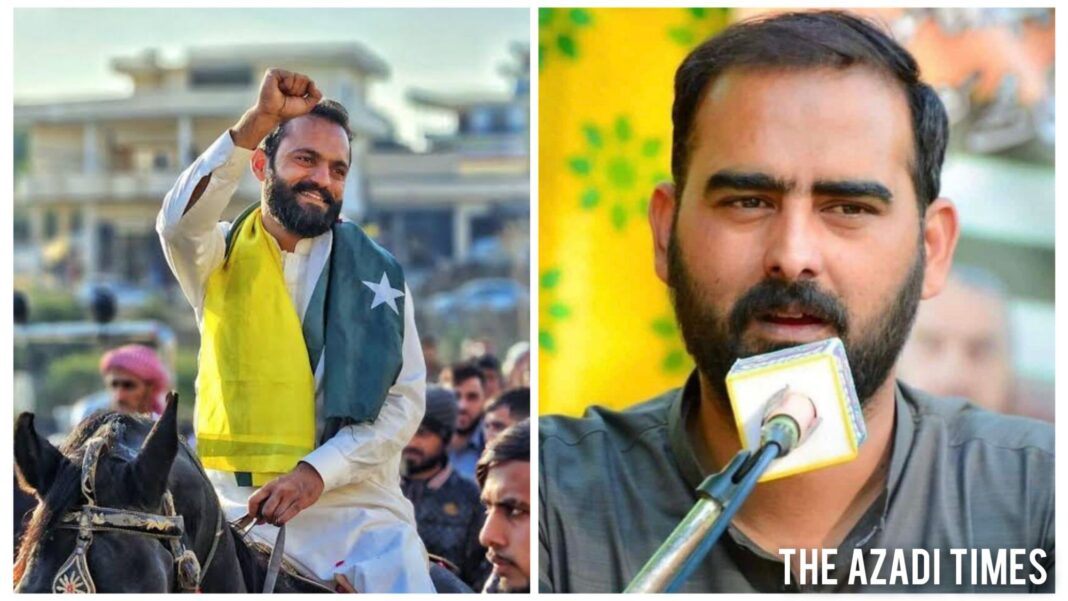
Two prominent contemporary examples often cited in youth discussions are Khawaja Mehran and Sardar Ruman, who, in a relatively short span of time, gained substantial recognition across Pakistan-administered Kashmir. With large social media followings and dedicated supporter bases, they represent a model of rapid political visibility that resonates deeply with younger audiences.
Their rise illustrates something broader: in today’s Kashmir, influence is no longer limited to traditional party hierarchies. It can be cultivated digitally, strategically, and emotionally.
However, the political landscape is not monolithic.
On one side are resistance-oriented groups that do not participate in electoral processes. They operate through activism, public mobilization, ideological campaigns, and social media engagement. Many of their workers face economic hardship, social pressure, and in some cases, legal or administrative consequences. Participation often demands sacrifice rather than financial reward.
On the other side are branches of mainstream Pakistani political parties that contest elections within Pakistan-administered Kashmir. These platforms offer structured political careers, clearer institutional pathways, and sometimes more stable economic prospects.
Young people navigate between these two worlds.
Some choose resistance politics out of ideological conviction. Others align with electoral parties, seeing them as pragmatic vehicles for influence and development. There are also those who publicly remain neutral — particularly government employees and salaried professionals — yet privately sympathize with one current or another.
This complexity challenges any simplistic reading of the trend.
According to an internal survey conducted by the team at The Azadi Times, analyzing social media behavior of users between 18 and 40 years of age, a clear pattern emerged: political and resistance-oriented content consistently receives higher engagement than entertainment or purely informational posts.
This does not necessarily indicate unanimous ideological alignment. Rather, it signals that political identity has become socially valuable. To speak on “حق” (rights), to critique governance, or to position oneself as a defender of collective dignity has become a source of recognition.
For many young Kashmiris, especially in districts such as Mirpur, Muzaffarabad, Kotli, and others, visibility in political discourse brings social legitimacy. It offers meaning in a region where economic constraints, limited industrial development, and restricted structural autonomy often produce frustration.
When traditional avenues of upward mobility feel constrained, symbolic arenas gain importance.
The central question is not whether youth engagement in politics is positive or negative. Political awareness is a sign of vitality in any society. Democracies and movements alike depend on informed, courageous young voices.
The deeper question is: what direction will this energy take?
Will it translate into policy innovation, community development, and institutional reform?
Or will it remain confined to performative competition on social media?
Can resistance discourse coexist with constructive governance frameworks?
And how can young Kashmiris balance ideological passion with educational, technological, and entrepreneurial advancement?
Globally, youth-led movements have often reshaped political landscapes. But sustainable change typically requires more than visibility; it demands strategy, organization, and inclusive thinking.
It would be inaccurate to suggest that all Kashmiri youth are turning toward resistance politics as a career path. Many remain focused on education, overseas employment, freelancing, civil services, and business ventures. The digital economy has opened new doors, and thousands quietly pursue economic mobility rather than political fame.
Yet, the symbolic weight of resistance politics has undeniably grown.
For some, it is a moral obligation.
For others, it is an identity statement.
For a few, it may also be a path to recognition in a competitive social environment.
The coexistence of electoral politics and non-electoral resistance politics creates a unique dynamic within Pakistan-administered Kashmir. It reflects both political aspiration and structural limitation — a society negotiating its place within a complex regional reality.
Independent journalism carries a particular responsibility in such a climate. Amplifying youth voices must go hand in hand with encouraging critical thinking. Sensationalism may generate clicks, but thoughtful analysis builds societies.
If the emerging trend of youth engagement in resistance politics is to contribute positively, it must remain anchored in democratic ethics, peaceful discourse, and long-term vision. Political passion without institutional literacy can lead to polarization. Conversely, apathy can breed stagnation.
Kashmir’s youth deserve more than binary choices. They deserve platforms that combine resistance with reform, identity with opportunity, and conviction with competence.
Ultimately, the rise of political competition among young Kashmiris is less about rivalry and more about relevance. It signals a generation unwilling to remain silent. Whether this momentum evolves into transformative leadership or remains a social media phenomenon will depend on how institutions, civil society, and political actors respond.
The story unfolding in Pakistan-administered Kashmir is not merely about resistance. It is about a generation searching for agency in a constrained environment — redefining what success, influence, and dignity mean in their context.
And that conversation is only just beginning.
By a Contributor from Mirpur (Name Withheld on Request)
Trending Topics


The Azadi Times is an independent digital news platform based in Muzaffarabad, Kashmir, dedicated to credible journalism, in-depth reporting, and global analysis. We cover Kashmir, South Asia, and international affairs with a commitment to truth, editorial integrity, and public accountability.
Get important news delivered directly to your inbox and stay connected!
© 2026 The Azadi Times. All Rights Reserved.