No state backing. No paywalls. Just truth. Support Kashmir's independent voice. Join 2,400+ patrons who fund independent voices.
Zero Paywalls
Reader Funded
Award Winning
Secure Payment
Encrypted
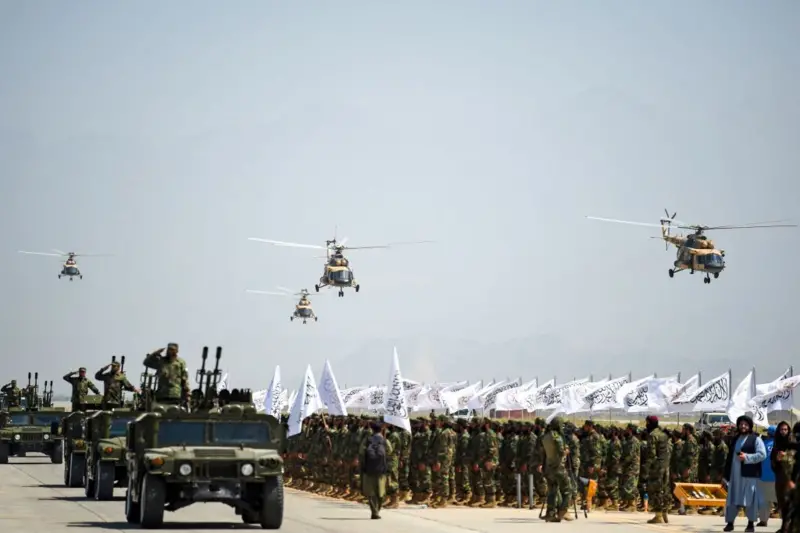
In recent weeks, fierce border skirmishes between Pakistan and the Taliban-led government in Afghanistan have once again brought regional tensions to the surface. The fighting, which preceded ceasefire negotiations in Doha and Istanbul, revealed not only the intensity of hostilities but also the evolving military capacities — and limitations — of both sides.
While Pakistan relied on its superior air power and guided missile systems, Taliban forces largely depended on light weaponry and guerrilla warfare tactics — a strategy rooted in their decades-long insurgent experience.
Videos circulating on Afghan social media show Taliban fighters attacking Pakistani border posts with small arms. In one viral clip, a fighter can be heard shouting “Wala ya Mullah Sahib,” a slogan that has since become a rallying cry among pro-Taliban supporters online.
No state backing. No paywalls. Just truth. Support Kashmir's independent voice. Join 2,400+ patrons who fund independent voices.
The clashes — which lasted several days along the Durand Line — sparked a debate among observers: has the Taliban truly transformed from a scattered insurgent group into a structured national army?
Security analyst Bismillah Taban, a former Afghan interior ministry officer, believes not entirely. “What we are seeing is still guerrilla-style engagement,” he explained. “Their advantage lies in surprise attacks and local familiarity, not in conventional warfare.”
Despite attempts to formalize their army, Taliban commanders continue to depend on mobility and local networks. One frontline commander told The Azadi Times under anonymity that “we focused on speed and surprise — hitting Pakistani posts before reinforcements could arrive.”
He added that orders were often decentralized: “Commanders on the ground had autonomy to act according to the situation, which allowed quick adaptation.”
Military expert Amir Rana in Islamabad agreed that the Taliban remain “a light-force army operating under guerrilla doctrines.” He noted that Pakistan, equipped with one of South Asia’s most capable militaries, viewed the border conflict as a “counterterrorism operation” rather than a full-scale war.
The Taliban’s current arsenal originates from three main sources:
Weapons seized from the former Afghan National Army.
Arms left behind by departing U.S. and NATO forces.
Purchases from black markets and cross-border trades.
Recent footage and field assessments show that Taliban fighters primarily use light and semi-heavy weapons such as AK-47s, M16s, M4 rifles, PKM machine guns, RPG-7s, and AT4 anti-tank rockets.
A Taliban officer claimed that night-vision scopes and laser-equipped rifles were “particularly effective” during nocturnal skirmishes.
According to U.S. reconstruction data, over 1.6 million weapons were supplied to Afghanistan during the previous government’s era — an estimated 70 percent of which eventually fell into Taliban hands after the 2021 takeover.
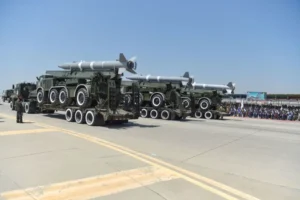
During a 2024 military parade at Bagram Air Base, the Taliban showcased Soviet-era artillery and decommissioned U.S. vehicles — including Howitzer D-30 cannons, ZT 2-23 anti-aircraft guns, and R-17 Scud missiles.
However, analysts believe most of these heavy systems are non-operational.
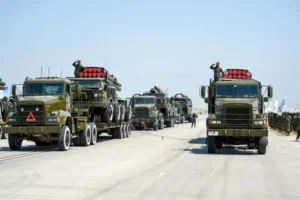
“Many of these weapons were never transferred to Afghan units before 2021,” said Taban. “Even now, maintenance issues and lack of trained operators limit their real-world use.”
While the Taliban claim to have reactivated several long-range weapons, experts suggest these parades are meant more for propaganda than for battlefield readiness.
Taliban commanders acknowledge the efficiency of lightweight arms in fast cross-border raids but admit that Pakistani airstrikes exposed their vulnerabilities. “Our units were under extreme pressure during bombardments,” said one commander, citing civilian casualties and communication breakdowns.
Their signature roadside bombs — known locally as “yellow barrel bombs” — continue to serve as inexpensive yet destructive tools against enemy convoys. However, reliance on such improvised explosives underscores the Taliban’s enduring insurgent mindset rather than a modern army’s discipline.
Pakistan’s edge in the air was undeniable. With modern fighter jets and precision-guided missiles, Islamabad maintained tactical superiority throughout the clashes.
Although the Taliban possess a limited number of refurbished aircraft, including MI-17 and MD-530 helicopters, experts confirm these have not been effectively deployed in combat.
“Afghanistan’s air force was never fully equipped,” said Taban. “The U.S. destroyed or removed many assets before withdrawing, leaving the Taliban with little aerial capacity.”
Currently, the Taliban claim to control around 60 aircraft — mostly grounded or used for surveillance. Without radar systems, maintenance crews, or trained pilots, the regime’s air ambitions remain aspirational at best.
Contrary to speculation, there’s no solid evidence that the Taliban operate military-grade drones.
Reports suggest the group uses commercial quadcopters for surveillance and, in rare cases, for dropping small explosives. These drones, purchased from black markets, offer limited range and accuracy.
“Groups like the Taliban or TTP use drones for observation,” explained Amir Rana, “but their operational impact is minimal compared to professional armies.”
The latest border conflict highlights a deeper geopolitical reality: Afghanistan’s ruling force has yet to transition from a guerrilla movement into a modern, cohesive army. Their dependence on light weapons, local networks, and outdated Soviet machinery contrasts sharply with Pakistan’s structured and technologically advanced defense apparatus.
Yet, in the unforgiving terrains of Kandahar and Spin Boldak, agility sometimes outweighs sophistication. The Taliban’s strength — for now — lies not in hardware, but in persistence, morale, and the will to fight against a better-armed neighbor.
Trending Topics


The Azadi Times is an independent digital news platform based in Muzaffarabad, Kashmir, dedicated to credible journalism, in-depth reporting, and global analysis. We cover Kashmir, South Asia, and international affairs with a commitment to truth, editorial integrity, and public accountability.
Get important news delivered directly to your inbox and stay connected!
© 2026 The Azadi Times. All Rights Reserved.