
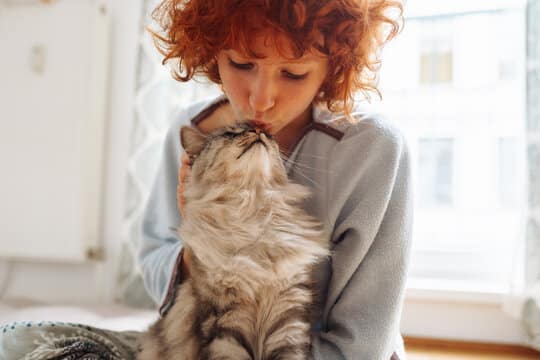

The low, gentle rumble of a cat’s purr is one of the most comforting sounds in the animal kingdom. It begins without warning — sometimes during petting, often at bedtime, occasionally inside a veterinary clinic when the cat seems least content. For centuries, humans have wondered: how do cats purr? Is it voluntary or automatic? And why do cats purr when they are injured or afraid, not only when they are happy?
Recent breakthroughs in biomechanics and laryngeal anatomy have finally provided clear answers. The mystery, it turns out, lies deep inside the cat’s voice box — and it challenges decades of earlier scientific assumptions.
The Old Theory
For much of the 20th century, many biologists believed that purring resulted from rapid contractions of the diaphragm and laryngeal muscles — approximately 25 to 150 times per second. This “active muscle contraction” theory suggested that cats consciously controlled each purr cycle, much like a human humming while exhaling.

But the theory had a flaw. It could not fully explain how do cats purr without fatiguing their muscles, since purring can continue uninterrupted for hours. Furthermore, cats with paralyzed larynges were still observed purring in some studies, confusing researchers for decades.
A ‘Purring Pad’ in the Vocal Folds
In 2023, a team of bioacousticians at the University of Vienna published a landmark study in Current Biology. Using excised larynges from domestic cats — donated after natural death — they pushed air through the vocal folds without any active neural input. Remarkably, the larynges produced self-sustaining purring sounds at the exact frequency (20–30 Hz) found in living cats.
Lead researcher Dr. Christian Herbst explained:


“We discovered that purring does not require constant muscle twitching. Instead, the vocal folds contain specialized connective tissue — a ‘purring pad’ — that oscillates passively when air flows. The cat simply needs to relax its larynx and breathe steadily.”
This means how do cats purr is closer to snoring in humans than to humming. The brain sends a low-level signal to keep the laryngeal muscles loose, and the physics of airflow does the rest.
But what tells the cat to begin purring in the first place? Neuroscience points to a small, poorly understood region in the brainstem called the central pattern generator — a neural oscillator that fires at the exact frequency of the purr. Similar generators control breathing and walking.


When a kitten nurses from its mother, the mother purrs to guide the kitten to her body. The kitten learns to activate its own oscillator within days of birth. This explains how do cats purr from such a young age — it is an instinctive, hardwired behavior, not a learned one.
Why Do Cats Purr When Stressed or Injured?
One of the most puzzling aspects of purring is its appearance during pain, labor, or severe illness. Veterinarians regularly report cats purring while recovering from surgery or even during euthanasia.
The leading theory is biomechanical self-repair. The 20–30 Hz frequency range of a cat’s purr corresponds precisely to the frequency known to promote bone healing, reduce swelling, and relieve pain in mammalian tissues. Some researchers have proposed that how do cats purr evolved not only for communication but also as a low-energy healing mechanism — a built-in physical therapy.
Dr. Elizabeth Von Muggenthaler, a bioacoustics researcher, stated:
“The purr frequency stimulates bone density and tissue regeneration. It is possible that cats purr to heal themselves after falls or fights. We have measured similar frequencies in therapeutic vibrating plates used for human astronauts to prevent bone loss in zero gravity.”
Not all purrs are equal. How do cats purr differs across the Felidae family. Domestic cats (Felis catus), bobcats, and lynxes purr continuously on both inhale and exhale. However, lions, tigers, leopards, and jaguars — the “roaring cats” — cannot purr. Their laryngeal anatomy favors a different set of vibrations that enable roaring but disable true purring.
Cheetahs, interestingly, are an exception. They purr like domestic cats despite being large felids, further complicating evolutionary models.
Science has now answered the mechanical question: how do cats purr through passive vibration of specialized vocal folds driven by steady airflow and a primitive brainstem oscillator. But the emotional question — why a cat purrs for you, at that exact moment — remains wonderfully mysterious.
Perhaps that is why the purr endures. It is a biological marvel and a quiet companion, unchanged for millions of years. And for those who listen closely, it is still the best sound in the world.