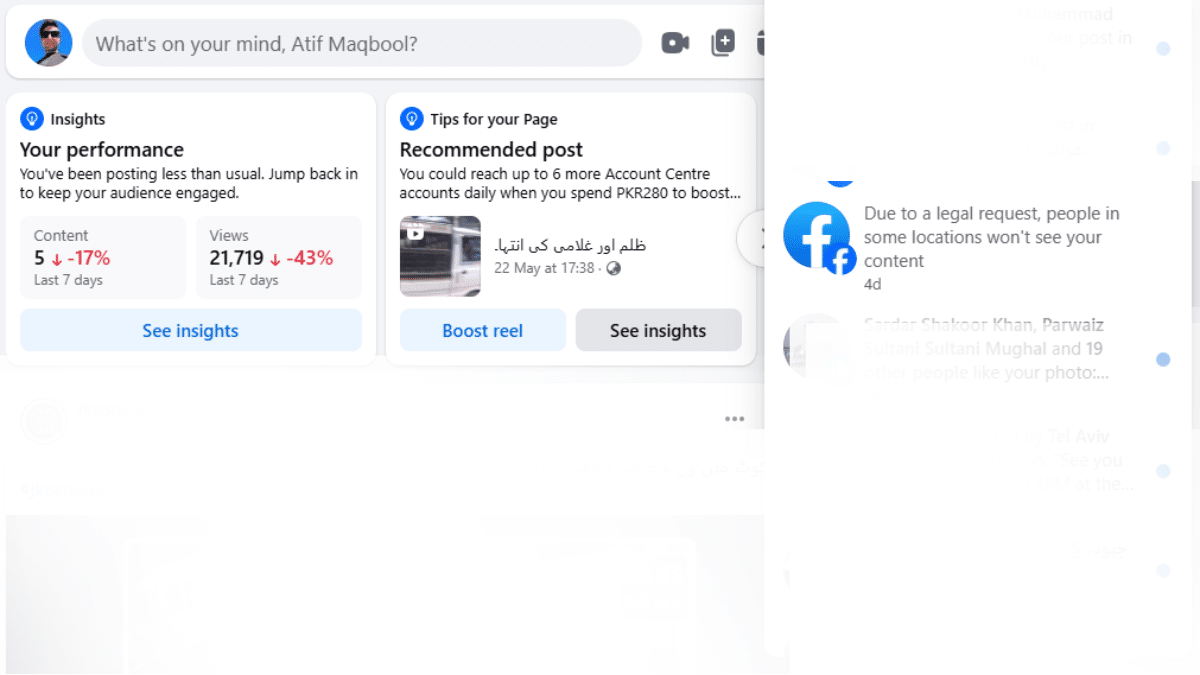

SRINAGAR/MUZAFFARABAD — In a sweeping new wave of digital censorship, Indian authorities have orchestrated the blocking of multiple Facebook accounts operated from Pakistan-administered Kashmir, dealing a severe blow to the already fragile cross-LoC communication lifeline for divided Kashmiri families. Among the prominent voices silenced is Atif Maqbool, founder and ex editor of The Azadi Times, the Jammu Kshmir’s only independent international news platform.
Several prominent digital activists, citizen journalists, and grassroots organizers from both sides of the Line of Control received stark notifications from Meta, the parent company of Facebook. The message was uniform and chilling: their accounts were being “restricted in India” due to a direct “legal request” from Indian government agencies.
The latest casualty list goes beyond Maqbool and includes high-profile names such as Nosheen Khawaja, a vocal human rights advocate, and an account operating under the regional moniker “District Kotli,” which served as a critical bridge sharing cultural and familial updates between the divided territories. Sources confirm that numerous smaller accounts, which played a vital role in connecting local communities, were also terminated without detailed public justification.
For Kashmiris, these platforms are not just social media; they are a digital lifeline. With physical movement across the heavily militarized LoC virtually impossible, Facebook and WhatsApp have for years served as the only “virtual J&K,” where separated cousins could meet, political opinions could be whispered, and a shared cultural identity could survive the barbed wire.
The Story of a Silenced Bridge
Atif Maqbool, who also serves as a member of the Jammu and Kashmir Joint Awami Action Committee (JKJAAC), took to X (formerly Twitter) to break the news of his own digital incarceration. In a post that resonated with the collective pain of a partitioned nation, Maqbool did not just announce a ban; he narrated a tragedy of human connection being severed.
He wrote: “On the ground, we are already prisoners in our own homeland, but now they are erecting borders on the internet as well. This is a violation of basic human rights. The people of Pakistan-administered Kashmir and India-administered Kashmir share relatives, political ideologies, culture, and grief. We only shared this pain through social media. Now, they have locked that door too.”
His statement paints a vivid picture of the cruel dichotomy of the Kashmir conflict. While the world discusses geopolitics, ordinary families who have not embraced in seven decades relied on a pixelated video call to mourn deaths and celebrate births. The blocking of the “District Kotli” account, for instance, effectively silences an entire region’s digital identity, erasing the daily narratives of life in that district from the view of their brethren across the divide.
The Weaponization of Legal Requests
This is not an isolated incident of a tech company enforcing community guidelines. This is a geopolitical act executed through legal channels. By pressuring Meta via “legal requests,” India is effectively extending its territorial censorship laws beyond the Line of Control, imposing its digital jurisdiction on the residents of Pakistan-administered Kashmir.
Maqbool’s robust voice, amplified through The Azadi Times, has consistently focused on human rights documentation and the right to self-determination. The blocking suggests an intolerance for independent Kashmiri journalism that refuses to be a mouthpiece for state narratives. It exposes a digital “Iron Curtain” descending over South Asia, where algorithms are weaponized to enforce a narrative and isolate a people.
“The World Must Answer for This Tyranny”
In his poignant message, Maqbool did not appeal to governments but to the global conscience. “The world will have to answer for this oppression. History will never forgive this silence,” he stated, echoing the sentiment of a generation of Kashmiris who feel abandoned by international human rights mechanisms.
It is an attempt to crush a platform that was born to break silences. Yet, the act of silencing itself becomes a testament to the power of the truth being spoken. As Maqbool and his colleagues face this new digital imprisonment, the question lingers in the cold mountain air of the Himalayas: Can you truly disconnect a heart from its homeland, even if you unplug the router?
The Azadi Times continues to monitor this developing situation and stands resilient in its mission to report the unfiltered truth of Jammu and Kashmir. We refuse to be silenced.
Digital Iron Curtain in Kashmir: India Blocks Dozens of Facebook Accounts, Including The Azadi Times Founder Atif MaqboolDigital Iron Curtain in Kashmir: India Blocks Dozens of Facebook Accounts, Including The Azadi Times Founder Atif Maqbool