
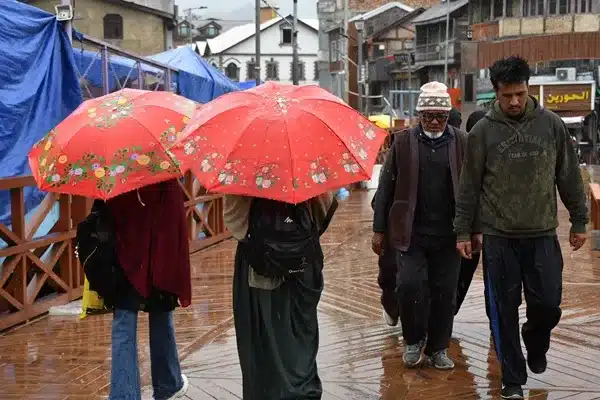

The inclement weather, which began picking up intensity on Friday, is attributed to a strong atmospheric disturbance originating from the Mediterranean region. This system has pulled significant moisture into the Himalayas, resulting in a chaotic weather mix: snow over the peaks and rain across the urban centers.
High-Altitude Hubs Blanketed in White
According to data from the meteorological department, the higher altitudes witnessed significant snow accumulation. Sadhna Top and other elevated zones in the Kupwara district, the strategic Mughal Road in Shopian, and the Margan Top connecting Anantnag with Kishtwar received fresh overnight snowfall. The scenic Affarwat mountain in Gulmarg, a popular destination for winter sports enthusiasts, along with the Sonamarg-Zojila axis, also turned white.
In contrast, the plains of the valley, including the summer capital Srinagar, witnessed continuous moderate to heavy rainfall. MeT data recorded up to 8:30 am showed that Srinagar city received 25.1 mm of rain, while the Srinagar Airport logged 29.2 mm. The ski resort of Gulmarg was one of the wettest locations, recording 32.2 mm of precipitation.

Arterial Roads Shut, Travel Advisory Issued
The dual impact of rain and snow has severely disrupted surface connectivity in the Union Territory. The historic Mughal Road, the Sinthan Top route, and the crucial Bandipora-Gurez road were officially closed for vehicular traffic due to the accumulation of snow. Most critically, the Srinagar-Leh National Highway was shut following the accumulation of snow along the treacherous Zojila Pass, cutting off the Ladakh region from the Kashmir Valley.
The district administration in Srinagar issued a public advisory urging residents to avoid non-essential travel. Authorities specifically warned tourists, shikara operators on Dal Lake, and sand miners to stay away from water bodies due to gusty winds and slippery banks, with wind speeds expected to reach 40–50 km/h.
Weather Forecast: A Week of Instability
The weatherman has predicted that the wet spell will remain erratic until at least April 10. There is expected to be a gradual improvement in conditions from Saturday evening; however, isolated places may experience light rain on Sunday and Monday.



A second active Western Disturbance is expected to hit the region from April 7 to 9, bringing fresh spells of light to moderate rain and snowfall in the higher reaches, accompanied by thunder, lightning, and gusty winds. The MeT department has warned that isolated parts of Jammu and Kashmir could witness intense heavy rain on April 7-8, raising the risk of flash floods and waterlogging in low-lying areas. Following this, scattered places may receive brief showers until April 11, with the weather expected to turn mainly dry from April 12 onward.
As the mercury dipped and the skies remained overcast, a wave of anxiety swept through the Valley’s apple-growing heartlands. With the apple trees entering the critical flower budding stage, the persistent wet and cool conditions have raised fears of scab and alternaria diseases, which can severely damage fruit yields and impact the region’s approximately approximately 1.08 billion to 1.12 billion US Dollars (USD) apple economy.
Tariq Rasool Rather, a Professor of Plant Pathology at the Sher-e-Kashmir University of Agricultural Sciences and Technology (SKUAST), noted that the rainy weather during the budding stage is worrisome. However, he urged farmers not to panic, advising them to utilize any brief pauses in rainfall to conduct mist spraying of recommended fungicides to prevent scabbing. The agricultural university has also issued guidelines asking farmers to ensure proper drainage in orchards to prevent root damage.


Beyond the immediate disruptions, experts warn that this pattern of intense rain in the plains and diminished snow cover in the mountains signals a broader climatic transition. Irfan Rashid, Associate Professor at the University of Kashmir’s Department of Geoinformatics, explained that a larger share of spring moisture is now falling as rain instead of remaining stored as seasonal snow, reducing the mountain’s natural buffering capacity. “Once the snow reservoir weakens, rivers respond faster, slopes destabilise sooner and even moderate rain spells can create flood-like situations,” Rashid said.
As the Valley braces for another spell of rough weather early next week, authorities have urged the public to remain vigilant and cooperate with safety protocols to avoid mishaps during this volatile spring season.