
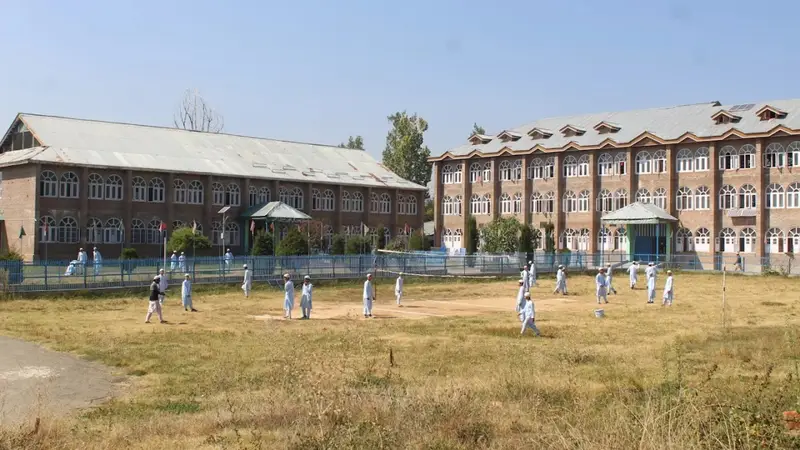

SHOPIAN, Indian-Administered Kashmir — The heavy iron gates of Darul Uloom Jamia Siraj-ul-Uloom were locked from the outside on the morning of April 28, 2026. For the 814 students and 102 staff members who called this campus home, the seminary in Imam Sahib village — a sprawling institution that has operated since 1992 — was suddenly, officially, no longer theirs to enter.
The previous evening, the Jammu and Kashmir administration had declared the institution an “unlawful entity” under the Unlawful Activities (Prevention) Act, 1967 (UAPA). The two-page order, issued by Kashmir Divisional Commissioner Anshul Garg, cited “sustained and covert linkages” with Jamaat-e-Islami — a religious and political organisation banned by the Government of India in 2019 — along with allegations of radicalisation, financial irregularities, and questionable land acquisition.
The decision has drawn sharp criticism from political leaders across Indian-administered Kashmir, raised questions about due process under India’s stringent counter-terrorism laws, and highlighted a broader pattern of civil society constriction in the region since 2019.
What the Administration Says
The administrative action traces back to March 24, 2026, when the Senior Superintendent of Police (SSP) for Shopian district submitted a confidential dossier to the Divisional Commissioner’s office. The dossier, according to the official order, alleged that an institution appearing on the surface to be a conventional religious educational establishment was allegedly harbouring “something more sinister beneath.”
The Divisional Commissioner’s order, issued under Section 8(1) of the UAPA, outlined four specific allegations:
Legal and Administrative Irregularities: The institution allegedly lacked mandatory registration with competent authorities and made “deliberate attempts to evade statutory oversight.” The order pointed to “questionable land acquisition” — a particularly sensitive issue in the region since the 2019 revocation of Article 370, which previously restricted non-resident land ownership.

Financial Opacity: The administration cited “lack of transparency in financial transactions” and “objectionable fund arrangements” as evidence that the institution’s monetary flows warranted scrutiny.
Alleged Militant Links: Perhaps the most serious charge concerned the institution’s alumni. The order stated that “a number of former students have been found involved in militant activities and acts prejudicial to national security,” suggesting that the seminary had “fostered an environment conducive to radicalisation.”
Jamaat-e-Islami Connections: The order referenced “credible inputs and evidence on record” indicating “sustained and covert linkages” with Jamaat-e-Islami, which was proscribed under the UAPA in February 2019 following the Pulwama attack that killed 40 Central Reserve Police Force personnel.


The institution’s chairman, Mohammad Shafi Lone, was issued a show-cause notice on March 31, 2026. He submitted a detailed response, but the SSP for Shopian, on April 21, 2026, dismissed the objections as “misconceived, factually untenable, and devoid of legal merit.” Four days later, the ban was formalised.
What Jamia Siraj-ul-Uloom Says
Jamia Siraj-ul-Uloom is not an obscure madrasa operating in the shadows. Established in 1992 as a society and commencing operations in 2000, it has grown into one of the more prominent religious educational institutions in south Kashmir — a region that has borne a disproportionate share of the Kashmir conflict’s violence over the past three decades.
The institution offers both religious and modern education. According to Chairman Lone, the school is affiliated with the School Federation of Kashmir, recognised by the Jammu and Kashmir Board of School Education, and its college is affiliated with the University of Kashmir — credentials that suggest a degree of official legitimacy and integration into the state’s educational framework.
The institution has also made public efforts to demonstrate its loyalty to the Indian state. In August 2025, teachers and students held a tricolour rally to express their patriotic allegiance — a move widely interpreted as an attempt to distance the seminary from separatist associations in an increasingly polarised environment.
Lone has consistently denied any links with Jamaat-e-Islami. Following the ban, he told media persons: “We are not involved in any unlawful activity and are following all government rules and regulations. We have no affiliation with Jamaat-e-Islami. The property belongs to a Sufi saint.” He expressed surprise at the sudden announcement, noting that he had already submitted a detailed response to the show-cause notice.
Political Reaction: ‘Flagrant Injustice’
The ban has drawn sharp criticism from across the political spectrum in Indian-administered Kashmir, most notably from former Chief Minister Mehbooba Mufti, who called the move “a flagrant injustice to the poor underprivileged sections of society.”
In a strongly worded statement, Mufti argued: “This institution served as a beacon of quality education for students unable to afford expensive schooling. It has produced reputed doctors and professionals who served this nation with dedication. Banning these altruistic institutions without any solid evidence of anti-national activity shows a deep-seated prejudice and ill intention.”
Her critique touches on a broader concern that has grown since 2019: that the space for civil society, religious expression, and even educational autonomy in Indian-administered Kashmir has been systematically constricted under the guise of security measures.
The Jammu and Kashmir Peoples Democratic Party (PDP) and various civil society organisations have questioned the evidentiary basis for the ban and the procedural fairness of the UAPA process, which allows for detention and property seizure with limited judicial oversight.
The Broader Security Context
To understand the Jamia Siraj-ul-Uloom ban, one must place it within the broader architecture of counter-terrorism measures that have reshaped civil society in Indian-administered Kashmir since 2019.
The proscription of Jamaat-e-Islami in February 2019 was a watershed moment. Founded in 1945, the organisation had long operated as a religious, social, and political force, running schools, orphanages, and welfare programmes alongside its political activities. The government accused it of supporting militancy and acting as an “overground worker” for terrorist groups — allegations the organisation consistently denied.
Following the ban, dozens of Jamaat-e-Islami members were arrested, its assets frozen, and its vast network of educational and charitable institutions came under intense scrutiny. The organisation’s bank accounts were seized, and its properties across the region were attached or sealed.
The 2019 crackdown was followed by the revocation of Article 370 in August of that year, which stripped Jammu and Kashmir of its special autonomous status and bifurcated the state into two union territories. The move was accompanied by a massive security deployment, communications blackouts, and the detention of thousands of political leaders, activists, and civil society figures.
Since then, the administration has pursued a dual strategy: heavy security measures to suppress militancy, alongside efforts to integrate the region more fully into the Indian Union through economic development, tourism promotion, and political restructuring. But critics argue that this approach has come at the cost of civil liberties, political dissent, and the autonomy of religious and educational institutions.
UAPA Explained: India’s Counter-Terrorism Law
The Unlawful Activities (Prevention) Act, 1967, is among India’s most stringent counter-terrorism laws. Amended multiple times — most significantly in 2004, 2008, 2012, and 2019 — it grants the state extraordinary powers to designate individuals and organisations as “terrorists,” seize properties, and detain suspects without the procedural safeguards available under ordinary criminal law.
Section 8(1) of the UAPA empowers the central or state government to declare an association “unlawful” if it believes the organisation is involved in activities “prejudicial to the sovereignty and integrity of India.” Once declared unlawful, the organisation’s offices can be sealed, its assets frozen, and its members subject to criminal prosecution.
Critics — including human rights organisations, legal scholars, and opposition parties — have raised serious concerns about the UAPA’s broad definitions, its reversal of the presumption of innocence, and the difficulty of challenging designations in court. The law has been described by some legal experts as creating a “reverse burden of proof,” where the accused must demonstrate their innocence rather than the state proving guilt.
In Kashmir, where the UAPA has been invoked against journalists, activists, students, and now educational institutions, these concerns carry particular weight. According to data from the National Crime Records Bureau, thousands of individuals have been detained under the UAPA in Jammu and Kashmir since 2019, though conviction rates remain relatively low — a pattern that has drawn scrutiny from legal observers.
The Human Cost: 814 Students and 102 Staff
Beyond the legal and political dimensions, the Jamia Siraj-ul-Uloom ban has immediate, tangible consequences for hundreds of families in one of the region’s most impoverished districts.
The 814 students enrolled at the institution — many from poor, rural backgrounds for whom the seminary represented a rare pathway to education — now face uncertainty. Where will they continue their studies? Will their academic records be recognised? Will their families, already struggling with the economic devastation of decades of conflict, be able to afford alternative schooling?
The 102 staff members — teachers, administrators, support workers — have lost their livelihoods overnight. In a region where formal employment is scarce and the private sector is underdeveloped, the loss of even a modest salary can push families into crisis.
For the community of Imam Sahib and the surrounding villages, the seminary functioned as more than a school. It was a social institution, a gathering place, a symbol of religious and cultural continuity. Its closure sends a message that extends far beyond its walls.
The most serious charge against Jamia Siraj-ul-Uloom — that some of its former students became involved in militant activities — is also the most difficult to verify independently.
The administration has not publicly released the names of the alleged militants, the specific incidents they were involved in, or the evidentiary basis for linking their activities to the seminary. Without this information, external observers cannot assess whether the institution actively fostered radicalisation, whether individual students were radicalised independently, or whether the alleged links exist at all.
This opacity is characteristic of UAPA cases, where much of the evidence is classified and subject to limited judicial review. It is also reflective of the broader challenge of counter-terrorism in Kashmir, where the lines between political dissent, religious expression, and militant activity are often blurred.
What is clear is that south Kashmir, and Shopian district in particular, has been a persistent hotspot for militancy. The district has seen numerous encounters between security forces and militants, and a significant number of local youth have joined militant ranks over the past decade. Whether educational institutions have contributed to this trend — or have simply existed in an environment where radicalisation occurs through multiple channels — remains an open question.
One of the more intriguing aspects of the case involves the institution’s property. Chairman Lone has asserted that the land belongs to a Sufi saint — a claim that, if verified, would complicate the administration’s narrative of “questionable land acquisition.”
Sufism has deep roots in Kashmir, where the Rishi tradition — exemplified by the 14th-century mystic Sheikh Noor-ud-Din Noorani, known as Nund Rishi — has historically provided a spiritual counterweight to more rigid forms of religious expression. Sufi shrines dot the Kashmiri landscape, and many educational and charitable institutions are associated with saintly lineages.
If Jamia Siraj-ul-Uloom’s property is indeed tied to a Sufi heritage, the administration’s allegations of irregular land acquisition would require careful scrutiny. Conversely, if the institution has encroached upon or misrepresented the ownership of religious property, that would raise its own set of ethical and legal questions.
The land issue also connects to broader anxieties in post-2019 Kashmir. The revocation of Article 370 removed restrictions on land ownership by non-residents, sparking fears — particularly among Kashmiri Muslims — that outsiders would buy up property and alter the region’s demographic and cultural character.
The Jamia Siraj-ul-Uloom ban occurs against a backdrop of global debate about the balance between religious freedom and counter-terrorism.
India has faced criticism from international human rights organisations — including the United States Commission on International Religious Freedom (USCIRF), Amnesty International, and Human Rights Watch — for what they describe as a pattern of restricting religious and civil liberties, particularly for Muslims. The UAPA has been singled out as a tool that enables arbitrary detention and suppresses dissent.
The Indian government has consistently rejected these criticisms, arguing that its counter-terrorism measures are necessary to protect national security in a region that has experienced decades of cross-border militancy. Officials point to Pakistan’s role in supporting militant groups and argue that stringent laws are required to prevent the radicalisation of youth.
This tension — between security imperatives and civil liberties, between state sovereignty and international human rights norms — is not unique to India. Similar debates have unfolded in the United States (the PATRIOT Act), the United Kingdom (Prevent strategy), France, and numerous other countries grappling with the threat of terrorism.
Legal Recourse and Potential Outcomes
Chairman Lone has indicated that he intends to challenge the ban in court. Under the UAPA, any designation as an “unlawful association” can be appealed to a tribunal constituted by the government under Section 5 of the Act. The tribunal, composed of a High Court judge, has the power to review the evidence and confirm or set aside the declaration.
However, legal experts note that UAPA tribunals have historically rarely overturned government designations. The burden of proof lies with the accused organisation to demonstrate that it is not unlawful — a reversal of the normal criminal standard that many legal scholars argue violates fundamental due process rights.
If the case proceeds to judicial review, the key questions will likely include: the nature and credibility of the evidence linking the seminary to Jamaat-e-Islami; whether alleged militant activities by former students can be attributed to the institution itself; and whether the administration has followed the procedural requirements of the UAPA.
A Locked Gate and an Open Question
The heavy iron gates of Jamia Siraj-ul-Uloom, sealed by administrative order on April 28, 2026, are a physical manifestation of a deeper reality: the shrinking space for civil society, religious expression, and educational autonomy in Indian-administered Kashmir.
Whether that shrinkage is a necessary price for security, or an overreach that risks alienating the very population the state seeks to integrate, depends on one’s perspective — and on the evidence that the administration has yet to make public.
For the 814 students who once walked those halls, for the 102 staff members who once taught and served there, and for the community that once gathered within its walls, the locked gate is not an abstraction. It is a daily reminder that in Kashmir, even education is political — and that the line between security and suppression is drawn not in law alone, but in the lived experience of those who must navigate it.
As Chairman Lone maintains his innocence and former Chief Minister Mufti decries the “flagrant injustice,” the case of Jamia Siraj-ul-Uloom will likely wind its way through India’s courts — where the burden of proof, reversed by the UAPA, will test the limits of justice in a region where justice has long been in short supply.
Until then, the gates remain locked. And the questions remain open.