No state backing. No paywalls. Just truth. Support Kashmir's independent voice. Join 2,400+ patrons who fund independent voices.
Zero Paywalls
Reader Funded
Award Winning
Secure Payment
Encrypted
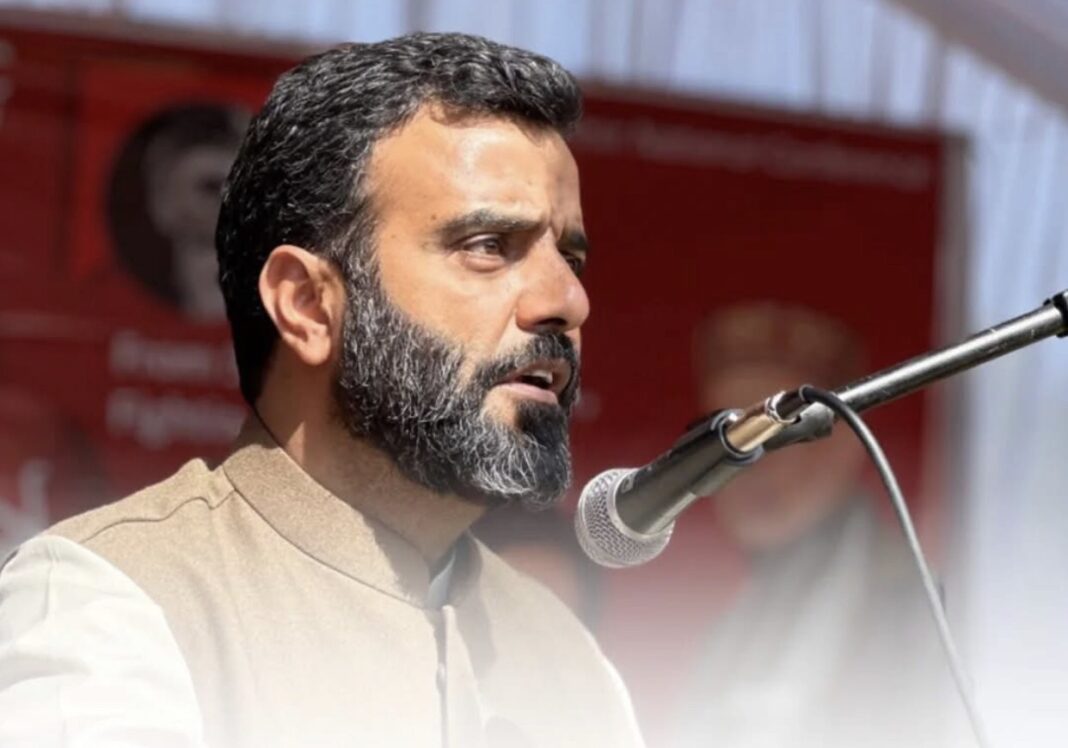
Lawmaker Accuses Indian Authorities of Weaponizing Anti-Corruption Body to Silence Pro-Kashmir Voices
Srinagar, Indian-Administered Jammu and Kashmir: Member of Parliament (MP) Ruhullah Mehdi, a prominent political figure in the region, has vehemently denied corruption charges filed against him by India’s Anti-Corruption Bureau (ACB), labeling the allegations a “politically motivated attempt to muzzle dissent” amid escalating tensions in Kashmir.
In a press conference on Thursday, Mehdi, affiliated with the National Conference party, dismissed the ACB’s claims as baseless and accused New Delhi of exploiting institutions to target critics of its policies in the disputed territory. “These charges are not about accountability—they are a crude tool to silence those who dare to speak against the oppression faced by Kashmiris since the illegal abrogation of our autonomy in 2019,” he asserted.
No state backing. No paywalls. Just truth. Support Kashmir's independent voice. Join 2,400+ patrons who fund independent voices.
The ACB, which operates under India’s direct administrative control in Jammu and Kashmir, alleges financial misconduct linked to Mehdi’s tenure in public office. However, the MP dismissed the case as a “fabrication,” insisting the charges lack evidence and are timed to undermine his advocacy for Kashmiri rights.
Political Context: Crackdown on Dissent
Mehdi’s accusations come against the backdrop of heightened scrutiny on Kashmiri politicians and activists following India’s unilateral revocation of Article 370 in August 2019, which stripped the region of its semi-autonomous status. Since then, critics argue that Indian authorities have intensified legal and bureaucratic tactics to suppress opposition, including frequent use of anti-terror laws, arbitrary detentions, and now, anti-corruption probes.
“This is not an isolated incident,” Mehdi stated. “Every Kashmiri who resists New Delhi’s narrative is branded corrupt, anti-national, or worse. The goal is to criminalize dissent and erase our struggle for self-determination.”
Party and Public Reaction
Mehdi’s National Conference party condemned the ACB’s move, calling it a “desperate act of intimidation” by India’s ruling establishment. Senior party leader Omar Abdullah echoed Mehdi’s sentiments, stating, “When the voices of Kashmiris grow louder, Delhi responds with coercion. This is a well-worn playbook to delegitimize our political aspirations.”
Local civil society groups and pro-freedom advocates have rallied behind Mehdi, organizing protests in Srinagar and branding the charges as part of a systemic campaign to discredit Kashmiri leadership. Social media platforms have flooded with hashtags like #StopSilencingKashmir and #StandWithRuhullah, reflecting widespread public skepticism toward the ACB’s actions.
Implications
International human rights organizations have repeatedly raised concerns about India’s shrinking democratic space in Kashmir. In recent years, dozens of Kashmiri politicians, journalists, and activists have faced similar legal battles, often under opaque circumstances. Critics argue that anti-corruption agencies, while vital for accountability, are increasingly weaponized to sideline dissenters.
Mehdi’s case has reignited debates over the precarious balance between governance and repression in the region. As tensions simmer, many Kashmiris view the charges as a litmus test for India’s commitment to due process in a territory where trust in New Delhi’s institutions remains deeply fractured.
For now, Ruhullah Mehdi vows to contest the charges legally and politically, framing his battle as emblematic of Kashmir’s broader resistance. “They can fabricate cases, but they cannot extinguish our demand for justice and freedom,” he declared.
As international observers watch closely, the outcome of this case may further shape the trajectory of Kashmir’s struggle for self-determination and India’s willingness to confront allegations of institutional abuse in one of the world’s most militarized regions.
Trending Topics


The Azadi Times is an independent digital news platform based in Muzaffarabad, Kashmir, dedicated to credible journalism, in-depth reporting, and global analysis. We cover Kashmir, South Asia, and international affairs with a commitment to truth, editorial integrity, and public accountability.
Get important news delivered directly to your inbox and stay connected!
© 2026 The Azadi Times. All Rights Reserved.