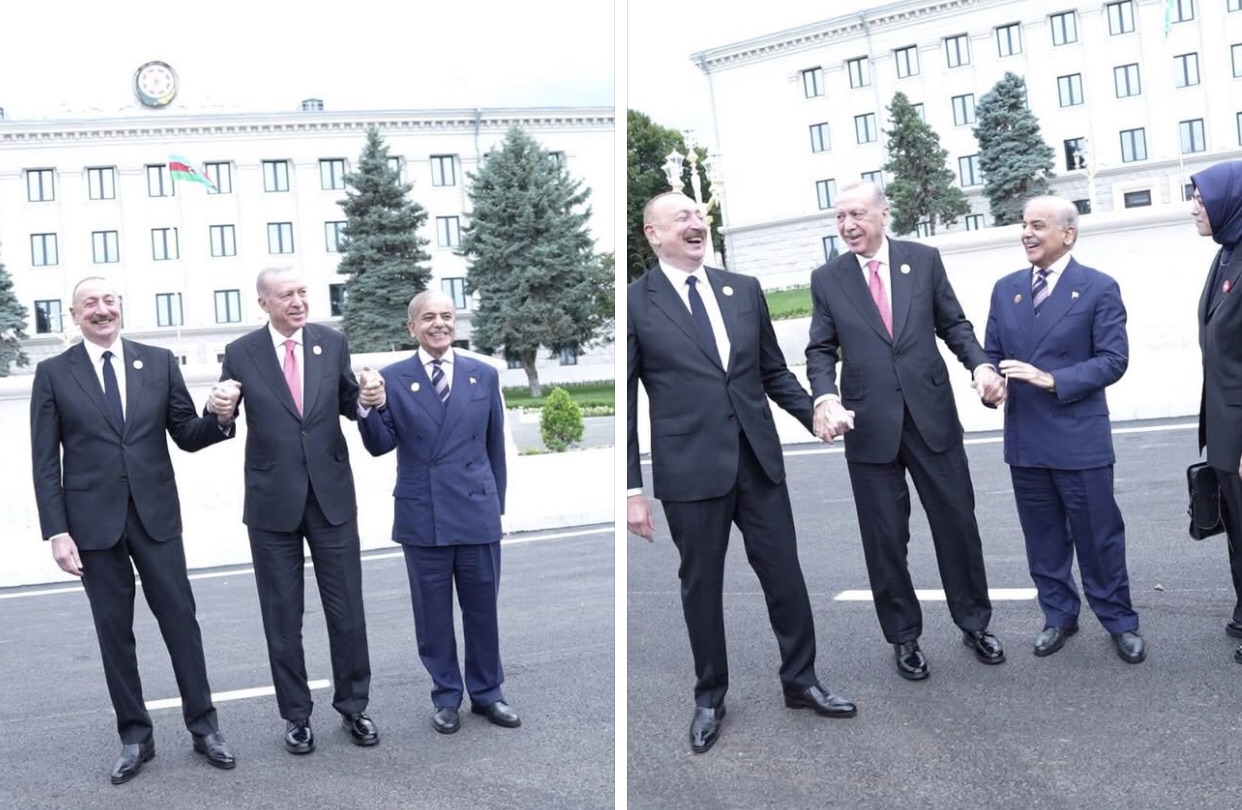

Khankendi, Azerbaijan – In a gesture laden with symbolism, the heads of state from Pakistan, Türkiye, and Azerbaijan were pictured holding hands following the conclusion of the 17th Economic Cooperation Organization (ECO) Summit in Khankendi, Azerbaijan—a city at the heart of the Nagorno-Karabakh conflict.
The image, now viral across social media platforms, captured Prime Minister Shehbaz Sharif, President Recep Tayyip Erdoğan, and President Ilham Aliyev standing together—visibly united in what officials are calling a moment of “strategic brotherhood.”
A Carefully Choreographed Show of Regional Solidarity
The summit, which brought together leaders from 10 ECO member states, focused on economic integration, sustainable development, and geopolitical coordination across South and Central Asia. But the visual impact of the three leaders walking hand-in-hand overshadowed formal agreements.
The Azadi Times
No state grants. No corporate lobby. Just ground‑truth reporting from Kashmir & beyond
You make this possible.
“It’s not just about trade—it’s about trust,” an Azerbaijani official told The Azadi Times, speaking on condition of anonymity.
While Türkiye and Azerbaijan have long enjoyed close military and diplomatic ties, Pakistan’s growing alignment with both nations—particularly on defense and climate issues—has introduced a new trilateral dynamic into an already shifting regional order.
This year’s venue, Khankendi, holds deep historical and political significance. Formerly known as Stepanakert, it was the de facto capital of the breakaway Nagorno-Karabakh Republic, which was dissolved following Azerbaijan’s 2023 military offensive.


Hosting an international summit in the city is widely interpreted as a diplomatic assertion by Baku, with support from Ankara and now—visibly—Islamabad.
“We are brothers in blood and belief,” President Erdoğan stated earlier during a joint press conference.
Pakistan’s Agenda: Climate, Trade, and Connectivity
PM Shehbaz Sharif used his address to spotlight Pakistan’s vulnerability to climate change, calling for:

- A Low-Emission ECO Corridor
- Regional investment in resilience infrastructure
- Establishment of an ECO Youth Climate Fellowship
He also announced a \$2 billion bilateral investment framework with Azerbaijan focused on energy cooperation, port development, and defense industrial exchange.
“Climate shocks know no borders,” Sharif said. “Neither should our solutions.”
Türkiye’s Calculated Support for Muslim Unity
President Erdoğan reiterated Türkiye’s support for “just causes,” referencing Gaza, Kashmir, and Karabakh—territories tied to Muslim-majority populations facing political disputes. While avoiding direct confrontation with India, Ankara’s statements mirrored previous alignments with Islamabad over Kashmir.
What the Viral Image Means
The now-famous image of the three leaders, smiling and holding hands against the backdrop of Khankendi’s recently rebuilt streets, has triggered a wave of reaction online.
“This isn’t just about brotherhood—it’s a soft-power statement to the world,” said political analyst Dr. Lina Qureshi.
The summit concluded with joint declarations emphasizing:
- Expansion of intra-regional trade
- Formation of an ECO Green Finance Task Force
- Increased digital infrastructure integration
- Commitment to multilateral peace efforts
Looking Ahead
- The 18th ECO Summit is expected to be held in Tehran in 2027.
- Implementation of the Khankendi Investment Plan begins Q4 2025.
- A joint trilateral development bank between Pakistan, Türkiye, and Azerbaijan is under review.
Analysis: A New Muslim Bloc in the Making?
While the summit’s official agenda was rooted in economics and climate resilience, the visual choreography and political language suggest something more:
“We are seeing the architecture of a new geopolitical triad,” says regional expert Dr. Faheem Mir. “It’s not military per se—but it’s moral, strategic, and increasingly economic.”
Still, critics warn that such alignments could risk further polarization in the region, especially if not balanced by active diplomacy with neighboring powers.