
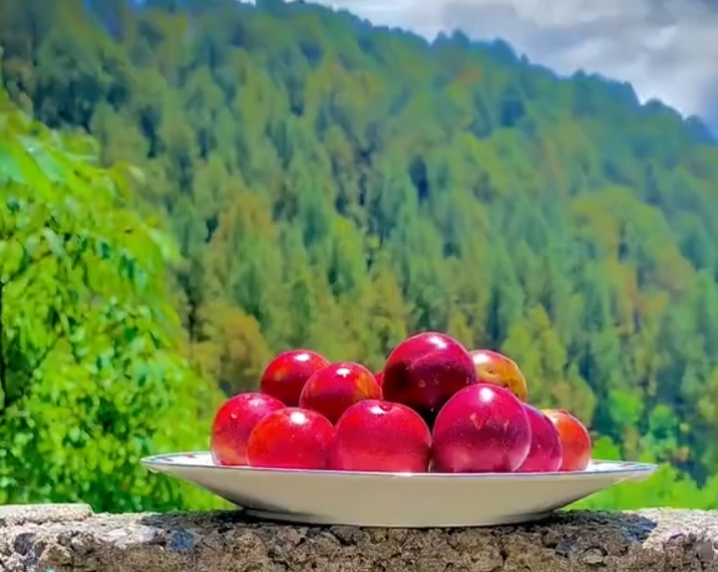

In the valley of Indian-administered Kashmir, the arrival of autumn is not marked solely by the crimson blush of the chinar leaf. It is heralded by a different, more profound red—and gold, and green—weighing down the branches of countless orchards that terrace the Himalayan foothills. This is the season of the Zhoonth, the Kashmiri apple, a fruit whose story is so deeply grafted onto the region’s identity that to separate the two is impossible. It is a narrative of history, culture, survival, and now, of profound economic and environmental challenge.
The apple is a global citizen, its wild origins traced to the forests of Central Asia. Yet, in Kashmir, it has found a second home, becoming so indigenous to the landscape that its presence feels eternal. This is no accident of nature, but a testament to centuries of deliberate human care, a living heritage carefully recorded and passed down.
The Deep Historical Roots
The apple’s formal place in Kashmir’s history is etched in parchment and stone. The 12th-century scholar-historian Kalhana, in his rigorous chronicle Rajatarangini, documented more than just kings and wars. He recorded a society advanced in its civic planning, noting how apple trees were planted systematically along roadways. Their purpose was dual: to offer shade to weary travelers and to provide sustenance. This early account reveals an intrinsic understanding of horticulture’s role in public welfare and infrastructure, a concept far ahead of its time.
The Azadi Times
No state grants. No corporate lobby. Just ground‑truth reporting from Kashmir & beyond
You make this possible.
Centuries before Kalhana, the Chinese Buddhist pilgrim Xuanzang (Hiuen Tsang), during his arduous journey between 627–643 CE, noted the valley’s astonishing fertility and its abundance of fruits. Later, the Mughal obsession with terrestrial paradise found its muse in Kashmir. Emperor Jahangir’s poetic waxing over its gardens is legendary. But it was the region’s own Sultan Zain-ul-Abidin (1420–1470), popularly called Budshah (the Great King), who institutionalized this love. His reign actively promoted horticulture, sericulture, and agriculture, laying an administrative foundation that turned apple cultivation from a subsistence activity into a cornerstone of the economy—a legacy that survived the rise and fall of empires.
Geography of a Livelihood
Today, the apple economy pulses through a specific geography. The districts of Shopian, Pulwama, Anantnag, Budgam, Srinagar, Ganderbal, and Kupwara form the core of this horticultural heartland. Here, the landscape itself has been reshaped by economic necessity. Over decades, lush paddy fields, once the staple of Kashmiri cuisine and culture, have steadily given way to orchards. The reason is stark arithmetic: apples offer a higher, more reliable return on investment and labor. This shift represents a fundamental transformation in land-use patterns, diet, and rural lifestyle, driven by global market forces that reach directly into these Himalayan villages.
Apple Varieties of Kashmir
Kashmir’s apple basket is deceptively diverse. The market is dominated by a handful of global commercial varieties, but beneath this monolithic surface exists a richer, more fragile biodiversity.
The Commercial Mainstays
These are the apples that fill crates destined for Delhi’s Azadpur Mandi and beyond. Their virtues are uniformity, yield, and durability.
Red Delicious & Royal Delicious: The undisputed kings of volume. Their deep red hue, consistent shape, and long shelf life make them a trader’s favourite. A Red Delicious tree bears fruit in 3-4 years, a critical factor for farmers needing income.
Golden Delicious: The mellower counterpart, its yellow skin a common sight. Its balanced flavour makes it versatile for both fresh eating and processing into sauces and fillings.
Gala and Fuji: The rising stars. Gala, with its candy-striped red and yellow skin, offers a lighter sweetness. The Fuji, exceptionally crisp and sugary with phenomenal storage ability, commands premium prices in urban markets.
Granny Smith: The tart, emerald-green apple preferred by bakers and health-conscious consumers for its lower sugar content and firm texture when cooked.

The Fading Indigenous Heritage
This is where the story turns poignant. Before the commercial wave, Kashmir had its own palette of flavours, now clinging to existence in isolated orchards and collective memory.
Maharaji, Hazratbali, Chamura: These names evoke a different era. Often irregular in shape, less brightly coloured, and with variable yields, they are apples of taste, not transport. Their complex, localized flavours have been sacrificed on the altar of market efficiency. Cultivation is now limited and often for personal use or hyper-local sale.
The Ambri: A Kingdom Lost, A Fight for Revival
Among these heritage varieties, one stands as a symbol of both Kashmir’s horticultural excellence and its loss: the Ambri.
Hailing specifically from the Shopian-Pulwama belt, the Ambri is not an import but a native son. For generations, it was revered as the “King of Kashmiri Apples,” a title earned through its intoxicating aroma, a perfect sweet-tart balance, and an ability to remain crisp for months without cold storage. Its decline is a textbook case of how globalized agriculture marginalizes local perfection.
The Ambri tree is contemplative and slow; it can take over a decade to mature. It bears fruit biennially, and its yield is modest. It is vulnerable to diseases that commercial varieties have been bred to resist. In a world where farmers operate on thin margins and need quick, reliable returns, the Ambri became an unaffordable luxury. Vast orchards were grubbed up and replaced with the quicker, more predictable Red Delicious.
However, its story may not be over. Recognizing this erosion of cultural and agricultural heritage, a vanguard of Kashmiri horticulturists and farmers is engaged in a quiet rescue mission. Their goal: to develop a hybrid red Ambri. The dream is to marry the Ambri’s unparalleled sensory profile with the disease resistance, colour, and bearing habits of commercial varieties. This scientific effort is not merely about saving a fruit; it is an act of cultural preservation, a fight for biodiversity, and a statement that Kashmir’s agricultural future need not be a choice between economic survival and unique identity. Its success hinges critically on sustained institutional research support and policy incentives.
Economy, Vulnerability, and Global Markets
The scale of dependency is staggering. Apple cultivation is the primary economic engine for an estimated 3.5 million people in Indian-administered Kashmir, directly or indirectly. According to the region’s Department of Horticulture, annual production hovers around 1.7 million metric tons, constituting roughly 75% of India’s total apple output.
This massive production exists within a tense national market. India supplements domestic demand with imports, primarily from Turkey and Iran, whose apples arrive at competitive prices, often to the dismay of local farmers. Imports from New Zealand and the United States, while prestigious, have waned due to high logistics costs.
The COVID-19 pandemic laid bare both vulnerability and resilience. Initial lockdowns caused catastrophic market disruptions, with farmers watching harvests rot on the trees. Yet, the subsequent surge in global demand for fresh, nutritious food also led to a price recovery and highlighted the sector’s critical role in food security.
Beyond markets, the spectre of climate change looms large. Unpredictable frosts, shifting snowfall patterns, and altered rainfall cycles directly threaten the delicate bloom and fruit-set cycle. The apple economy is not just battling market forces but a changing climate.
To reduce the Kashmiri apple, the Zhoonth, to a commodity is to miss its essence. It is a living chronicle. Its roots are in the civic vision of Kalhana’s era, the administrative reforms of Budshah, and the aesthetic appreciation of the Mughals. Its branches hold the weight of millions of livelihoods in a politically sensitive region. Its very genetic diversity, embodied in the struggle of the Ambri, mirrors the broader tensions between globalization and local identity.
The future of the Kashmiri apple will be written at the intersection of smart horticulture, climate adaptation, fair market access, and cultural will. It will depend on whether supply chains can become more equitable for the farmer, whether sustainable water management can be implemented, and whether the unique heritage encoded in varieties like the Ambri is valued enough to be saved.
In every crate shipped from the valley, there is more than fruit; there is history, labour, and an unyielding connection to a land where survival and identity have always been intertwined. The Zhoonth, therefore, is not merely cultivated. It is endured, cherished, and fought for—a quiet, steadfast symbol of Kashmir itself.