No state backing. No paywalls. Just truth. Support Kashmir's independent voice. Join 2,400+ patrons who fund independent voices.
Zero Paywalls
Reader Funded
Award Winning
Secure Payment
Encrypted
Srinagar, Indian-administered Kashmir: In a dramatic escalation that has sent shockwaves through Pulwama, the family home of Dr. Umar Nabi, accused in the Red Fort blast, was demolished by security forces earlier today. The demolition has drawn sharp criticism from Aga Ruhullah Mehdi, senior Kashmiri leader and Member of the Jammu & Kashmir National Conference, who described the action as “collective punishment carried out without evidence, judicial oversight, or legal justification.”
Issuing a statement on X, Mehdi emphasized that the destruction of homes in such operations does not deliver justice to victims of terrorism and instead amplifies the suffering of ordinary Kashmiri families.
“Destroying homes does not establish peace or justice. Only transparent investigations and holding the real perpetrators accountable can achieve justice,” he said.
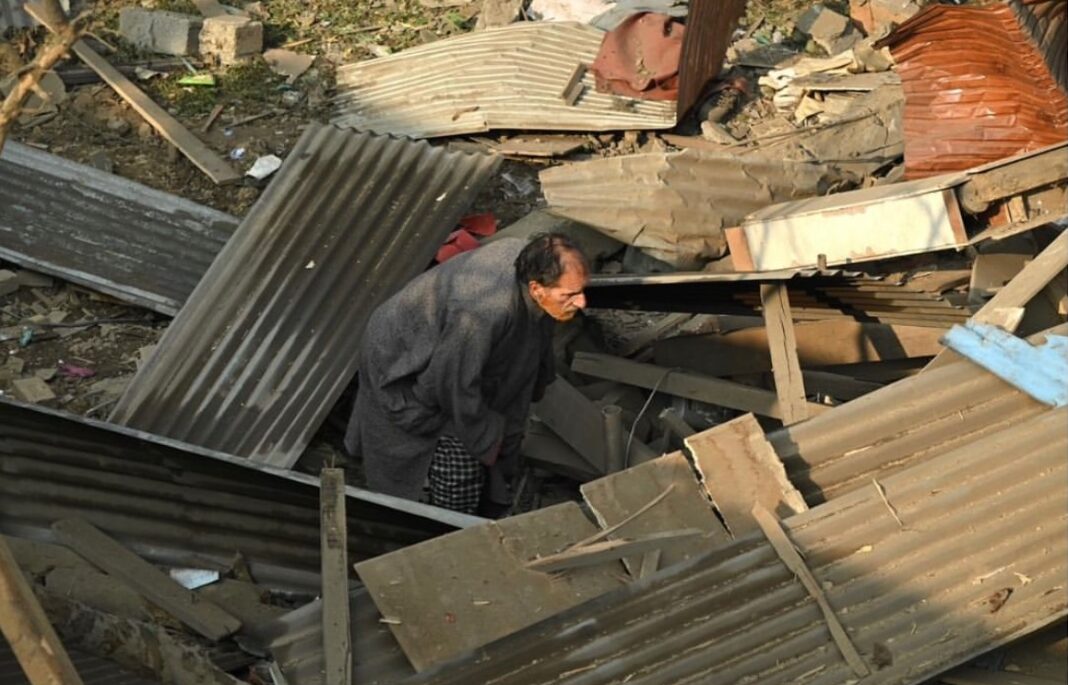
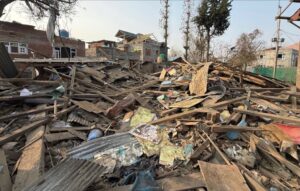
According to multiple local sources, security forces entered Pulwama in the early hours and carried out the demolition using explosives. Photographs from the site show Dr. Umar Nabi’s father standing amid the rubble, surveying what remains of his family home. The demolition has reignited debates over pre-trial punitive measures against entire families, a practice increasingly criticized by local leaders and human rights observers.
No state backing. No paywalls. Just truth. Support Kashmir's independent voice. Join 2,400+ patrons who fund independent voices.
Residents in Pulwama expressed shock, grief, and anger at the demolition:
Aslam, 45, a neighbor, said:
“We heard a loud explosion in the morning. When we came out, the house was gone. Innocent families shouldn’t suffer for alleged crimes. This does not solve the problem of terrorism—it only deepens our pain.”
Shabana, 38, another local, added:
“It destroys more than homes—it destroys trust and hope in our communities. How can there be peace when families are punished for the actions of one individual?”
Abdul, 52, a shopkeeper living nearby, said:
“Even if someone is accused, entire families should not pay the price. This sends fear into every household here.”
These accounts underscore the human cost of demolitions, highlighting the emotional and psychological impact on families caught in the crossfire of security operations.
Aga Ruhullah Mehdi is a senior Kashmiri political leader and Member of the Jammu & Kashmir National Conference, recognized for advocating civil rights, due process, and accountability in Indian-administered Kashmir. Over the years, Mehdi has consistently criticized actions that target innocent families under security pretexts, emphasizing the need for evidence-based justice and transparent investigations.
His comments reflect the perspective of many Kashmiris who argue that such demolitions erode trust, inflame grievances, and deepen the sense of injustice in communities already struggling under decades of conflict.
Legal experts and human rights activists have questioned the legality and ethics of pre-trial demolitions.
Advocate Zahid, a local legal expert, told Azadi Times:
“There is no legal or ethical justification for demolishing a family home before any conviction. Such pre-trial punishment undermines justice and causes irreversible harm to innocent people.”
A Kashmiri human rights activist, requesting anonymity, added:
“Collective punishment erodes the social fabric of Kashmir. Families are being held accountable for crimes they may not have committed. Independent and transparent investigations are essential to uphold justice.”
International observers have repeatedly criticized such practices, highlighting the risk of perpetuating cycles of resentment and insecurity in the region.
Security sources stated that the demolition was carried out due to “operational necessity,” claiming the house was allegedly used in terrorist activities. No official independent verification has been made public. The lack of transparency around such operations has intensified skepticism among local communities.
Local residents condemned the demolition as unjust and counterproductive:
Ashfaq Khande, a Pulwama shopkeeper, said:
“We are against terrorism, but punishment must target the guilty alone. Families should not suffer.”
Nasreen Jan, another resident, added:
“Every time a house is destroyed, a whole family’s life is shattered. Innocent lives shouldn’t be collateral damage.”
Aga Ruhullah Mehdi warned that illegal demolitions, mass detentions, and coercive interrogations risk pushing Kashmir “decades backward” rather than fostering sustainable peace.
“Justice must be grounded in evidence, not intimidation or collective punishment,” he emphasized.
Pre-trial demolitions in Kashmir have long been criticized by independent human rights organizations. Experts argue that such actions violate human rights norms, undermine the social and legal fabric of the region, and risk inflaming existing tensions. Analysts stress that punitive measures targeting families, rather than individuals responsible, deeply damage trust and perpetuate cycles of conflict.
The Pulwama demolition underscores the growing tension between security operations and the protection of Kashmiri civil rights. The destruction of Dr. Umar Nabi’s family home, before any conviction, raises urgent questions about legality, accountability, and the broader human impact of collective punishment.
Aga Ruhullah Mehdi and other Kashmiri leaders continue to call for transparent investigations and evidence-based justice, warning that continued disregard for due process risks destabilizing communities and deepening resentment across the region.
Trending Topics


The Azadi Times is an independent digital news platform based in Muzaffarabad, Kashmir, dedicated to credible journalism, in-depth reporting, and global analysis. We cover Kashmir, South Asia, and international affairs with a commitment to truth, editorial integrity, and public accountability.
Get important news delivered directly to your inbox and stay connected!
© 2026 The Azadi Times. All Rights Reserved.