
Home Blog Page 145

Nationalist Kashmiri Leader Launches ‘Back to Home’ Journey, Crossing LOC from AJK to J&K with White Flag

0

Nationalist Leader Mohammad Zubair Bhatti Embarks on ‘Back to Home Journey’ from Kotli to Mahinder

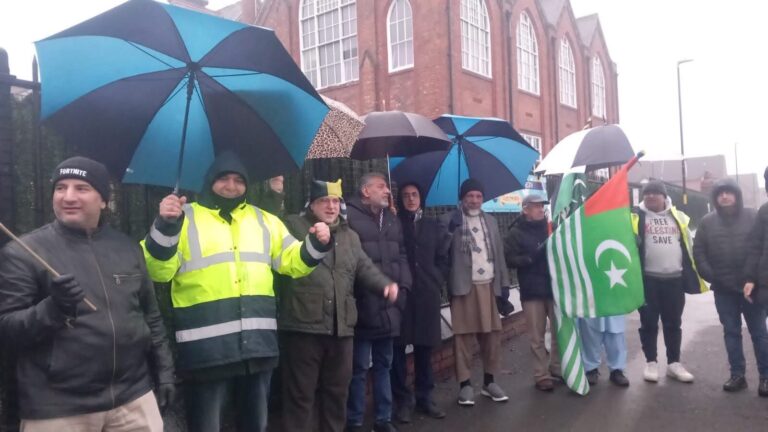
Kotli, Azad Jammu and Kashmir – Mohammad Zubair Bhatti, a nationalist leader from Kotli, has commenced a symbolic journey from Kotli Courthouse to Mahinder, a city in Indian-administered Jammu and Kashmir, naming it the Back to Home Journey.

Holding a white flag, widely recognized as a symbol of peace, Bhatti set off with a message underscoring the right of Jammu and Kashmir’s people to travel freely across their homeland.

At the start of his journey, Bhatti expressed his belief that, as a citizen of Jammu and Kashmir, he has the inherent right to move unrestricted within the state. “We, the citizens of Jammu and Kashmir, should be free to travel wherever we wish within our state without barriers,” he stated.

He also extended a message of hope to the Pakistani and Indian forces stationed along the Line of Control (LoC), expressing his optimism that they would not obstruct his journey. Bhatti urged both forces to cooperate in ensuring a smooth and peaceful completion of his journey.

The Back to Home Journey has also been shared on Bhatti’s Facebook profile, where he called for unity and peace, advocating for unrestricted movement across Jammu and Kashmir as a basic right for its people.

Jammu & Kashmir Assembly Passes Resolution for Restoration of Article 370 Amid BJP Protests

    0

    Srinagar – In a significant move, the Jammu and Kashmir Assembly has passed a resolution calling for the restoration of Article 370, which previously granted special autonomy to the region.

    According to Kashmir Uzma, the resolution, presented by Deputy Chief Minister Surinder Chaudhary, was passed with a majority vote on Wednesday, the third day of the Assembly session.

    Chief Minister Omar Abdullah, when asked about the development, remarked, “The Assembly has done its job; that’s all I’ll say on this matter.” His response indicates a focus on letting the legislative process speak for itself without further commentary.

    However, the decision sparked strong opposition from BJP leaders within the Assembly, who staged a protest, calling the resolution an “anti-national agenda.” They stated, “We reject this resolution, as it is against the interests of India.

    Martyrs’ Day of Jammu: The Massacre of November 6, 1947 Motivations and Facts

    0

    Today is November 6, on this day in 1947, a caravan of Muslim refugees from Jammu set out for Sialkot. This caravan, consisting of women, children, and the elderly, departed from Jammu with dreams of a bright future and hopes in their hearts. However, the caravan never reached Sialkot.

    Sheikh Abdullah, the Chief Executive of Jammu and Kashmir and commander of the Indian forces in the region failed to provide any military security for the caravan. Taking advantage of this situation, armed Hindu and Sikh militants stopped the caravan between Deghiana and Samba, separated the young women, and then killed all the other members of the caravan—including the elderly, men, and children—with bullets and axes.

    A few people managed to survive, hiding amidst the dead and injured, and when the attackers believed all were dead, they took the women and fled. The surviving individuals managed to reach Sialkot after hiding and avoiding further attacks.

    According to the testimonies of the survivors, this ill-fated caravan consisted of thirty buses. This incident of mass killings, looting, and abduction marked the peak of the attacks by armed Hindu militias on the Muslim refugees from Jammu, which had been occurring sporadically since September. In remembrance of the Muslims killed during these attacks, November 6 is observed as Martyrs’ Day of Jammu in Pakistan and the so-called Azad Kashmir. The day condemns the massacres of Muslims in Jammu, highlighting the widespread violence and the abduction of many women.

    These killings were not limited to the refugee caravans alone, as many villages and towns in Jammu were also targeted by the terrorists. Nearly half of the Muslim population in the Kathua district was affected. The killings of hundreds of Gujjars in Mohala Ram Nagar and the burning of the Raipur village in the Jammu Cantonment area in September are part of this ongoing violence. The massacres of Jammu are undoubtedly a criminal act by the Hindus against the Muslims and should be condemned in the strongest terms.

    The responsibility for this massacre also lies with the Jammu and Kashmir administration, led by Sheikh Abdullah, who failed to provide protection for the Muslim refugee caravans on November 6. It is essential to understand why and how these horrific incidents of killing and violence occurred on November 6. When these events took place, Sheikh Abdullah was the head of the administration.

    He cannot absolve himself from responsibility for the massacre. On November 9, a similar attack on a Muslim refugee convoy was repelled by the army, resulting in the death of 150 attackers. After this, no such attacks occurred on any convoy. This clearly means that if the protective measures of November 9 had been implemented on November 6, the massacre could have been prevented.

    However, in the tragedy of our national history, historians have written about these events with extreme bias, without making any effort to analyze the actual nature of these events and their causes. This is a significant flaw, as the partition of the Indian subcontinent was an extremely ill-conceived and impractical step, intended to sow discord among the people of the subcontinent and keep them divided, perpetually under British colonial control and global imperialism.

    Has anyone ever wondered why, in 1947, people who had lived peacefully together for centuries, despite their religious differences, suddenly became bloodthirsty enemies of each other? The answer lies in a British conspiracy, which created an atmosphere of misunderstandings, rumors, and hostility among the public, leading to the violence, looting, and massacres of 1947.

    The November 6 massacre in Jammu was part of this larger narrative. When the British decided to partition the subcontinent, Maharaja Hari Singh, the last ruler of Jammu and Kashmir, rejected the partition plan and proposed an independent and fully sovereign Jammu and Kashmir. The British disagreed with his plan, fearing that an independent state of Jammu and Kashmir could thwart their grand scheme. To undermine the Maharaja’s proposal, the British began conspiring against him. They orchestrated “Operation Gulmarg” under the supervision of General Frank Messervy, the British Army Chief of Pakistan, which resulted in the tribal invasion of Jammu and Kashmir on October 22, 1947.

    The massacre of November 6, 1947, was also a consequence of the British divide-and-rule strategy. The British were extremely biased in their actions, manipulating the narrative in the media and by historians to distort the events of 1947. British newspapers like The London Times twisted the events of November 6, while editors like Ian Stephen and Harris Alexander, in their works, also presented a biased view of the massacre. Harris Alexander and Ian Stephen both reported the death toll in the Jammu massacre as 200,000, while *The London Times* claimed it to be 237,000. Many Muslim and Pakistan-affiliated historians have suggested that the actual number of victims was more than 500,000, but this remains a controversial claim due to the political agendas of different factions during the partition.

    The survivors who managed to reach Sialkot after the massacre described the caravan as consisting of thirty buses. Based on this, readers can estimate how many people were part of the caravan. Muslim and Pakistan-oriented historians often exaggerate the scale of the massacre to support the idea that Hindus and Muslims could never live together in Jammu and Kashmir and that the partition and creation of Pakistan were essential for the survival and progress of Muslims. However, this is a baseless and fabricated propaganda aimed at dividing Jammu and Kashmir on religious lines and ultimately annexing its Muslim-majority areas to Pakistan.

    In reality, the root cause of the massacres in Jammu in November was the incompetence of the Jammu and Kashmir administration. Had the government ensured proper protection for the refugee caravans, such massacres could have been avoided. The November 1947 massacre in Jammu was part of a larger pattern of violence that occurred in the aftermath of partition, particularly in areas such as Western Punjab, Khyber Pakhtunkhwa, and Jammu and Kashmir, where Muslims perpetrated violence against non-Muslims in retaliation for earlier attacks. Since April 1947, Hindu refugee caravans fleeing from the violence in Rawalpindi, Attock, Murree, Bannu, and Hazara began arriving in Jammu, fueling further animosity.

    Following the creation of Pakistan, over 160,000 Hindus from Pakistan’s western districts migrated to Jammu, and by mid-September 1947, over 65,000 Hindu refugees had arrived in Jammu city alone. These refugees brought with them tales of Muslim atrocities, which were amplified by the media as part of the British strategy to incite hatred and division. This created a deep-seated animosity among Hindus towards Muslims, which played a significant role in the violence that ensued. Another contributing factor was the presence of Sikh military units from the Indian army who fled to Jammu, bringing arms with them, which were used to seize land and property from Muslims.

    Written by: Sameena Raja, Jammu and Kashmir

    China Congratulates Donald Trump on Re-election as U.S. President, Reaffirms Commitment to Mutual Respect

    0

    Beijing (The Azadi Times) – China has congratulated Donald Trump on once again assuming the position of U.S. President.

    A spokesperson from China’s Ministry of Foreign Affairs stated that China will continue to work with the United States on the basis of mutual respect. China’s policy towards the United States remains unchanged, and they respect the choice of the American people.

    It is noted that Donald Trump has won the U.S. presidential election, becoming the 47th President of the United States.

    This marks Trump’s second term as President. In the election, out of 538 electoral votes, the Republican candidate Donald Trump secured 277, while the Democratic candidate Kamala Harris received 226 electoral votes.

    To win, a candidate must secure a minimum of 270 out of 538 electoral votes.

    New Law in Azad Kashmir: Stricter Regulations on Public Gatherings and Protests

    0

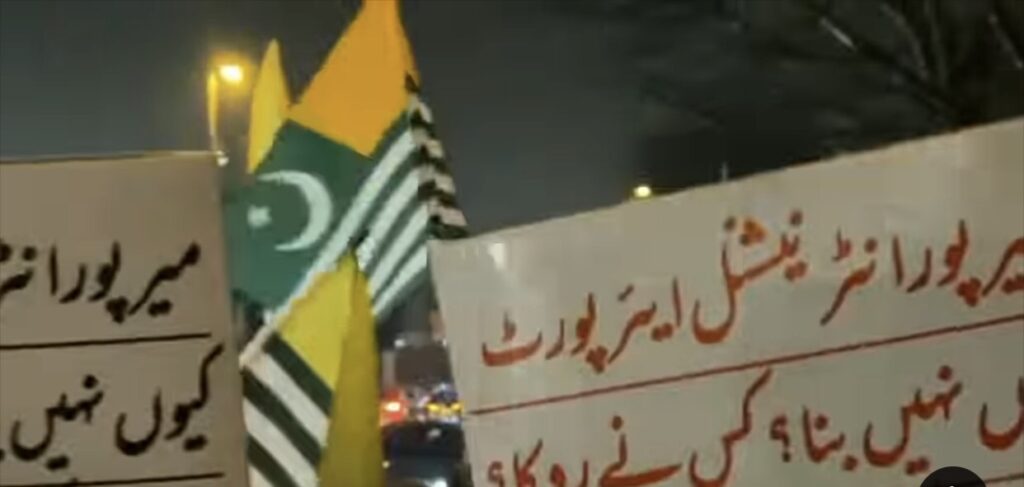
    MUZAFFARABAD: A new law has been enacted in Azad Kashmir regarding public gatherings and protests, imposing severe penalties for violations, including up to 7 years of imprisonment and detention.

    The Azad Kashmir government has implemented regulations governing public gatherings, protests, rallies, and meetings. The President of the State, Barrister Sultan Mehmood, has approved the ordinance sent by the Azad Kashmir government, which is now in immediate effect.

    Under the new law, no unregistered political or religious party, organization, union, or association will be permitted to hold public gatherings or protests. Only registered entities will have the right to protest, and they must obtain permission from the Deputy Commissioner.

    In case of violations, the Deputy Commissioner, acting as a first-class magistrate, has the authority to impose a sentence of up to 3 years or more on offenders. They can detain individuals for 3 to 5 days and may also place them under administrative detention for up to 10 days. Registered organizations must submit their applications for public gatherings, rallies, and protests at least 7 days in advance.

    According to the ordinance, the application must include the coordinator’s name, copies of identity cards, phone numbers, the location, start and end times of the event, and an estimate of the number of participants. The Deputy Commissioner will review the application and obtain reports from law enforcement agencies before granting permission. The decision will be based on whether the proposed gathering will disrupt daily life, trade, or transportation, and whether it poses a risk to public property and citizen rights.

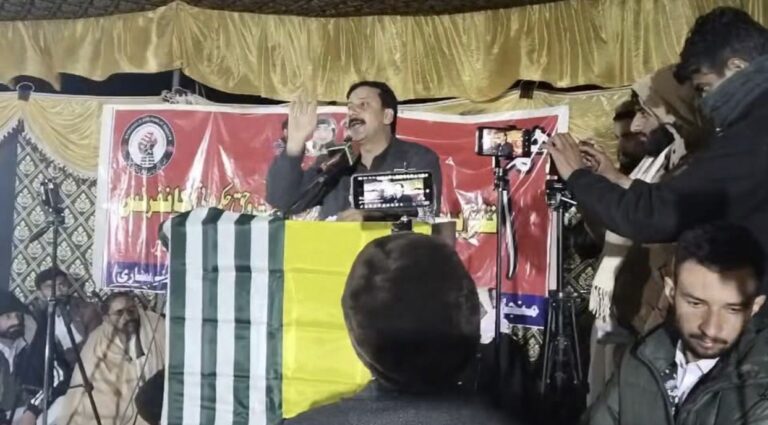
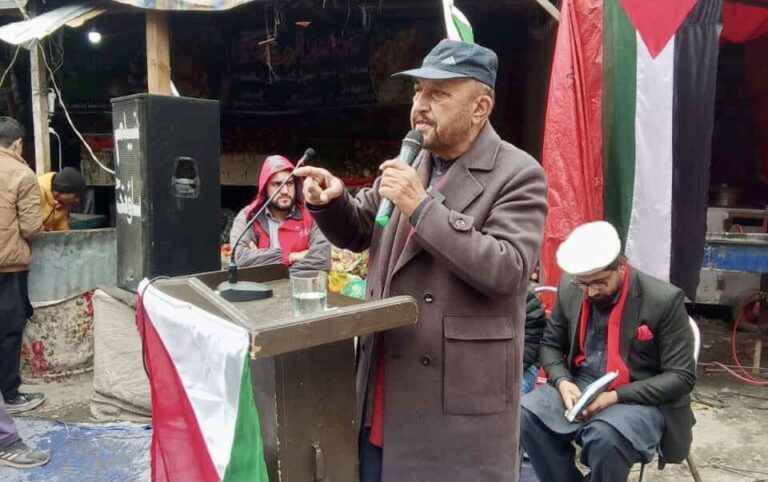
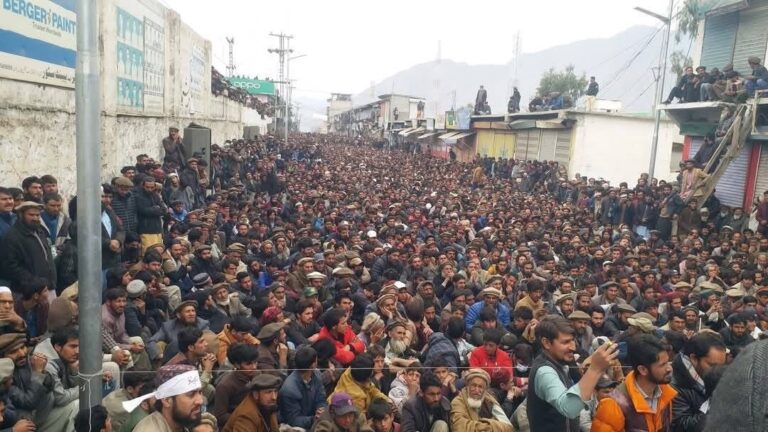
    Rally and Conference in Kotli Demand Release of Yasin Malik and Kashmir’s Right to Self-Determination

    The gatherings must remain peaceful, and the use of weapons, sticks, or stones, as well as inflammatory speech, will not be tolerated. The Deputy Commissioner will designate specific areas for public gatherings and protests and has the authority to declare any area in their district as a red zone or high-security zone, where gatherings will be prohibited.

    The district administration has the power to impose temporary bans on protests within their jurisdiction, with options to reduce or extend these restrictions. They may also terminate any gathering, rally, or protest immediately in light of national security or the protection of public rights. Violations of the designated location or time can result in dispersal or arrests.

    Applicants may appeal decisions regarding gathering permissions to the Commissioner, with further appeals possible against the Commissioner’s decision to the Secretary of Home Affairs. The appellate authority can uphold, revoke, or amend the Deputy Commissioner’s orders and is required to issue a decision within 15 days.

    The government claims that the immediate enforcement of this ordinance aims to ensure the protection of citizens’ fundamental rights as guaranteed by the constitution.

    Gilgit Baltistan Land Reform Bill Rejected: State Subject Rule to be Activated; Gilgit-Baltistan Awami Action Committee

    0

    GILGIT: An important meeting of the People’s Awami Action Committee Gilgit-Baltistan was held under the chairmanship of Central Chairman Ihsan Advocate in Gilgit. The meeting expressed strong dissatisfaction over the government’s efforts to approve the Land Reform Bill and unanimously rejected the bill, making it clear that the Awami Action Committee will not accept this anti-people bill under any circumstances.

    The Land Reform Bill is an attempt to legitimize illegal occupations and transfers of public land that have occurred since 1947. This so-called bill is designed to permanently seize the people’s lands, pastures, forests, and mountains.

    The Awami Action Committee Gilgit-Baltistan will vigorously resist this bill and launch a strong public movement. The people of Gilgit-Baltistan should awaken to safeguard their future; with the power of the masses, we will thwart this conspiracy just like before.

    We warn those assembly members who are acting as facilitators for the approval of this bill that they should refrain from selling Gilgit-Baltistan for a few coins and privileges, or else they will be labeled national traitors, and the public will never forgive them.

    If the government is serious, it must stop the violations of the State Subject Rule as per the agreement made with the People’s Action Committee and activate the customs laws of Gilgit-Baltistan. No other option will be acceptable.

    The people of Gilgit-Baltistan are being stripped of their lands, minerals, tourism, and all resources through a systematic plan. The public must awaken and protect their rights under the banner of the People’s Action Committee.

    Kamran Hameed Butt, Chairman of Mission Kashmir Task Force, Passes Away in France

    0

    In an unexpected and heartbreaking development, Kamran Hameed Butt, Chairman of the Mission Kashmir Task Force, has passed away due to a heart attack in France, according to family sources. The sudden demise of the leader has left many in shock.

    Kamran Hameed Butt had been residing in France for employment purposes while simultaneously managing the affairs of the Mission Kashmir Task Force. Despite being abroad, his dedication to the cause of Kashmir’s autonomy never faltered. He frequently visited Azad Kashmir and played a crucial role in strengthening the party, which is a registered political entity in the region. The Mission Kashmir Task Force, now officially recognized for over two years, saw significant growth under his leadership.

    Kamran Hameed Butt, a native of the Bagh district in Azad Kashmir, was an ardent supporter of an independent Kashmir. His lifelong struggle for the self-determination of the Kashmiri people made him a respected figure in the political landscape. Last year, during a visit to Azad Kashmir, he took substantial steps to solidify the party’s structure and vision.

    Also Read: Amanullah Khan’s 8th Anniversary: JKLF Announces Events to Mark Anniversary

    Following his passing, social media has been flooded with condolence messages from supporters, party members, and well-wishers. Many have expressed their grief over the loss, while reiterating their commitment to carrying forward his mission. Supporters have vowed that Kamran Hameed Butt’s dream of an independent Kashmir will never be forgotten, and his mission will continue with full force.

    As the community mourns this tremendous loss, they also draw strength from his unwavering belief in the cause of Kashmir’s freedom. His ideological companions and party members remain determined to keep his vision alive.

    May Allah grant him eternal peace and give his family and loved ones the strength to bear this irreparable loss. His mission will continue, Insha’Allah.

    Andaleeb Sartaj: A Beacon of Hope for the Youth in Jammu and Kashmir

    0

    BAGH — In a momentous development for student activism in the Azad Jammu Kashmir (Pakistan-administered Kashmir), Andaleeb Sartaj, a passionate and determined student from Jamia Bagh, has officially joined the Jammu Kashmir National Students Federation (JKNSF). This federation has long been at the forefront of advocating for the rights and welfare of students while fighting for the broader cause of freedom and autonomy for Jammu and Kashmir.

    Andaleeb’s induction into the JKNSF marks a significant step in empowering young voices, particularly women, who play a critical role in the region’s socio-political landscape. As a symbol of resilience and determination, she embodies the aspirations of countless young individuals who are striving for justice and equality.

    The JKNSF has welcomed Sartaj with enthusiasm, recognizing her potential to be a powerful spokesperson for the movement. Her activism is not limited to educational rights; it extends to advocating for the liberation of Jammu and Kashmir from oppressive forces, with a vision for a non-class society.

    Sartaj expressed her gratitude for the opportunity to represent the youth of Jammu and Kashmir, stating, “Joining the JKNSF is an honor. I am committed to our struggle for freedom, autonomy, and dignity. Together, we will amplify our voices and push for the changes our society desperately needs.”

    As Sartaj takes on this new role, her efforts reflect a growing wave of youth engagement in Jammu and Kashmir, signaling hope for a future where their rights are recognized and upheld. The collective action of young leaders like her is a testament to the indomitable spirit of the region’s youth, who continue to challenge the status quo and advocate for a brighter tomorrow.

    The JKNSF remains steadfast in its mission to unite students and empower them in their quest for justice, with the belief that the future of Jammu and Kashmir lies in the hands of its youth.

    Effective Ways to Keep Your Home Warm This Winter

    0

    In winter, everyone takes every possible precaution to protect themselves and their families from the cold. This includes actions such as closing the windows, avoiding leaving doors open unnecessarily and choosing warm, dark-colored carpets and curtains. Similarly, in our bedrooms, thick, warm, and dark-colored sheets and pillow covers are used. This is why we specifically keep such sheets for the winter season.

    Just as sheets, clothing, and even food are adapted to the winter season, the colors of walls are also specific for winter. To keep a house warm, modern construction experts emphasize the importance of energy-saving measures from the very beginning of construction. This makes it easier to keep the house warm in winter and cool in summer.

    Heating Systems in Ceilings and Floors

    In extremely cold regions like Russia and Eastern Europe, hot water is circulated through pipes and motors in ceilings and floors to raise temperatures below freezing point. However, with new technology, this can also be achieved with electric heaters. With the widespread adoption of solar energy systems, using solar panels to heat water is no longer a new concept.

    Carpet Recommendations

    Cover the floors of rooms with carpets to avoid walking on cold floors, as marble floors become extremely cold in winter. Experts suggest that using an underlay with carpets not only makes them thicker but also helps keep the home warm.

    Laying rubber under carpets extends their lifespan and reduces the costs associated with measures taken to keep the home warm. Another option is waffle underlay, which contains air bubbles that help keep carpets soft while also having the capacity to retain warmth in the house. If for some reason you cannot lay down a carpet, try to wear slippers or shoes on the cold floors.

    Repairs and Maintenance

    Before the arrival of each season, necessary modifications and additions must be made to the house. When preparing for winter, make sure to seal open areas and holes, as these can allow cold air to enter the home. Repair window and door seals, and if their hinges are broken, have them fixed. The winds coming through these holes can be harmful, especially for infants, resulting in allergies and colds.

    Arrangement of Geysers

    Previously, gas geysers were more commonly sold, but due to gas load-shedding, there is now a trend toward installing electric geysers. The price of a geyser depends on its size; larger geysers tend to be more expensive.

    Also Read: https://azaditimes.com/lifestyle/dreamy-ceilings-design-ideas-to-elevate-your-bedroom-oasis-expert-tips/

    Although electric geysers are generally cheaper than gas geysers, their use tends to increase electricity bills. However, one advantage is that there is usually no electricity load-shedding in winter, so you can have access to hot water at all times. If your geyser runs on gas, make sure to have it serviced regularly.

    Winter Colors

    If you want to paint your home in winter, you can choose warm colors suitable for the season, such as light beige, deep purple, gray, and blue. These colors on the walls create a feeling of warmth during winter.

    Caution in Using Heaters

    First, ensure that the heater is working properly. It is essential to use heaters with caution; you should turn off gas heaters completely before going to bed to avoid accidents caused by gas leaks. Many people use gas heaters while keeping the rooms closed, which increases the risk of significant accidents due to gas emissions and a lack of oxygen. Therefore, caution should be exercised when using gas heaters or warm air blowers to avoid various complications.

    Natural Energy

    During the day, utilize solar energy to keep yourself and your rooms warm. Sunbathing also positively affects health. Do essential tasks that you can easily do in the sun. It is better to step outside and do work rather than suffer from the cold indoors, as this also positively impacts health. Allow direct sunlight into the room and remove curtains from the windows.

    Geysers Uncovered: Types, Uses, and Safety Tips

    0

    In the cold season, the use of geysers for heating water increases. Various types of water heaters are used for this purpose, including traditional geysers made of iron sheets that burn wood to heat water.

    In urban areas where natural gas is not available, electric geysers are also installed, which lead to higher electricity bills.

    Where gas is available, two types of geysers are installed. One type is the stand-alone geyser, which is made similarly to the electric and wood-burning geysers with iron sheets, and then insulated with an additional steel cover that is painted for an attractive finish. It has a large gas burner on the bottom side connected to an automatic switch, which turns off the burner once the water reaches a specified temperature. There is also a small pilot light that stays lit continuously, helping the burner ignite.

    The second type is the instant geyser, which consists of a long silver pipe coiled into a bunch, with gas burners placed underneath. A battery cell is used to provide a spark to ignite the burners. When the mixer is turned on for hot water, the spark ignites the burners, and gas supply begins, heating the water passing through the silver pipe. As soon as the mixer is turned off, the gas supply is cut off, and the geyser turns off.

    Now, let’s evaluate which geyser is better and safer. Based on our opinion and experience, although the instant geyser is cheaper in terms of cost and gas usage, it does have some drawbacks.

    If it is installed outdoors, the burner may frequently extinguish due to strong winds. Rainwater can cause rust in the sealed compartment, leading to the spark system failing, resulting in the geyser not turning on at times.

    If the mixer is fully open, the water temperature will be appropriate, but if the water flow from the mixer is low, the geyser burner may remain fully on, causing the water to become excessively hot. This can not only burn your hands or body but also harden the rubber seals inside the mixer, leading to premature wear and tear. If the mixer is turned off, it may start leaking.

    Excessively hot water can also cause leaks in any joints of your underground pipeline.

    Many people install instant geysers inside bathrooms, which can be extremely dangerous and potentially life-threatening. Geysers should always be installed outside the bathroom in open spaces.

    In contrast, stand-alone geysers do not heat water beyond a specific temperature and automatically turn off the burner, keeping the water temperature under control. However, this type of geyser requires some common sense to avoid excessively high gas bills.

    Do not set the thermostat to full hot; instead, set it to warm to save gas. When fewer family members are at home and water usage is low, turn off the thermostat, and hot water can be provided just by the pilot light.

    Install this geyser in a location where you can easily check it daily, allowing you to turn it on or off when needed. Avoid installing it on a top floor, as regular access becomes difficult, and people often forget to adjust the thermostat, resulting in high gas expenses throughout the season.

    Ensure that a safety valve is installed during installation. This valve opens when too much steam builds up in the geyser, releasing excess pressure. Without this valve, excessive pressure could cause the geyser to burst. Many plumbers do not inform or install safety valves, and if mentioned, they reassure that it is unnecessary because the thermostat is automatic and shuts off by itself.

    Also Read This: https://azaditimes.com/business/in-winter-household-customers-will-receive-gas-at-three-times-sui-northern/

    Do not be misled by such plumbers, as if, God forbid, the thermostat fails and the burner does not turn off, you will bear the consequences, and there will be no benefit in blaming the plumber afterward.

    Keep in mind that wherever you install a stand-alone geyser—whether it heats water using wood, electricity, or gas—a safety valve is essential.

    There is another type called a solar geyser. Its cost is somewhat higher, but it incurs no expenses for heating water; however, it only works during sunlight, so it does not heat water at night. If you have installed an electric backup heating system, you can obtain hot water at night as well.

    To extend the life of the geyser, ensure that water flow remains within it during hot weather. If you do not use the hot side tap, the standing water inside the geyser can cause rust on the internal side, leading to premature failure.

    Generally, round-headed mixers are used in homes, where hot and cold water heads are separate, and in summer, usually, only the cold side head is used.

    It is better to use a lever mixer instead of a head mixer. When you turn it to the left, the geyser water will start flowing, keeping water circulation ongoing even during summer.