Home Blog Page 17

“Is Gilgit-Baltistan a Province of Pakistan?” Why the Question Itself Tells the Story of a Forgotten Land

0

Is Gilgit-Baltistan a province of Pakistan? The Azadi Times travels from Skardu to Islamabad, weaving history, hydropower receipts and women’s rallies into a 2,000-word human narrative that Google snippets can’t capture.

I. The Question that Echoes in Every Valley

“Is Gilgit-Baltistan a province of Pakistan?”

Type the words into Google from a café in Muzaffarabad and you get a tidy blue box: “Gilgit-Baltistan is an autonomous region under Pakistani administration.”

Type the same query from a 3-G signal in Skardu’s Hussainabad neighbourhood and the page keeps loading until the battery dies. The algorithmic silence is louder than any answer. Because here, the question is not semantic it is existential. It is asked by 16-year-old Mehak who can’t apply to Punjab University without a domicile she is denied; by driver Bashir whose truck can’t cross the Khunjerab without a permit stamped “Temporary”; by grandmother Zahra who still votes in Kashmiri elections that never materialise.

For The Azadi Times, a Kashmir-based independent newsroom that reports from both sides of the Line of Control, the keyword “is Gilgit-Baltistan a province of Pakistan” is therefore more than an article.

It is a window into the lived geography of what Kashmiris call Mashriqi Kashmir—eastern Kashmir an arc of pain and resistance stretching from Mirpur to Gilgit, from Muzaffarabad to Kargil. This article lets the people who inhabit that arc speak for themselves, while placing their voices inside the historical and political scaffolding that Google can never fit into a snippet.

II. A Brief Cartography of Confusion
Gilgit-Baltistan comprises 72,971 km² of snow-cock and cedar, sapphire and uranium. It borders China’s Xinjiang, Afghanistan’s Wakhan corridor, and the Indian-administered Ladakh. It also contains the only land route of the China-Pakistan Economic Corridor (CPEC). Yet it is absent from Pakistan’s constitution. Islamabad has issued three separate autonomy packages (1974, 1994, 2009, 2018), each re-branding the area with a new adjective—Federally Administered, Self-Governing, Provisional Provincial—but none granting the constitutional status enjoyed by Pakistan’s four provinces.

The contradiction is not lost on locals. “We’re told we’re Pakistani, but our ID cards say ‘Resident of Gilgit-Baltistan’,” laughs Sajjad Hussain, a university student in Karachi who must fly home to vote because no absentee ballot exists. “Even the stamp on my passport is different. Immigration officers abroad ask, ‘Which country is G-B?’”

III. The 1947 Snapshot Nobody Agreed On
To understand why the province question lingers, rewind to 26 October 1947—the day the Maharaja of Jammu & Kashmir signed the controversial Instrument of Accession to India. Three weeks earlier, Gilgit’s British-officered scouts had already mutinied, hoisting Pakistani flags in the Scouts’ Mess. Their local commander, Major William Brown, later wrote that he acted to keep the territory “out of communal chaos.” Pakistan moved in political agents but never held a referendum. When the UN brokered a cease-fire in 1949, Gilgit-Baltistan fell under the vague label “Pakistan-administered Kashmir,” awaiting a plebiscite that never came.

Seven decades later, that temporary label calcified into governance. “Our fathers thought it would last six months,” says 82-year-old Syed Yahya Shah, the first civilian to win a court case against the Ministry of Kashmir Affairs in 1972. “I still have the court receipt—Rs 2 stamp paper. The judge ruled we were ‘citizens of the state of Jammu & Kashmir under Pakistani administration.’ My grandchildren study that sentence in history class, yet nothing has changed.”

IV. CPEC Arrives—So Does the Security State
In 2015 the first convoy of Chinese engineers rumbled down the Karakoram Highway, turning Gilgit’s dusty River View Hotel into a logistics hub. Overnight, land prices in Danyor quadrupled; Islamabad announced a 46 billion corridor whose crown jewel, the Gwadar port, is fed by roads slicing through Gilgit-Baltistan.

Locals expected jobs. What followed, they say, was a tightening of the vise. Section 144 orders—ban on public assembly—became routine. Activists who demanded royalties for hydropower were booked under anti-terror laws. “They turned our mountains into a cantonment,” says Baba Jan, the trade-unionist who spent nine years in prison for organising a rally after the 2010 Attabad landslide displaced 1,500 families. Released in 2020, he is greeted in bazaars with the chant “Zinda hai Jan, zinda hai” (Jan is alive), a slogan once reserved for Bhutto.

Baba Jan’s crime was to ask whether CPEC contracts would be published in Urdu or Shina, the region’s lingua franca. The question still hangs in the air, unanswered, like the diesel fumes over the Khunjerab pass.

V. The Youth Who Hack the Silence
With local newspapers pressured, reporting migrates to WhatsApp groups and 60-second Instagram reels. Enter the “GB Bloggers”—a decentralised collective of 20-somethings who shoot vertical videos on cell-phones:

  • Shimshal Valley Girls chronicles the first all-female trekking team.
  • Hunza’s Kitchen mixes apricot recipes with snippets about land-grab cases.
  • Skardu Memes overlays Burushaski rap on clips of police checkpoints.

Their most viral post—1.4 million views—shows a teenage girl staring at the Karakoram and asking, “If Gilgit-Baltistan is Pakistan, why can’t I join the Pakistan Army without a Punjab domicile?” The army’s media wing, ISPR, issued a clarification; the bloggers responded with a follow-up reel listing constitutional articles that still exclude G-B from the National Finance Commission.

“Traditional media waits for press releases,” says 23-year-old Amina Khan, who runs the feminist page Karakoram Siren. “We tell the story while the snow is still melting.” Azadi Times often embeds these reels inside its own reports, a cross-platform symbiosis that beats bandwidth throttling.

VI. Women at the Edge of Empire
Ask any NGO for gender statistics and you’ll hear the same paradox: Gilgit-Baltistan outperforms Pakistan’s national average in female primary-school enrolment (92 % vs 78 %), yet posts the lowest share of women in elected office—one seat in a 33-member assembly. The reason, researchers say, is the “dual purdah”: patriarchal norms reinforced by security protocols that bar women from public gatherings.

Housewife-turned-candidate Shahnaz Raza decided to test the barrier in 2020. She filed nomination papers for a valley seat long monopolised by timber contractors. Within days, village elders sent her a bowl of white rice—a symbolic request to withdraw. She refused. On polling day, her husband was detained at a check-post for “routine verification.” Shahnaz still secured 18 % of votes, the highest ever by a woman. “Next time I’ll win,” she tells Azadi Times over tea in her apricot orchard, toddler balanced on hip. “The mountains remember who stood up.”

VII. The Old Man Who Keeps the Archive
In a single-room museum above Gilgit’s old polo ground, 78-year-old curator Muhammad Yousuf keeps temperature-sensitive folders under moth-eaten quilts—newspapers from 1948, court petitions handwritten in Persian, grainy photos of the 1974 student uprising. He calls the collection Aks-e-Jadeed (Reflections of Modernity). There is no government funding; donors are politely directed to a sign that reads, “History is not a provincial subject.”

Yousuf’s lifework answers the Google query better than any algorithm: “Gilgit-Baltistan is not a province of Pakistan; it is a province of memory. Provinces have legislatures—memory has martyrs.” He flips to a 1954 headline: “Pakistan Promises Plebiscite Within Six Months.” The paper is yellow, but the ink still burns.

VIII. What International Law Actually Says
Islamabad insists any change in status must await the UN-mandated plebiscite across all of Jammu & Kashmir—an elegant way to do nothing. New Delhi counters that Gilgit-Baltistan is India’s by the 1947 accession—equally academic to a mother in Astore whose son disappeared in 2019.

The UN Secretary-General’s 2020 report on Kashmir mentions Gilgit-Baltistan once, in a footnote. The European Parliament’s 2021 resolution on CPEC urged Pakistan to “ensure constitutional rights” but stopped short of calling G-B a province. Meanwhile, China’s official maps colour the region the same shade as Punjab—de-facto recognition that investors, if not jurists, crave clarity.

IX. The Economic Numbers That Never Add Up

  • Hydropower: G-B produces 4,500 MW, enough to light up Karachi, yet villages inches from dams get load-shedding 12 hours a day.
  • Tourism: 2.5 million domestic visitors spent 480 million in 2023; local hotel owners say 80 % of bookings flow to online platforms registered in Lahore.
  • Mining: Sapphire, granite and uranium leases are issued by the federal Ministry of Kashmir Affairs, not the G-B assembly. Royalty rate: 2 %, compared to 10 % in Balochistan.

“Resource extraction without representation,” economist Dr. Attaullah Shah calls it. He calculates that if G-B were a province, its per-capita revenue share under the NFC formula would quadruple to 900—still half of Punjab’s, but enough to build the region’s first oncology ward. Cancer rates are spiking; patients must cross 500 km of avalanche-prone road to reach Rawalpindi.

X. The Martyrs’ Friday
Every 15 November, thousands trek to Chinar Bagh in Gilgit where 35 protesters were shot in 1978 while demanding removal of the colonial-era Frontier Crimes Regulation. Islamabad banned the commemoration in 2019, citing “security.” Families now hold parallel ceremonies inside homes, holding framed portraits aloft like silent placards. Azadi Times live-streamed the 2023 gathering; within minutes the feed was geo-blocked inside Pakistan. Viewership spiked in diaspora hubs—Birmingham, Toronto, Abu Dhabi—where second-generation Kashmiris screenshot every frame, archiving them in Google drives labelled “Digital Return.”

XI. A Forward-Looking Hope, Not a Slogan
Back in Hussainabad, Mehak—the student who can’t get a domicile—has found a workaround: she applied for a Turkish scholarship that accepts “stateless Kashmiris.” If selected, she will become the first girl from her valley to study aerospace engineering. “I’ll design drones that can plant deodar saplings,” she laughs. Her mother, once skeptical of “too much education,” now sells embroidery to buy Mehak a second-hand laptop.

Stories like hers refuse to fit the binary of “province vs. colony.” They point to a horizon where the question “is Gilgit-Baltistan a province of Pakistan” becomes obsolete, replaced by a simpler demand: the right to decide, freely and without fear, how to govern the mountains that cradled their grandmothers’ lullabies. Until that day, journalists, bloggers, bakers and beekeepers will keep documenting, pixel by pixel, vote by vote, sapling by sapling.

As the call to prayer drifts over the Rakaposhi peak, one can almost hear the mountains answer:

“We are not a province. We are a promise—still unfulfilled, still alive.”

XII. Sources & Further Reading

  • Baba Jan interview, Skardu Central Jail, August 2020 (Azadi Times video archive).
  • European Parliament resolution 2021/2594(RSP) on CPEC human rights.
  • UN Secretary-General Report S/2020/762, para 47.
  • Dr. Attaullah Shah, Resource Federalism in Pakistan, Oxford University Press, 2022.
  • Shahnaz Raza nomination papers, Election Commission G-B, 2020.
  • “GB Bloggers” Instagram analytics, CrowdTangle data, 2023.

Breaking: Pakistan-Administered Kashmir Revives Third-Party Recruitment Act After Landmark Court Victory

0

Historic Judgment Reshapes Government Hiring Landscape Across Azad Jammu and Kashmir

Muzaffarabad, Pakistan-Administered Kashmir – In a landmark development that promises to transform government recruitment processes across the region, the Azad Jammu and Kashmir government has officially reinstated the Recruitment Third Party Act 2021 for scales 7 through 15, following a decisive High Court ruling that has sent ripples through the administrative corridors of Pakistan-administered Kashmir.

The reinstatement comes after months of legal uncertainty and represents a significant victory for transparency advocates who had challenged the act’s earlier suspension. The High Court’s comprehensive judgment, delivered on December 24, 2025, has not only restored the third-party recruitment mechanism but has also introduced sweeping reforms that could redefine merit-based hiring in the region.

The Court Battle That Changed Everything

The legal saga began when the Azad Jammu and Kashmir Bar Association filed a writ petition (No. 21/06/2025) challenging the government’s decision to suspend the Third Party Recruitment Act. The petition argued that the suspension undermined merit-based recruitment and opened doors to potential corruption in government hiring processes.

“The court’s decision represents a triumph of merit over favoritism,” explains Advocate Amjad Ali Khan, one of the petitioners who challenged the act’s suspension. “For years, we’ve seen qualified candidates overlooked while those with connections secured positions. The Third Party Act provides an independent mechanism that ensures transparency and fairness.”

The High Court, after hearing consolidated arguments from multiple petitioners, ruled decisively in favor of reinstating the original 2021 act in its entirety. The judgment specifically addressed concerns about the selection committees formed under the controversial notification of April 11, 2025, which had been challenged for lacking clearly defined criteria.

Understanding the Third Party Recruitment Act

The reinstated Recruitment Third Party Act 2021 establishes an independent recruitment mechanism for government positions in scales 7 through 15, effectively removing direct hiring authority from individual departments and placing it under neutral third-party committees.

Under this system, selection committees comprising education experts, retired civil servants, and professionals from relevant fields will conduct transparent recruitment processes. The act mandates written examinations, interviews, and merit-based selections, with all proceedings documented and made available for public scrutiny.

“This isn’t just about filling positions,” remarks Dr. Shaista Khan, a former civil servant who helped draft the original legislation. “It’s about building institutional capacity and ensuring that the most qualified candidates serve the people of Pakistan-administered Kashmir.”

Decoding the Court’s Comprehensive Judgment

The High Court’s December 24 ruling addressed multiple interconnected issues that had created confusion within government departments. The judgment clarified several critical points:

Selection Committee Formation: The court ordered reconstitution of selection committees for scales 1-15, ensuring representation from diverse professional backgrounds while maintaining independence from hiring departments.

Merit-Based Admissions: In a significant expansion of merit principles, the court extended open-merit policies not only to civil service recruitment but also to educational institution admissions, effectively eliminating district-wise quotas that had been challenged in various petitions.

Appeal Provisions: The court allowed appeals specifically regarding the 6% service quota for Jammu and Kashmir refugees from 1989, while upholding all other aspects of the judgment.

Implementation Timeline: Government departments were given strict deadlines to implement the court’s orders, with failure to comply potentially resulting in contempt proceedings.

Impact on Government Departments

The reinstatement has triggered urgent activity across government departments throughout Pakistan-administered Kashmir. The Services and General Administration Department (S&GAD) has issued fresh notifications clarifying implementation procedures, while individual departments scramble to understand their new roles in the recruitment process.

“We’ve established help desks in every district headquarters,” explains an S&GAD official who requested anonymity. “The transition period will be challenging, but ultimately this will strengthen our civil service capacity.”

However, not all departments have welcomed the changes enthusiastically. Some department heads, accustomed to direct hiring authority, privately express concerns about losing control over recruitment processes.

“The old system allowed us to build teams with specific skill sets,” admits one department head who spoke on condition of anonymity. “Under the new system, we might get technically qualified candidates who don’t understand our department’s unique requirements.”

The District Quota Controversy

One of the most contentious aspects of the court’s judgment involves the elimination of district-wise quotas in civil service recruitment and educational admissions. The court ruled that district quotas violated merit principles and ordered immediate implementation of open-merit systems.

This decision has generated mixed reactions across Pakistan-administered Kashmir’s diverse districts. While urban areas with better educational infrastructure generally welcome the change, remote districts fear being marginalized in competitive processes.

“Open merit sounds fair in theory,” observes Sajjad Ahmed, a student from Neelum Valley. “But when your village school lacks basic facilities, how can you compete with students from Muzaffarabad or Mirpur who had access to quality education and private tuition?”

Voices from the Ground: Stakeholders React

Job Seekers Welcome Transparency

For thousands of unemployed graduates across Pakistan-administered Kashmir, the act’s reinstatement offers renewed hope for fair competition in government jobs.

“I’ve been applying for government positions for three years,” shares 26-year-old Ayesha Bibi from Kotli. “Each time, someone with connections got selected while I, despite having better qualifications, was overlooked. The Third Party Act gives me confidence that my merit will finally be recognized.”

Educational Institutions Adapt

Colleges and training centers report increased enrollment in preparatory courses as students anticipate more competitive recruitment processes under the new system.

“We’ve seen 40% increase in enrollment for CSS and PMS preparation courses,” notes Professor Mohammad Shafiq, who runs a private academy in Muzaffarabad. “Students understand that under third-party recruitment, they need to be genuinely prepared rather than relying on recommendations.”

Political Reactions

Political parties have responded cautiously to the development, with most issuing measured statements supporting transparency while expressing concerns about implementation challenges.

“The court’s judgment reinforces our commitment to merit-based governance,” states a spokesperson for the ruling party. “However, we must ensure that merit doesn’t become a code word for excluding historically disadvantaged communities.”

Challenges Ahead: Implementation Hurdles

Despite the court’s clear directives, significant challenges remain in implementing the Third Party Recruitment Act:

Infrastructure Requirements: Establishing examination centers, digital systems, and secure evaluation processes requires substantial investment and technical expertise.

Human Resource Needs: Training sufficient numbers of qualified panel members and examination administrators will take time and resources.

Resistance from Status Quo: Individuals and groups benefiting from the previous system may attempt to undermine implementation through various means.

Public Awareness: Ensuring that job seekers, particularly in remote areas, understand new application procedures and preparation requirements.

The Regional Context: Pakistan-Administered Kashmir’s Administrative Evolution

The recruitment reforms represent part of broader administrative modernization efforts in Pakistan-administered Kashmir. Similar initiatives in other regions have shown mixed results, with successful implementation requiring sustained political will and institutional support.

“Kashmir’s experience will be closely watched by other regions,” observes Dr. Farhan Ahmed, who studies governance reforms in South Asia. “If Pakistan-administered Kashmir can successfully implement transparent recruitment at scale, it could serve as a model for similar regions.”

Looking Forward: What This Means for Kashmir’s Future

The reinstatement of the Third Party Recruitment Act signals a potential shift toward more meritocratic governance in Pakistan-administered Kashmir. If successfully implemented, it could:

  • Improve civil service quality through competitive selection
  • Reduce corruption in government hiring
  • Enhance public trust in administrative institutions
  • Create career advancement opportunities based on merit rather than connections
  • Attract better-qualified candidates to public service

However, success will depend on careful implementation that addresses legitimate concerns about equity and accessibility while maintaining rigorous merit standards.

Expert Analysis: Legal and Administrative Perspectives

Legal experts praise the court’s comprehensive approach to addressing recruitment irregularities. “The judgment doesn’t just restore a law—it establishes clear principles for transparent governance,” notes Advocate Raja Shafiqullah, who represented several petitioners.

Administrative specialists caution that implementation will require careful calibration. “We need systems that are both transparent and practical,” suggests retired bureaucrat Mohammad Iqbal Khan. “Overly complex procedures could discourage qualified candidates while overly simple systems might compromise quality.”

The Human Element: Stories Behind the Headlines

Behind the legal arguments and administrative procedures lie human stories that illustrate why these reforms matter:

The Qualified Teacher: “I topped my university in education, but for two years I watched less qualified candidates secure teaching positions because they had connections,” shares 24-year-old Saima Bibi from Bhimber. “The Third Party Act gives me hope that my qualifications will finally matter.”

The Frustrated Parent: “My son scored 85% in intermediate exams, but we couldn’t afford to pay bribes for his admission to a government college,” explains Mohammad Yousuf from Poonch. “The court’s decision on open merit in education gives honest families like ours a fair chance.”

The Optimistic Official: “I’ve seen how corruption demoralizes dedicated civil servants,” says one mid-level government official. “Transparent recruitment will help us build institutions we can be proud of.”

Conclusion: A New Chapter Begins

The reinstatement of the Third Party Recruitment Act represents more than a legal victory—it embodies the aspirations of thousands of Pakistan-administered Kashmir residents who believe in merit, transparency, and equal opportunity. While challenges remain, the court’s decisive judgment has created momentum for meaningful administrative reform.

As government departments rush to comply with the court’s directives, the true test lies ahead. Will Pakistan-administered Kashmir successfully implement these reforms and build a more meritocratic civil service? Or will implementation challenges and resistance from entrenched interests undermine this historic opportunity for change?

The answer will determine not just the future of government recruitment in the region, but potentially the broader trajectory of governance reform across Pakistan-administered Kashmir. For now, thousands of qualified young people across the region dare to hope that their merit will finally receive the recognition it deserves.

Heavy Snowfall Blankets Kashmir: Leepa Valley Cut Off, Authorities Issue Travel Warnings

0

Muzaffarabad | The Azadi Times Special Report: The first major winter storm of 2026 has transformed Pakistan-administered Kashmir into a pristine white landscape, bringing both hope and hardship to the region’s residents as heavy snowfall and torrential rains continue to pound various districts for the second consecutive day.

In the picturesque Leepa Valley, often called the “jewel of Kashmir,” more than one foot of fresh snow has accumulated since Tuesday night, while upper reaches of the valley have recorded over three inches of snowfall. The legendary Leepa-Rawalakot road, a vital artery connecting remote villages to urban centers, has been completely blocked, leaving hundreds of residents effectively stranded in their mountain homes.

Valley of Isolation: Life Under Snow

Forty-five-year-old Mohammad Rafiq, a shopkeeper from Leepa Bazaar, describes the scene: “The snow started falling around midnight, and by dawn, everything was white. Our village looks like a Christmas card, but the beauty comes with challenges. My children couldn’t reach their school, and we couldn’t open our shop today.”

The State Disaster Management Authority (SDMA) has confirmed that temperatures across the region have plummeted to bone-chilling levels, with Aath Maqam recording minus 4°C, Shardah minus 3°C, Kel an astonishing minus 10°C, and Taobat registering minus 9°C. These extreme conditions have prompted authorities to issue the year’s first severe weather alert.

Beyond Leepa: A Region Under Weather Siege

The snowfall isn’t limited to Leepa Valley. Districts across Pakistan-administered Kashmir are experiencing varying intensities of winter weather. From the verdant hills of Bagh to the alpine meadows of Neelum Valley, from the terraced fields of Haveli to the pine forests of Jhelum Valley, intermittent snowfall continues to transform the landscape.

Neelam Valley resident and schoolteacher Shabana Akhtar, 38, shares her experience: “This is the heaviest snowfall we’ve seen in three years. My students were so excited when they saw the first flakes, but as teachers, we worry about how long the roads will remain blocked. Many of our students walk 5-7 kilometers through mountain paths to reach school.”

A Double-Edged Sword: Blessing and Challenge

While the heavy precipitation brings immediate challenges, it also carries profound significance for the region’s ecology and economy. The snowpack serves as a crucial water reservoir for the upcoming summer months, feeding the numerous streams and rivers that irrigate Kashmir’s agricultural heartland.

“This snowfall is indeed a blessing in disguise,” explains Dr. Amjad Hussain, a local environmental scientist. “After two relatively dry winters, this precipitation will recharge our groundwater systems, revive dried-up springs, and ensure adequate water supply for our hydroelectric projects. The snow we see today will become the electricity that lights our homes in summer.”

Authorities Spring Into Action

The Roads and Buildings Department has deployed heavy machinery and emergency crews at strategic locations throughout affected areas. According to Chief Engineer Mohammad Iqbal, “Our teams are on standby at Leepa, Shardah, and Kel. The moment weather conditions permit safe operations, we’ll begin snow clearance operations. However, night travel remains extremely dangerous due to potential avalanches and landslides.”

The Meteorological Department has extended its weather warning through Thursday, predicting continued heavy snowfall for upper regions and moderate to heavy rainfall in plains areas. This forecast has prompted authorities to maintain heightened alert status across all emergency services.

Tourism vs. Safety: The Perennial Dilemma

The snowfall arrives during what should be peak tourist season for Pakistan-administered Kashmir’s winter destinations. However, authorities have strongly advised against non-essential travel, particularly to high-altitude areas.

“We understand people’s desire to experience Kashmir’s winter beauty,” states SDMA Director General Major (Retd) Tariq Mahmood. “But safety must come first. We’ve seen too many incidents where tourists ventured into dangerous areas and required emergency rescue operations. This puts both visitors and our rescue personnel at unnecessary risk.”

Community Resilience Shines Through

Despite the challenges, Kashmir’s mountain communities demonstrate remarkable resilience. In villages throughout affected areas, neighbors check on elderly residents, share food supplies, and collectively clear pathways between homes.

Sixty-seven-year-old Fatima Begum from Shardah village embodies this spirit: “In our time, we didn’t have machinery or government help. We helped each other. Today, while we appreciate government support, our community bonds remain strong. My neighbor’s son brought us firewood yesterday, and I shared fresh bread with their family this morning. This is how we survive mountain winters.”

Looking Ahead: Weather Patterns and Climate Concerns

Climate experts note that while this snowfall brings relief, it also reflects changing weather patterns in the Himalayan region. Dr. Saira Khan, a climate researcher based in Muzaffarabad, warns: “We’re seeing more intense but less frequent precipitation events. This creates a feast-or-famine cycle that’s difficult for both ecosystems and human communities to adapt to.”

The current weather system is expected to begin weakening by Friday, though temperatures will likely remain below freezing throughout the weekend. Authorities continue to monitor avalanche-prone areas and maintain emergency protocols.

Emergency Contact Information

Authorities have established dedicated emergency helplines for weather-related incidents:

  • SDMA Control Room: 05822-920032
  • Rescue 1122: 1122
  • Muzaffarabad Police Helpline: 15

For residents and potential visitors, the message remains clear: appreciate Kashmir’s winter beauty from a safe distance, respect nature’s power, and allow emergency services to work without unnecessary complications.

As night falls over the snow-covered valleys of Pakistan-administered Kashmir, families huddle around traditional bukharis (wood-burning stoves), sharing stories and warmth while the snow continues its ancient task of transforming the landscape. Tomorrow will bring new challenges, but also the promise of water for crops, electricity for homes, and the timeless beauty that makes Kashmir truly paradise on earth—albeit a paradise that demands respect for its formidable winters.

Stay updated with The Azadi Times for continuous coverage of weather conditions and their impact across Pakistan-administered Kashmir. For breaking news and emergency alerts, follow our WhatsApp channel and social media platforms.

Sardar Antique Ahmed Khan Speaks on Peace March Controversy Amid Political Tensions in Pakistan-Administered Kashmir

0

Pakistan-administered Kashmir (Azad Kashmir) – Former Prime Minister Sardar Atiq Khan has publicly addressed the ongoing controversy surrounding the peace march led by Raja Saqib Majeed, clarifying his reasons for leaving the Muslim Conference and joining the Pakistan Muslim League-N (PML-N).

In a statement released to the media, Sardar Atiq Khan described the peace march as a personal initiative by Raja Saqib Majeed, which, according to him, violated party discipline. He noted that the decision was not endorsed by the party leadership, and subsequent inquiries into the matter prompted his departure from the Muslim Conference.


“The peace march was announced as a party activity by Raja Saqib Majeed, but it violated organizational rules. Following the internal review, I made the decision to leave the Muslim Conference and align with PML-N,” Sardar Atiq stated.


Allegations and Public Backlash
The Joint People’s Action Committee has criticized the march, alleging that participants, with support from Raja Saqib Majeed and his associates, collaborated with state forces, leading to open firing on peaceful demonstrators. This reportedly resulted in loss of lives and heightened tensions across Azad Kashmir.


The Action Committee has also labeled the Muslim Conference as a terrorist organization and called for a ban, citing the violent outcome of the event.


Analysts Interpret Khan’s Statement
Political observers suggest that Sardar Atiq Khan’s public remarks may be an attempt to mitigate public pressure on the Muslim Conference, while also clarifying his position and distancing himself from the incident. His statement is viewed as an effort to address public concerns and restore credibility amid rising political tensions.


Context and Implications
The controversy highlights deep political divisions in Pakistan-administered Kashmir, with multiple parties and committees involved in mobilizing public opinion. Analysts note that such incidents can significantly impact party credibility and public trust, emphasizing the importance of discipline, accountability, and transparent leadership within political organizations.

Severe Electricity Shortages Plague Gilgit-Baltistan Despite Vast Hydropower Potential

Gilgit-Baltistan, Pakistan administrated Kashmir – Residents of Gilgit-Baltistan, a region administered by Pakistan in Kashmir, continue to face severe electricity shortages, despite the area’s enormous potential for hydropower. According to official data from the Gilgit-Baltistan Power Department (January 2026), the region’s installed electricity generation capacity stands at 211 megawatts (MW), yet actual production barely reaches 91.27 MW.

The gap between supply and demand is striking. Summer electricity requirements peak at 254.82 MW, leaving a shortfall of 132.46 MW, while winter demand rises sharply to 453.19 MW, resulting in an alarming 361.92 MW deficit. This chronic energy shortfall forces authorities to impose extreme load-shedding schedules, leaving many communities with electricity for only two hours per day.

Hydropower: A Massive Untapped Resource

Gilgit-Baltistan is home to immense hydropower potential, estimated at 40,000 MW, yet the region’s infrastructure has not been able to harness this resource effectively. Experts argue that tapping even a fraction of this capacity could not only eliminate chronic power shortages but also stimulate local industry, agriculture, and mining sectors, which collectively extract over 11,000 tons of minerals annually.

Projects like the Diamer-Basha Dam, currently under construction on the Indus River, promise a generation capacity of 4,500 MW, which could transform the region’s energy landscape. However, large-scale projects face delays, funding challenges, and logistical hurdles in the rugged mountainous terrain of Gilgit-Baltistan.

Socioeconomic Impact of Power Shortages

The lack of reliable electricity affects nearly every aspect of daily life in Gilgit-Baltistan. Households, businesses, hospitals, and schools all struggle with limited power availability, particularly during harsh winter months. Farmers and local industries are constrained in processing and storage, while residents rely heavily on costly fuel-based generators.

Energy analysts emphasize that strategic investment in small and medium-scale hydropower projects, combined with modernization of the transmission network, could provide sustainable, long-term solutions.

Path Forward: Policy and Investment

To address the region’s energy crisis, policymakers highlight the need for:

  • Accelerated completion of major hydropower projects (e.g., Diamer-Basha Dam)
  • Decentralized renewable energy solutions for remote communities
  • Infrastructure upgrades to reduce transmission losses
  • Integrated planning with Pakistan’s national grid for consistent energy distribution

Experts warn that without urgent action, the power deficit in Gilgit-Baltistan will continue to hamper economic growth, limit access to essential services, and perpetuate the cycle of energy poverty in Pakistan-administered Kashmir.

Quick Facts (Gilgit-Baltistan Power, January 2026)

  • Installed Capacity: 211 MW
  • Actual Generation: 91.27 MW
  • Summer Demand: 254.82 MW → Shortfall: 132.46 MW
  • Winter Demand: 453.19 MW → Shortfall: 361.92 MW
  • Hydropower Potential: 40,000 MW
  • Annual Mineral Extraction: 11,000+ tons

Zhoonth: The Story of Kashmir’s Apple – History, Economy & a Fight for Survival

In the valley of Indian-administered Kashmir, the arrival of autumn is not marked solely by the crimson blush of the chinar leaf. It is heralded by a different, more profound red—and gold, and green—weighing down the branches of countless orchards that terrace the Himalayan foothills. This is the season of the Zhoonth, the Kashmiri apple, a fruit whose story is so deeply grafted onto the region’s identity that to separate the two is impossible. It is a narrative of history, culture, survival, and now, of profound economic and environmental challenge.

The apple is a global citizen, its wild origins traced to the forests of Central Asia. Yet, in Kashmir, it has found a second home, becoming so indigenous to the landscape that its presence feels eternal. This is no accident of nature, but a testament to centuries of deliberate human care, a living heritage carefully recorded and passed down.

The Deep Historical Roots

The apple’s formal place in Kashmir’s history is etched in parchment and stone. The 12th-century scholar-historian Kalhana, in his rigorous chronicle Rajatarangini, documented more than just kings and wars. He recorded a society advanced in its civic planning, noting how apple trees were planted systematically along roadways. Their purpose was dual: to offer shade to weary travelers and to provide sustenance. This early account reveals an intrinsic understanding of horticulture’s role in public welfare and infrastructure, a concept far ahead of its time.

Centuries before Kalhana, the Chinese Buddhist pilgrim Xuanzang (Hiuen Tsang), during his arduous journey between 627–643 CE, noted the valley’s astonishing fertility and its abundance of fruits. Later, the Mughal obsession with terrestrial paradise found its muse in Kashmir. Emperor Jahangir’s poetic waxing over its gardens is legendary. But it was the region’s own Sultan Zain-ul-Abidin (1420–1470), popularly called Budshah (the Great King), who institutionalized this love. His reign actively promoted horticulture, sericulture, and agriculture, laying an administrative foundation that turned apple cultivation from a subsistence activity into a cornerstone of the economy—a legacy that survived the rise and fall of empires.

 Geography of a Livelihood

Today, the apple economy pulses through a specific geography. The districts of Shopian, Pulwama, Anantnag, Budgam, Srinagar, Ganderbal, and Kupwara form the core of this horticultural heartland. Here, the landscape itself has been reshaped by economic necessity. Over decades, lush paddy fields, once the staple of Kashmiri cuisine and culture, have steadily given way to orchards. The reason is stark arithmetic: apples offer a higher, more reliable return on investment and labor. This shift represents a fundamental transformation in land-use patterns, diet, and rural lifestyle, driven by global market forces that reach directly into these Himalayan villages.

Apple Varieties of Kashmir

Kashmir’s apple basket is deceptively diverse. The market is dominated by a handful of global commercial varieties, but beneath this monolithic surface exists a richer, more fragile biodiversity.

The Commercial Mainstays

These are the apples that fill crates destined for Delhi’s Azadpur Mandi and beyond. Their virtues are uniformity, yield, and durability.

  • Red Delicious & Royal Delicious: The undisputed kings of volume. Their deep red hue, consistent shape, and long shelf life make them a trader’s favourite. A Red Delicious tree bears fruit in 3-4 years, a critical factor for farmers needing income.

  • Golden Delicious: The mellower counterpart, its yellow skin a common sight. Its balanced flavour makes it versatile for both fresh eating and processing into sauces and fillings.

  • Gala and Fuji: The rising stars. Gala, with its candy-striped red and yellow skin, offers a lighter sweetness. The Fuji, exceptionally crisp and sugary with phenomenal storage ability, commands premium prices in urban markets.

  • Granny Smith: The tart, emerald-green apple preferred by bakers and health-conscious consumers for its lower sugar content and firm texture when cooked.

The Fading Indigenous Heritage

This is where the story turns poignant. Before the commercial wave, Kashmir had its own palette of flavours, now clinging to existence in isolated orchards and collective memory.

  • Maharaji, Hazratbali, Chamura: These names evoke a different era. Often irregular in shape, less brightly coloured, and with variable yields, they are apples of taste, not transport. Their complex, localized flavours have been sacrificed on the altar of market efficiency. Cultivation is now limited and often for personal use or hyper-local sale.

The Ambri: A Kingdom Lost, A Fight for Revival

Among these heritage varieties, one stands as a symbol of both Kashmir’s horticultural excellence and its loss: the Ambri.

Hailing specifically from the Shopian-Pulwama belt, the Ambri is not an import but a native son. For generations, it was revered as the “King of Kashmiri Apples,” a title earned through its intoxicating aroma, a perfect sweet-tart balance, and an ability to remain crisp for months without cold storage. Its decline is a textbook case of how globalized agriculture marginalizes local perfection.

The Ambri tree is contemplative and slow; it can take over a decade to mature. It bears fruit biennially, and its yield is modest. It is vulnerable to diseases that commercial varieties have been bred to resist. In a world where farmers operate on thin margins and need quick, reliable returns, the Ambri became an unaffordable luxury. Vast orchards were grubbed up and replaced with the quicker, more predictable Red Delicious.

However, its story may not be over. Recognizing this erosion of cultural and agricultural heritage, a vanguard of Kashmiri horticulturists and farmers is engaged in a quiet rescue mission. Their goal: to develop a hybrid red Ambri. The dream is to marry the Ambri’s unparalleled sensory profile with the disease resistance, colour, and bearing habits of commercial varieties. This scientific effort is not merely about saving a fruit; it is an act of cultural preservation, a fight for biodiversity, and a statement that Kashmir’s agricultural future need not be a choice between economic survival and unique identity. Its success hinges critically on sustained institutional research support and policy incentives.

Economy, Vulnerability, and Global Markets

The scale of dependency is staggering. Apple cultivation is the primary economic engine for an estimated 3.5 million people in Indian-administered Kashmir, directly or indirectly. According to the region’s Department of Horticulture, annual production hovers around 1.7 million metric tons, constituting roughly 75% of India’s total apple output.

This massive production exists within a tense national market. India supplements domestic demand with imports, primarily from Turkey and Iran, whose apples arrive at competitive prices, often to the dismay of local farmers. Imports from New Zealand and the United States, while prestigious, have waned due to high logistics costs.

The COVID-19 pandemic laid bare both vulnerability and resilience. Initial lockdowns caused catastrophic market disruptions, with farmers watching harvests rot on the trees. Yet, the subsequent surge in global demand for fresh, nutritious food also led to a price recovery and highlighted the sector’s critical role in food security.

Beyond markets, the spectre of climate change looms large. Unpredictable frosts, shifting snowfall patterns, and altered rainfall cycles directly threaten the delicate bloom and fruit-set cycle. The apple economy is not just battling market forces but a changing climate.

To reduce the Kashmiri apple, the Zhoonth, to a commodity is to miss its essence. It is a living chronicle. Its roots are in the civic vision of Kalhana’s era, the administrative reforms of Budshah, and the aesthetic appreciation of the Mughals. Its branches hold the weight of millions of livelihoods in a politically sensitive region. Its very genetic diversity, embodied in the struggle of the Ambri, mirrors the broader tensions between globalization and local identity.

The future of the Kashmiri apple will be written at the intersection of smart horticulture, climate adaptation, fair market access, and cultural will. It will depend on whether supply chains can become more equitable for the farmer, whether sustainable water management can be implemented, and whether the unique heritage encoded in varieties like the Ambri is valued enough to be saved.

In every crate shipped from the valley, there is more than fruit; there is history, labour, and an unyielding connection to a land where survival and identity have always been intertwined. The Zhoonth, therefore, is not merely cultivated. It is endured, cherished, and fought for—a quiet, steadfast symbol of Kashmir itself.

JKJAAC Flags “Serious Breaches” of October 2025 Agreement in Pakistan-Administered Kashmir

0

Muzaffarabad / Pakistan administrated Kashmir — The Jammu Kashmir Joint Awami Action Committee (JKJAAC) has raised serious concerns over what it describes as continued violations of a landmark agreement signed with the Government of Pakistan following the deadly events of late 2025 in Pakistan-administered Kashmir (Azad Jammu and Kashmir).

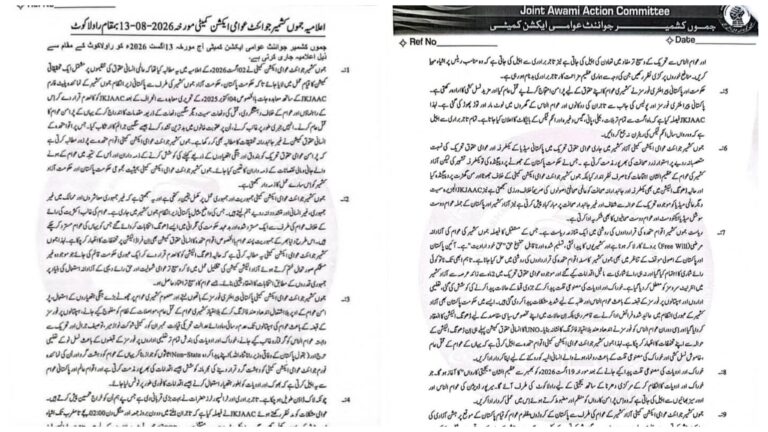
In a detailed two-page submission addressed to Prime Minister Mian Muhammad Shehbaz Sharif and dated 17 January 2026, the Committee warned that the failure to implement key clauses of the 13/14 October 2025 agreement has deepened public frustration and eroded trust among the people of the region.

From Public Movement to Agreement

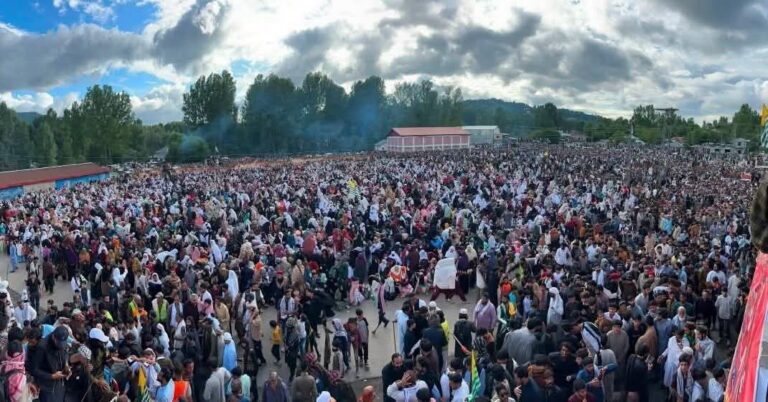
Formed on 17 September 2023, the Jammu Kashmir Joint Awami Action Committee brought together representatives from diverse social and political backgrounds to press for long-standing public demands in Azad Jammu and Kashmir. The movement intensified after violent incidents between 29 September and 13 October 2025, during which several civilians were killed and many others injured.

Following these events, a high-powered delegation from Islamabad, acting on the Prime Minister’s directives, visited Muzaffarabad and signed what was widely described as a historic agreement with the Committee. The accord was seen as a moment of reassurance for Kashmiris, signaling acknowledgment of their grievances and a commitment to justice and reform.

Travel Bans, FIRs and Airport Offloading

One of the most contentious issues highlighted by JKJAAC is the continued placement of activists and ordinary citizens on the Exit Control List (ECL) and Passport Control List (PCL), despite assurances that such measures would be withdrawn.

The Committee states that FIRs registered between 9 May 2023 and 4 October 2025 against JKJAAC members and members of the public were to be cancelled under the agreement. However, months later, individuals seeking overseas employment are still being offloaded from flights and detained at airports — a situation JKJAAC says has caused severe financial loss and psychological trauma.

Compensation and Health Card Promises Unfulfilled

Clause 11 of the English-language agreement committed authorities to provide:

  • Compensation equivalent to Law Enforcement Agencies (LEAs) for families of those killed on 1 and 2 October 2025
  • Rs 1 million for each person injured by gunfire
  • A government job within 20 days to a family member of each deceased

As of mid-January 2026, JAAC maintains that full implementation remains pending.

Similarly, while the agreement promised implementation of the Health Card scheme within 15 days, the Committee notes that several major hospitals in Azad Kashmir are not empanelled with State Life Insurance. As a result, poor patients are forced to travel to Islamabad or Rawalpindi for treatment, undermining the scheme’s stated purpose.

High-Powered Committee Clause Under Question

Another central grievance concerns the clause mandating a high-powered committee of legal and constitutional experts to examine the status of Assembly members elected from constituencies outside Azad Jammu and Kashmir.

According to the agreement, all privileges, concessions, funds, and ministerial status of such members were to remain suspended until the committee submitted its final report. JKJAAC alleges that not only was the committee’s formation delayed without explanation, but privileges were restored and parliamentary roles assigned, which the Committee describes as a direct violation of the written accord.

Political Developments and Public Anger

The Committee’s submission also references growing unease ahead of upcoming elections in Pakistan-administered Kashmir. Particular anger has been directed at the induction of Saqib Majeed into the Pakistan Muslim League (N), a figure accused by protestors of opening fire on peaceful demonstrators in Muzaffarabad on 29 September 2025, resulting in three deaths and multiple injuries.

JKJAAC states that no individual has yet been arrested or convicted in connection with those killings, intensifying public resentment and raising questions about accountability and political patronage.

Questions Over the Remaining 38 Demands

Beyond the points listed in the January submission, social media users and civil society voices continue to ask what happened to the remaining 38 demands originally presented by the Awami Action Committee. Observers note that while selective commitments were announced, there has been little official clarity on which demands have been accepted, rejected, or deferred.

These questions were also echoed online by Atif Maqbool, a political communicator and core activist of the Jammu Kashmir Joint Awami Action Committee, who wrote on X that those accused of involvement in the 29 September violence continue to move freely and enjoy political backing, while no arrests have been made to date.

Call for Immediate Intervention

In its appeal, the Jammu Kashmir Joint Awami Action Committee urged Prime Minister Shehbaz Sharif to take personal notice of what it calls systematic deviations from the agreement and to ensure that justice, accountability, and transparency are delivered to the people of Pakistan-administered Kashmir.

As public debate intensifies both on the ground and online the fate of the October 2025 agreement is increasingly being viewed as a critical test of governance, credibility, and the state’s relationship with Kashmiris.

2026 Public Holiday Calendar for Azad Jammu & Kashmir: Official List, Dates & Cultural Context

0

How Azad Jammu & Kashmir Marks Time, Memory, and Identity

MUZAFFARABAD, Azad Jammu & Kashmir — In the delicate architecture of a nation’s year, public holidays are more than days off. They are the pillars of collective memory, the rhythm of religious devotion, and the scheduled pauses for political reflection. For Azad Jammu & Kashmir (AJK), a region where history is felt acutely and identity is woven from multiple threads, the official holiday calendar for 2026 serves as a profound civic script.

Released by the Government of Pakistan and applicable across AJK, the schedule is a map of the year’s emotional and ideological landscape. It moves from the solemn political solidarity of February to the joyous religious feasts of spring and summer, through days of national creation and constitutional birth, and into the sacred mourning of Muharram. To read this calendar is to understand the forces—faith, nationhood, struggle, and culture—that structure life here.

The Political Pillars: Days of Solidarity and Sovereignty

The year’s formal commemoration begins not with celebration, but with assertion. Kashmir Solidarity Day on February 5 (Thursday) transcends the typical public holiday. Government offices close, but the streets often fill. It is a day of rallies, seminars, and human chains—a performative act of unity between Pakistani and AJK citizens meant to echo in international corridors. “It’s not a holiday in the sense of rest,” notes Muzaffarabad-based political analyst Dr. Saba Gul. “It’s a holiday in the original sense of a ‘holy day’—a day set aside for the sacred duty of remembering the unresolved struggle. The closure of institutions forces a societal focus on the issue.”

Three national holidays form the core of Pakistan’s, and by extension AJK’s, foundational narrative. Pakistan Day (March 23) commemorates the 1940 Lahore Resolution, the ideological birth certificate. Youm-e-Takbeer (May 28) marks the 1998 nuclear tests, a day of strategic sovereignty that often tangles with Eid celebrations. The crescendo is Independence Day on August 14, a full-bodied celebration where the green of the flag paints entire towns, and state-sponsored ceremonies blend with spontaneous street festivities.

These are more than days off; they are rituals of statecraft. Schools hold essay competitions on the “Ideology of Pakistan,” state media runs marathon patriotic programming, and the military holds showpiece parades. In AJK, these observances carry a distinct resonance, reinforcing the region’s constitutional integration with Pakistan while its ultimate status remains a global question.

The Sacred Rhythm: The Lunar Calendar’s Movable Feasts

Interlaced with the fixed Gregorian dates of national days is the fluid, celestial rhythm of the Islamic lunar calendar. These are the holidays that truly dictate the pulse of society, their provisional dates (marked with asterisks below) a reminder of tradition’s authority over the modern state apparatus.

· Eid-ul-Fitr (Estimated: March 21-23): This is the festival of breaking the fast, a collective exhale after the austerity of Ramadan. Its impact is socio-economic: a massive internal migration occurs as urban workers return to ancestral villages in AJK’s Neelum, Jhelum, and Leepa valleys. The bazaars of Muzaffarabad and Mirpur see a frenzy of spending on clothes, sweets, and gifts. For three days, public life halts for private joy.


· Eid-ul-Adha (Estimated: May 27-28): The Feast of Sacrifice is a starker, more profound observance. It is a spectacle of faith and economics, where livestock markets spring up overnight and the sound of the takbir mixes with the bleating of sheep. The ritual distribution of meat underscores obligations to family and community. When it coincides with Youm-e-Takbeer, as it does in 2026, the narrative intertwines religious sacrifice with national strength.


· Ashura (Estimated: June 25-26): The 9th and 10th of Muharram are days of profound communal mourning for the martyrdom of Imam Hussain (RA). In towns like Bhimber and Kotli, processions (juloos) transform main arteries into rivers of black-clad mourners. It is a holiday of a different tenor—one of somber reflection, where the state’s role shifts from celebration to providing security for emotionally charged gatherings.


· Eid Milad-un-Nabi (Estimated: August 25): The Prophet’s birthday is marked by devotional gatherings, illuminations, and emphasis on his teachings of peace. It is a holiday that leans more toward spiritual study and less toward private festivity.

The fact that these dates are tentative, subject to the Ruet-e-Hilal Committee’s moon-sighting announcements, is a critical cultural detail. It is a weekly lesson that some schedules cannot be dictated by spreadsheet, but must bow to the sky.

The Pluralist Notes: Labour, Iqbal, and Christmas

The calendar also incorporates universal and minority observances, revealing a layered identity. Labour Day (May 1) acknowledges workers’ rights within a global context. Allama Iqbal Day (November 9) honors the poet-philosopher whose vision inspired the state, a holiday of the intellect celebrated in academic circles.

Most notably, December 25 is a dual holiday: Quaid-e-Azam Day for the founding father Muhammad Ali Jinnah, and Christmas Day, an official holiday for Pakistan’s Christian community and widely observed as a day off. The granting of December 26 as an additional holiday for Christian employees formalizes a space for religious pluralism within the national schedule.

The Impact: A Society Synchronized by Pause

The practical effects of this calendar are immense. It dictates the annual cycle of business, education, and travel.

· The Government & Economy: The back-to-back holidays around Eid-ul-Fitr and Eid-ul-Adha bring formal commerce to a standstill for nearly a week. The stock exchange closes, banks halt transactions, and government services pause. This synchronized break creates a unique economic rhythm of pre-holiday boom and post-holiday lull.
· Education: The academic year for AJK’s schools and universities is sculpted around these holidays. Summer vacations often begin after Eid-ul-Fitr, and winter breaks align with the year-end holidays. Exam schedules are meticulously plotted to avoid sacred and national days.
· Tourism & Travel: The holidays trigger the largest domestic migration waves. Eid sees choked highways as families reunite. The pleasant weather of March and August makes long weekends like Pakistan Day and Independence Day prime times for tourism into AJK’s hill stations, flooding Neelum Valley with visitors and testing local infrastructure.

Conclusion: A Calendar as a Contract

The 2026 public holiday calendar for Azad Jammu & Kashmir is, in essence, a social contract. It is the state officially sanctioning time for remembrance, worship, celebration, and rest. It acknowledges the political reality of the Kashmir cause, the religious devotion of the majority, the legacy of the nation’s founders, and the rights of minority communities.

For the resident, it is a practical guide to the year. For the observer, it is a key to understanding the complex, sometimes competing, loyalties and rhythms that define life in this beautiful, contested region. The fixed dates promise structure; the movable feasts insist on tradition. Together, they chart a year in the life of Azad Jammu & Kashmir.

Official Public Holiday Calendar for AJK & Pakistan – 2026

Date Day Holiday Category
5 Feb Thursday Kashmir Solidarity Day National Observance
21–23 Mar* Sat–Mon Eid-ul-Fitr Religious (Islamic)
23 Mar Monday Pakistan Day National
1 May Friday Labour Day National
27–28 May* Wed–Thu Eid-ul-Adha Religious (Islamic)
28 May Thursday Youm-e-Takbeer National
25–26 Jun* Thu–Fri Ashura (9th & 10th Muharram) Religious (Islamic)
14 Aug Friday Independence Day National
25 Aug* Tuesday Eid Milad-un-Nabi (PBUH) Religious (Islamic)
9 Nov Monday Allama Iqbal Day National
25 Dec Friday Quaid-e-Azam Day & Christmas Day National & Christian Holiday
26 Dec Saturday Second Day of Christmas (for Christian employees) Christian Holiday

*Dates are provisional and subject to moon-sighting confirmation.

The Fort That Refuses to Fall: Muzaffarabad’s Red Fort and the Unyielding Memory of Kashmir

MUZAFFARABAD, Azad Jammu & Kashmir (PaJK)—From the bend in the Neelum River, it looks less like a monument and more like a geological fact. The reddish-brown walls of Muzaffarabad’s Red Fort rise from the bedrock, merging with the cliff face as if carved by the river itself.

For nearly five centuries, this citadel has not merely stood; it has witnessed. It has watched empires march, borders harden, and the very river that once defended it slowly eat away at its foundations. Today, it stands as perhaps the most potent, if crumbling, physical archive of Kashmiri history in the region’s capital.

This is not a story of frozen architecture. It is a chronicle of adaptation, survival, and silent testimony. The Red Fort’s stones hold the ambitions of the Chak dynasty, the administrative chill of the Mughals, the martial stamp of the Durranis, and the heavy hand of the Dogras. Its current state—a mix of melancholic grandeur and visible decay—poses urgent questions about heritage, memory, and what a community chooses to preserve.

Strategic Birth on a Contested Frontier

Our story begins in 1549, in a world of shifting suzerainties. The independent Chak rulers of Kashmir, their kingdom a jewel coveted by the expanding Mughal Empire to the south, faced a perennial threat. Their response was one of strategic genius.

Photo: Red Fort Muzaffarabad

They chose a spit of land where the Neelum River (then called the Kishan Ganga) hooks sharply, creating a natural moat on three sides. Only a narrow land bridge connected it to the city. “They weren’t just building a fort; they were sculpting a dilemma for any invading force,” says Dr. Arif Malik, a historian focusing on Himalayan architecture. “Attack from land, and you face a bottleneck under the fort’s walls. Try the river, and you’re exposed and battling the current. It was a defender’s dream.”

Built by local artisans with massive, rounded river stones, the original fort was a purely military organism—a place for garrison, storage, and imposing control over the trade route along the river.

A Chameleon Under Empires

History, however, has a way of repurposing symbols of power. With the Mughal annexation of Kashmir in 1587, the fort’s stark military purpose faded. The empire’s frontiers lay far to the northwest. The fort was demilitarized into a royal serai—a luxurious lodge for Mughal elites on their famed pilgrimages to Kashmir’s gardens. “It became a destination, not a deterrent,” notes Malik. “The echoes in its courtyards changed from the clang of arms to the discussions of courtiers.”

This interlude was brief. The Afghan Durrani Empire, which seized control in the mid-18th century, saw the region’s value anew. Under Sultan Muzaffar Khan—the city’s namesake—the fort was expanded and re-fortified, its walls thickened for a new era of conflict.

The most transformative—and, for many Kashmiris, most painful—chapter came with the Dogras in the 19th century. For Maharajas Gulab Singh and Ranbir Singh, the fort was the key to holding Muzaffarabad, the western gateway to the Vale of Kashmir. They renovated it extensively, using it as an administrative nerve center and garrison to consolidate their often-brutal rule.

It is here that the fort’s darkest spaces speak loudest: a labyrinth of eight subterranean dungeons, cells of damp brick and perpetual shadow. “These kāl koṭhṛīs (black cells) are not Mughal or Afghan; their construction is Dogra,” explains a local archaeologist who requested anonymity due to the sensitivity of historical interpretation. “They are the physical infrastructure of control. You can feel the weight of that history in the cold air.”

The Assaults of Earth and Water

The Dogras left in 1928. For decades, the fort slumbered, a haunted place slowly ceded to the elements, until it was handed over to AJK’s Department of Archaeology.

Then, nature delivered its own sieges.

The 1992 floods were a warning. The 2005 Kashmir earthquake was a cataclysm. The 7.6-magnitude tremor shattered walls, collapsed entire sections facing the river, and severely damaged a small on-site museum, scattering or burying its artifacts. The outer sarai (travelers’ inn) was reduced to rubble.

But the most insidious enemy is constant: the Neelum River itself. The very waters that defined its strength are now eroding its being. Annual floods, exacerbated by climate change and upstream environmental shifts, gnaw at the foundations. A 2010 flood was so severe it prompted the construction of a large protective embankment—a stark, modern wall now guarding the ancient one.

“It’s a race against time and hydrology,” the site’s longtime caretaker, Muhammad Farooq, tells me, gesturing towards the river’s edge where stonework has recently vanished. “The river is hungry. Every monsoon, we hold our breath.”

The Present: Picnickers, Plans, and a Precarious Future

Today, the fort is a park. On a sunny afternoon, families picnic in its weathered courtyards, children chase pigeons through arches that once framed marching soldiers. It is a space reclaimed for casual joy, its grim past softened by samosas and laughter. Yet, this very normalcy masks a precarious reality.

The conservation challenges are immense. “This isn’t a simple restoration,” says Farooq. “It requires geotechnical engineering to stabilize the riverbank, archaeological expertise to guide rebuilding, and significant, sustained funding.” He confirms that restoration blueprints exist with the Department of Archaeology, but the leap from plan to action, always slow, has been stalled by bureaucratic and financial hurdles.

The fort thus exists in a liminal state—between memory and oblivion, between being a protected heritage site and a slowly disintegrating landmark.

The Unyielding Stone

To walk through the Red Fort today is to take a palimpsest tour of Kashmir’s soul. It is all here: the indigenous shrewdness of its founding, the imprint of continental empires, the trauma of subjugation, the resilience in the face of natural disaster, and the quiet, daily reclamation by the people who live in its shadow.

Its value for an independent Kashmiri audience, and for the international community, is profound. It is evidence. In a region where history is often contested or erased, the fort’s stones are stubbornly factual. They tell a contiguous story of strategic importance, of adaptation, of suffering, and of endurance.

The planned restoration is not merely a technical task. It is a moral and political one. Will this archive in stone be preserved? Will the dungeons be contextualized, the Mughal lodgings explained, the Chak craftsmanship celebrated? Or will it continue to weather away, its stories lost to the river?

The Red Fort has withstood conquerors. It has withstood earthquakes. Its final test may be against the silent forces of indifference and the relentless flow of time. For now, it refuses to fall, a silent, scarred sentinel keeping watch over the Neelum, insisting, against all odds, on being remembered.

Lahore to Muzaffarabad Bus Service: A Comprehensive Travel Guide & Schedule | The Azadi Times

Planning a trip to Kashmir? Our verified guide covers all bus services from Lahore to Muzaffarabad, including operator contacts, fares, booking platforms, terminals, and practical travel tips for 2024.

Lahore to Muzaffarabad Bus Service: The Essential Overland Link to Kashmir

By The Azadi Times Travel & Tourism Desk
Filed under: Transport, Kashmir Travel, Practical Guides

For residents, tourists, and diaspora of Pakistan administrated Azad Jammu & Kashmir, the road from Lahore to Muzaffarabad is more than just a route it is a vital artery. This corridor connects Pakistan’s cultural heartland to the serene valleys of Kashmir, serving students returning home, journalists covering the region, families reuniting during festivals, and adventurous tourists drawn by the promise of pristine landscapes. In the absence of a direct, year-round air link, the Lahore to Muzaffarabad bus service remains the most accessible, economical, and widely used mode of transport.

This guide is the product of direct verification with operators, analysis of booking platforms, and cross-referencing of schedules and terminal information. We provide a clear, factual roadmap for your journey, avoiding promotional fluff in favor of the practical details that matter on the ground.

The Route at a Glance: What Every Traveller Should Know

The journey covers approximately 350–400 kilometers, depending on the specific routing. The road transitions dramatically from the flat expanses of Punjab to the rugged, terraced hills of Hazara, before descending through the iconic Kohala Bridge into the Neelum Valley vicinity and onward to Muzaffarabad.

· Typical Travel Time: 8 to 10 hours for direct services. Connecting services can take 9 to 12 hours, accounting for layovers.
· Direct Fare Range (Economy AC): PKR 2,500 – PKR 3,500. Prices fluctuate based on season, fuel costs, and coach class.
· Primary Routing: Lahore → Islamabad/Rawalpindi Bypass → Hazara Motorway/GT Road → Havelian/Abbottabad → Murree Hills/Kohala → Muzaffarabad.

Direct Bus Services from Lahore to Muzaffarabad

While several companies list this route, one operator maintains the most consistent, direct service.

Srinagar Express

The name most frequently associated with direct travel to Kashmir from major Pakistani cities. They run dedicated coaches on this long-haul route, sparing passengers the hassle of changing buses.

· Service Type: Air-conditioned, recliner/seater coaches. Some luxury options may be available during peak season.
· Departure Point in Lahore: Primarily from Badami Bagh General Bus Stand. Some pickups may be arranged from designated points along the route (confirm at booking).
· Arrival Point in Muzaffarabad: Central Bus Stand near Neelum Valley Road.
· Estimated Travel Time: 8–9 hours in optimal conditions.
· Fare Range: PKR 2,800 – PKR 3,500.
· Booking & Contact:
· UAN/Helpline: 0346-6684666
· Booking Method: Primarily via phone reservation and terminal ticket counters. They may also be listed on aggregate platforms like Bookme.pk.

The Connecting Route: Lahore to Islamabad, Then to Muzaffarabad

This is the most flexible and often necessary alternative, especially when direct seats are unavailable. It involves two distinct legs.

Leg 1: Lahore to Islamabad/Rawalpindi

This segment is served by numerous reputable, large-scale operators with frequent departures.

  1. Faisal Movers
    A major player with a strong safety record and extensive schedule.

· Types: AC Standard, Business Class (recliner), and Sleeper Coaches on some timings.
· Departure Terminals in Lahore: Main Terminal at Thokar Niaz Baig, with pickups from various city stops.
· Arrival in Islamabad: Peshawar Morr Terminal, Islamabad; Saddar, Rawalpindi.
· Travel Time: ~4 hours via Motorway.
· Fare Range: PKR 1,800 – PKR 2,800.
· Booking: Phone: 111-22-44-88 (Landline: 042-111-22-44-88). Online: Faisal Movers Website or via Bookme.pk.

  1. Daewoo Express
    Known for punctuality and terminal facilities.

· Types: AC Standard and Executive.
· Departure in Lahore: Lahore Daewoo Terminal, near Kalma Chowk.
· Arrival in Islamabad: Islamabad Daewoo Terminal, G-9.
· Travel Time: ~4 hours.
· Fare Range: PKR 1,900 – PKR 3,000.
· Booking: Daewoo Express Website or terminal.

Other reputable operators for this leg include Skyways, Billion Star, and Road Master.

Leg 2: Islamabad/Rawalpindi to Muzaffarabad

This sector is handled by regional operators. Services are frequent, with coaches and smaller vans departing as they fill up.

· Key Departure Points:
· Islamabad: Pir Wadhai Bus Stand (the main hub).
· Rawalpindi: Committee Chowk, Raja Bazaar area.
· Operators: Local companies like Kashmir Express, Niazi Express, and several private van services. There is no single dominant brand; services are often organized by unions.
· Travel Time: 2 to 3.5 hours. The variance is due to traffic, weather on the Murree hills, and road conditions. According to mapping resources like Rome2rio, the distance is roughly 138 km via the Kohala route.
· Fare Range: PKR 1,000 – PKR 1,800 for AC coach/shuttle.
· Booking: On-the-spot at the bus stands. Pre-booking is uncommon but can sometimes be arranged through local travel agents in Rawalpindi.

Terminal Guide & Key Contacts

Lahore:

· Badami Bagh General Bus Stand: The primary hub for north-bound and Kashmir-specific coaches. It is a large, bustling complex. Confirm your operator’s exact booth location.
· Thokar Niaz Baig Terminals: Used by Faisal Movers and others.
· Daewoo Terminal, near Kalma Chowk.

Islamabad/Rawalpindi (for connections):

· Pir Wadhai Bus Stand (Islamabad): The major interchange for onward travel to AJK and the North. Expect a crowded but well-serviced environment.
· Committee Chowk/Raja Bazaar (Rawalpindi): Another active point for Muzaffarabad-bound vehicles.

The Traveller’s Experience: Scenery & Cultural Context

The journey is a narrative in itself. After the monotony of the motorway, the turn towards Hazara Division signals a change. The air cools, the terrain rises, and the scenery becomes cinematic. The stretch from Abbottabad towards Khaira Gali and Murree offers pine-forested hills and panoramic views. The descent to Kohala is marked by sharp turns and the roar of the Jhelum River below. Crossing the Kohala Bridge—the symbolic gateway into AJK—is a moment many travellers note.

You’ll share the space with a cross-section of society: families with excited children, students with backpacks, traders, and occasionally, journalists or researchers. The onboard atmosphere is typically respectful; it’s advisable to dress modestly. Stops at roadside dhabas offer chai, parathas, and simple meals—a chance to stretch and absorb the local rhythm.

Realistic Challenges & Practical Advice

Booking is Crucial: For direct services or the Lahore-Islamabad leg, book ahead, especially before Eid holidays, summer vacations (May-August), and weekends. Use Bookme.pk or operator websites for e-tickets, which are essential for international travellers.

Weather is a Factor: From December to February, fog and rain can cause significant delays on the Murree-Kohala stretch. Landslides are possible during monsoon rains (July-August). Always check road conditions before departing.

  1. Safety & Comfort:
    · Choose reputable operators for better-maintained vehicles.
    · Keep valuables in a small bag with you.
    · Carry warm clothing even in summer for night travel and variable mountain weather.
    · Have Pakistani currency (PKR) for snacks, chai, and unforeseen expenses.
  2. For International Visitors:
    · Carry your passport and visa. While checkpoints on this route are not typically for tourists, random ID checks can occur.
    · Have the address and contact of your Muzaffarabad accommodation.
    · Purchase a local SIM for connectivity, as some stretches have patchy reception.
  3. Luggage: Label your bags clearly. Luggage is usually stored in the bus hold. Keep medicines, documents, and essentials in your hand carry.

Final Summary

The Lahore to Muzaffarabad bus service is a testament to the enduring demand for land connectivity to Kashmir. It is not merely a transport option but a journey that acquaints you with the changing face of the country.

For the budget-conscious, the curious, and those who find poetry in road travel, the bus is unequivocally the best choice. It offers affordability, flexibility, and an authentic ground-level perspective of the region.

If your priority is speed and comfort, consider flying to Islamabad and hiring a private car to Muzaffarabad—a more expensive but faster alternative.

Quick-Reference Directory

Service Contact Key Booking Platform
Srinagar Express (Direct) 0346-6684666 Phone/ Terminal
Faisal Movers (Lahore-ISB) 111-22-44-88 faisalmovers.com
Daewoo (Lahore-ISB) 111-007-008 daewoo.com.pk
Online Aggregator N/A Bookme.pk

Editorial Note: This guide was compiled through direct verification of operator schedules, analysis of public booking platforms, and reference to established transport directories. Information, especially fares and schedules, is subject to change. The Azadi Times recommends confirming all details directly with the service provider before finalizing travel plans. This report is intended as a factual public service for travellers.