Wednesday, March 25, 2026
10.5 C
Srinagar
Home Blog Page 38

Former AJK Prime Minister and PTI President Sardar Abdul Qayyum Niazi Arrested in Bhimber

0

Bhimber, AJK (Pakistan-administered Kashmir: Former Prime Minister of Azad Jammu and Kashmir (AJK) and President of Pakistan Tehreek-e-Insaf (PTI) AJK, Sardar Abdul Qayyum Khan Niazi, was arrested in Bhimber on Saturday, intensifying the already fragile political atmosphere in the region.

According to local sources, Niazi was taken into custody while on his way from Samahni to Bhimber, where he was scheduled to lead rallies and attend political conventions. Witnesses say his arrest came under direct orders from AJK’s current Prime Minister Chaudhry Anwarul Haq, whose home district is Bhimber.

Eyewitnesses reported that a heavy police contingent intercepted Niazi’s convoy near Samahni Jandi Chontra, and swiftly moved him to Mirpur. Local political activists described the scene as “harassment of a senior politician under the presence of an overwhelming police force.”

In Bhimber, Niazi was scheduled to address PTI’s district convention. “The timing of the arrest was designed to suppress political mobilization,” one activist alleged, speaking to Kashmir Digital on condition of anonymity due to safety concerns.

Sardar Abdul Qayyum Niazi is facing over 11 cases registered against him in Rawalpindi, Islamabad, and other cities. Warrants had already been issued two days before his arrest, particularly linked to the events of May 9, when widespread protests shook Pakistan after the arrest of former Prime Minister Imran Khan.

An anti-terrorism court in Islamabad had also ordered his arrest in connection with those cases. Following Saturday’s detention, officials confirmed he will likely be handed over to Islamabad police.

The arrest has triggered immediate protests in parts of Azad Kashmir. In Hajira, demonstrators blocked the Siraari Chowk for hours, raising slogans against what they termed “politically motivated actions.” Police later moved in to disperse the crowds, but tensions remain high.

Observers note that these developments are further evidence of how Pakistan’s internal political struggles are spilling over into Azad Kashmir. “The same politicians who came to power on Imran Khan’s ticket are now orchestrating arrests of PTI leaders in Kashmir. It shows the depth of opportunism in our politics,” a political commentator from Muzaffarabad told Kashmir Digital.

Analysts argue that the arrest of Niazi highlights how Kashmir’s fragile democratic space is being shaped and often destabilized by power struggles in Pakistan. While pro-Kashmir voices call for a politics centered on self-determination and local accountability, the prevailing trend suggests that Islamabad’s political battles continue to dominate the discourse in Azad Kashmir.

“This is not about justice or rule of law. It’s about who controls the narrative,” said one Kashmiri rights advocate, speaking anonymously. “Such actions silence independent voices and weaken the idea of an autonomous Kashmiri political identity.”

With PTI having announced nationwide protests for August 5 — a symbolic date for Kashmir — Niazi was expected to lead demonstrations in AJK. His arrest not only prevents him from doing so but also signals the possibility of more arrests of political leaders in the coming days.

For many in Azad Kashmir, the developments are another reminder of how local aspirations are overshadowed by Pakistan’s divisive power politics. Whether this crackdown will further alienate Kashmiri voters or consolidate control for the current government remains to be seen.

Commander of Banned Outfit Faces Public Backlash in Rawalakot

0

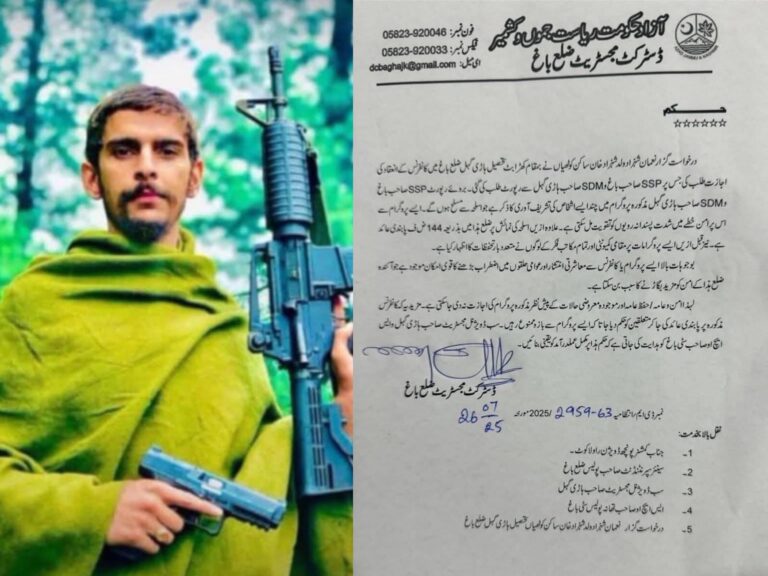
In the village of Koiyaan, located near the town of Khai Gulla in Poonch district of Pakistan-administered Jammu and Kashmir, a commander of a banned militant organization and his associates faced intense public backlash on Wednesday. According to local sources, the commander fled the scene along with his armed companions.

The local population, in response to the incident, has announced plans to hold a public jirga (community assembly) in the coming days to formulate a collective stance against militant recruitment and activities in the region.

A few days earlier, reports had gone viral on social media claiming that a young man named Habib Tahir, alias Chhoto, from Koiyaan village, had been killed by the Indian army in Indian-administered Jammu and Kashmir. A funeral in absentia (ghaybana namaz-e-janaza) was held for Habib Tahir in his native village on Wednesday. However, in the wake of the news about his death, there was a noticeable wave of anger among the local community against militant organizations. As a result, Habib Tahir’s family had explicitly barred members of the militant group from attending his funeral.

According to local residents, Habib Tahir had been recruited and trained by the banned militant group Jamaat-ud-Dawa (formerly known as Lashkar-e-Taiba) and was then sent across the Ceasefire line Line of Control (LoC), where he was ultimately killed by Indian forces.

Despite the family’s clear instructions, a covert local commander of Jamaat-ud-Dawa, Rizwan Hanif, and a public leader of the political front formed under its new name, United Movement, attended the funeral along with his three brothers and a nephew. Local sources stated that two of the individuals accompanying Rizwan Hanif were armed bodyguards.

When Habib Tahir’s family members began questioning Rizwan Hanif regarding the circumstances, his nephew allegedly attempted to intimidate them by brandishing a weapon. This provoked the family members and others present at the funeral to confront the armed men physically. It is noteworthy that Rizwan Hanif has reportedly designated his own brother and nephew as bodyguards, keeping all related expenses and salaries within the family.

As Rizwan Hanif and his armed associates exited the premises, they were reportedly chased and verbally condemned by Habib Tahir’s friends and other villagers. They pursued the fleeing group for quite a distance.

This is the second such incident in the Khai Gulla area in which the local community has actively opposed the activities of banned militant outfits. In April this year, residents of Barming village also reacted strongly during a funeral and memorial conference held after a young man was killed by Indian forces in Indian-administered Jammu and Kashmir.

A shift in the state’s policy also appears to be emerging after a long silence. On July 26, in the Khara Butt area of the Harighel tehsil of Bagh district, the banned militant organization Jaish-e-Muhammad had announced a conference. However, law enforcement intervened following the imposition of Section 144 by the District Magistrate of Bagh. A heavy contingent of police arrived at the location and prevented the event from taking place.

Over the past two years, there had been a noticeable surge in the public activities of banned militant organizations, often under state patronage. However, following heightened military tensions between Pakistan and India, a subtle yet significant shift in the situation has been observed. There has been a marked decline in militant activities, and if any are still occurring, efforts are being made to ensure that photos and videos do not reach the public domain.

Ultimately, the only sustainable way to protect the youth of this region from the dangers of militant exploitation is to impose a complete ban on organizations, recruitment centers, and training facilities that promote militancy. The policy of using young people as fodder for this imperialist conflict must be fully abandoned.

Note: The information in this report has been gathered from verified social media accounts, official documents, and credible local journalists based in the region.

Tension in Bajaur: Restricted Movement in Mamund as Targeted Military Operations Continue

0

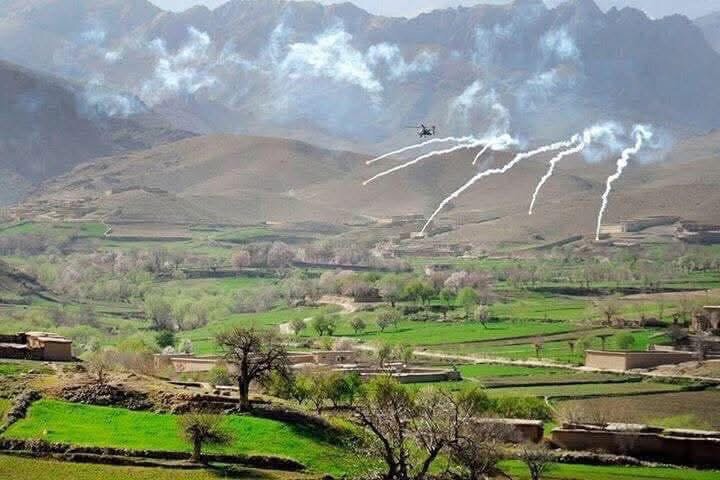
For the second consecutive day, strict movement restrictions remain in place across 16 villages of Mamund tehsil in Pakistan’s Bajaur district, bordering Afghanistan. These curbs were imposed by local authorities in support of ongoing “targeted operations” against suspected militant groups.

While Tuesday (the first day of restrictions) witnessed intense gunfire and the presence of military helicopters, residents report that Wednesday has been comparatively calmer — with no aerial surveillance or explosions heard so far.

Local journalist Bilal Yasir told The Azadi Times that Tuesday’s operations caused panic among civilians, prompting several families to flee the area. He added that a protest is currently underway at Umari Chowk — the main route leading to Mamund — where demonstrators, holding copies of the Quran, are voicing opposition to the military operation. The protest is reportedly being led by former PTI lawmaker Gul Zafar Khan.

Three-Day Curfew and Lack of Official Clarity

On July 29, the Deputy Commissioner’s office in Bajaur issued a notification enforcing a complete restriction on civilian movement in the specified villages until 5:00 PM on July 31. The directive cited security reasons, stressing the need to safeguard lives during the anti-militant operations, as recommended by the District Intelligence Coordination Committee.

However, no official statement has been released by the military’s media wing, ISPR, regarding the operation.

While some locals allege that several people were killed in the first day of the crackdown, no official confirmation has been provided by hospitals or government representatives. Attempts by media outlets to contact Bajaur’s Deputy Commissioner and District Police Officer have so far gone unanswered.

Dr. Hayat, the Medical Superintendent of Bajaur Hospital, stated that all casualty-related data has been submitted to the DC’s office, where media inquiries should be directed.

Government Response and Political Reactions

In a video message following a parliamentary meeting of PTI’s Khyber Pakhtunkhwa chapter, Chief Minister Ali Amin Gandapur expressed regret over the reported loss of innocent lives. His office announced financial compensation of PKR 10 million for each deceased civilian or security personnel, and PKR 2.5 million for those injured.

However, the exact number of casualties was not disclosed.

Chief Minister Gandapur further instructed all deputy commissioners to refrain from imposing curfews or Section 144 without prior approval from the provincial Home Department — hinting at possible concerns over unauthorized enforcement.

Multiple political parties have also voiced concerns over the situation. ANP President Aimal Wali Khan posted on X (formerly Twitter), calling for an immediate halt to civilian casualties. A spokesperson for Jamiat Ulema-e-Islam-F condemned the operation, warning that past military campaigns have failed to bring lasting peace to the region.

Why Mamund Matters

Mamund is Bajaur’s largest tehsil, strategically positioned along the Afghan border. It directly connects to Kunar province in Afghanistan, which has historically been a hotbed for various extremist factions, including ISIS-Khorasan.

Security analysts say the porous border has allowed armed militants to cross freely between Afghanistan and Pakistan, using Bajaur as a staging ground. Notably, Bajaur has seen increased militant activity in recent months, particularly from Tehrik-i-Taliban Pakistan (TTP).

Earlier this month, a deadly roadside bomb in the region claimed the lives of an Assistant Commissioner, a local tehsildar, and two police officers. Weeks before that, ANP leader Maulana Khan Zeb was assassinated while preparing for a tribal peace gathering.

A Growing Insurgency

Experts suggest that TTP has been steadily attempting to re-establish its influence across tribal areas since the start of 2025. Video footage shared on social media reportedly shows armed militants openly patrolling roads, setting up temporary checkpoints, and moving freely through civilian areas.

Abdul Sayed, a specialist on extremist movements in Pakistan, notes that while the TTP avoids formally claiming control over any region, their increased visibility is concerning. “They know they can’t hold territory for long in the presence of military forces,” he explained.

As tensions mount in Bajaur, calls for transparency, civilian protection, and long-term peace are growing louder. But with a complex web of cross-border militancy and local unrest, restoring stability in Mamund and beyond remains a formidable challenge for the Pakistani state.

Note:
This report includes some information sourced from BBC Urdu, adapted and rewritten by The Azadi Times for clarity and originality.

10 Kashmiri Leaders Still Fighting for Independence in 20245 – Their Shocking Stories

The snow-capped peaks of the Pir Panjal mountains have witnessed seven decades of geopolitical struggle. As India and Pakistan continue their bitter dispute over Kashmir, a quieter but persistent movement refuses to align with either nuclear-armed neighbor. Their demand? Complete independence for all of historic Kashmir, including Gilgit-Baltistan, free from Indian, Pakistani, and Chinese control.

In dimly lit homes across Srinagar, in the refugee camps of Muzaffarabad, and among the diaspora in London, a network of activists, scholars, and former militants keeps alive what may be the most radical idea in South Asia: that Kashmir should belong only to Kashmiris.

The Lifetime Prisoner: Yasin Malik’s Unbroken Will

The most famous face of this movement sits in Delhi’s Tihar Jail, serving a life sentence. Yasin Malik, the 57-year-old chairman of the Jammu Kashmir Liberation Front (JKLF), has become the symbol of Kashmiri resistance—and its evolution.

Once a militant commander who crossed the Line of Control (LoC) with an AK-47, Malik renounced violence in 1994, declaring that “guns had brought Kashmir to ruins.” His transformation mirrored South Africa’s ANC or Ireland’s Sinn Féin—armed struggle giving way to political activism.

But India never recognized this shift. In May 2022, Malik was convicted under the Unlawful Activities Prevention Act (UAPA) for allegedly funding militancy—charges he denies. From prison, his handwritten notes circulate among supporters, arguing that Kashmir’s distinct identity—where Muslims, Pandits and Sikhs once coexisted—predates both India and Pakistan.

“Yasin Sahib’s message is simple,” explains a young law student in Srinagar who asked to remain anonymous. “We are not Indians who need to become Pakistanis, nor Pakistanis who should become Indians. We were Kashmiris before these countries existed.”

The Mandela of Kashmir: Shabir Shah‘s 35-Year Resistance

If Malik represents the movement’s public face, 70-year-old Shabir Shah is its moral conscience. Jailed since 2017—and spending over half his life in Indian prisons—the founder of the Jammu & Kashmir Democratic Freedom Party (DFP) is often compared to Nelson Mandela.

His crime? Consistently advocating for Kashmir’s right to self-determination through nonviolent means. Court documents show prosecutors arguing that even Shah’s calls for UN-monitored plebiscites constitute “sedition.”

“Shabir Shah makes Delhi uncomfortable because he exposes the contradiction,” says London-based human rights lawyer Barrister Aamir Rana. “India claims Kashmir is integral, yet arrests those who want to test that claim democratically.”

The Diaspora Voice: Shabir Choudhry’s Legal Crusade

3,000 miles away in a modest office in South London, 68-year-old Shabir Choudhry keeps the flame alive through legal channels. The UK-based founder of the Kashmir National Party has spent decades presenting Kashmir’s case at the UN and European Parliament.

His 2023 legal analysis went viral in activist circles—it highlighted how Pakistan’s own Constitution (Article 257) implicitly acknowledges Kashmir’s special status, while India’s revocation of Article 370 violated the Simla Agreement.

“Kashmir isn’t real estate to be divided between two quarrelsome brothers,” Choudhry tells me over mint tea. “The third option—independence—was on the table in 1947, 1948, 1957 and 1994. It remains the only just solution.”

The Gilgit-Baltistan Factor: China’s Shadow

The independence movement faces its most complex challenge in the snowbound valleys of Gilgit-Baltistan (GB)—territory administered by Pakistan but claimed by India, where China has made deep economic inroads through the $65 billion China-Pakistan Economic Corridor (CPEC).

Here, 76-year-old Abdul Hamid Khan of the Balawaristan National Front (BNF) wages a lonely battle. Exiled to Sweden for years, he returned in 2019 to protest CPEC projects that he says are “colonizing” the region.

“First the British, then Pakistan, now China—all treat us as a territory, not a people,” Khan said in a rare 2023 interview before being detained again. His movement documents how GB’s population has changed from 98% locals in 1947 to under 60% today—a demographic shift mirroring concerns in Indian-administered Kashmir.

The Youth Movement: Digital Resistance

In the absence of established leaders—many jailed or exiled—a new generation employs technology to bypass censorship.

  • The GB United Movement runs anonymous Instagram accounts documenting land acquisitions

  • JKNSF Youth in Muzaffarabad and Poonch uses Signal to coordinate protests

  • “Kashmir Third Option” podcasts discuss independence models from Montenegro to Timor-Leste

“They’ve criminalized our political parties, so we become the party,” says a 24-year-old female activist in Srinagar who organizes through encrypted apps.

While India and Pakistan dominate headlines with their competing claims over Kashmir, a quieter but resolute camp insists on an alternative path: full independence from all three powers—India, Pakistan, and China. From Srinagar’s prisons to Gilgit-Baltistan’s mountain valleys and the diaspora hubs of London, a generation of Kashmiri and GB leaders have kept alive the vision of Azadi in its truest sense. Their journeys—marked by imprisonment, exile, and relentless advocacy—highlight not just political defiance, but the enduring belief that Kashmiris deserve to decide their own future. The following figures represent some of the most prominent voices in this movement.

Key Figures of the Independence Movement

LeaderRegion / BaseBelief / Political Stance
Yasin MalikSrinagar (JKLF Chairman)Advocates complete independence of Jammu & Kashmir, rejected militancy since 1994, jailed for life in India.
Shabir ShahSrinagar (DFP Founder)Calls for UN‑monitored plebiscite, refuses merger with either India or Pakistan, 35+ years imprisoned.
Shabir ChoudhryUK (Diaspora / KNP)Legal voice of the movement, promotes “Third Option” – full independence under international law.
Dr. Toqeer GilaniAJK / Gilgit-Baltistan (JKLF AJK President)Campaigns against Indian, Pakistani, and Chinese control, led major “Azadi March” in 2019.
Abdul Hamid KhanGilgit-Baltistan (BNF Founder)Opposes Pakistani rule and Chinese CPEC influence, demands sovereignty for GB.
Nawaz Khan NajiGilgit-Baltistan (BNF‑Naji Group)Only elected GB leader calling openly for independence, stresses cultural and political autonomy.
Hashim QureshiSrinagar (JKDLP Chairman)Early JKLF co‑founder, now advocates nonviolent struggle for a unified, independent Kashmir.
Masroor Abbas AnsariSrinagar (JKIM / APHC)Shia cleric promoting sectarian unity and self‑determination beyond India‑Pakistan binaries.
JKNSF Youth LeadersAJK & GB grassroots movementMobilize digitally for Azadi marches, reject both Indian and Pakistani sovereignty.
GBUM Youth ActivistsGilgit-BaltistanDemand self‑rule, oppose Pakistan’s constitutional absorption, highlight 1947’s independent GB history.

Why This Matters Beyond Kashmir

The independence movement in Jammu, Kashmir, and Gilgit-Baltistan is not just a regional dispute. It raises deeper questions about how borders are drawn, how people are governed, and whether international law still has space for genuine self-determination.

It challenges the assumption that the partitions of the 20th century were final. It reminds the world that Kashmir remains one of the last disputes still listed on the United Nations agenda. And it forces global powers to consider how an independent Kashmir—positioned at the crossroads of South and Central Asia—would affect projects like China’s Belt and Road and America’s Indo-Pacific strategy.

As veteran journalist Ahmed Rashid observes: “Kashmir’s independence struggle is the ghost at the feast of India-Pakistan relations. However much both states try to ignore it, the idea refuses to die.”

The Road Ahead

The space for peaceful activism is narrowing. In Indian-administered Kashmir, counterinsurgency operations and strict laws silence dissent. In Azad Jammu and Kashmir and Gilgit-Baltistan, Pakistan clamps down on pro-independence voices, particularly those who oppose Chinese-backed development projects.

Yet despite repression, the idea of azadi persists. Families continue to honor the sacrifices of leaders like Yasin Malik. Shabir Shah’s writings smuggled from prison circulate quietly among young activists. Diaspora groups in London, Brussels, and New York keep the issue alive in international forums. And digitally savvy Kashmiri youth find new ways to connect their struggle with other global independence movements.

For its supporters, independence is no longer just a slogan of the past. It is a living political vision—a demand for dignity, recognition, and the right to self-determination. As long as these voices endure, the dream of a free Kashmir—beyond India, Pakistan, and China—will continue to survive.

The Global Pursuit of Justice: Best Universities for Law Education in 2025

In the shadow of conflict and amid the pursuit of justice, students from Kashmir to Kuala Lumpur envision careers as legal pioneers. Choosing a law school is more than selecting a career path—it reflects a vision of justice, identity, and global engagement. Whether you’re a Kashmiri student balancing geopolitical realities or an international scholar navigating international legal systems, the institution you choose can shape both perspectives and possibilities.

Law today extends far beyond memorising statutes—it intersects with global challenges such as climate change, digital rights, corporate accountability, and refugee protection. For students from conflict-affected regions like Kashmir, Sudan, or Myanmar, studying law abroad isn’t just about academic advancement. It represents the chance to engage with international frameworks and amplify marginalized voices.

The Global Giants: Harvard, Oxford, Yale & Beyond

Harvard Law School (USA)

Renowned for producing U.S. Presidents, Supreme Court Justices, and global leaders, Harvard remains a beacon for international legal education. Its LL.M. program enrolls around 180 lawyers annually—97% from outside the U.S.—contributing significantly to global legal discourse (Reuters). For 2025–26, tuition alone is projected at $80,760, with total cost (including living expenses) approaching $121,800 (Harvard Law School). However, Harvard’s financial aid initiatives—such as tuition waivers for students from households earning under $100,000—are making it more accessible (The Times).

University of Oxford (UK)

With its tutorial-based pedagogical model, Oxford produces lawyers who engage deeply with legal theory and practice. Its alumni populate international judicial bodies and human rights institutions. The tutorial system fosters critical thinking over rote memorization.

Yale Law School (USA)

Yale tops rankings in scholarly impact—it leads the world in recognized law journal citations among faculty. The school emphasizes legal theory, policy, and lawyering seminars, attracting students aiming to shape future legal doctrines.

Rising Excellence in Asia, Australia & Africa

National University of Singapore (NUS)

Breaking into the QS top‑10 global rankings for law, NUS reflects Asia’s growing influence in international arbitration, trade, and common law traditions. Its global partnerships open cross‑continental learning opportunities.

University of Melbourne (Australia)

Australia ranks third in educational breadth globally. Melbourne’s law programs—especially in international law and jurisprudence—are frequently listed among top 10 worldwide subjects.

University of Cape Town (South Africa)

UCT stands out for its historic roots in the anti-apartheid movement and ongoing emphasis on human rights, constitutional law, and social justice.

Leiden University (Netherlands)

Known for its strength in international criminal law and human rights, Leiden’s graduates are regulars at The Hague’s International Court of Justice.

Regional Leaders with Global Reach

National Law School of India University (NLSIU), Bengaluru

India’s premier law school, ranked #1 under NIRF for six consecutive years through 2023 and again in 2024, scores high on outreach, inclusivity, and research impact. NLSIU offers a five-year BA-LLB (Hons.) and LL.M programs, and is the only Indian school to have won the Philip C. Jessup International Law Moot Court competition twice.

National Law University Delhi (NLUD)

Second-ranked in NIRF 2023–24, NLUD emphasizes legal scholarship and houses an extensive library of more than 41,000 legal texts across disciplines like international law and cyber law.

West Bengal National University of Juridical Sciences (WBNUJS), Kolkata

Fourth in the NIRF ranking, NUJS offers specialized programs including international and technology law, with strong faculty leadership and constitutional oversight from India’s Chief Justice.

Pedagogy & Specializations: What Sets Schools Apart

One of the most striking features of global legal education in 2024 is how different institutions teach and specialize. Law is not a one‑size‑fits‑all discipline—its traditions and future pathways are deeply tied to pedagogy. For students deciding where to pursue their degrees, understanding these approaches can make the difference between simply earning a qualification and gaining a transformative intellectual experience.

Technology & Law

As technology disrupts every sector, from finance to healthcare, law schools have begun to respond with specialized tracks. At King’s College London, the Law & Technology pathway has become one of Europe’s most talked‑about programs. Students study modules in artificial intelligence, blockchain governance, e‑commerce regulation, and data privacy. The program is bolstered by TELOS, the school’s leading research centre on law and ethics in technology, which brings policymakers, engineers, and legal scholars into the same room. For graduates, this combination provides a unique edge in sectors where digital transformation is rewriting the rules.

Across the Atlantic, Stanford Law School’s CodeX program has turned Silicon Valley into a classroom. Students here work on projects that go far beyond theory—developing legal tech tools for contract review, access to justice platforms for veterans, and even AI‑driven compliance systems for corporations. Regular hackathons, where lawyers and coders collaborate, reflect a new reality: tomorrow’s most influential lawyers may need to be just as comfortable with algorithms as with case law. For students from emerging economies and conflict‑affected regions like Kashmir, where digital rights and cyber governance are becoming urgent, these programs offer skills with immediate relevance.

Civil vs. Common Law Training

Equally important is the divide between common law and civil law traditions. At institutions like Oxford and Harvard, the case‑based method dominates. Students engage in Socratic debates, parsing through precedent and reasoning through judicial interpretation. This approach trains lawyers to think critically about legal ambiguity, a skill highly prized in Anglo‑American jurisdictions.

By contrast, schools such as Humboldt University in Berlin or Université Paris 1 Panthéon‑Sorbonne immerse students in code‑based legal systems. Here, the emphasis is on structured rules and written codes rather than evolving judicial precedent. This distinction matters profoundly: a lawyer trained at Cambridge might approach constitutional disputes through judicial history, while one trained in Munich will work from codified principles. For global students—particularly those who aspire to careers in international organizations—it is crucial to understand both traditions, since bodies like the International Court of Justice blend influences from both systems.

Interdisciplinary Programs

The best law schools are increasingly recognizing that the practice of law does not exist in isolation. At New York University (NYU), the joint law and journalism program equips students to communicate legal complexities to a global audience. At a time when misinformation and propaganda cloud public debate, this ability to translate technical arguments into accessible narratives is invaluable.

Meanwhile, the University of Melbourne’s Indigenous Law Centre explores legal pluralism—how state laws intersect with indigenous traditions and customary practices. For students from multi‑legal regions such as Kashmir, Nigeria, or Latin America, these models provide insights into how diverse legal traditions can coexist within one national framework. Such programs illustrate that law is not only about courts and statutes, but about communities, culture, and lived realities.

Cost & Financial Access: Affordability in Focus

If pedagogy shapes intellectual growth, affordability often determines whether students can access these opportunities at all. The contrast between elite American schools and European public universities is especially stark.

Harvard

At Harvard Law School, annual expenses for J.D. students exceed $116,000 when tuition, housing, and health insurance are included. For many, this cost seems prohibitive. Yet Harvard has made strides in expanding access: more than half of LL.M. students now receive grant‑based financial aid, with median awards of around $35,000 in 2024–25. The school also runs loan‑forgiveness programs for graduates entering public service, signaling an awareness of the financial burdens graduates face.

Germany & Europe

In sharp contrast, universities such as Ludwig Maximilian University of Munich (LMU) or Humboldt University in Germany charge either negligible or zero tuition fees, even for international students. Students only pay modest semester contributions, making these schools among the most affordable in the world. Combined with Germany’s growing reputation for excellence in legal research, this model demonstrates that world‑class legal education need not come with a crushing financial burden. For students from developing regions—including Kashmir—this accessibility can be life‑changing.

Indian National Law Universities (NLUs)

Closer to South Asia, India’s National Law Universities—such as NLSIU Bengaluru and NLU Delhi—offer rigorous programs at costs significantly lower than Western counterparts. Even with rising tuition fees, they remain far more affordable, especially for domestic students. Scholarships and fee waivers make these institutions accessible to marginalized communities. With their focus on constitutional law, human rights, and public policy, NLUs are becoming attractive not only for Indian students but also for those from neighboring regions seeking high‑quality education without the expenses of Europe or America.

Student Voices: Why Law Matters

  • Aisha (Nairobi → UCT): “I wanted a law school where constitutional justice isn’t just theory—it was central to history and activism.”
  • Hamza (Kashmir → Oxford LL.M.): “Law isn’t abstract; it is survival and recognition.” For him, studying human rights internationally equips him to advocate for Kashmir at global forums.

From international refugees trained in peace negotiation to Kashmiri graduates now working with UN institutions in Geneva, these narratives show how law education can transform individual purpose into global impact.

For Kashmir-based students, legal education abroad presents a balance: international exposure vs. local relevance. The University of Kashmir’s law faculty offers deep engagement with regional legal codes, whereas institutions like SOAS University of London offer courses rooted in South Asian legal traditions with global articulation.

Emerging Trends for 2025

  • Interdisciplinary training (law + journalism, technology, human rights) is becoming increasingly valued.
  • Climate law, digital policy, and indigenous legal systems are emerging priorities.
  • Alumni are shaping global justice: McGill-trained refugees negotiate peace, Kashmiri graduates serve with UN human rights bodies.

Top-tier universities like Harvard, Yale, and Oxford will continue to attract global talent. But for many students from marginalized regions, universities such as NLSIU, UCT, NUS, King’s College London, and Melbourne offer equally powerful—and sometimes more accessible—paths to global legal relevance.

The ultimate measure of the “best” law school isn’t its ranking. It is its ability to equip students from Kashmir, Sub-Saharan Africa, or Southeast Asia with tools to navigate injustice, defend rights, and redefine legal systems for a more just future.

The Search for Belonging: How Union Council Numbers Connect Citizens to Governance

In the labyrinth of modern governance, where bureaucracy often feels impersonal and distant, there exists a small but powerful identifier that ties millions to their most immediate form of democracy: the union council number. From rural Bangladesh to contested Kashmir, this unassuming code—sometimes a string of digits, other times a name—holds the key to everything from voting rights to disaster relief. Its mundanity belies its significance. When people search “what is my union council number,” they aren’t just looking for administrative data; they’re seeking proof of their place in a system that ought to serve them.

The concept of hyper-local governance isn’t new. France has its communes, Japan its chōnaikai, and Scandinavia its folkebrevs—all variations on the theme of community-level administration. But in South Asia, the union council system carries particular weight, born of colonial legacies and post-independence experiments in decentralisation. These councils, often covering just a few villages or urban neighbourhoods, are where abstract policies become tangible: a road repaired, a widow’s pension approved, a school built. The council number, then, becomes a citizen’s coordinates in this intricate map of participatory governance.

Union Councils in Everyday Life

Nowhere is this more palpable than in the Himalayan region of Jammu and Kashmir, where competing governance models mirror geopolitical complexities. In Azad Jammu and Kashmir (AJK), Pakistan’s administered territory, union councils function as the primary tier of local government. Residents might need their union council number to access subsidised wheat or register a property sale—mundane needs that transcend politics. Across the Line of Control, in Indian-administered Jammu and Kashmir, the Panchayati Raj system serves a similar purpose, with elected village councils (panchayats) overseeing local development. Though the terminology differs—panchayat versus union council—the existential question remains the same: how do ordinary people navigate systems designed to empower them but often mired in opacity?

Take the case of Rafiq Ahmad (name changed), a shopkeeper in Muzaffarabad who spent weeks trying to confirm his union council number after floods destroyed his home in 2022. “Without that number, I didn’t exist to the relief agencies,” he says. His experience mirrors that of Priya, a college student in Srinagar, who needed her panchayat number to apply for a scholarship but found no clear way to locate it online. These struggles reveal a paradox: systems meant to bring governance closer to the people often remain frustratingly inaccessible to those they’re meant to serve.

And this paradox is not confined to South Asia. In Africa, ward numbers in Kenya and Nigeria often determine access to local health schemes and agricultural subsidies. In Latin America, municipalities in Peru and Brazil issue household registration codes that dictate everything from school enrolments to disaster compensation. Across continents, the local identifier becomes a passport to basic rights—yet one that is often difficult to find.

The Digital Age: Between Efficiency and Exclusion

The digital age has compounded both the challenges and opportunities. In Bangladesh, where union councils (known as union parishads) are the bedrock of local governance, the government’s push for digitisation has made council numbers easier to find—at least for those with internet access. Websites list villages and council jurisdictions, allowing citizens to locate themselves on an administrative map that once required multiple office visits.

Meanwhile, in Pakistan’s Punjab province, a 2019 initiative linked union council numbers to biometric verification systems, streamlining service delivery but raising privacy concerns. By tying a citizen’s fingerprint or ID card directly to their council record, the system reduced duplication but created new anxieties over surveillance and data misuse.

Globally, too, digital systems offer hope and hazard in equal measure. In Estonia, often hailed as the world’s most digitalised democracy, citizens can access municipal records online with a secure ID card. Yet in regions where literacy levels are low, such as parts of rural South Asia or Sub-Saharan Africa, online portals risk excluding those who cannot navigate them. Efficiency becomes a double-edged sword: speeding up service delivery for some while locking others out altogether.

Invisible Borders and Shifting Identities

Kashmir’s dual systems offer a microcosm of this global dynamic. In Pakistan-administered Azad Jammu Kashmir  (AJK), union council numbers are typically assigned based on ancestral villages, creating occasional disputes when families are divided by migration or conflict. On the Indian side, the 2020 delimitation process redrew panchayat boundaries, leaving some residents uncertain about their new jurisdictional affiliations. For many, these shifts were not just bureaucratic but existential—suddenly, the administrative map that defined their access to food aid or scholarships no longer matched their lived geography.

Similar stories emerge worldwide. In Syria, families displaced by war struggle to prove their home district codes, complicating aid distribution. In the Philippines, typhoon survivors have been denied relief because their barangay numbers were misrecorded. In each case, invisible lines on administrative maps dictate who is seen by the system and who is forgotten.

Union Councils and the Question of Belonging

The quest for a union council number also reveals deeper questions about citizenship and identity. For diaspora communities—whether Kashmiri, Bangladeshi, or Pakistani—these identifiers become lifelines to ancestral homelands, necessary for property claims or voting in overseas elections.

“It’s like a DNA test for bureaucracy,” quips a London-based Kashmiri activist, who recently navigated both AJK and Indian consular systems to reclaim family land. His ordeal involved verifying union council records from 1947—a stark reminder of how administrative systems outlive regimes, wars, and redrawn borders.

Union council numbers, panchayat identifiers, or ward codes are not just bureaucratic trivia; they are markers of belonging. For a migrant worker sending remittances home, for a refugee seeking recognition, for a student applying for aid, these numbers serve as proof that they exist within a system that acknowledges them.

Global Push for Inclusive Local Institutions

Globally, the trend toward localised governance continues to gain momentum. The United Nations’ Sustainable Development Goals explicitly call for inclusive local institutions by 2030. But as the search for union council numbers shows, inclusion requires more than just structures on paper. It demands transparency, accessibility, and recognition.

Countries experimenting with digitisation must balance efficiency with equity. Local administrations must invest not just in databases, but in outreach—ensuring that the elderly woman in a mountain hamlet, the displaced farmer in a floodplain, and the migrant family abroad can all find their place in the system.

Do I Count?

When people ask “what is my union council number,” they’re really asking something far more profound: “Do I count?”

The answer lies in whether systems designed to serve can bridge the gap between policy and lived reality—in Kashmir, in Bangladesh, in Africa, in Europe. Because ultimately, these small codes carry large meanings. They are not only about roads or pensions or relief packages. They are about dignity, belonging, and the right to exist within the framework of governance.

A union council number is never just a number. It is an acknowledgement: You are here. You belong. You count.

What Is a Manger? The Humble Object That Shaped a Global Story

On a cold night in Bethlehem, as the story goes, there was no space in the inn. A young mother gave birth to her first child and placed him not in a cradle, but in a manger — a rough feeding trough meant for animals.

That single image has echoed across centuries, retold in scripture, hymns, paintings, and Christmas traditions around the world. The manger, ordinary in its purpose, extraordinary in its symbolism, became inseparable from the story of Christianity.

But what is a manger, really? Beyond its religious associations, it is an object from daily farming life, with a history in agriculture, culture, and language. To understand its meaning today, we must look both at its practical roots and at the symbolic weight it has carried across history.

The word manger sounds poetic today, but its origin is practical. It comes from the Old French mangier — “to eat” — itself derived from the Latin manducare.

In simple terms, a manger is a trough or open box, traditionally made of wood or stone, where livestock such as cattle, sheep, or donkeys feed. Farmers built them to keep food off the ground, reduce waste, and allow multiple animals to eat at once.

In villages of the ancient Mediterranean, a manger was as common as a cooking pot or a water jar — an unremarkable object of everyday life.

And yet, precisely because it was ordinary, the manger became so powerful as a symbol in Christian tradition: a reminder that the extraordinary often begins in the simplest of places.

The Biblical Manger

The Gospel of Luke describes Mary laying the infant Jesus in a manger “because there was no room for them in the inn.” That detail transformed the word forever.

For Christians, the manger is not just a feeding trough. It represents:

  • Humility: The savior of the world born in poverty, not in a palace.

  • Accessibility: Shepherds were the first to see the child in the manger, underscoring that faith was for the ordinary and the poor.

  • Divine Paradox: That the holy could be found in the most mundane of objects.

The manger, then, is more than furniture. It is a theological symbol. Christmas carols such as Away in a Manger and nativity scenes across the world retell this detail, embedding it in cultural memory.

To grasp the impact of the biblical image, it helps to step back into its original context.

In the ancient world, most people were tied to farming or herding. Mangers were carved out of stone or built from timber in stables and caves where animals were sheltered. Archaeologists in Israel and Palestine have uncovered limestone feeding troughs remarkably similar to those described in scripture.

To ancient farmers, a manger was about efficiency. Food stayed cleaner, animals gathered in one place, and caretaking became easier. No one would have considered it special.

That is what makes its role in the nativity so striking: an object of daily life becomes, in the Christian telling, the cradle of God.

Over centuries, the manger was reimagined through art and culture. Medieval paintings portrayed it glowing with divine light. In European cathedrals, carved cribs adorned altars at Christmas. Poets and preachers used it to symbolize humility, poverty, and new beginnings.

Its very ordinariness became its power. A feeding trough, after all, is not glamorous. But in the nativity, it becomes the meeting point between heaven and earth.

The Nativity Across Cultures

What began as a detail in Luke’s gospel spread into one of the most replicated scenes in the world: the nativity. And everywhere it went, the manger was at the center.

  • Europe: In Italy, the presepe tradition builds entire villages around the manger. In France, small clay figurines called santons crowd around the Christ child.

  • Latin America: Mexican nacimientos place the manger within elaborate displays that grow throughout Advent.

  • Africa: Nativity scenes often incorporate local life — placing the manger in huts, with goats, camels, or elephants nearby.

  • Asia: In the Philippines, the belen is decorated with tropical designs. In India, nativity cribs are displayed outside churches and homes, often with local cultural motifs.

  • Middle East: In Bethlehem itself, pilgrims gather at the Church of the Nativity, which commemorates the spot where, according to tradition, the manger once stood.

The manger, once a farmer’s tool, became a global cultural artifact, reshaped by local traditions yet carrying the same core image.

The manger also survives in the way we speak and write. Hymns and carols keep the word alive every December. In poetry, it appears as a metaphor for beginnings or for the coexistence of poverty and greatness.

Writers have used the image of the manger to remind readers of social justice — that greatness can come from humility, and that wealth does not define worth.

Its resonance continues even for those outside Christianity, as an enduring symbol of simplicity, vulnerability, and hope.

Outside Christmas, the word manger is less common. It sometimes gets confused with:

  • Manager: An entirely unrelated word from Latin manus (hand) + agere (to lead).

  • Manga: Japanese comics, phonetically different but visually similar.

Such confusions highlight how closely the word manger has become tied to one story — the nativity — and how rarely it is used otherwise.

Archaeological discoveries give weight to the biblical story’s details. Excavations in the Bethlehem region have uncovered stone troughs used for animals, similar to those described in Luke. Some were found in caves, consistent with traditions that Jesus may have been born in such a shelter.

While historians debate the specifics, these findings confirm that the manger described in scripture was no invention: it was a real and ordinary object of daily life in Judea.

What makes the manger enduring is its duality. On one hand, it is practical: a farmer’s trough. On the other, it is spiritual: a symbol of humility, poverty, and divine presence.

For believers, it anchors Christmas celebrations. For artists, it provides a canvas for cultural expression. For historians, it illustrates the overlap of daily life and sacred narrative.

And for farmers, it remains a reminder that the objects of ordinary life can hold extraordinary meaning.

So, what is a manger? At its most literal, it is a feeding trough, built to hold hay or grain for animals. But in the Christian imagination, it became something greater — the bed of Jesus, the symbol of divine humility, the centerpiece of global nativity traditions.

From Bethlehem to Mexico City, from Provence to the Philippines, the manger remains both an agricultural artifact and a cultural icon. Its power lies in its paradox: a rough, ordinary box that came to represent hope, humility, and the possibility that the extraordinary can begin in the simplest of places.

Cosmetology Explained: From Ancient Beauty Rituals to a $500 Billion Global Industry

Step into a salon in New York, a nail bar in Seoul, or a beauty spa in Lagos, and you’ll find yourself in the world of cosmetology. But what is cosmetology, and why has it become one of the fastest‑growing industries worldwide?

At its simplest, cosmetology is the study and professional practice of beauty care. It encompasses hair, skin, makeup, nails, and spa treatments. Yet beyond the surface, cosmetology reflects cultural ideals of beauty, drives global fashion, and provides livelihoods for millions. From Cleopatra’s kohl‑lined eyes to today’s AI‑driven skincare apps, cosmetology is as much about history and identity as it is about appearance.

The Meaning of Cosmetology

The word itself comes from the Greek kosmetikos, meaning “skilled in adornment.” In modern terms, cosmetology refers to both the science and art of enhancing appearance.

It is often confused with related fields. Dermatology, for instance, is medical and deals with skin diseases, while estheticians specialize in skincare. Cosmetologists, by contrast, train to provide a broader range of services — from hair coloring to nail design — that blend artistry with technical skill.

Beauty rituals have deep roots in human history. In ancient Egypt, men and women used kohl to line their eyes and henna to dye their hair. In India, Ayurveda prescribed turmeric and herbal oils for glowing skin. In Greece and Rome, oils, perfumes, and elaborate hairstyles were tied to wealth and social status.

The profession took on a more formal identity in the 20th century, as beauty schools spread across Europe and the United States, regulations were introduced, and global brands emerged. By the 21st century, cosmetology had transformed into a structured career path — one that spans local salons, high fashion, and even the film industry.

Cosmetology is not a single discipline but a collection of specialties that together define modern beauty culture.

In hair salons, cosmetologists cut, color, and style hair, often using chemical treatments to create dramatic transformations. In skincare, they perform facials, exfoliations, and non‑medical treatments that promise rejuvenation. Makeup artistry ranges from everyday looks to high‑fashion editorials and film special effects. Nail aesthetics, too, have grown into a global trend, with intricate designs and techniques like gel polish dominating markets.

The spa and wellness sector reflects another dimension: massage, aromatherapy, and holistic treatments that blur the line between beauty and health.

To practice, most cosmetologists undergo structured training at specialized schools. In the United States, this usually means between 1,000 and 2,000 hours of coursework followed by a state licensing exam. In the UK, National Vocational Qualifications (NVQs) in beauty therapy provide certification. India and other parts of Asia rely on a mix of private academies and government‑backed diploma programs, while Australia and Canada follow similar regulatory models.

Courses typically include anatomy, chemistry of beauty products, hygiene practices, and business management, preparing graduates not only to work with clients but also to run their own salons.

Life as a Cosmetologist

What does a cosmetologist do in practice? The work is varied and often creative: cutting and styling hair, performing facials, designing bridal makeup, or creating looks for film sets. Some enter the fashion industry, working backstage at runway shows. Others freelance, building personal brands on social media.

The pay scale reflects this diversity. In the United States, the average cosmetologist earns about $30,000 a year, though high‑profile stylists and celebrity makeup artists command much higher fees. In countries like India, entry‑level earnings are modest, but the profession is expanding rapidly in urban markets. Globally, the beauty and personal care industry was valued at $579 billion in 2023 and continues to grow.

Cosmetology looks different across regions. In the United States and Europe, it is tied closely to fashion and individuality. In Asia, South Korea and Japan lead innovations in skincare, while India blends traditional Ayurvedic practices with modern beauty trends. Across Africa, hair care — particularly braiding and natural hair styling — is not just a business but also a cultural practice. In the Middle East, luxury services thrive, reflecting both tradition and wealth.

These regional differences shape not only consumer demand but also the skills and services cosmetologists must master.

While cosmetology fuels creativity and self‑expression, it also attracts criticism. The industry is often accused of reinforcing unrealistic beauty standards, contributing to pressure and insecurity, particularly among women and young people.

There are also concerns about hygiene and safety. Poor training or unregulated salons can expose clients to infections or chemical burns. In some countries, a lack of formal licensing means anyone can call themselves a cosmetologist, creating risks for consumers. Environmental critics also point to waste and pollution caused by beauty products and packaging.

Despite challenges, the industry shows no signs of slowing down. The future of cosmetology is shaped by two major forces: sustainability and technology. Eco‑friendly packaging, cruelty‑free testing, and plant‑based ingredients are gaining global momentum. At the same time, digital innovation is reshaping services — from AI apps that analyze skin to virtual reality makeup try‑ons.

As cultural definitions of beauty evolve toward inclusivity and diversity, cosmetology is set to remain both an art form and a livelihood for millions worldwide.

So, what is cosmetology? It is far more than a salon service or a makeup trend. It is a global profession rooted in history, shaped by culture, and constantly evolving with science and technology. For some, it is a path to creative expression. For others, it is a means of livelihood. For societies, it is a mirror reflecting how beauty is defined, challenged, and reimagined.

What Prescription Is Legally Blind? A Explainer

For anyone who has ever squinted at the board in school, leaned too close to a phone screen, or collected a new pair of glasses, the question may seem simple: what prescription is legally blind?

But the answer is far more complicated than a line of numbers on an optometrist’s slip. Legal blindness is not just a matter of whether you are nearsighted or farsighted. It is a medical‑legal definition that determines who qualifies for disability benefits, who can hold a driver’s license, and what kind of support governments are obliged to provide.

At its core, the concept of “legal blindness” reflects the difference between what an eye chart says and how a person functions in daily life. And that distinction varies across the world.

What Does “Legally Blind” Mean?

In the United States, the law is precise: a person is considered legally blind if, even with glasses or contact lenses, their vision in the better eye is 20/200 or worse. That means what someone with normal eyesight can see clearly from 200 feet away, a legally blind individual can only see from 20 feet.

There is another pathway to the definition: if a person’s visual field — the area they can see without moving their eyes — is restricted to 20 degrees or less, they also qualify as legally blind.

This is not the same as being totally blind. In fact, most people who are “legally blind” still have some vision. They may distinguish shapes, light, or colors, but their vision is severely limited for daily tasks.

Different Standards Around the World

Legal blindness is not defined in the same way everywhere. Governments and health authorities set their own benchmarks, which means the classification can vary depending on geography. The World Health Organization (WHO), for instance, defines blindness as having a visual acuity of less than 3/60 — roughly the equivalent of 20/400 in U.S. terms — in the better eye, or a visual field narrower than 10 degrees.

In the United Kingdom, the term “severely sight impaired” is used, and certification is carried out by ophthalmologists in coordination with local councils, taking into account both acuity and field of vision. Canada generally adopts the 20/200 measure in the better eye, though eligibility for disability support can differ by province. Australia largely follows WHO guidelines, also considering whether a loss of visual field makes everyday activities impossible. In India, a scale based on both acuity and field is used, with categories such as “low vision” and “blindness” that determine eligibility for government support.

The result is that two people with identical eye test results may be classified differently, depending entirely on the country in which they live.

Prescriptions, Diopters, and Misconceptions

Many people assume that legal blindness can be identified by the numbers on a glasses prescription — for example, –6.00 or –10.00 diopters. But this is a misunderstanding. Prescriptions measure the degree of correction required, not the level of sight a person has with that correction.

A patient with –10.00 diopters of myopia may see almost nothing without glasses, yet achieve perfect 20/20 vision once corrected. Such a person would not be legally blind. On the other hand, someone with a relatively mild prescription but advanced eye disease might be unable to reach 20/200 vision even with the strongest lenses, and therefore could be classified as legally blind.

In short, legal blindness is determined by functional vision — visual acuity and field of vision — rather than the strength of an optical prescription.

The Numbers in Context

To put this into perspective, around –6.00 diopters of myopia often leaves a person functionally blind without correction, but they can see clearly once fitted with glasses. At –10.00 diopters, uncorrected vision may border on severe impairment, yet the person can still live normally if the right lenses restore clarity. Legal blindness, however, is only declared when vision remains at 20/200 or worse even with the best correction available.

The Human Consequences

Being classified as legally blind carries implications far beyond the doctor’s office. In the United States, it can qualify a person for Social Security Disability Insurance (SSDI) or Supplemental Security Income (SSI). In the UK, registration as “severely sight impaired” opens doors to allowances and concessions. Many countries also provide tax relief for those officially certified as legally blind.

Employment and education are affected too, with accommodations such as screen‑reading technology, extended exam times, and workplace modifications often required by law. Driving is another area where the impact is immediate: in most jurisdictions, a diagnosis of legal blindness disqualifies a person from holding a standard driver’s license.

What Causes Legal Blindness?

The conditions that lead to severe vision loss differ worldwide, but some causes are consistently prevalent. Age‑related macular degeneration is the leading cause among older adults in developed countries, while glaucoma — progressive damage to the optic nerve — often remains undetected until late stages. Diabetic retinopathy is increasingly common in regions facing high rates of diabetes, and cataracts remain the top cause of blindness in low‑income countries, despite being treatable with surgery.

According to the World Health Organization, more than 43 million people worldwide live with blindness, while hundreds of millions more face moderate or severe visual impairment.

Living With Legal Blindness

Despite these challenges, many people adapt and continue to live fulfilling lives, aided by technology, law, and community support. Screen readers, braille displays, magnifiers, and accessibility tools on smartphones make information more accessible. White canes, guide dogs, and GPS‑enabled navigation apps help people move independently.

Education systems are also adapting, with braille textbooks, inclusive classrooms, and legal frameworks mandating accommodations for visually impaired students. In India, community‑based rehabilitation centers focus on teaching daily living skills, while in the United States advocacy groups push for greater digital accessibility in workplaces.

These examples underscore that legal blindness is more than a medical category. It influences identity, shapes opportunities, and determines access to rights.

A Global Perspective

The way societies define and respond to legal blindness reflects cultural priorities as much as medical realities. In the United States, the 20/200 standard ties directly to eligibility for federal programs. In the UK, certification is managed by ophthalmologists and linked to local social services. Australia and Canada apply similar thresholds, but benefits and support can vary by region. In India and parts of Africa, definitions are tied closely to eligibility for pensions and rehabilitation schemes.

This global variation highlights an important truth: while the eye chart may be a universal medical tool, the social meaning of blindness — and the support structures that come with it — are deeply shaped by where a person lives.

Conclusion: Beyond the Prescription

So, what prescription is legally blind? The answer is: none. There is no single diopter value that makes a person legally blind. Instead, legal blindness is defined by how well someone sees with their best possible correction — specifically, whether their vision is 20/200 or worse, or whether their visual field is extremely limited.

It is a reminder that vision is about more than numbers on a slip of paper. It is about daily life: crossing a street, reading a bus schedule, recognizing a face. And it is about the responsibilities of societies worldwide to ensure that people with severe sight loss are not left behind.

Disclaimer

This article is for informational purposes only and does not replace professional medical advice. For concerns about vision or eye health, consult a qualified eye specialist.

What Is the Strongest Natural Antibiotic for Tooth Infection?

Tooth infections are more than a painful inconvenience. They occur when bacteria enter the dental pulp — the soft tissue inside a tooth that contains nerves and blood vessels. Left untreated, an infection can spread beyond the tooth to the jaw, face, or even the bloodstream, posing serious health risks.

Dentists often prescribe antibiotics and perform procedures such as root canals or extractions to stop the infection. But alongside conventional treatment, many people worldwide turn to natural remedies to ease pain and control bacterial growth. This raises the question: what is the strongest natural antibiotic for tooth infection?

What Are Natural Antibiotics?

Natural antibiotics refer to plant‑based or naturally occurring substances that show antibacterial, anti‑inflammatory, or antimicrobial properties. Unlike prescribed antibiotics such as amoxicillin or metronidazole, natural remedies are typically derived from herbs, spices, and oils that have been used in traditional medicine for centuries.

While they may help reduce symptoms or support oral hygiene, experts caution that natural options are not a replacement for professional dental care, especially when dealing with abscesses or severe infections.

Strongest Natural Options for Tooth Infection

Research and traditional knowledge highlight several natural substances known for their antibacterial and pain‑relieving properties.

1. Garlic

Often called “nature’s antibiotic,” garlic contains allicin, a compound with proven antibacterial and antimicrobial effects. Crushing fresh garlic and applying it carefully to the affected area is a traditional remedy used across cultures.

2. Clove Oil

Clove oil has long been used in dentistry for its eugenol content, which acts as both an antiseptic and a natural anesthetic. A drop of diluted clove oil on a cotton ball applied to the infected area can temporarily relieve pain.

3. Turmeric

Turmeric contains curcumin, known for anti‑inflammatory and antibacterial properties. In traditional South Asian medicine, turmeric paste or rinses are used to soothe gum and tooth pain.

4. Oregano Oil

Oregano oil contains carvacrol and thymol, compounds with strong antimicrobial effects. Diluted oregano oil may help curb bacterial growth around the infection site.

5. Saltwater Rinse

A simple but effective remedy, a warm saltwater rinse helps draw out fluid, reduce swelling, and clean the infected area. Dentists themselves often recommend this as a first‑line home measure.

6. Tea Tree Oil

Known for its broad antimicrobial properties, diluted tea tree oil may be used as a mouth rinse. However, it should never be swallowed due to its toxicity if ingested.

7. Ginger

Fresh ginger has anti‑inflammatory and antibacterial properties. Studies suggest its compounds may help limit oral bacteria linked to gum and tooth infections.

8. Echinacea

Traditionally used to boost immunity, echinacea may help the body fight bacterial infections. While less common in dentistry, it is sometimes used in herbal oral rinses.

How These Remedies Work

Natural antibiotics for dental infections typically work in three main ways:

  • Antibacterial: Killing or slowing the growth of harmful bacteria (garlic, oregano oil, tea tree oil).

  • Anti‑inflammatory: Reducing swelling and discomfort around the affected area (turmeric, ginger).

  • Pain Relief: Providing temporary numbing or soothing effects (clove oil, saltwater rinse).

Though promising, their effects are generally mild compared to prescribed antibiotics.

Safe Use and Practical Guidance

Using natural remedies requires caution. Experts suggest the following:

  • Dilution is essential: Essential oils like clove, oregano, and tea tree should always be diluted with a carrier oil to avoid burns.

  • Temporary relief only: These remedies may reduce pain or swelling but do not eliminate the root cause of infection.

  • Do not delay professional care: If symptoms persist more than 24–48 hours, or if swelling spreads, urgent dental treatment is needed.

  • Combine with oral hygiene: Brushing, flossing, and rinsing are key to preventing infections from worsening.

Evidence and Studies

  • A study published in the Journal of Dentistry found that clove oil’s eugenol is nearly as effective as synthetic pain relievers for dental pain.

  • Research in Phytotherapy Research highlighted garlic’s allicin as a powerful antibacterial against oral pathogens.

  • Turmeric and ginger extracts have been shown in laboratory studies to inhibit bacteria responsible for gum disease and infections.

These findings support traditional practices but also underline the need for more clinical research to confirm effectiveness in real‑world dental abscess cases.

Risks and Limitations

Natural remedies should not be viewed as cures. The risks of relying solely on them include:

  • Abscess progression: Untreated infections can spread to the jawbone or bloodstream (sepsis).

  • False sense of security: Pain relief may mask a worsening condition.

  • Potential allergic reactions: Some individuals may react badly to essential oils or herbal compounds.

Dentists warn that delaying professional care can turn a treatable infection into a life‑threatening emergency.

Across cultures, natural antibiotics have long been part of oral health traditions. In India, turmeric pastes are common; in East Africa, chewing sticks with antimicrobial properties are used; in China, herbal rinses remain popular. Western dentistry, meanwhile, has largely focused on pharmaceutical antibiotics and surgical procedures.

Today, there is growing interest in integrating both approaches. While modern dentistry remains the gold standard for treating infections, natural remedies continue to play a role in supportive care, prevention, and pain management, particularly in communities with limited access to dental services.

So, what is the strongest natural antibiotic for tooth infection? Remedies such as garlic, clove oil, turmeric, oregano oil, saltwater rinse, and tea tree oil have all shown promise for easing symptoms and supporting oral health. They may provide temporary relief and complement professional care, but they are not substitutes for proper dental treatment.

The safest approach is to use natural remedies as supportive measures while seeking timely care from a qualified dentist. When balanced wisely, traditional knowledge and modern medicine can together protect one of our most vital assets: our oral health.

Disclaimer

This article is for informational purposes only and should not replace professional dental advice. If you suspect a tooth infection, consult a licensed dentist immediately.