
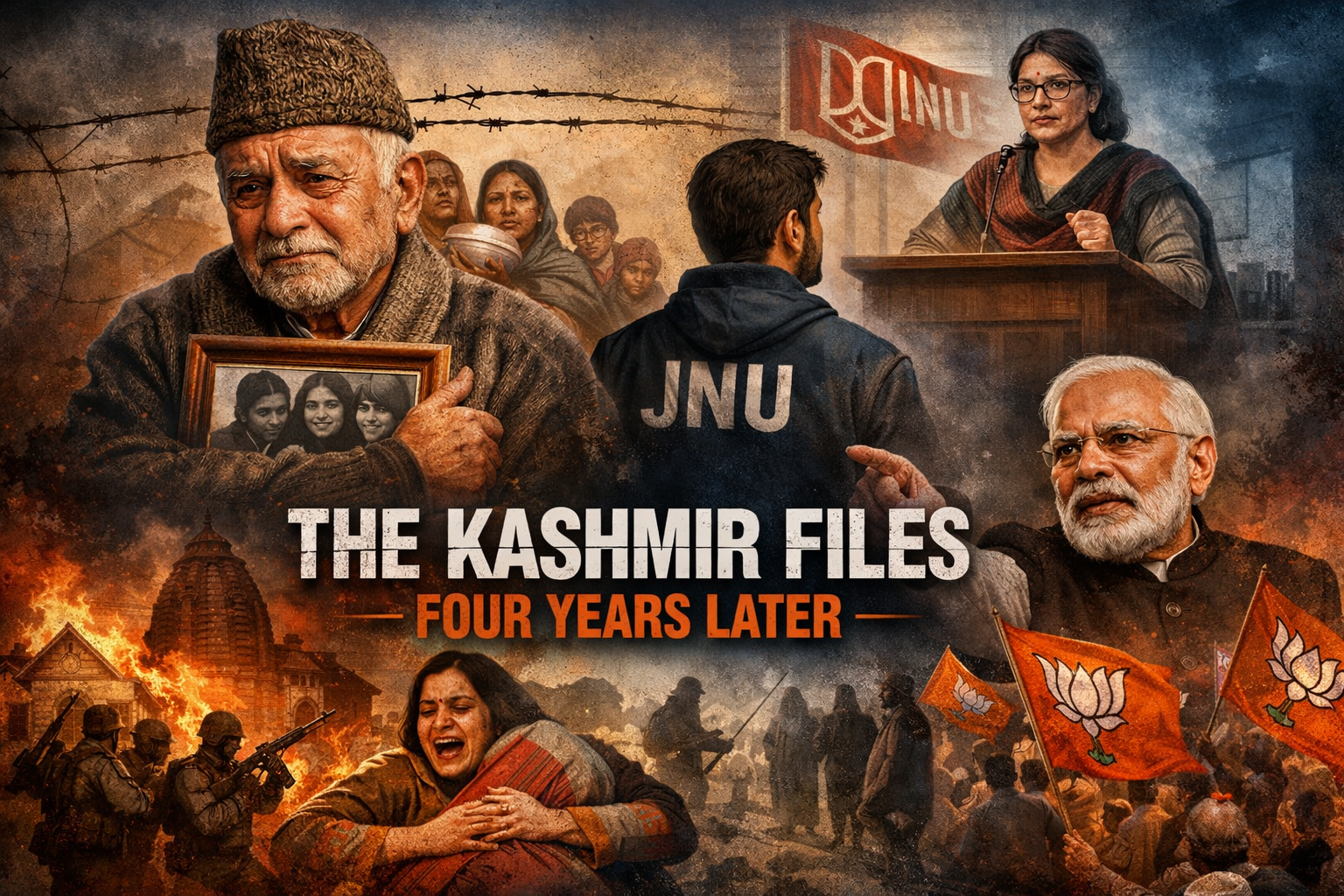

Four years after its theatrical release, The Kashmir Files remains one of the most polarizing cultural artifacts in modern Indian history. The 2022 Hindi-language drama, directed by Vivek Agnihotri, claimed to expose the “untold story” of the 1990 exodus of Kashmiri Hindus from India-administered Kashmir — a community of approximately 500,000 people forced to flee their ancestral homeland during the rise of armed insurgency.
To its supporters, the film was a long-overdue reckoning — a cinematic truth-telling that broke a decades-long conspiracy of silence. To its critics, it was a piece of calculated propaganda, weaponized by the ruling Bharatiya Janata Party (BJP) to stoke majoritarian sentiment and vilify an entire region and its people.
The numbers tell one story: a modest budget of approximately $1.8–3 million USD and a worldwide box office collection exceeding around $41 million USD, alongside tax-free status in more than a dozen BJP-ruled states. But the numbers alone do not capture the anguish, the anger, or the enduring wounds that the film reopened — and, for many, deepened.

The Historical Wound: What Happened in 1990?
Between 1989 and 1991, as an armed insurgency demanding independence from India or merger with Pakistan took root in the Kashmir Valley, approximately 65,000 families overwhelmingly Kashmiri Pandits, an upper-caste Hindu minority fled their homes. Many left in the dead of night, abandoning centuries-old homes, temples, and livelihoods. The trigger was a wave of targeted killings, intimidation, and a chilling ultimatum reportedly issued by militant groups: “Convert, leave, or die.”
The exodus is an undisputed historical fact. What remains disputed is the scale, the intent, and the responsibility. For the displaced Pandits scattered across India and the diaspora, 19 January 1990 is observed as Exodus Day — the date of one of the darkest nights in the valley, when mass flight began in earnest. Some estimate the death toll of Pandits killed during the insurgency at approximately 400 to 500, though exact figures remain contested.
Agnihotri and his team have claimed to have interviewed nearly 700 survivors, gathering material for three years before production began. “All 500,000 people were forced to leave because of killings and rapes. They now are scattered all over the world. They never spoke about this,” Agnihotri told the Golden Globes. “We interviewed almost 700 people who survived, talked with historians, and read books and press reports of that time”.


But the film’s historical accuracy has been sharply questioned. The Quint, in a detailed fact-check, noted several “glaring deviations” from the known timeline. For instance, the film suggests that a threat issued by a local Urdu newspaper, Al-Safa, warning Pandits to leave within two days, preceded the exodus. In reality, that headline appeared on 14 April 1990 — nearly three months after 19 January, the night the mass flight began.
The Film’s Narrative: A Grandson’s Quest for Truth
The Kashmir Files follows Krishna Pandit (Darshan Kumar), a Kashmiri Hindu college student studying at Jawaharlal Nehru University (JNU) in New Delhi. Raised by his exiled grandfather, Pushkar Nath (Anupam Kher), Krishna has been told that his parents died in a car accident. After his grandfather’s death, Krishna embarks on a journey back to Kashmir to uncover the truth.
The narrative alternates between two timelines: the violence of 1990, where militants storm homes and commit atrocities, and the ideological battle of the present, represented by a pro-separatist JNU professor (Pallavi Joshi) whom the film portrays as an apologist for terrorism. Krishna, caught between these competing narratives, must decide whose version of history to believe.


Critics have pointed to the film’s stark Manichaeism. Writing for Pakistan Today, one reviewer called the characters “not people but loglines” — cardboard cutouts of virtue and vice. “Pushkar: a devout and peaceful Hindu, Krishna: a naïve and ‘liberal’ student, Radhika: a manipulative and agenda-driven professor. These are not characters as much as WhatsApp forwards,” the reviewer wrote.
Yet for many in the Kashmiri Hindu diaspora, the film’s emotional power transcended its cinematic flaws. Comedian Samay Raina, a Kashmiri Pandit, posted on X (formerly Twitter) after watching the film: “I was in tears. As a Kashmiri Pandit kid who grew up safely in a different city like many of my fellow KP 90s kids, the movie really shows how brutal the genocide really was and the horrors our parents and families faced”.
Political Weaponization: The BJP’s Embrace
No analysis of The Kashmir Files is complete without examining its political utility. Within days of its release, the film received an unprecedented endorsement from the highest office in the land.
Prime Minister Narendra Modi addressed his BJP parliamentary party meeting on 15 March 2022, praising the film and slamming what he called a “campaign to discredit” it. “They are shocked that the truth that they tried to suppress is now coming out with the backing of facts and efforts,” Modi said. “The whole ecosystem opposes anyone who tries to show the truth”.
BJP-ruled states, including Uttar Pradesh, Gujarat, Karnataka, Madhya Pradesh, and Haryana, declared the film tax-free, effectively subsidizing its viewership. Home Minister Amit Shah urged citizens to watch the film to “learn how atrocities and terror gripped Kashmir during Congress rule,” explicitly framing the film as a political indictment of the opposition party.
Opposition figures reacted with alarm. Farooq Abdullah, former chief minister of Jammu and Kashmir and a National Conference leader, accused the government of using the film to incite hatred. “They want to further penetrate people’s hearts with hatred. They are saying that every policeman and soldier… everybody should see this movie so that they hate us to the extreme, as was in the Germany that Hitler and Goebbles created,” Abdullah said. “Six million Jews had to pay the price then. How many will have to pay the price in India, I don’t know”.
The film’s central claim — that the exodus constituted a “genocide” — has been the subject of intense semantic and legal debate. While some Kashmiri Pandit organizations use the term to demand justice and rehabilitation, others argue that the scale of deaths (approximately 400–500) does not meet the international legal definition of genocide under the UN Convention. Wikipedia notes that the film “presents a fictional storyline” but “depicts the exodus and the events leading up to it as a genocide”.
The Propaganda Debate: Truth or Tactic?
The question of whether The Kashmir Files is a documentary or a work of fiction lies at the heart of its controversy. Agnihotri has consistently claimed the film is “based on true stories” and “backed by facts.” Yet the film carries no disclaimer stating that events have been dramatized, and several sequences — including the infamous “saw machine” scene — have been criticized as exaggerated or unverified.
Agnihotri told the Golden Globes about the emotional impact on survivors: “The woman who was cut alive in a saw machine. Her family had never spoken about it amongst themselves. Now, after seeing the film, they made a video call and spoke with each other. Now, we are starting to heal”. Such testimonies, if true, speak to the film’s power as a vehicle for collective catharsis. But critics argue that emotional authenticity does not substitute for factual precision.
Israeli filmmaker Nadav Lapid, head of the jury at the International Film Festival of India (IFFI) in 2022, publicly criticized the film’s inclusion, calling it “propaganda in a vulgar trope purporting to empathise with a great tragedy that befell the minority Brahmin community in predominantly Muslim Kashmir”. Bollywood actor Gulshan Devaiah went further, accusing Agnihotri of “exploiting somebody’s pain and trauma” through his marketing strategy, which prominently featured footage of real survivors.
Beyond the Film: The Documentary Sequel
In August 2023, Agnihotri and his actor-producer wife Pallavi Joshi released The Kashmir Files: Unreported, a seven-episode documentary series on the Zee5 streaming platform. The series purported to delve deeper into the historical, ethnical, and geopolitical details of the exodus, featuring survivor testimonies, archival footage, and conversations with historians and experts.
But critics found the series to be more of the same. Cinema Express gave it two stars out of five, noting that each episode played with a disclaimer stating: “None of the statements expressed claims accuracy or factuality, and none is authenticated or substantiated by any court or any authority.” The review concluded: “Like the film, here also, Vivek Agnihotri fails at an unbiased and unpolarised view”.
2026: The Film’s Legacy in Real Time
Four years later, The Kashmir Files continues to surface in public discourse. In January 2026, the film was re-released in theatres to commemorate Kashmiri Hindu Exodus Day, with Agnihotri announcing on social media: “This is the first time ever a film is releasing twice in a year”.
In April 2026, a new controversy erupted when IPL anchor Sahiba Bali, a Kashmiri herself, faced intense online backlash after resurfaced clips showed her calling The Kashmir Files a “propaganda” film. The controversy was amplified by her remarks praising Pakistan, with social media users linking her comments to the 2008 Mumbai attacks and the broader historical trauma of Kashmiri Hindus. Samay Raina, her friend and collaborator, found his own 2022 praise of the film going viral in contrast, further polarizing the online debate.
The episode illustrates a broader phenomenon: The Kashmir Files has become a cultural shibboleth — a litmus test of political allegiance in India’s deeply polarized digital ecosystem.
The Unanswered Questions
For all the debate, several fundamental questions remain unanswered. Did the Indian state fail the Kashmiri Pandits in 1990? Undoubtedly. Was the exodus a genocide, a forced displacement, or something in between? The answer depends largely on which survivors you ask and which legal definition you apply. Has the film helped or harmed the cause of justice for displaced Pandits? Even that is disputed.
What is not disputed is that approximately 65,000 families lost their homes, their temples, and their sense of belonging. Many still live in refugee colonies in Jammu, Delhi, and other Indian cities, waiting for rehabilitation that has never fully materialized. The Kashmiri Pandit community, once a vibrant and integral part of the valley’s cultural fabric, has been reduced to a scattered diaspora.
Farooq Abdullah, in his critique of the film, called for a truth commission — not just for the Pandits, but for the Sikhs and Muslims who also suffered during the 1990s insurgency. “My MLAs, my workers, my ministers — we had to pick their meat from treetops. That was the situation,” he said. It was a rare acknowledgment that the tragedy of 1990 had no single victimhood — that the valley itself bled in ways that no single film could ever fully capture.
Conclusion: A Film, Not a Verdict
The Kashmir Files is not a documentary. It is not a work of objective journalism. It is a piece of cinema — passionately argued, narratively manipulative, and deeply effective at what it sets out to do: force a national conversation about a suppressed history. Whether that conversation leads to justice or to further division remains an open question.
What is certain is that the wounds of 1990 have not healed. And until the displaced are rehabilitated, the perpetrators — on all sides — are held accountable, and the valley finds a path toward genuine reconciliation, films like The Kashmir Files will continue to serve not as answers, but as battlefields.