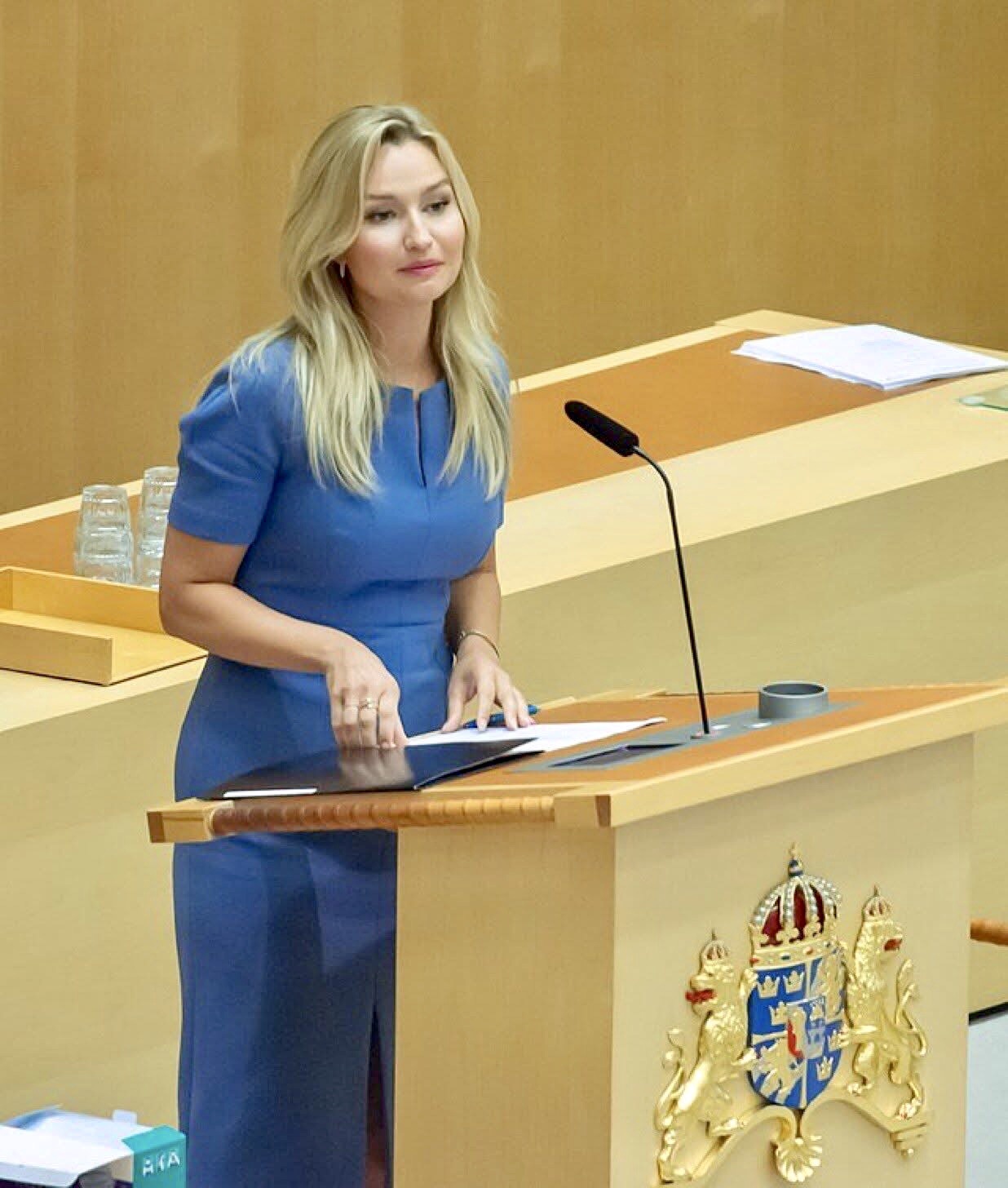

Stockholm | Srinagar – Ebba Busch, the leader of Sweden’s Christian Democrats and Deputy Prime Minister, has become one of the most prominent and controversial political figures in Europe. Known for her blend of conservative Christian values and modern populist rhetoric, Busch’s rise to power in Sweden marks a significant moment in the shifting dynamics of European right-wing politics. As Europe faces increasing political polarization and social unrest, her influence continues to grow, both in Sweden and abroad.
Born Ebba Elisabeth Busch-Christensen on February 11, 1987, in Uppsala, Sweden, she was raised in a family that deeply valued Christian ethics. Her early life was shaped by a strong sense of community and faith, values that would later define her political career. From a young age, she demonstrated a keen interest in politics, joining the Christian Democrats (KD) in her twenties. She later pursued political science and peace and conflict studies at Uppsala University, laying the groundwork for her future leadership. It was clear early on that Busch possessed both the charisma and intellect to make a significant mark on Swedish politics.
Busch’s breakthrough came in 2015 when, at just 28 years old, she was elected leader of the Christian Democrats, one of Sweden’s traditionally center-right parties. Under her leadership, the party began to rebrand itself, shifting its focus from primarily Christian values to a broader conservative platform. She emphasized issues such as law and order, lower taxes, and a more restrictive immigration policy, attracting a significant portion of voters dissatisfied with Sweden’s mainstream political parties. Busch’s energetic communication style, both in the media and on social platforms, played a crucial role in revitalizing the party and bringing it back into national prominence.

The Azadi Times
No state grants. No corporate lobby. Just ground‑truth reporting from Kashmir & beyond
You make this possible.
Her leadership was further solidified in the 2022 Swedish elections, when the Christian Democrats managed to retain their position in a fragile right-wing coalition government led by Ulf Kristersson of the Moderate Party. Busch was appointed as Deputy Prime Minister and Minister for Energy, Business, and Industry. In this new role, she faced some of Sweden’s most pressing issues, including the transition to renewable energy and the global energy crisis exacerbated by the war in Ukraine. While Busch’s advocacy for nuclear energy and industrial growth has earned her praise for strengthening Sweden’s energy security, it has also drawn criticism from environmental groups who believe her focus on nuclear power undermines Sweden’s climate goals.
One of the defining aspects of Busch’s political identity is her stance on immigration. Over the years, she has shifted the Christian Democrats’ position from a more compassionate, Christian-inspired policy to a tougher, more nationalist approach. Her rhetoric on immigration focuses heavily on issues of assimilation and integration, with an emphasis on law and order. She often links the rise in gang violence and crime to Sweden’s immigration policies, framing the narrative as one of failed integration and cultural dislocation. While her views have resonated with a significant portion of the Swedish electorate, they have also sparked intense debate within the country and beyond, particularly as Europe grapples with its own immigration challenges.
Busch’s communication style is undeniably one of her greatest strengths. She has mastered the art of using social media to convey her messages directly to voters, bypassing traditional media channels. Her viral social media posts, often accompanied by confident speeches and polished videos, have made her a familiar face across Europe. However, her populist rhetoric and occasional controversial statements have sparked criticism, particularly from those who accuse her of simplifying complex issues and deepening societal divisions. Despite this, her ability to connect with a broad swath of voters, especially those disillusioned with the establishment, has made her an influential figure in European politics.


Her career has not been without its share of controversies. One of the most notable incidents occurred in 2020 when Busch was involved in a legal dispute over the purchase of a house from an elderly man, a case that led to allegations of deceptive practices. While the controversy briefly affected her reputation, Busch’s resilience in the face of adversity only seemed to strengthen her political standing. Critics argue that such incidents reveal a more complex and less transparent side to her political persona, while her supporters maintain that the media has unfairly targeted her.
As of mid-2025, Ebba Busch remains a key player in Swedish and European politics. As Deputy Prime Minister, she continues to advocate for her vision of a stronger, more secure Sweden, one that prioritizes national interests over European integration. Her emphasis on nuclear energy, tougher immigration policies, and a growing focus on economic growth make her a polarizing figure, but also one who is shaping the future of Swedish conservatism. The challenges ahead for her include addressing Sweden’s economic pressures, dealing with climate activists’ demands for faster action on climate change, and navigating her political alliances, particularly with the far-right Sweden Democrats.
Globally, Ebba Busch is increasingly being viewed as a symbol of the new wave of European conservatism, one that seeks to blend traditional values with populist rhetoric. From Italy’s Giorgia Meloni to France’s Marine Le Pen, Busch is part of a growing network of right-wing leaders who are reshaping the political landscape across the continent. Her influence extends beyond Sweden, and she is now seen as a potential leader on the European stage, capable of uniting conservative forces across the continent.

As Europe prepares for the next round of elections and political realignments, Ebba Busch’s future remains uncertain, but her impact is undeniable. For Sweden, she represents a new chapter in the evolution of its conservative politics, one that is more assertive, populist, and in tune with the changing tides of European nationalism. For Europe, she is part of a broader trend that is shifting the continent’s political identity, as traditional parties adopt more nationalist and populist stances to appeal to an increasingly disenchanted electorate. As the world watches, it is clear that Ebba Busch will continue to play a central role in shaping the political future of Sweden and Europe.