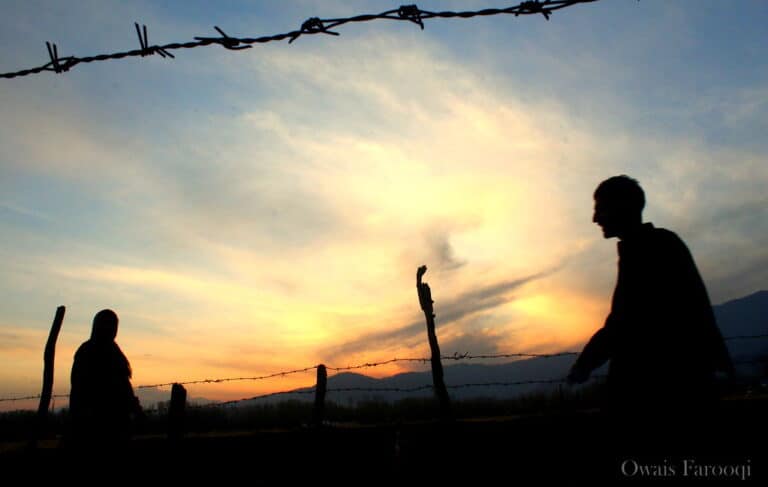



Hunza is often celebrated as a breathtaking tourist destination, a valley of snow-capped peaks, apricot blossoms, and unmatched hospitality. Yet beneath the postcard image lies a deeper truth. Nestled in the northern reaches of Gilgit-Baltistan, Hunza is part of the wider disputed territory of Jammu and Kashmir, a region divided for decades but bound together by shared geography, culture, and history.
For the world, Hunza may appear on Instagram feeds as an untouched paradise. But for its people, life here is a daily balance of resilience and uncertainty shaped by political ambiguity, fragile ecologies, and the enduring struggle to protect identity.
This story is not just about landscapes; it is about people. It is about farmers tending their orchards, women opening classrooms in remote valleys, and communities striving to hold on to traditions in a rapidly changing world. Hunza’s narrative is part of the larger Kashmir story — one too often absent in mainstream coverage.

The Azadi Times
No state grants. No corporate lobby. Just ground‑truth reporting from Kashmir & beyond
You make this possible.
A Historical Crossroads
For centuries, Hunza stood as a vital crossroads of civilizations. Once a small princely state, it lay along the ancient Silk Road, linking Central Asia with South Asia. Traders, monks, and explorers passed through its valleys, leaving behind a mosaic of languages, ideas, and traditions.
During the colonial era, Hunza’s strategic position gained prominence in the “Great Game” between imperial Britain and Tsarist Russia. The valley’s fate — like that of the entire Jammu and Kashmir region — was shaped less by its people and more by geopolitical rivalries.
Today, Hunza lies within Gilgit-Baltistan, a region administered by Pakistan but claimed as part of the wider state of Jammu and Kashmir. Its people remain without full constitutional rights, navigating life between competing sovereignties. For them, identity is not a legal label; it is a living bond — tied to culture, memory, and belonging within the wider Kashmiri narrative.



Culture and People
What makes Hunza extraordinary is not only its geography but its people. The Hunzakuts, as they are often called, are known for their warmth, resilience, and unique traditions.
Language and Identity
Burushaski, Wakhi, and Shina are among the languages spoken in Hunza — each carrying centuries of history. These languages have survived despite little state support, testifying to the community’s determination to preserve its cultural heritage. Linguists often describe Burushaski as a “language isolate,” meaning it has no known relatives, which makes Hunza a living museum of linguistic history.
An elder from Hunza told The Azadi Times:
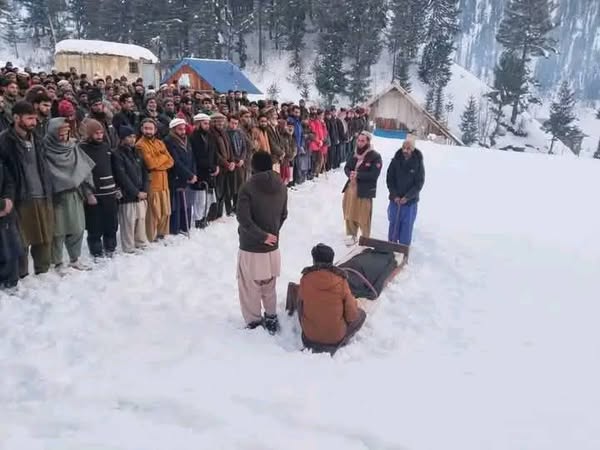
“Our language is our soul. If Burushaski dies, a part of Hunza will die with it. We teach it to our children not because the government supports us, but because it is our duty.”
Traditions and Festivals
From spring blossom festivals to traditional dances, Hunza’s culture reflects a fusion of Central Asian, Tibetan, and Kashmiri influences. In April, the valley bursts into color as apricot blossoms cover the landscape, celebrated with music, food, and community gatherings. Traditional polo matches — often played without rules in the old style — draw crowds from neighboring valleys.
Hospitality is not just a custom but a way of life. Strangers are treated as honored guests, often invited for tea or a meal even without prior acquaintance.
A young guide in Karimabad explained to The Azadi Times:
“We don’t see tourists as outsiders. For us, every guest is a blessing. Maybe that’s why people keep coming back to Hunza — not just for the mountains, but for the people.”
The Myth of Longevity
Hunza often makes headlines for the remarkable longevity of its people, with some reports claiming average lifespans of over 100 years. While such claims are exaggerated, there is truth in the fact that Hunza’s lifestyle — based on organic food, fresh mountain air, and daily physical activity — contributes to health and vitality.
Doctors working in Gilgit-Baltistan suggest that diets rich in apricots, walnuts, and locally grown grains have long played a role in community health. The image of Hunza as the “Valley of Eternal Youth” may be a myth, but it reflects a real admiration for the community’s healthy way of life.
Tourism
In recent years, Hunza has become a major tourism hub. Pakistan markets it as a crown jewel of its northern areas, and foreign travelers increasingly flock to its valleys.
The Boom
From Karimabad to the iconic Passu Cones, the breathtaking landscapes have made Hunza one of the most photographed places in South Asia. Guesthouses and boutique hotels have mushroomed across the valley, creating jobs and opportunities for the youth. Many young people now work as guides, translators, or entrepreneurs, offering everything from trekking tours to eco-lodges.
A local hotel owner shared with The Azadi Times:
“Ten years ago, there were only a handful of guesthouses here. Now every family is trying to open one. Tourism has changed our economy, but it has also changed our way of living.”
The Challenge
But this rapid boom also comes with challenges:
Environmental pressure: Unchecked construction threatens to scar the valley’s fragile ecosystem. Waste management has become a growing concern as thousands of tourists visit each year.
Cultural dilution: Traditional ways of life risk being overshadowed by commercialized versions designed for tourists.
Economic inequality: While some families profit from hotels and tour services, others are left behind, widening social gaps.
A young activist in Hunza told The Azadi Times:
“Tourism brings money, but it also brings problems. If we are not careful, Hunza will become a victim of its own beauty.”
Hunza’s story is not only one of beauty but also of a community struggling to balance modernity with tradition, economic opportunity with sustainability, and global recognition with local control.
Climate Change: The Looming Threat
Beyond politics and tourism, Hunza faces a challenge that could reshape its very existence — climate change. In this fragile Himalayan ecosystem, the effects of global warming are not distant forecasts; they are a lived reality.
Glacial Melt and GLOFs
Hunza is home to some of the world’s largest glaciers outside the polar regions, including Batura and Hopper. Rising temperatures are causing these glaciers to retreat at alarming rates. The threat of Glacial Lake Outburst Floods (GLOFs) looms over entire communities. In Attabad in 2010, a massive landslide created a lake that submerged villages, displaced thousands, and cut off vital trade routes.
A farmer from Gulmit told The Azadi Times:
“We live with fear. Every summer, we wonder if the glacier above us will burst. For outsiders, it’s just climate change. For us, it is life and death.”
Water Scarcity
Once blessed with abundant glacial water, Hunza’s communities now face seasonal shortages. Changing weather patterns have disrupted traditional irrigation systems that sustained apricot orchards and terraced fields for centuries.
Young women, often responsible for fetching water, walk longer distances as springs dry up. This hidden burden on women rarely makes it into policy discussions.
Landslides and Earthquakes
The region’s fragile geography makes it prone to natural disasters. Landslides frequently cut off the Karakoram Highway, isolating villages for weeks. Earthquakes add to the anxiety of living in a seismic zone where every tremor could mean devastation.
Despite these challenges, Hunza has little access to climate adaptation funds or disaster relief mechanisms. International agencies highlight the risks, but meaningful action remains scarce.
As one local teacher remarked:
“The world talks about saving glaciers. But nobody asks how the people under those glaciers are surviving.”
The Geopolitical Lens: Hunza and the Kashmir Dispute
Hunza’s breathtaking landscapes often mask its strategic significance. Its location places it at the heart of the larger Kashmir dispute, making it not just a valley of beauty but also of contested politics.
A Corridor of Power
The Karakoram Highway, linking Hunza to China’s Xinjiang region, is more than a road. Under the China-Pakistan Economic Corridor (CPEC), it has become a geopolitical artery that global powers watch closely. Trucks carrying goods between Kashgar and Islamabad pass through Hunza’s narrow valleys, transforming a once-isolated region into an international corridor.
For governments, this is a success story of connectivity. But for locals, it often feels like development without representation.
Marginalized Voices
Hunza lies within Gilgit-Baltistan, administered by Pakistan but historically tied to the larger state of Jammu and Kashmir. Its people remain without full constitutional rights, caught between competing sovereignties.
A student activist from Karimabad told The Azadi Times:
“We are Kashmiri when it comes to history, Pakistani when it comes to administration, and stateless when it comes to rights. Nobody asks us what we want.”
International Diplomacy vs. Local Reality
In international discussions, Hunza is reduced to a strategic corridor — a point on a map where borders, trade, and power converge. Yet on the ground, it is home to families, farmers, teachers, and artisans who simply seek dignity and recognition.
The contradiction is stark: while Hunza is photographed as a paradise for global tourists, its people often feel invisible in decisions that shape their future.
As one elder in Passu reflected:
“Mountains do not vote. Rivers do not speak. That is why outsiders can use them. But people of Hunza have voices, and one day the world must listen.”
Voices from Hunza: Stories of Resilience
Hunza’s strength lies not only in its mountains but in its people. Their stories reveal a community determined to protect its heritage while embracing change.
In Karimabad, a young woman has taken the lead in educating local girls, challenging old barriers and inspiring a new generation. Her classroom is more than a space for learning — it is a symbol of Hunza’s quiet revolution in women’s empowerment.
In the Gojal Valley, farmers continue to nurture their apricot and walnut orchards despite growing water shortages. By preserving these centuries-old agricultural practices, they are keeping alive both the economy and the cultural memory of the valley.
Meanwhile, youth-led initiatives are reshaping Hunza’s future through eco-tourism projects. Determined to defend their fragile environment from unchecked commercialization, they are showing that development can go hand-in-hand with sustainability.
These voices remind the world that Hunza is far more than a backdrop for scenic photography. It is a living, breathing community — one that faces challenges with resilience, adapts with creativity, and continues to dream of a dignified future.
Hunza stands at a crossroads. It could either become a model of sustainable tourism, cultural preservation, and environmental resilience — or it could be consumed by political neglect and ecological disaster.
For this to change, local voices must be heard in shaping the valley’s future. Internationally, Hunza deserves recognition not only as a tourist destination but as part of the unresolved Kashmir question, where communities seek dignity, rights, and representation.
Hunza Valley is more than a paradise for travelers; it is a living testament to resilience. Its snow-clad mountains whisper stories of endurance, its turquoise rivers mirror the struggles of survival, and its people embody the unyielding spirit of Kashmir’s forgotten frontiers.
For the global audience, Hunza is not just a destination but an inspiration — a call to protect fragile mountain ecologies, to value cultural diversity, and to listen to voices too often silenced in mainstream narratives.