
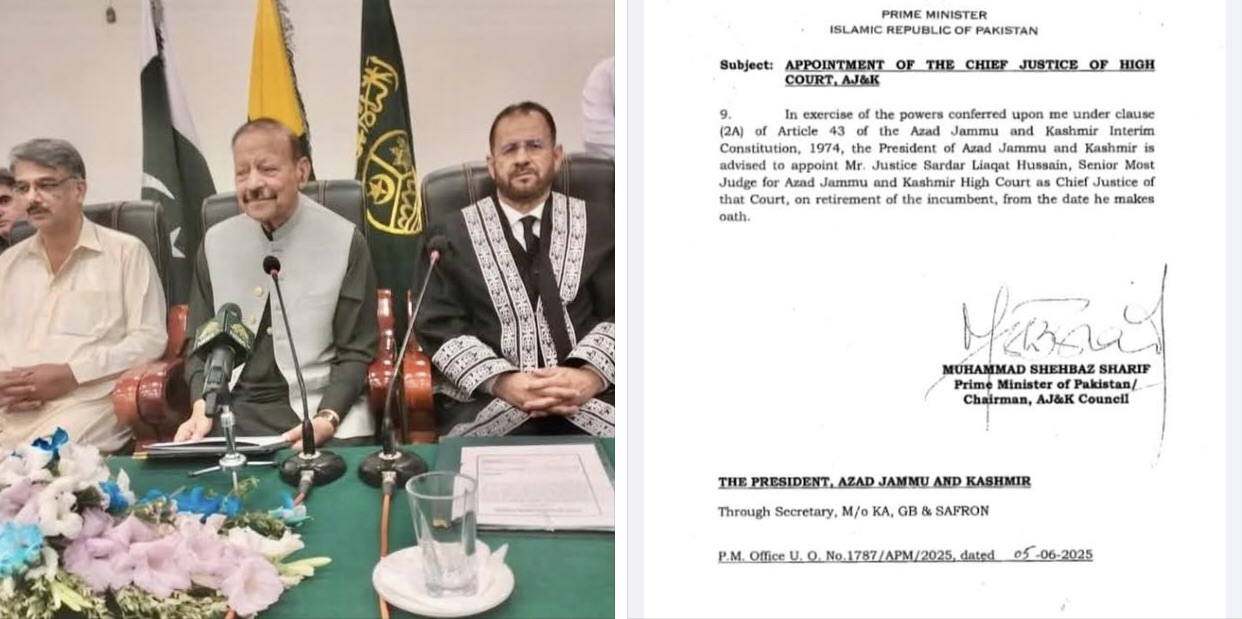

Islamabad (The Azadi Times) – Justice Sardar Liaqat Hussain was sworn in as the Acting Chief Justice of the Azad Jammu and Kashmir (AJK) High Court in a formal ceremony held at the multipurpose hall of Kashmir House, Islamabad, Pakistan. The oath was administered by Azad Jammu Kashmir (Pakistan administrated Kashmir) AJK President Barrister Sultan Mehmood Chaudhry, marking a pivotal moment for the judiciary in the region amid ongoing controversy surrounding the delay in appointing a permanent Chief Justice.
The ceremony witnessed the presence of high-ranking officials and dignitaries, including Prime Minister of AJK Chaudhry Anwar-ul-Haq, former AJK Prime Minister Sardar Muhammad Yaqoob Khan, former Supreme Court Justice Ghulam Mustafa Mughal, senior judges of the High Court, members of the AJK Assembly, and representatives from the legal fraternity, district judiciary, High Court establishment, civil society, and senior media personnel.
Justice Sardar Liaqat Hussain, after taking oath, mingled with attendees, received congratulatory messages, and was presented with floral bouquets from lawyers and citizens alike.

Legal Fraternity Expresses Concern Over Delay in Permanent Appointment
Despite the celebratory atmosphere, the event was overshadowed by rising tensions within the legal community regarding the delay in issuing a notification for the permanent appointment of the Chief Justice of AJK High Court.
According to Supreme Court Bar Association President Javed Najam Al-Thaqib Advocate and other senior lawyers, a Supreme Court ruling stipulates that a vacant constitutional position like the Chief Justice must be filled on a permanent basis within one month. The legal community argues that this timeline has not been honored, even though approval for the appointment was granted by the Prime Minister of Pakistan.
In response, the Bar Council has issued a 48-hour notice to the federal government, demanding immediate action to notify a permanent Chief Justice. Vice Chairman of the Bar Council, Aqab Hashmi Advocate, voiced these concerns during an emergency meeting, emphasizing that failure to meet the deadline could lead to a statewide protest movement.



Additionally, Secretary General of the High Court Bar Association, Zafar Umar Advocate, has begun consultations with legal representatives across the region to explore further legal and democratic options in response to the delay.
Debate Over Oath-Taking in Islamabad Sparks Public Discussion
The location of the oath-taking ceremony in Islamabad—rather than within AJK—has also stirred public debate across social media platforms, where citizens and activists questioned the symbolism and implications of holding such a significant judicial ceremony outside the territorial boundaries of Azad Jammu and Kashmir.
Some commentators argue that such actions may undermine the autonomy of AJK’s institutions, while others pointed out logistical or diplomatic justifications. Nevertheless, the topic continues to trend online, especially among pro-Kashmiri voices advocating for greater judicial independence and institutional transparency.


What Lies Ahead for the Judiciary in AJK?
Justice Sardar Liaqat Hussain’s appointment as Acting Chief Justice comes at a crucial juncture for AJK’s legal system. With mounting pressure from the Bar Councils and civil society, the delay in the permanent appointment is not just an administrative concern—it’s becoming a symbolic issue tied to legal sovereignty and institutional respect.
Observers note that the coming days will be decisive. If the federal government fails to issue a notification within the Bar Council’s deadline, the region could witness widespread protests, legal action, or even a temporary judicial impasse. On the other hand, swift action by the authorities could help restore confidence in the judicial process and strengthen the rule of law in Azad Jammu and Kashmir.
Conclusion
While the swearing-in of Justice Sardar Liaqat Hussain is a formally significant event, it has also triggered serious questions about legal procedures, institutional independence, and the broader political relationship between Islamabad and Muzaffarabad. As the situation unfolds, the eyes of the region remain on both the judiciary and the government, with hopes for a resolution that respects the constitution, judicial integrity, and the democratic will of the people of Azad Jammu and Kashmir.