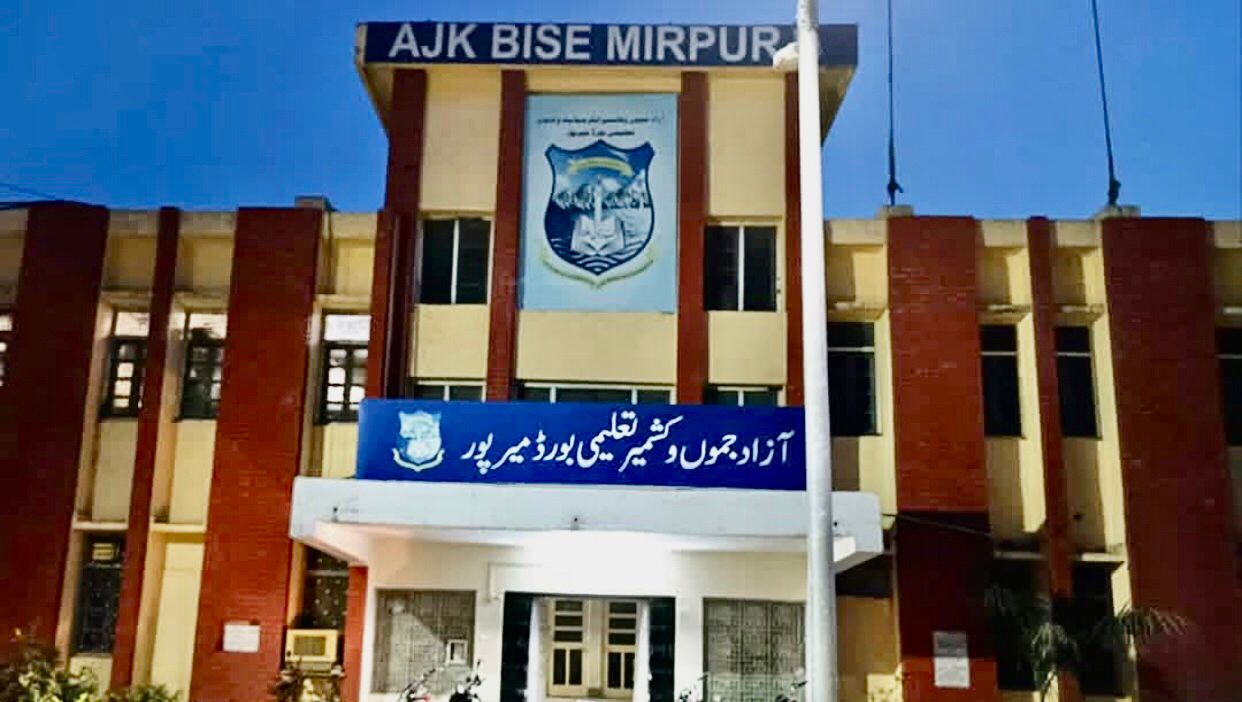

After nearly six months of delay, the results of the Intermediate First Year examinations in Pakistan-administered Jammu and Kashmir were finally announced on October 30, 2025. The announcement immediately triggered widespread outrage among students, who began voicing serious complaints. For the past two days, students have been staging continuous protests, demanding rechecking of their examination papers.
Both students and educationists have claimed that the exam papers were marked on an average-marking basis rather than according to actual performance. Students who had consistently scored above 90% in previous years were allegedly given unexpectedly low marks — and in some cases, even declared failed. Meanwhile, there were also reports that some students were marked passed in subjects whose exams they had not even attended.
Hundreds of Physics students reportedly received exactly 45 marks, while several Urdu students also received identical scores. In some cases, students who performed excellently in all other subjects were failed in Urdu or Islamic Studies. According to the protesting students, the marking and final results did not reflect their actual exam performance.
A principal of a private educational institution further alleged that only a few days before the results were announced, officials had informed him that the paper marking process was still incomplete. He claimed that, in haste, the Board simply filled in average marks to generate a “fake result” rather than completing the marking properly.
On the other hand, the Mirpur Board of Intermediate and Secondary Education (BISE) has issued two separate press releases addressing the controversy.
In the first press release, the Board dismissed the allegations circulating on social media as baseless and contrary to facts, claiming that they were an attempt to damage the institution’s reputation. The same statement confirmed that five subjects — Physics, Chemistry, Biology, English, and Computer Science — were checked through a new e-marking system. It further stated that a committee comprising subject specialists was being formed to assess the quality of the e-marking process and present a report within a week.
In another press release, the Board announced that applications for paper rechecking had been opened. Students were instructed to apply online for rechecking before November 18, paying a fee of 1,500 rupees per paper. This means that a student wishing to have seven papers rechecked would need to pay 10,500 rupees, effectively generating new revenue for the Board — ironically, to correct its own mistakes.
Normally, the purpose of examination fees is to ensure that the Board conducts the entire exam process — from paper preparation to evaluation — with transparency and accuracy. However, when the Board itself becomes the source of massive irregularities and delays, the financial and emotional burden falls unfairly upon students.
The protesting students have made several key demands:


- The establishment of paper checking centers in every district to ensure timely and accurate marking.
- Waiver of rechecking fees for all students seeking to verify their results.
- Re-marking instead of mere re-counting — meaning papers should be re-evaluated, not just have their marks added again.
- Rechecking should be conducted by different teachers from those who originally marked the papers.
- The re-examination fees for students forced to retake exams due to Board errors should be waived.
It should be noted that this was the first year the Mirpur Board experimented with computerized marking of five subjects. However, rather than saving time, the e-marking project caused further delays. Even the tenders for the e-marking software — which were once available on the Board’s website — have since been removed, raising concerns about transparency and the type of software procured.
Reportedly, the Mirpur Board launched the e-marking system in collaboration with the Punjab Information Technology Board (PITB). Yet, it took six months to check the papers of only 43,000 students, a task that previously took just two to two-and-a-half months using the manual system.
The main purpose of e-marking is to save time and minimize human error, but in this case, it achieved neither.
Once considered a model institution, the Mirpur Board of Education has seen its reputation decline sharply in recent years. There was a time when passing matriculation or intermediate exams from the Mirpur Board was seen as a mark of distinction — second only to Pakistan’s Federal Board. Today, however, the Board is repeatedly accused of irregularities in awarding top positions, negligence during paper marking, and general mismanagement. Financially, the Board continues to generate significant revenue, but its credibility in conducting fair and transparent examinations has eroded severely.
One contributing factor could be the Education Department’s flawed decision-making and inadequate curriculum reform. Additionally, the increasing population has placed extra pressure on the Board’s limited capacity.
Other systemic issues include:
- Appointment of Board chairpersons and members on political grounds.
- Political interference and incompetent recruitment practices.
- Outsourcing paper marking to teachers without verifying their qualifications or subject expertise — many of whom delegate the marking to their relatives or friends.
As a result, students who barely write anything on their exam papers end up passing, while hardworking and deserving students either get average marks or are failed unfairly.
More than 15 years ago, it was decided that two additional education boards should be established to distribute the growing workload. However, the plan was never implemented due to regional favoritism and political manipulation, which pitted communities against one another.
Recently, following legal pressures, the government signed an agreement with the Action Committee to establish two new education boards. Yet, some circles in Mirpur reacted negatively, portraying the decision as an attack on regional pride rather than a step toward academic reform and transparency. They framed it as if the creation of new boards would somehow insult Mirpur’s identity or diminish its importance.
What is truly needed, however, is swift action to create two additional education boards, designed on modern, globally recognized educational standards. These boards must adopt artificial intelligence–based systems for evaluation, combining digital marking with human analysis to enhance both efficiency and accuracy.
Moreover, Pakistan-administered Kashmir’s examination system should move away from the rote-learning model toward one based on analysis, reasoning, and application. A roadmap must be developed to gradually replace the current annual high-stakes exams with a continuous learning assessment model that measures students’ intellectual growth, creativity, and comprehension.
Examinations should no longer be treated as a punitive exercise but rather as a dialogue of learning — an opportunity to measure understanding and nurture critical thinking. Only then can the education system truly serve the purpose of building capable, independent, and intellectually mature students.