


 Rural communities face the sharpest increase as poverty deepens across all provinces
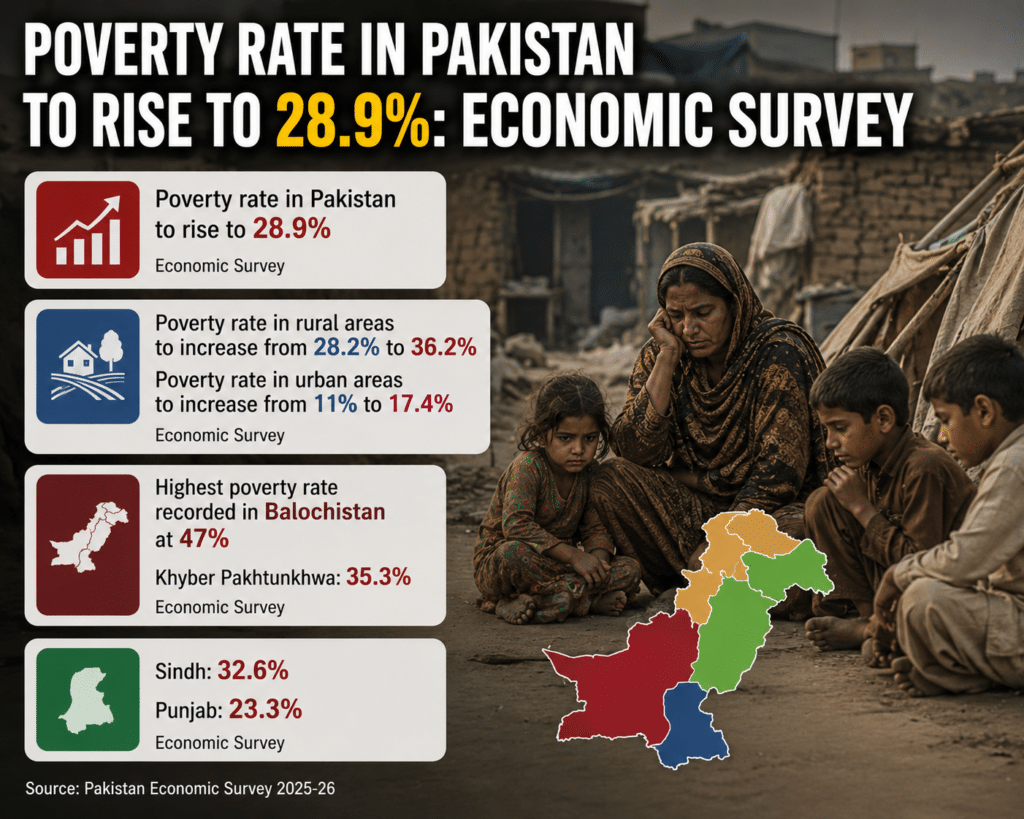
ISLAMABAD — Pakistan’s poverty rate has climbed to 28.9 percent, according to findings presented in the latest Economic Survey, underscoring the growing economic challenges confronting millions of households amid inflation, rising living costs, and slowing income growth.
The survey paints a concerning picture of economic hardship across both urban and rural areas. Rural poverty recorded the sharpest increase, rising from 28.2 percent to 36.2 percent, while urban poverty increased from 11 percent to 17.4 percent.
The data highlights significant regional disparities. Balochistan continues to record the highest poverty rate in the country at 47 percent, followed by Khyber Pakhtunkhwa at 35.3 percent. In Sindh, the poverty rate stands at 32.6 percent, while Punjab recorded the lowest rate among the provinces at 23.3 percent.
Economists say the figures reflect the cumulative impact of prolonged inflation, reduced purchasing power, energy price increases, and economic instability that have affected households across the country in recent years.
The widening gap between urban and rural communities is likely to be of particular concern to policymakers. Experts warn that increasing poverty levels could place additional pressure on public services, healthcare, education, and employment sectors unless comprehensive economic reforms and targeted social protection measures are introduced.


The latest figures come at a time when Pakistan continues to face broader economic challenges, including fiscal pressures, debt obligations, and efforts to stabilize growth while addressing the cost-of-living crisis.
Analysts note that poverty statistics are not only economic indicators but also measures of social well-being, making them critical for assessing the effectiveness of development policies and government welfare programs.
The survey’s findings are expected to fuel debate among economists, policymakers, and civil society groups over the direction of economic policy and the need for stronger interventions to support vulnerable communities.