
No state backing. No paywalls. Just truth. Support Kashmir's independent voice. Join 2,400+ patrons who fund independent voices.
Zero Paywalls
Reader Funded
Award Winning
Secure Payment
Encrypted
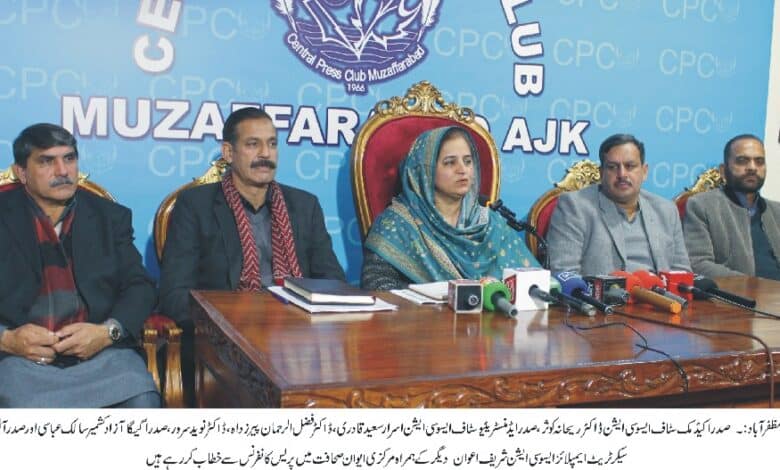
Muzaffarabad, Pakistan administrated Kashmir — Academic and administrative staff of the University of Azad Jammu and Kashmir (UAJK) have issued a final deadline of 1 February 2026 to the university authorities and the Azad Kashmir government to resolve the institution’s long-standing financial crisis, warning that failure to meet their demands will result in the complete shutdown of all five university campuses and a march towards the Legislative Assembly on 2 February 2026.
The announcement was made during a joint press conference held at the Central Press Club in Muzaffarabad by representatives of the Academic Staff Association (ASA), Administrative Staff Association (AdSA), and major employee unions. The protest movement has also received formal backing from the All Government Employees Association (AGEGA) Azad Kashmir and the All Secretariat Employees Association, significantly broadening the scope of the agitation across the state.
Addressing the media, ASA President Dr Rehana Kausar, AdSA President Israr Saeed Qadri, along with senior faculty members Dr Fazal-ur-Rehman Pirzada, Dr Naveed Sarwar, and union leaders Shakil Bashir Awan, Raja Siraj, Imtiaz Ali Butt, Salik Abbasi (President AGEGA AJK) and Sharif Awan (President All Secretariat Employees Association) said the university is currently facing a financial deficit exceeding PKR 1 billion, pushing employees into severe economic and psychological distress.
Salary Increments Withheld, Retirees Without Pensions
Despite approved salary increases in the 2025–26 fiscal year, university employees and faculty members have not received the revised pay scales. More than 30 retired employees remain deprived of pension payments, leave encashment, and post-retirement benefits. Several families of deceased employees have not received assistance under the official family support package due to the unavailability of funds.
Union leaders further disclosed that numerous employees suffering from life-threatening illnesses such as cancer, heart disease, and kidney failure are unable to access medical treatment because their medical bills remain unpaid.
“The uncertainty has pushed employees into extreme anxiety,” speakers said, adding that salary arrears promised between 15 October and 25 October 2025 were never paid despite repeated assurances.
A Historic Institution Under Financial Strain
Founded in 1980, the University of Azad Jammu and Kashmir is the oldest and largest public university in the region, having educated hundreds of thousands of students who now serve in Pakistan, Azad Kashmir, and abroad. Currently, thousands of students are enrolled across its campuses, and the university continues to play a central role in higher education and academic research within the state.
However, the speakers traced the roots of the financial crisis back to 2009, when the Mirpur campus was granted the status of an independent university. Similar decisions followed for the Poonch campus in 2012 and the Kotli campus in 2014. According to union representatives, these transitions were carried out without proper financial planning, while valuable assets worth billions of rupees were transferred to the newly established universities, leaving UAJK burdened with ongoing financial liabilities.
The situation was further aggravated by a decline in student enrolment, significantly reducing the university’s internal revenue. Despite these challenges, the institution continued to operate within its limited means until 2017, when the implementation of Pakistan’s 18th Constitutional Amendment devolved higher education funding responsibilities to provincial governments. Following this shift, UAJK’s government grant was effectively frozen.
“A Mockery of Funding”
Union leaders strongly criticized the Azad Kashmir government for providing an annual grant of only PKR 3.5 million to the state’s largest university, calling it “a mockery” and “institutional neglect.” They stressed that globally, governments remain responsible for the financial sustainability of public universities, especially where assets have been redistributed through state policy decisions.
Due to this prolonged funding gap, UAJK has been unable to pay annual salary increments on time for the past four to five years. Salary increases approved in 2023 were paid in 2024, with arrears released as late as September 2025. The 2024 increment was paid after a four-month delay, while the 2025 salary increase remains unpaid even after seven months, despite timely payments across other government departments and universities in Azad Kashmir.
Escalation of Protest
Faculty members and staff have already been observing a partial boycott of teaching and administrative activities for over a week. However, they say neither university authorities nor government officials have responded meaningfully.
Letters requesting emergency financial intervention have previously been sent to the Azad Kashmir government by current and former Vice Chancellors, the President of the State, and the Chairman of the Higher Education Commission, but no concrete action has followed.
In light of continued inaction, the Academic and Administrative Staff Associations have issued an ultimatum: if the financial crisis is not resolved and payments are not released by 1 February 2026, all five campuses of the University of Azad Jammu and Kashmir will face a complete academic and administrative shutdown from 2 February 2026, accompanied by mass protests at the Chehla Campus and a march to the Legislative Assembly. The unions warned that the protest movement could expand beyond university premises if their demands remain unmet.
A Test for Governance and Higher Education Policy
Observers note that the unfolding crisis poses a serious challenge to governance, higher education policy, and social stability in Azad Jammu and Kashmir. With strong union backing and growing public sympathy, the dispute is rapidly emerging as a state-wide issue, raising concerns over the future of public higher education and the welfare of academic workers in the region.
For now, the coming weeks will determine whether dialogue and funding intervention can avert a full-scale shutdown of Azad Kashmir’s premier university.
Trending Topics


The Azadi Times is an independent digital news platform based in Muzaffarabad, Kashmir, dedicated to credible journalism, in-depth reporting, and global analysis. We cover Kashmir, South Asia, and international affairs with a commitment to truth, editorial integrity, and public accountability.
Get important news delivered directly to your inbox and stay connected!
© 2026 The Azadi Times. All Rights Reserved.