Wednesday, April 1, 2026
10.1 C
Srinagar
Home Blog Page 105

Kashmir Apple: Everything You Need to Know – Varieties, Rates, Quality & Benefits

0

With Kashmir crisp mountain air, mineral-rich soil, and a climate that alternates between warm days and cool nights, Kashmir has become a powerhouse of apple production, supplying markets across Asia, the Middle East, and Europe. The Kashmir apples are prized for their exceptional sweetness, rich aroma, and distinct crunch, making them a staple in homes and marketplaces worldwide.

Beyond their economic value, Kashmiri apples hold deep cultural and historical significance, shaping the lives and livelihoods of generations of orchardists who have mastered the art of apple farming over centuries.

Apple Season in Kashmir: A Spectacular Harvest

The apple season in Kashmir typically begins in late summer and extends through the autumn months, from August to October. During this period, the valleys and mountains of Kashmir turn into an expansive canvas of vibrant reds, greens, and yellows as apples ripen under the cool, crisp air and abundant sunshine of the region. Kashmir’s temperate climate and well-irrigated soil create the perfect conditions for apple cultivation, and it is no surprise that these apples are renowned for their sweet, juicy flavor and unmatched crispness.

The Apple Gardens of Kashmir

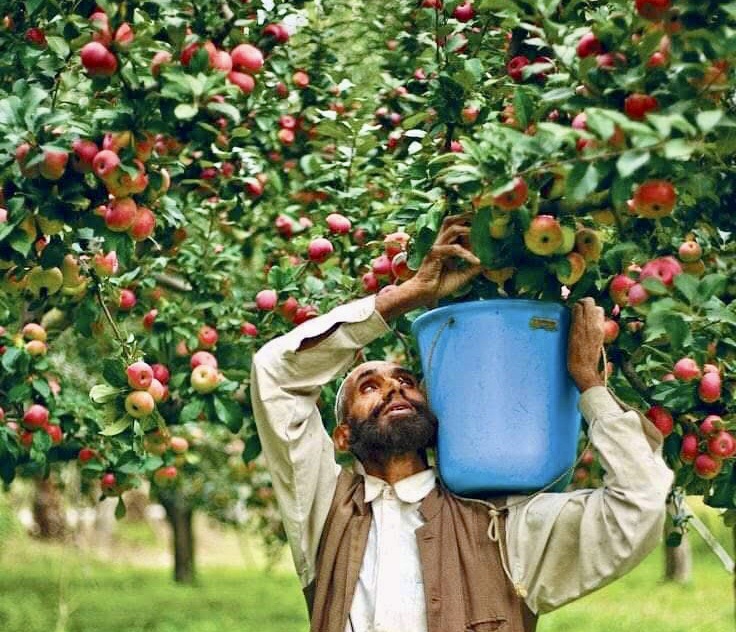
Kashmir’s apple gardens are spread across the stunning valleys of Srinagar, Pulwama, Shopian, and Anantnag, among others. These orchards, often surrounded by snow-capped mountains and lush meadows, offer a peaceful retreat for both locals and visitors. The apple trees, laden with fruit, provide a picturesque sight, especially during harvest time. Many of these gardens have been in operation for generations, with families passing down the knowledge and techniques of apple cultivation from one generation to the next.

Apple Town of Kashmir: Shopian, the Heart of Kashmir’s Apple Industry

Shopian, a district in the Kashmir Valley, is often referred to as the “Apple Town” of Kashmir. The region produces a significant percentage of Kashmir’s total apple crop, and its apples are exported worldwide. Known for their vibrant color and exceptional taste, apples from Shopian are some of the most prized in the global market. During the harvest season, the town and its surrounding areas bustle with activity as thousands of workers hand-pick the ripened fruits, which are then packed and shipped to different corners of the globe.

Why Kashmir Apples Stand Out: A Unique Blend of Taste and Quality

Kashmir apples are distinct due to several factors. The region’s soil, rich in minerals, coupled with the cool climate, results in apples that are firm, crisp, and packed with flavor. Varieties such as the “Kashmiri Red Delicious,” “Kala Kulu,” and “Golden Delicious” are particularly popular among consumers. These apples are not only a treat for the taste buds but are also known for their long shelf life, which is a major advantage for international exports.

In addition to their exceptional quality, Kashmir apples are grown without excessive use of pesticides and chemicals, making them a natural, healthier option for consumers worldwide. Many orchards in Kashmir have adopted organic farming methods, further enhancing the appeal of these apples in international markets.

A Guide to the Best Apples from Kashmir

Due to Jammu Kashmir’s cold climate and fertile soil, Kashmiri apples have a distinct flavor and longer shelf life, making them highly sought after in both domestic and international markets. Below are some of the most popular apple varieties cultivated in Kashmir:
Kashmiri Apple Varieties & Their Features

Apple VarietyColor & AppearanceTaste & TextureHarvesting SeasonExport Demand
Ambri AppleGreenish-red, medium sizeCrisp, aromatic, sweet-tartOctober – NovemberHigh (Gulf countries, Europe)
Maharaji AppleDeep red, largeDense, rich sweetnessSeptember – OctoberPremium export quality
Kashmir Golden AppleGolden-yellow, smooth skinSoft, juicy, honey-like flavorSeptember – NovemberHigh (Middle East, Europe)
Delicious AppleBright red, shinyCrunchy, mildly sweetAugust – OctoberPopular (India, UAE, Bangladesh)
American AppleSmooth, uniform redSweet, crisp, juicySeptember – OctoberHigh (Supermarkets, exports)


Kashmir: A Land Beyond Boundaries

While the region is often subject to geopolitical discussions and disputes, it is crucial to recognize that Kashmir, in its natural and cultural essence, is a unique and independent entity. The international community generally regards Kashmir as a disputed region, with both India and Pakistan claiming sovereignty over the territory. The people of Kashmir, however, have a rich and diverse heritage that transcends borders, and their agricultural practices, especially apple cultivation, play a significant role in the region’s economy.

Kashmir is home to diverse communities that have lived harmoniously for centuries, and the apples they grow are a symbol of the land’s fertile nature and the resilience of its people. As an international community, it is important to appreciate Kashmir’s natural beauty and agricultural contributions beyond the political context.

Apple Mandi Rate Today in Kashmir (Updated Prices 2025)

The apple mandi rates in Kashmir fluctuate daily due to seasonal demand, export trends, and market conditions. Below are the latest rates for different apple varieties in Kashmir, converted into USD for international buyers and traders.

Latest Apple Prices in Kashmir (March 2025)

Apple VarietyPrice per Kg (INR)Price per Kg (USD)Wholesale Rate (Per Box in USD)
Kashmiri American Apple₹70 – ₹100$0.85 – $1.20$18 – $26
Kashmir Golden Apple₹80 – ₹120$1.00 – $1.45$22 – $30
Maharaji Apple₹60 – ₹90$0.72 – $1.10$17 – $24
Ambri Apple₹100 – ₹150$1.20 – $1.80$30 – $42

Note: These rates are approximate and may vary based on market conditions, export quality, and international demand. For real-time apple mandi prices, stay updated with our latest market reports.

Health Benefits of Kashmiri Apples

Kashmiri apples are not just a seasonal delight; they are a powerhouse of essential nutrients that offer a wide range of health benefits. Packed with fiber, antioxidants, and vital vitamins, these apples contribute to overall well-being and are an excellent addition to a balanced diet. Rich in vitamin C, they help strengthen the immune system, making the body more resilient against infections and seasonal illnesses.

Their high fiber content supports digestion by promoting gut health and preventing constipation while also helping in weight management by keeping you fuller for longer. The presence of potassium and flavonoids in Kashmiri apples plays a significant role in maintaining heart health by lowering bad cholesterol (LDL) and regulating blood pressure, reducing the risk of cardiovascular diseases.

Uses of Kashmiri Apples

One of the most common uses is in the fruit export industry, where these apples are highly valued for their long shelf life and superior taste. In the food sector, Kashmiri apples are used to produce apple juice, cider, vinegar, jams, and preserves, catering to both local and international markets. They are also a key ingredient in baking and desserts, including apple pies, tarts, cakes, and puddings. In traditional Kashmiri cuisine, dried apples are often used in winter months as a natural snack or added to dishes for a sweet, tangy flavor. Additionally, apple extracts are widely used in the cosmetic and skincare industry as they contain antioxidants that promote healthy skin and reduce signs of aging.

The Global Appeal of Kashmir Apples

With a growing demand for high-quality fruits, Kashmir apples have found a significant place in international markets. The United States, Europe, the Middle East, and several Asian countries import Kashmir’s apples, attracted by their premium quality and distinctive flavor. The apple industry in Kashmir supports thousands of farmers, contributing substantially to the region’s economy and livelihoods.

Frequently Asked Questions (FAQs) About Kashmiri Apples

1. Why are Kashmiri apples so famous?

Kashmiri apples are renowned for their sweet, crisp texture, rich aroma, and long shelf life. Grown in the mineral-rich soil and cool climate of Kashmir, they have a unique taste and quality that make them highly sought after in both domestic and international markets.

2. What are the different varieties of apples grown in Kashmir?

Kashmir produces several apple varieties, including the Ambri, Maharaji, Kashmir Golden Apple, Delicious Apple, and American Apple.

3. When is the apple harvest season in Kashmir?

The apple harvest season in Kashmir typically begins in August and lasts until November, depending on the variety. This period sees peak production, with fresh apples being transported to markets across India and exported worldwide.

4. What is the current apple mandi rate in Kashmir?

The price of Kashmiri apples varies based on season, quality, and market demand. On average, apple prices range between $0.85 – $1.80 per kg (USD). Wholesale rates for export-quality apples can go higher depending on the variety.

5. Where can I buy Kashmiri apples online?

Kashmiri apples are available on e-commerce platforms, online fruit markets, and specialty grocery stores that sell premium-quality apples. Many suppliers also export directly to the Middle East, Europe, and Asia.

6. Are Kashmiri apples organic?

Many orchards in Kashmir use natural and traditional farming methods with minimal chemical pesticides, making Kashmiri apples a healthier option. However, some farmers also follow certified organic farming practices to meet global organic produce standards.

7. What are the health benefits of Kashmiri apples?

Kashmiri apples are rich in fiber, antioxidants, and vitamin C, which help improve digestion, boost immunity, support heart health, and promote glowing skin. Their low-calorie content makes them a great choice for weight management.

8. Can Kashmiri apples be used for making cider or vinegar?

Yes, Kashmiri apples are excellent for making apple cider, vinegar, and juices due to their natural sweetness and high juice content. Many local and international brands use them in the production of organic apple-based beverages.

9. How do Kashmiri apples compare to Indian apples?

While both Kashmir and Himachal Pradesh produce high-quality apples, Kashmiri apples are generally sweeter, juicier, and more aromatic, whereas Himachal apples tend to be slightly firmer and tangier. The colder climate of Kashmir contributes to the crisp texture and longer shelf life of its apples.

10. How can I store Kashmiri apples to keep them fresh for longer?

To extend their shelf life, store Kashmiri apples in a cool, dry place or refrigerate them. Keeping them in a perforated bag or a well-ventilated container helps prevent moisture buildup, which can cause spoilage.

 

Controversial Fashion Show in Kashmir’s Gulmarg Sparks Outrage During Ramadan

0

SRINAGAR, Kashmir: A fashion show organized by Elle India in the picturesque resort town of Gulmarg has ignited fierce backlash across the disputed region of Kashmir, with critics accusing the event of undermining local cultural and religious sensitivities during the holy month of Ramadan.

Viral videos and images of the show, held against the backdrop of snow-capped peaks, have drawn sharp condemnation from political leaders, religious figures, and residents, reigniting debates about the balance between tourism promotion and cultural preservation.

“Shameful and Unacceptable”: Political, Religious Leaders React

The event, hosted earlier this week, featured models in Western-style attire walking a runway in Gulmarg, a popular tourist destination in the Kashmir Valley. While organizers framed it as a celebration of Kashmir’s natural beauty, critics labeled it “vulgar” and “inappropriate” for coinciding with Ramadan, a period of fasting, prayer, and reflection for Muslims.

Mirwaiz Umar Farooq, a prominent religious and political leader, issued a scathing statement:
“This is utterly shameful! A semi-nude fashion show in Gulmarg during Ramadan—when millions are observing piety has deeply hurt the sentiments of Kashmiris. Our Sufi traditions and religious values cannot tolerate such obscenity in the guise of tourism. Those responsible must be held accountable immediately.”

Chief Minister of Jammu and Kashmir, Omar Abdullah, also weighed in on social media platform X:
“The anger and shock are entirely justified. The images I’ve seen show a complete disregard for local sensitivities, especially during this sacred month. My office has contacted local authorities, and I’ve demanded a report within 24 hours. Further action will follow based on findings.”

Public Fury and Calls for Accountability

The controversy has dominated social media, with hashtags like #GulmargShame and #RespectKashmir trending. Users accused organizers of disrespecting Kashmiri culture and exploiting the region’s beauty for commercial gains.

  • Abu Bakr Pandit, a Srinagar-based activist, posted:
    “Disgraceful! How was a semi-naked show allowed in Gulmarg during Ramadan? The CEO of the Gulmarg Development Authority must explain who approved this or face legal action.”
  • Tariq Peerzada, another user, wrote:
    “If we respect others’ beliefs, why are ours ignored? This event mocks our values. It’s unacceptable!”

Cultural Clash or Tourism Promotion?

The backlash highlights the fragile intersection of globalization and tradition in Kashmir, a region with a distinct cultural identity shaped by Sufi Islam and centuries-old customs. Critics argue that while tourism is vital for the economy, events like these risk alienating local communities.

Elle India has yet to issue a public statement, but sources claim the show aimed to “showcase Kashmir’s potential as a global fashion destination.” However, many residents see it as part of a broader pattern of outsiders imposing narratives on the region.

Authorities Under Pressure

The Jammu and Kashmir administration has launched an inquiry into how permissions were granted for the event. Local officials initially defended the show as “apolitical” but now face demands for transparency.

A senior police officer, speaking anonymously, said:
“We’re reviewing whether the organizers violated any codes. If misconduct is found, legal steps will follow.”

Broader Implications

This incident underscores ongoing tensions in Kashmir, where efforts to project “normalcy” through tourism and cultural events often clash with grassroots demands for respect toward local identity. The region, claimed in full by both India and Pakistan and administered in parts by each, remains a geopolitical flashpoint.

For now, the Gulmarg controversy has added another layer to Kashmir’s complex narrative—one where snow-covered valleys and simmering discontent coexist.

The Azadi Times is an independent news platform dedicated to covering socio-political, cultural, and human rights issues in the Kashmir region.

Azad Jammu and Kashmir Set to Roll Out Internationally Compliant Driving Licenses with Enhanced Security Features

0

MUZAFFARABAD, Pakistan administrated Azad Jammu and Kashmir: Authorities in Azad Jammu and Kashmir (AJK) are finalizing plans to issue modernized, computerized driving licenses equipped with advanced security features, a move aimed at aligning the region’s documentation systems with global standards. The initiative, spearheaded by the AJK Police in collaboration with Punjab’s Information Technology Board (PITB), seeks to address the growing needs of citizens who frequently travel abroad for work, education, and other purposes.

Modernization Drive for Global Compliance

The new licenses, designed using software modeled after Punjab Police’s system, will incorporate cutting-edge security elements such as holograms, QR codes, and biometric data integration. These features are intended to reduce fraud and ensure international recognition, critical for AJK residents who often face bureaucratic hurdles overseas due to outdated or non-compliant documents.

“The transition to computerized licenses is not just about technology it’s about dignity and convenience for our citizens,” a spokesperson for AJK Police stated. “Thousands travel abroad annually, and a standardized, secure license will ease their access to essential services globally.”

Behind the Scenes: Collaboration and Implementation

Multiple high-level meetings between AJK Police, PITB, and regional stakeholders have been held to finalize the design and security protocols. Centralized printing facilities are being established at AJK Police headquarters to ensure uniformity and quality control. The licenses will be printed on tamper-proof materials, with serialized tracking to prevent duplication.

Officials confirmed that the system’s backbone—a software suite developed by PITB—has already been tested for compatibility with international databases, including those used by the International Driving Permit (IDP) system.

Timeline and Public Response

If all approvals proceed smoothly, the first batch of licenses is expected to be issued shortly after Eid al-Fitr, marking a significant upgrade from the current manual process. Social media has buzzed with anticipation since a leaked design draft went viral last week, showcasing a sleek, multilingual format with embedded security layers.

Civil society groups have welcomed the move but urge transparency. “While modernization is overdue, the government must ensure affordability and accessibility, particularly for rural applicants,” said rights activist Amina Khan.

Broader Implications

This initiative reflects AJK’s broader push to digitize governance and improve cross-border mobility for its citizens. However, challenges remain, including updating legacy infrastructure and training staff to manage the new system. The region’s proximity to the Line of Control (LoC) also necessitates robust data security measures to prevent misuse.

Baghsar Fort: A Historical Marvel in Pakistan-Administered Kashmir’s Bhimber District

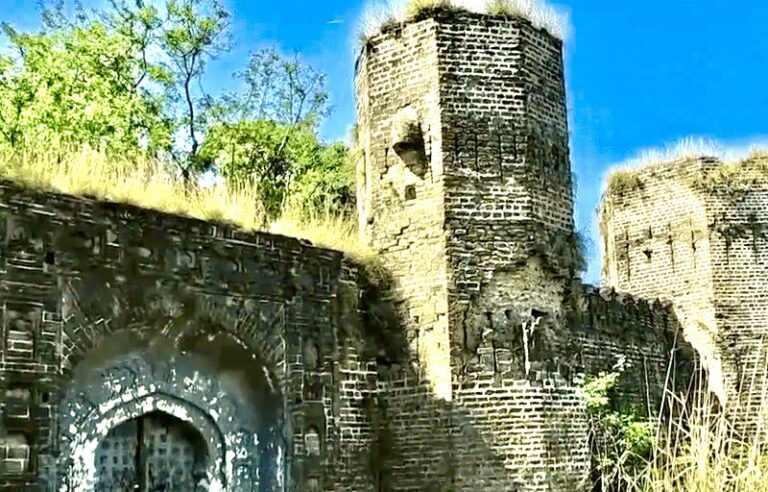
BHIMBER, Pakistan-Administered Kashmir: Rising 3,422 feet above sea level in the serene Samahni Valley, the centuries-old Baghsar Fort is more than an architectural relic it is a silent witness to the ebb and flow of empires, cultures, and conflicts. With its origins debated among historians, the fort’s very stones seem to whisper tales of Mughal grandeur, Dogra ambition, and the unresolved echoes of Kashmir’s contested past.

Believed to have been built in the 16th century, Baghsar Fort’s exact genesis remains shrouded in mystery. While some credit its foundation to the Mughals, others argue it was expanded under the Dogra dynasty, rulers of Jammu and Kashmir in the 19th century. This ambiguity is etched into its walls: the exterior reflects classic Mughal precision, while intricate Hindu carvings and granite-dominated interiors suggest a melting pot of influences. Inside, 80 rooms sprawl across four levels, anchored by a sprawling darbar (royal court), a weathered mosque, and remnants of a temple—a rare coexistence of faiths frozen in time.

The fort’s strategic perch near the Line of Control (LoC), the militarized boundary dividing Kashmir between India and Pakistan, adds layers to its story. From its ramparts, visitors peer into the mist-clad valleys of Indian-administered Kashmir, a stark reminder of the region’s fractured geography. Yet Baghsar’s allure transcends politics. Mughal Emperor Jahangir, the patron of the Taj Mahal’s builder, Shah Jahan, drew his last breath nearby in 1627 during a voyage to Kashmir. His entrails, legend says, were interred within the fort’s grounds—a macabre footnote that draws history enthusiasts.

Nature amplifies the fort’s mystique. To the east lies a tranquil, half-kilometer-long lake, commissioned by Dogra ruler Maharaja Ranbir Singh. Framed by cedar-covered hills and lotus ponds, it hosts migratory ducks and swans, offering a counterpoint to the fort’s martial past. The name Baghsar itself—”land of water and gardens”—hints at the oasis-like beauty that once made it a retreat for kings.

Today, however, Baghsar’s splendor is tinged with neglect. Thousands of tourists brave rugged roads annually to glimpse its fading glory, only to find crumbling infrastructure and scant preservation efforts. Locals and historians alike urge authorities to safeguard this cultural keystone, warning that time is erasing its stories.

As the sun sets over Samahni Valley, casting golden hues on Baghsar’s weathered walls, the fort stands as both a monument and a metaphor—a testament to Kashmir’s layered identity, where history, conflict, and natural beauty remain inextricably entwined.

Azad Jammu Kashmir Local Representatives Threaten Protests Over Fund DiversionKashmir Digital / March 9, 2025

0

Muzaffarabad, Pakistan-administered Kashmir: Local government representatives across Azad Jammu and Kashmir (AJK) have issued a stern warning to the region’s government, threatening mass protests, sit-ins, and blockades of key entry points if it attempts to divert funds earmarked for municipal bodies.

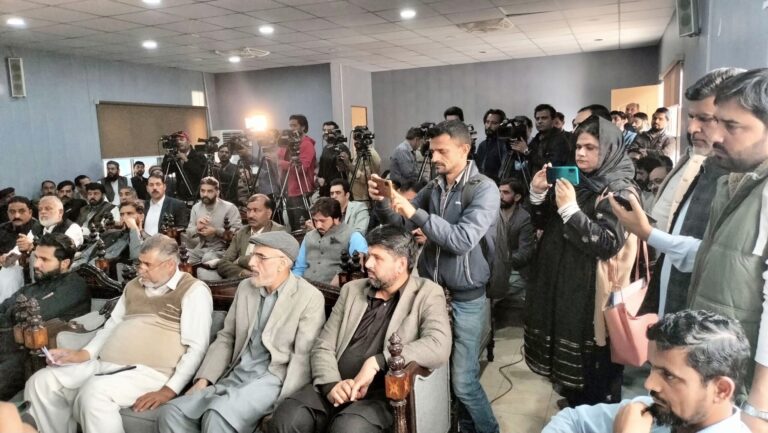
The announcement came during a press conference at Islamabad’s National Press Club, where leaders accused the AJK administration of undermining grassroots governance by withholding finances and planning legislation to centralize control over local funds.

Key Demands and Warnings

Led by a coalition of municipal chairpersons, mayors, and union council representatives, the group declared:

  • No Tolerance for Fund Diversion: “We will resist any law that allows the AJK government to seize funds allocated to local bodies. These resources belong to communities, not legislators,” said Sardar Javed Sharif, a focal person for the movement.
  • Assembly Siege Threat: If the government proceeds, protesters will surround the AJK Legislative Assembly and block all major entry points to pressure authorities.
  • Court Order Cited: Representatives emphasized a 2023 AJK High Court ruling that mandated local governments—not lawmakers—to manage development budgets. “MLAs’ role is legislation, not allocating funds. The court has already clarified this,” stated Mir Imtiaz Ahmed, Central Secretary of the Municipal Alliance.

Background: Decades of Delayed Local Governance

Local leaders highlighted that AJK’s first municipal elections in 30 years were held in 2023 only after a Supreme Court order. “For three decades, political parties avoided empowering grassroots institutions. Now, they want to sabotage them again,” said Dawood Khan, Chairman of the Jhelum Valley Municipal Committee.

Critics accuse AJK’s political elite of prioritizing self-interest:

  • MLAs recently approved significant salary hikes for themselves while freezing funds for local councils.
  • Over 90% of development budgets remain under MLA control, violating the court’s directive.

Government Response and Rising Tensions

While AJK’s Minister for Local Government claims funds are “being released” and protests are unwarranted, representatives dispute this. “Not a single rupee has reached our accounts. Instead, we hear rumors of laws to legitimize fund grabs,” said Isra Rabbani, Vice Chairperson of Dhirkot Union Council.

The movement has gained political backing, including from senior leader Tariq Farooq, who called the demands “just” and vowed solidarity.

Broader Implications

The standoff reflects deepening friction between AJK’s centralized governance model and grassroots aspirations for autonomy. Analysts warn that sidelining local bodies risks alienating communities already frustrated by unemployment and infrastructure gaps.

“Local governments are the bedrock of democracy. Defunding them undermines development and trust in institutions,” noted political commentator Prof. Asif Khan.

International Context

The crisis mirrors challenges in other conflict-affected regions, where centralized authorities often clash with local governance structures. AJK’s struggle highlights the global tension between legislative power and community-led development.

Azad Jammu and Kashmir Announces Temporary Healthcare Recruitment Drive

0

Muzaffarabad, Azad Jammu and Kashmir: The Health Department of Azad Jammu and Kashmir has launched a temporary recruitment initiative to address staffing shortages across its healthcare facilities. The move aims to fill vacancies created by new roles and existing gaps in critical specialties, including radiology, anesthesiology, surgery, and nursing.

Key Positions and Interview Schedule

The recruitment targets the following roles on an ad-hoc basis:

  • Specialists (BPS-18): Radiologists, Gynecologists, Pathologists, ENT Surgeons, Nephrologists, Pediatric Surgeons, and Gastroenterologists.
  • Medical Officers, Pharmacists, and Dental Surgeons (BPS-17).
  • Staff Nurses (BPS-16).

Interviews:

  • Specialists: March 20, 2025, at 9:00 AM.
  • Staff Nurses: March 21, 2025, at 9:00 AM.
  • Location: Public Health Secretary’s Office, 966-B Qasim Market, Rawalpindi.

Eligibility and Terms

  1. Temporary Appointments: Roles are strictly provisional and do not guarantee permanent employment.
  2. Termination Clause: The regional government reserves the right to terminate positions with one month’s notice.
  3. Residency Priority:
  • Applicants from Azad Jammu and Kashmir, including displaced communities (e.g., Mangla Dam affectees, 1989 migrants), will be prioritized.
  • Non-residents may apply but will be considered only if local candidates are unavailable.
  1. No Travel Reimbursement: Candidates must cover their own expenses for interviews.

Context and Implications

The recruitment drive comes amid growing pressure on Azad Jammu and Kashmir’s healthcare infrastructure, which faces challenges such as rural-urban disparities and limited specialist availability. By prioritizing local talent, authorities aim to bolster medical services while addressing unemployment in the region.

International Relevance

Healthcare workforce shortages are a global issue, particularly in conflict-affected and mountainous regions like Kashmir. This initiative highlights efforts to strengthen public health systems in underserved areas—a challenge echoed in regions from the Himalayas to Sub-Saharan Africa.

Barrister Sultan Meets HEC Chairman; Discuss Establishment of New University in Pakistan-Administered Kashmir

0

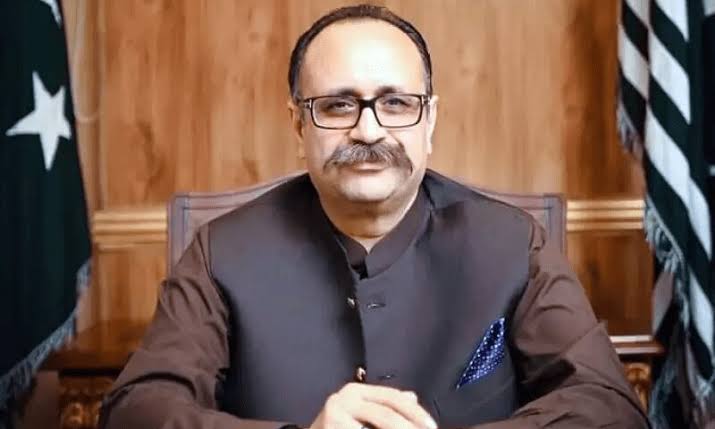
Islamabad (Kashmir Digital): President of the independent government of Azad Jammu and Kashmir, Barrister Sultan Mahmood Chaudhry, held a detailed meeting with Dr. Mukhtar Ahmed, Chairman of Pakistan’s Higher Education Commission (HEC), at Kashmir House in Islamabad on Monday.

During the meeting, Dr. Mukhtar Ahmed assured Barrister Sultan Mahmood Chaudhry that the HEC would extend full financial and technical support to universities in Pakistan-administered Kashmir. This includes assistance for ongoing and upcoming educational projects aimed at improving infrastructure, academic quality, and research capabilities in the region.

President Barrister Sultan Mahmood Chaudhry thanked the HEC chairman for the commission’s efforts to promote higher education in Pakistan-administered Kashmir and emphasized the need for continued collaboration. “The HEC must play a pivotal role in advancing academic activities and elevating the standard of education in Azad Kashmir’s universities,” he stated.

The two leaders also discussed plans to establish a new university in the region, a project described as critical for expanding access to quality higher education. While specifics of the proposed institution were not disclosed, both sides expressed mutual commitment to accelerating the initiative.

Kashmiri Inclusion in India-Pakistan Talks Reiterated
In a separate statement, Barrister Sultan Mahmood Chaudhry reiterated his long-standing position that Kashmiri representatives must be included in any future dialogue between India and Pakistan. “Whenever talks occur, the aspirations of the Kashmiri people must be central to the process,” he emphasized, reflecting the independent government’s stance on the Kashmir dispute.

Dr. Mukhtar Ahmed reaffirmed the HEC’s dedication to supporting educational development in Pakistan-administered Kashmir, calling it a “priority area” for the commission. The meeting also covered broader areas of mutual interest, including joint research programs, faculty exchanges, and efforts to address challenges faced by students in the region.

Strengthening Educational Ties
The discussion underscored the growing collaboration between the HEC and the independent government of Azad Jammu and Kashmir. Observers view the proposed university as a strategic step to reduce educational disparities and empower youth in the region, which has long faced infrastructural and resource constraints.

The meeting concluded with both leaders expressing optimism about future partnerships. “Education is the foundation of progress, and we are committed to ensuring Azad Kashmir’s institutions meet global standards,” Barrister Sultan remarked.

The development aligns with recent efforts by the independent government to bolster education, healthcare, and infrastructure in Pakistan-administered Kashmir amid ongoing geopolitical challenges.

Sardar Tanveer Ilyas Decides to Leave IPP; Key Meetings Determine Political Future

    0

    Muzaffarabad: Sardar Tanveer Ilyas, former Prime Minister of Azad Jammu and Kashmir (AJK) Pakistan administrated Kashmir, has decided to quit the Istiqam-e-Pakistan Party (IPP) and is expected to join a new political party soon.

    According to details, Ilyas, who also served as the IPP’s AJK president, finalized his decision to leave the party after the Supreme Court recently overturned his disqualification. Sources indicate he has held crucial meetings with leaders from the Pakistan Muslim League-Nawaz (PML-N), Pakistan Peoples Party (PPP), and the Muslim Conference to discuss his political future.

    Sardar Tanveer Ilyas was elected from Bagh constituency in the 2021 AJK elections on a Pakistan Tehreek-e-Insaf (PTI) ticket and was a candidate for the premiership during government formation. However, PTI founder Imran Khan nominated Sardar Qayyum Niazi as Prime Minister instead, appointing Ilyas as a senior minister and placating Barrister Sultan Mahmood by making him AJK President.

    Following the ouster of Imran Khan’s federal government via a no-confidence vote in 2022, Ilyas allied with PTI dissident Ali Amin Gandapur to table a no-confidence motion against his own party’s Prime Minister, Sardar Qayyum Niazi. The motion succeeded, paving the way for Ilyas to assume the premiership. However, the AJK High Court later disqualified him over a controversial speech criticizing judges. His disqualification was revoked by the Supreme Court last month.

    Likely Shift to Muslim Conference
    Insiders suggest Ilyas may join the Muslim Conference, a regional party currently reduced to a single seat in the AJK Assembly. His entry could reinvigorate the party, which has historically advocated for Kashmir’s right to self-determination.

    Consultations Underway, Says Spokesperson
    Sardar Mashal Younis, IPP AJK’s spokesperson, clarified that Sardar Tanveer Ilyas remains the party’s head for now but is consulting widely on his political future. He confirmed that several political figures from AJK and Pakistan have contacted Ilyas with invitations to join their parties.

    “Any decision will consider AJK’s evolving political landscape, challenges faced by the region, public aspirations, and the hopes of oppressed communities in Indian-occupied Kashmir,” Younis stated.

    The move comes amid shifting alliances in AJK politics, with observers closely watching how Ilyas’s next steps could reshape the region’s governance ahead of future elections.

    Sorry 100 Times – Copy, Paste, Type & Emoji Versions & Reason (Ready to Use)

    In today’s fast-paced world, apologies have taken on new forms in the realm of digital communication. Whether you’ve typed “sorry 100 times,” used a “sorry 100 times copy-paste” technique, or even sprinkled a few emojis into your apology with “sorry 100 times with emoji,” this trend has become a curious and sometimes amusing part of online interaction. But what drives this unique phenomenon, and why do we feel compelled to apologize in such a dramatic way?

    Let’s dive deeper into this growing trend of apologizing 100 times and understand the psychology behind it.

    Why 100 Times? The Psychology Behind Repeated Apologies

    Have you ever found yourself repeatedly typing “sorry 100 times” in a message, even when one simple “sorry” might suffice? It’s a trend that many social media users and chatroom participants engage in—whether it’s out of habit or to add extra weight to the apology.

    The number 100 seems arbitrary, yet it’s symbolic of going above and beyond. In many cases, repeating an apology 100 times, or using “sorry 100 times copy-paste,” gives the illusion of sincerity and regret, as if quantity can somehow equate to quality in expressing remorse. Psychologically, this action can be seen as a way to amplify the emotional tone of the message, making sure the recipient knows just how truly sorry the sender is.

    The Impact of Repetition

    Repetition is a powerful tool, especially in written communication where tone and emotion can be hard to convey. When someone types “sorry 100 times,” it’s more than just a series of apologies—it’s a signal that they’re putting in extra effort to make amends. The repetition of “sorry” creates a sense of urgency and sincerity that one single apology may not achieve.

    In some cases, people will literally type “sorry” 100 times in a message to emphasize the depth of their apology. This might happen in response to a small mistake, an online argument, or simply as part of a meme or joke. The humor behind repeating an apology so many times often adds a layer of playfulness, but underneath that, it’s still an attempt to communicate regret.

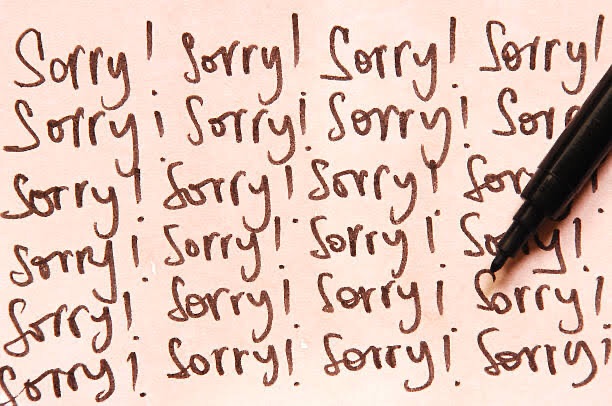
    Sorry 100 Times Copy-Paste (Simple & Ready to Use)

    One way people participate in this trend is by copy-pasting “sorry” 100 times. It’s quick, efficient, and gets the point across (or at least it seems to). The simplicity of this method reflects the internet’s love for shortcuts and quick fixes, but it also raises the question of whether a copy-pasted apology can ever truly convey genuine remorse.

    To copy the complete text, click on the Copy button.

    Sorry 100 Times with Emoji Copy-Paste Ready

    On the other hand, the sheer number of repeated “sorrys” can come across as absurd, which is why it works well in casual digital conversations, especially in spaces like social media or gaming. Whether it’s in a group chat, comment section, or meme culture, typing “sorry 100 times” or seeing someone do so often invites a laugh, but it still carries the weight of an apology.

    To copy the complete text, click on the Copy button.

    How to Type “Sorry” 100 Times Quickly?

    Despite the lighthearted nature of a “sorry 100 times” message, there’s something about seeing that many repeated apologies that can stir emotions. For some, it can feel like a heartfelt expression of guilt or remorse, while others might view it as excessive or insincere. The emotional response depends largely on the context in which it’s used.

    The Role of “Sorry 100 Times” in Online Communities

    While the “sorry 100 times” trend might seem trivial or even humorous at times, it plays a larger role in online communities, particularly in social media, chatrooms, and gaming environments. In these spaces, expressing regret is often done in a lighthearted, exaggerated manner. Apologizing 100 times—or typing a huge “sorry” over and over—can be a way to diffuse tension and show that you acknowledge your mistake, all while avoiding heavy confrontation.

    In these digital communities, an apology is sometimes more about showing acknowledgment than truly seeking forgiveness. The sheer number of “sorrys” may be a way to appease others or to comply with an unwritten rule of digital etiquette—particularly in situations where an argument or conflict arises.

    Israel Prepares to Send Delegation to Doha for Further Ceasefire Negotiations, Hamas Urges Immediate Talks

    0

    World Desk: Israel is preparing to send a delegation to Doha on Monday for further negotiations on a ceasefire, while Hamas has called for immediate talks on the second phase of the ceasefire, hoping that this would pave the way for a permanent end to the ongoing conflict.

    Representatives from the Palestinian group Hamas met with mediating countries’ representatives in Cairo over the weekend. According to a statement from Hamas, they emphasized the urgent need for the “uninterrupted and unconditional restoration of aid” to the besieged Gaza Strip.

    Hamas senior leader Mahmoud Mardawi told AFP, “Hamas insists that the occupying forces must be pressured into starting the second phase of negotiations immediately, based on agreed-upon terms.” He added that this step would pave the way for a permanent end to the war.

    Mardawi further stated that Hamas’ main demands for the second phase include the complete withdrawal of Israeli troops from Gaza, the lifting of the Israeli blockade, reconstruction of Palestinian territories, and financial aid.

    After talks with mediating countries, Hamas spokesperson Abdel Latif al-Qanoua said that initial signals from the negotiations were “positive.”

    Israeli Prime Minister Benjamin Netanyahu’s office confirmed that a delegation would be sent to Doha for discussions on Monday. Israeli media reported that the security cabinet would meet on Sunday to discuss the matter.

    Israel has expressed its desire to extend the first phase of the ceasefire until mid-April. The first phase of the ceasefire concluded on March 1, after a relatively calm six-week period. During this time, 25 living hostages and eight bodies were exchanged for nearly 1,800 Palestinian prisoners held in Israeli jails.

    The ceasefire has largely halted the 15-month-long war in Gaza, where Israel’s ruthless military operations have left nearly the entire population displaced. The ceasefire also allowed for the delivery of essential food, shelter, and medical aid to Gaza.

    However, when Israel later halted this aid, the United Nations and human rights organizations accused the government of “using hunger as a weapon.”

    A Palestinian widow, Hanin Al-Dura, who was displaced during the conflict, told AFP that she and her children had been forced to spend weeks on the streets “between dogs and rats” before they found a tent. She said, “As the sole breadwinner, this situation was deeply distressing, and I couldn’t sleep at night.”

    “Final Warning” from Trump

    Last week, U.S. President Donald Trump warned that further destruction in Gaza would occur if all remaining hostages were not released. He issued an “ultimate warning” to Hamas leaders and threatened the residents of Gaza, saying, “A beautiful future is waiting for you, but not if you continue to hold hostages. If you do, you are dead.”

    Hamas responded by stating that Trump’s threats would only provoke Israel to violate the ceasefire agreement further.

    The Trump administration also confirmed that it had begun direct negotiations with Hamas, an unprecedented step since Washington labeled Hamas a terrorist organization in 1997 and refused to engage with it. Among the 251 individuals held hostage by Palestinian militants, 58 are still in Gaza, including five U.S. citizens. Four American hostages have been confirmed dead, while there is hope that one, named Aden Alexander, is still alive.

    Earlier, President Trump had proposed a plan to expel Palestinians from Gaza, which was widely condemned. In response, Arab leaders presented an alternative plan that involves providing financial aid through a trust fund for Gaza’s reconstruction and having the Palestinian Authority in Ramallah resume control of the region.

    Trump’s Middle East envoy, Steve Witkoff, told reporters in Washington, “We need more discussions on this, but it’s a good-faith initial step.”

    Witkoff will visit the region again this week and travel to Saudi Arabia to hold talks on the war in Ukraine.

    Meanwhile, during a weekly protest in Tel Aviv, the families of Israeli prisoners demanded that the government fully implement the ceasefire. Matan Zangauker’s mother, Eina Zangauker, addressed the crowd with a candle and poster, saying, “The war could restart in a week. They’ve even chosen a name for the operation. The war will not bring the hostages home; it will kill them.”