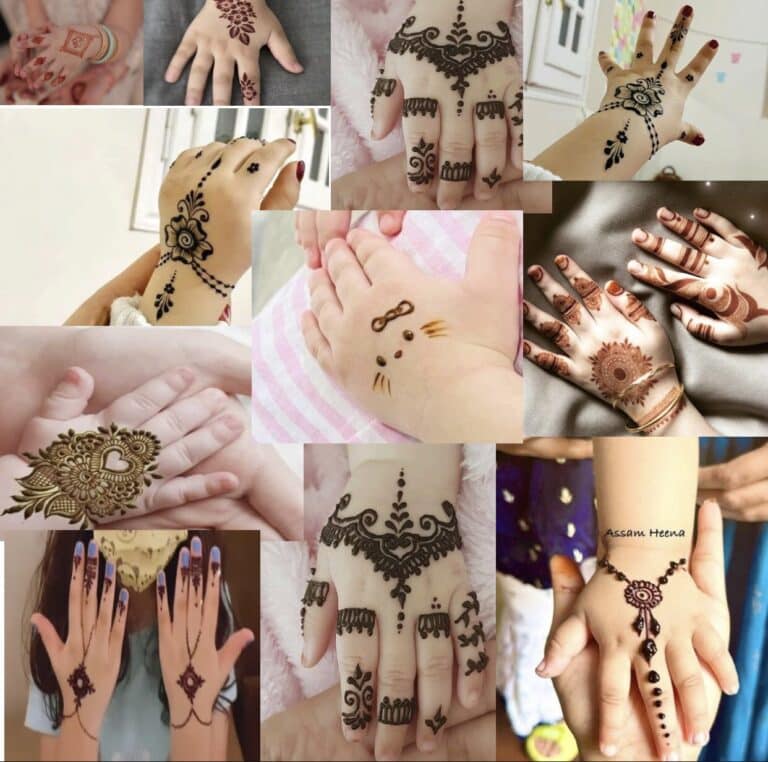
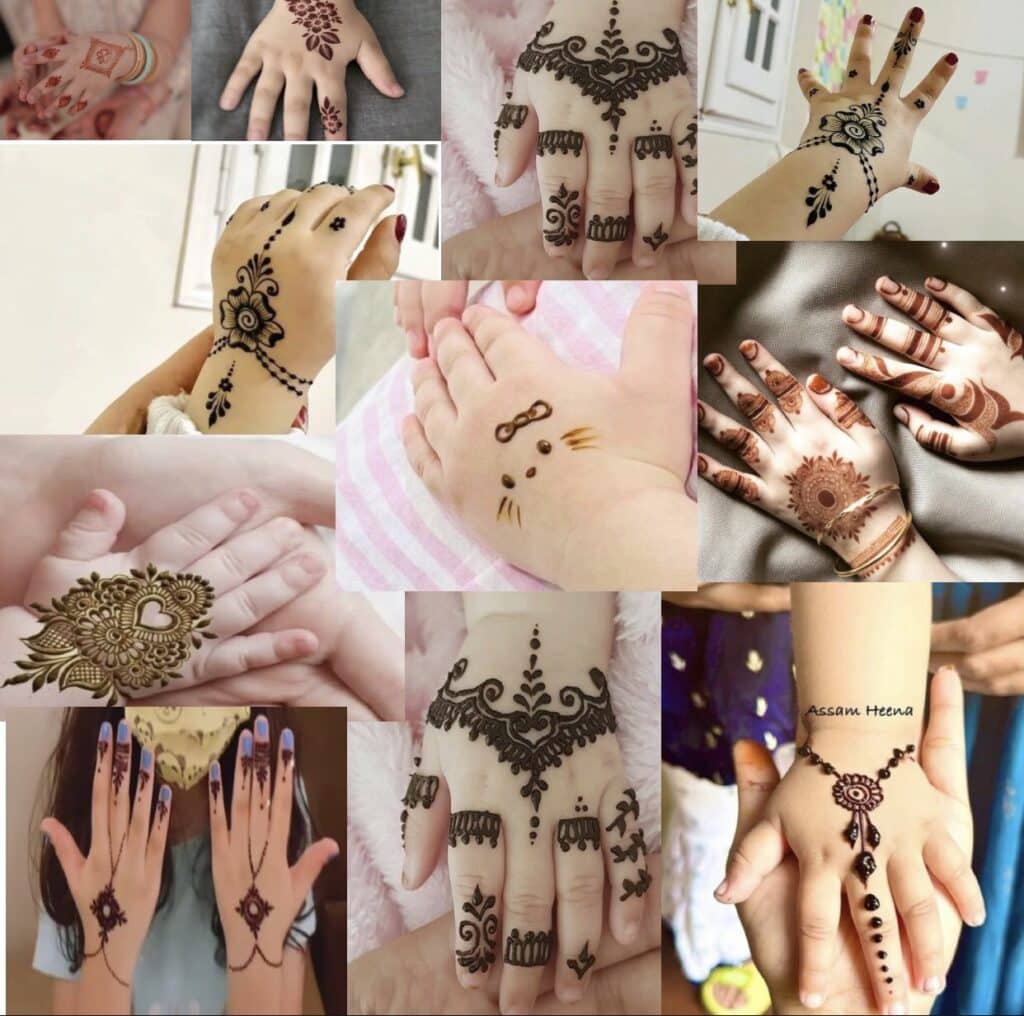
Mehndi, also called henna, can make kids feel special. The beautiful temporary tattoos are great for celebrations. But is it safe? Some types of henna have harsh chemicals. Don’t worry! We’ll explore safe, natural alternatives and awesome cute mehndi design ideas perfect for your little ones.
Why Mehndi is a Fun and Festive Activity for Children
Mehndi is more than just pretty designs. It’s a fun way to celebrate! This ancient tradition is full of meaning.
Latest Trending Cute Mehndi Designs
Latest trending cute Mehndi designs for Kids
Cultural Significance
Mehndi has roots in India, the Middle East, and Africa. It’s been used for centuries in celebrations. These celebrations often involve intricate patterns with deep meaning. It represents joy, luck, and new beginnings.
Festive Celebrations
Ever been to a wedding with beautiful henna art? Mehndi is very popular during weddings. Also, it’s used for festivals like Diwali and Eid. It makes these special occasions even more fun for kids and adults.
Creative Expression
Mehndi lets kids show their unique style! They can choose designs they love. From flowers to animals, it is a great way for children to express themselves and their individuality.
Choosing Safe and Natural Mehndi Ingredients for Kids
Safety first! Natural henna is the way to go for your child’s skin. Stay away from harsh chemicals.
Understanding Natural Henna
Pure henna is from the henna plant. It creates a brown or reddish-brown stain. It’s safe when it doesn’t have added chemicals. Always double-check the ingredients!
Identifying Harmful Chemicals
Black henna is dangerous. It has a chemical called PPD. This can cause burns, scars, and allergic reactions. Always avoid henna that claims to be black.
DIY Henna Paste Recipe
Want to make your own safe henna paste? Here is a simple recipe:
Mix 1/4 cup of natural henna powder with 1/4 cup of lemon juice.
Add a few drops of lavender or tea tree oil (for scent and skin benefits).
Mix until it looks like thick yogurt.
Let it sit for at least 2 hours before using.
Simple and Adorable Mehndi Designs Perfect for Little Hands
Little hands need designs that are easy and cute! Here are a few fun ideas:
Floral Patterns
Flowers are a classic choice. Simple petals, vines, and leaves are easy to draw. These are ideal for a sweet, simple look.
Animal Motifs
Kids adore animals! Butterflies, ladybugs, cats, and dogs make great mehndi designs. These are fun, whimsical, and super cute!
Star and Moon Designs
Stars and moons are universally loved. These patterns are simple to create. They can be arranged in many ways for a magical look.
Step-by-Step Guide to Applying Mehndi on Children
Applying mehndi can be easy. Here’s how to make it a smooth experience:
Preparing the Skin
Clean the skin with mild soap and water. Make sure it’s dry before you start. You can also put on a little moisturizer.
Applying the Mehndi
Use a henna cone or applicator bottle. Gently squeeze out the paste to create your design. If you make a mistake, wipe it away fast with a damp cloth.
Aftercare Tips
Let the mehndi paste dry completely. This might take 30-60 minutes. Then, mix lemon juice and sugar. Gently dab it on the dried paste. This helps make the stain darker and last longer. Avoid washing the area for as long as possible.
Making Mehndi a Fun and Safe Experience for Everyone
Mehndi should be fun! Here’s how to keep it safe and enjoyable:
Addressing Skin Sensitivities
Do a patch test first. Put a small amount of henna on your child’s skin. Wait 24 hours to see if there is a reaction. If their skin is super sensitive, consider using jagua. This is a natural alternative.
Managing Application Time
Keep kids busy during application. Play their favorite music. Tell them a story. Have them watch a fun video. This helps them stay still and happy!
Safety Precautions
Always supervise kids. Make sure they don’t put henna paste in their mouth or eyes. Keep henna out of reach when you’re not using it.
Conclusion
Using safe mehndi designs can be super fun for kids. Embrace this creative, cultural activity while keeping safety first. With natural henna and simple designs, mehndi becomes a memorable and joyful event for everyone!
Muzaffarabad (Pakistan administrated Kashmir) – Two young men from Muzaffarabad, who were abducted during their travels in Thailand, have been rescued after being held captive in Myanmar. The abduction occurred on October 10, 2024, when the two individuals, Umar Abbasi and Rais Abbasi, were traveling in Thailand. They were forcefully taken to Myanmar after being drugged by a taxi driver and later found themselves imprisoned in a notorious camp in Myanmar.
The victims were held in captivity for months, enduring severe physical and mental abuse, along with daily torture. According to their accounts, the conditions were harrowing, with around 100 individuals confined in a large compound, all subjected to brutal treatment and forced labor. “We were told we had been bought, and any attempt to escape would result in our deaths,” said Umar Abbasi, one of the victims.
Despite several attempts to alert the Pakistani government, their families were left without much support from the Ministry of Foreign Affairs, embassies in Thailand and Myanmar, or the Azad Jammu and Kashmir government. “The governments did not play any active role in our rescue,” said Abbasi. “Only a few individuals like Minister Bazil Naqvi from the Azad Kashmir government made efforts by writing letters. But our families had to negotiate a hefty ransom with human traffickers to secure our release.”
The victims were eventually rescued through the assistance of American and Australian NGOs that focus on the release of kidnapped individuals. The ransom was paid, and the two men were transported from Myanmar to Thailand, where they are now safe. “We are deeply grateful for the support of international NGOs, but the lack of help from our own government was disappointing,” Abbasi said.
Both men also highlighted the involvement of transnational criminal networks and pointed out that, despite Thailand and Myanmar having several border checkpoints, they were able to be smuggled across the borders without detection. “How is it possible to cross borders without any checks? The situation clearly points to an organized network between the Thai and Myanmar authorities,” said Abbasi.
As of now, the two men have been reunited with their families, who expressed immense relief. However, they continue to call for government intervention to investigate the abduction and trafficking networks operating between these countries. The family members are also urging the Pakistani government to formally lodge a protest with Myanmar and Thailand regarding the safety and treatment of their citizens.
Meanwhile, other victims from around the world, numbering in the thousands, remain trapped in similar conditions. At present, there are over 40,000 individuals from nearly 37 countries held in Myanmar, where they are subjected to constant torture, forced labor, and inadequate living conditions.
The two victims are now seeking justice, calling for the investigation of all involved parties, including the human traffickers and the authorities who may have facilitated their abduction.
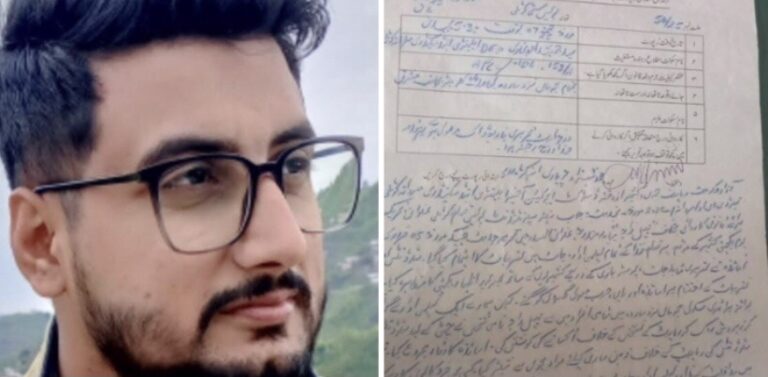
Muzaffarabad, Pakistan-administered Kashmir — Tensions escalated in Muzaffarabad as authorities filed sedition and terrorism charges against leaders of the Jammu Kashmir National Students Federation (JKNSF), including its central president, Khawaja Mujtaba Banday. The charges, linked to a rally commemorating Kashmiri national leader Maqbool Butt’s death anniversary, have sparked outrage among student groups, who allege political vendetta.
Charges Stem from Slogans at Maqbool Butt Memorial Rally
On February 18, JKNSF members and progressive organizations held a rally at the mausoleum of Maqbool Butt, a prominent Kashmiri nationalist executed in India in 1984. The event, marked by anti-establishment slogans, led local police to register a case under sections 489, 506, 504, 505, 120-B, and 500 of the Pakistan Penal Code a move critics call an attempt to stifle dissent.
Among the 20 individuals charged are JKNSF Central President Khawaja Mujtaba Banday, Central Committee members Saddam Wani and Saad Dar, city leaders Raja Kafi and Raja Suhrab, and district general secretary Mudassir Chishti.
JKNSF Denounces “Fabricated” Case, Plans UN Protest
The JKNSF and allied groups condemned the charges as “baseless and politically motivated,” accusing authorities of targeting dissent. In response, the federation announced a march to the United Nations Military Observer Group in India and Pakistan (UNMOGIP) offices in Muzaffarabad on February 25, followed by a sit-in.
“These cases are pure intimidation,” a JKNSF spokesperson stated. “We will resist legally and globally, urging international bodies to hold Pakistan accountable for suppressing Kashmiri voices.”
Context and Implications
The rally honored Maqbool Butt, a symbol of Kashmiri resistance, whose hanging in 1984 is annually observed across Jammu Kashmir. The charges against student leaders reflect growing friction between activists and authorities in Pakistan-administered Kashmir, where calls for self-determination and critiques of governance often face crackdowns.
Human rights advocates warn the case could deepen mistrust among youth, already disillusioned by limited political freedoms. The planned UN protest aims to spotlight these grievances on an international stage.
The Azadi Times is an independent platform covering underreported stories from Jammu and Kashmir. Follow us for updates on this developing situation.
Note for Readers:
Maqbool Butt: Founder of the Jammu Kashmir Liberation Front (JKLF), executed in New Delhi’s Tihar Jail in 1984. His legacy remains contentious, revered by some as a freedom fighter and criticized by others.
UNMOGIP: Established in 1949 to monitor the India-Pakistan ceasefire in Kashmir, its role remains limited amid ongoing disputes over its mandate.
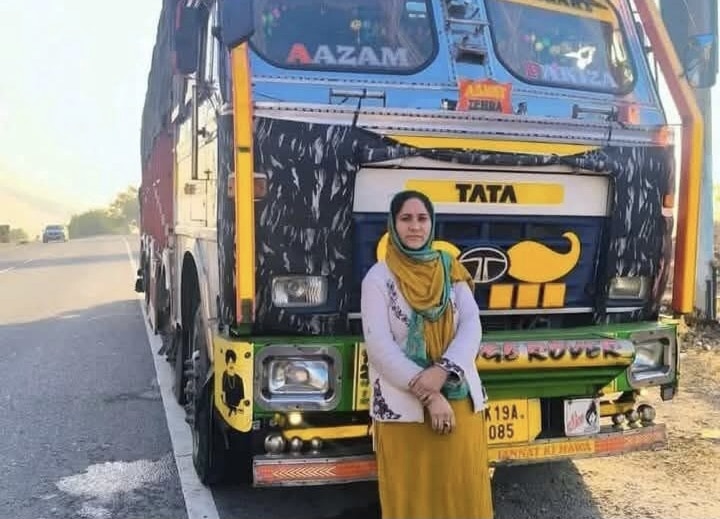
Pulwama, Jammu and Kashmir: In a remarkable stride toward gender empowerment in Kashmir, 26-year-old Rabia Yaseen from Pulwama’s Wakhara Van has shattered stereotypes to become the region’s first female truck driver. Her journey, fueled by familial support and personal determination, is inspiring women across the Valley to challenge traditional norms.
Family Backing Paves the Way
Rabia’s trailblazing achievement owes much to the unwavering encouragement of her family, particularly her mother-in-law, Shahnaaz Begum. In an exclusive conversation with News18, Shahnaaz revealed how Rabia’s passion for driving was nurtured within the household. “She had an interest in driving for years. My son, Muhammad Imtiyaz, who is also a driver, began teaching her during their rides together. When they asked my opinion, I said, ‘If my daughter-in-law wants to achieve something, it’s a matter of pride for us,’” Shahnaaz shared.
Emphasizing the importance of supporting women, she added, “Why shouldn’t we stand by our daughters-in-law? Today’s girls are proving their mettle in every field. We must empower them.”
From Hobby to History
Rabia’s journey began as a casual learner alongside her husband. Over time, her skills sharpened, and she transitioned from navigating local roads to mastering heavy vehicles. Today, she confidently maneuvers trucks across challenging terrains, a feat rarely associated with women in Kashmir’s male-dominated transport sector.
“Initially, she learned gradually. Now, she drives independently. This is a proud moment for our family,” Shahnaaz remarked, highlighting Rabia’s dedication.
A Message to Kashmir’s Women
Shahnaaz Begum had a resounding message for women confined by societal expectations: “Self-reliance is key. Don’t hold out your hands for help stand on your own feet. Rabia’s story shows that with courage, barriers can be broken.”
Her words resonate deeply in Kashmir, where female participation in non-traditional roles remains limited. Rabia’s success mirrors a slow but growing shift, with women increasingly entering fields like entrepreneurship, sports, and now transport.
Symbol of Change
Rabia’s accomplishment is more than a personal milestone it’s a beacon for gender equality in the region. As her truck roams the roads of Pulwama, it carries a powerful statement: tradition need not dictate destiny.
“This is just the beginning,” Shahnaaz asserted. “When families support their daughters and daughters-in-law, society transforms.”
About The Azadi Times Kashmir News Network is an independent media platform dedicated to spotlighting stories of resilience, innovation, and progress from Jammu and Kashmir.
A reception ceremony was held under the auspices of the Hotels, Restaurants, Guesthouses, and Marriage Halls Joint Action Committee in honor of the Jammu Kashmir Joint Awami Action Committee (JKJAAC). The event was attended by members of the Jammu Kashmir Joint Awami Action Committee, including the Core Committee, and representatives from the Hotels, Restaurants, Guesthouses, and Marriage Halls Joint Action Committee from all across Azad Kashmir.
During the meeting, it was unanimously decided that the Act 2021 is entirely unacceptable and must be revoked immediately.
Additionally, the meeting concluded with a strong stance against Green Tourism or any similar company or institution, emphasizing that such entities should not be allowed in Azad Kashmir. The government has been warned to refrain from introducing any such companies or organizations in the region.
A complete ban will be imposed on the leasing or buying and selling of land by any non-state entity or individual in Azad Kashmir.
Furthermore, the electricity tariff for hotels, restaurants, guesthouses, and marriage halls will be implemented as per the agreement with the Jammu Kashmir Joint Public Action Committee, and the outstanding electricity bills will be settled in 36 installments.
The Hotels, Restaurants, Guesthouses, and Marriage Halls Joint Action Committee has vowed to continue the joint struggle until the full implementation of the Jammu Kashmir Joint Public Action Committee’s Charter of Demands.
The Jammu Kashmir Joint Public Action Committee will provide full support at all levels for resolving the issues faced by hotels, restaurants, guesthouses, and marriage halls.
Issued by Department of Media and Publications Jammu Kashmir Joint Public Action Committee
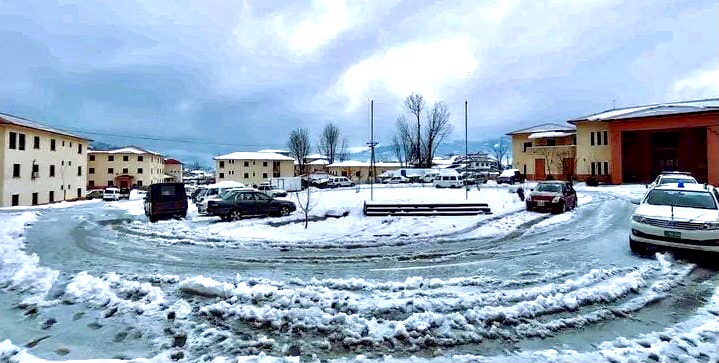
Rawalakot (Azad Kashmir): After a prolonged dry spell, Rawalakot is finally witnessing the long-awaited snowfall, bringing much-needed relief and joy to the local residents. Today, the entire city was covered in a blanket of white as snow began to fall, transforming the landscape into a picturesque winter wonderland.
This snowfall not only rejuvenates the earth but also lifts the spirits of the local community. The beautiful white cover over the mountains, trees, and rooftops of Rawalakot has added to the charm of the region, creating a breathtaking view. For many locals, this moment is a welcome relief after months of drought, which severely affected agriculture and caused water shortages in the area.
As the snow blankets Rawalakot, the air has turned crisp and cool, and people are stepping outside in warm clothes, enjoying the winter weather. Children can be seen playing in the snow, farmers clearing their paths, and families making the most of this delightful weather.
The snowfall has not only brightened up the weather but also provided much-needed hope for the community that has been grappling with the adverse effects of the dry season. This refreshing change in Rawalakot weather has reminded everyone of the beauty of nature and the joy it brings.
MUZAFFARABAD: In response to public demand, the Jammu Kashmir Joint Awami Action Committee of Azad Kashmir is now preparing to enter the political arena in the upcoming elections, as hinted by Shaukat Nawaz Mir.
In an exclusive interview with a local news outlet, Shaukat Nawaz Mir, a member of the Jammu Kashmir Joint Awami Action Committee, stated that given the current circumstances and the increasing public outreach, they will have to make a decision regarding contesting the elections.
He said, “The Joint Awami Action Committee is the voice of the people, and no one can stop us from participating in the elections. People are confused in the current situation, and thus, we have to take a decision.”
Various analyses are being conducted at the public level, and Joint Awami Action Committee leader Raja Amjad Ali Khan had also made it clear that they were consulting the public regarding the elections.
It is noteworthy that the growing popularity of the Joint Public Action Committee in Azad Kashmir has caught the attention of the masses, with people urging the leaders of the committee to contest the elections.
While the leaders of the Joint Public Action Committee had previously stated that they had no intentions of getting involved in politics, as the elections draw nearer, the committee leaders are now preparing to enter the political field.
The entry of the Joint Action Committee into politics could pose significant challenges for established political parties, as a large segment of the population is now supporting the committee’s leaders, particularly after their successful campaigns advocating for affordable electricity and flour.
Kotli (Azad Kashmir): A new wave of repression has emerged in Azad Kashmir (Pakistan administrated Kashmir), where expressing one’s identity and autonomy as Kashmiris is now being treated as a criminal act. On February 5, the occasion of Kashmir Solidarity Day, government officials forced students in a school in the village of Sarda Manjoman, near Kotli, to chant slogans like “We are Pakistanis, Pakistan is ours.” This move has sparked widespread public outrage. The students were pressured by schoolteachers and government officials to participate in these chants.
Nabeel Kashmiri, leader of the Jammu Kashmir National Freedom Alliance, asked the students who had forced them to shout these slogans. The students revealed that they had been coerced by teachers and government officials. In response, Nabeel Kashmiri simply stated, “We are Kashmiris, and we speak for our sovereign state of Jammu and Kashmir.”
When the truth came to light, the state machinery could not tolerate this and, through the DEO (District Education Officer) of Kotli, a false FIR was filed against Nabeel Kashmiri, accusing him of inciting children against the state.
The filing of this FIR has been strongly condemned, and there are calls for its immediate withdrawal. If Nabeel Kashmiri or anyone else is arrested based on this false case, it will provoke a strong public reaction.
New Restrictions on Kashmir’s Identity and Autonomy
Citizens of Azad Kashmir and Gilgit-Baltistan are constitutionally not considered citizens of Pakistan, yet recent events show that the local government has unilaterally imposed restrictions on Kashmiris’ identity and autonomy. Local political leaders and public figures have emphasized that Kashmiris will not compromise on their identity and autonomy.
There is a growing expectation of a strong public response if Nabeel Kashmiri is arrested. This incident could mark a new phase in the struggle for freedom and autonomy in Kashmir, bringing to the forefront various political and social issues within the region.
The Call for Kashmir’s Freedom Grows Louder
The Jammu Kashmir National Freedom Alliance and other political parties are calling for the immediate withdrawal of the false case, urging respect for the rights and freedoms of Kashmiris. Nabeel Kashmiri and his supporters have stated that if anyone is arrested based on this baseless case, it will lead to a massive public outcry and further amplify the call for Kashmiris’ freedom.
This incident has once again demonstrated that the struggle for Kashmiris’ identity and autonomy is not just geographically significant but also a political and human right that needs to be recognized on the global stage. This new political development in Kashmir is gaining international attention, as the people of Kashmir prepare to raise their voices for their rights.
Kashmiris have always emphasized the importance of their identity and autonomy, and following this incident, their voices will only grow louder. The demand for the withdrawal of false cases against Nabeel Kashmiri and other Kashmiri leaders will mark a new chapter in the ongoing struggle for Kashmir’s freedom.
Gulab Singh’s journey from Jammu to the court of Punjab’s ruler, the illustrious Maharaja Ranjit Singh, and the manner in which he established his reputation and influence there is a uniquely fascinating tale.
Likewise, the account of how, following the conflict between the British and the Sikhs and, subsequently, as war indemnity, the Kashmir region was purchased by Gulab Singh who then became Maharaja is another ghastly chapter of history.
Similarly, the story of how Ladakh and Gilgit-Baltistan were brought under the control of the Jammu government at the hands of Gulab Singh’s ministers, Zorawar Singh Kalahoria and Lakhipat Rai, along with Colonel Nathu Shah, is a tale in its own right.
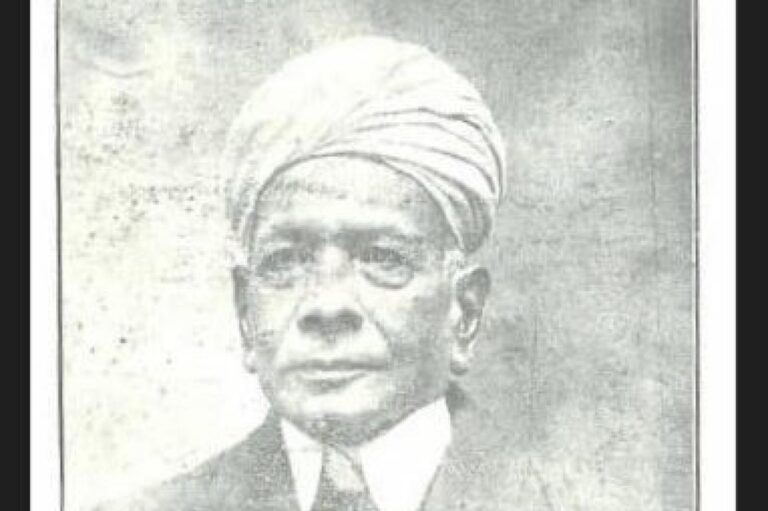
My intention is not to reiterate all of these events but rather to highlight the remarkable practical and scholarly work of one of the key functionaries of the Dogra government, namely Minister Maulvi Hashmatullah Khan Lucknowi, whose work is the primary source on the history of Gilgit-Baltistan.
It was probably in 1939 that Maulvi Hashmatullah Khan’s book, Mukhtasar Tareekh-e-Jammu o Kashmir aur Aqsaa-e-Tab, was published in Lucknow, in which the histories of Jammu & Kashmir, Kishtwar, Kargil, Ladakh, and Gilgit-Baltistan were compiled.
Although the author of the book was a functionary of the Dogra government and, consequently, the main objective of his writing was, in his own words, to extol the conquests and greatness of the state, the history he compiled set apart from the political and expansionist aims of the Dogra regime serves as a milestone in the history of Gilgit-Baltistan.
During the Dogra rule, Gilgit-Baltistan and Ladakh were organized under distinct administrative divisions. In Baltistan, initially a kardar (administrator) was appointed, and later an official holding the position of Minister served as the administrator. This ministry also encompassed Kargil and Ladakh.
Maulvi Hashmatullah Khan Lucknowi was posted in Gilgit in 1894 and in Chitral in 1895 under the Department of Foreign Affairs of the Government of English India. In 1898, he entered the service of the State of Jammu & Kashmir and served in Gilgit, Muzaffarabad, Rajouri, Kargil, Ladakh, and Baltistan.
He served as the Minister of Administration and worked tirelessly during this period to gather material for his book, the details of which he mentioned in the preface. During his tenure, he not only became well-acquainted with every inch of the State of Jammu and Kashmir but also developed a deep interest in its history and culture. Therefore, after retiring from service in 1928, he began compiling his book, which was published in 1939.
Before discussing the contents and significance of the book, it is both interesting and important to mention how this book reached Baltistan. At the end of the preface, the name of the place “Aligarh” is mentioned, suggesting that Maulvi Hashmatullah Khan may have settled there after retirement.
Now, let us shift our focus from Lucknow back to Kharmang, Skardu, where a man from the village of Pari traveled to Lucknow in pursuit of education. There, at a scrap bookstore, he discovered the mentioned book, Tareekh-e-Jammu (History of Jammu). However, the story is not as simple as merely traveling to Lucknow, acquiring an education, and returning to Skardu with the book. It was far from an easy journey.
Ali Mumtaz belonged to the village of Pari in Kharmang, a place renowned for producing notable figures in Gilgit-Baltistan. Many of its residents have made significant contributions in various fields. The village is also famous across Pakistan for its apples, known as Suspolo, which are cherished for their exquisite taste and fragrance. It was in this very village that Ali Mumtaz was born.
The story of Sheikh Ali Mumtaz’s journey to Lucknow and his acquisition of the book Tareekh-e-Jammu o Kashmir o Aqsaa-e-Tibet was narrated to me by Muhammad Ali, who is more commonly known as Muhammad Ali PIA—a nickname derived from his employment with Pakistan International Airlines (PIA). Muhammad Ali recounted that he and Baltistan’s esteemed historian, Yousuf Hussain Abadi, traveled to Shigar several years ago to meet Sheikh Ali Mumtaz for one specific reason: the book Tareekh-e-Jammu. It was rumored that Sheikh Ali Mumtaz possessed the first edition of the book, published in 1939 in Lucknow, which had since become rare. While later editions were published in Lahore and by Verinag Publishers in Azad Kashmir, none matched the beauty of the first edition. Additionally, the original edition included hand-drawn illustrations that were omitted in subsequent reprints. Yousuf Hussain Abadi managed to photocopy the first edition before returning the original to Sheikh Ali Mumtaz.
The journey of Sheikh Ali Mumtaz from Kharmang, Baltistan, to Lucknow in pursuit of education was filled with hardship and perseverance.
Ali Mumtaz developed a keen interest in religious studies, but since there were no educational facilities in his village, he wandered from place to place until he eventually reached Skardu. There, someone advised him to go to Rawalpindi to pursue a better education. However, in those days, traveling to Rawalpindi was no easy task—it was not as simple as boarding a bus and arriving comfortably. Back then, the journey required crossing Deosai, then Burzil Pass, followed by Minimarg, Qamri Top, Azad Kashmir, and finally reaching Rawalpindi—all on foot. The entire trek took Ali Mumtaz a full month.
Even after reaching Rawalpindi, he was not satisfied. Someone suggested, “If you are so eager to study, why not go to Lucknow? Why waste time here?” The idea struck him deeply. However, traveling to Lucknow was even more arduous than reaching Rawalpindi.
Ali Mumtaz returned to Baltistan on foot and exercised patience for a while. The following year, he sold some livestock to fund his long and treacherous journey. He set out from Kharmang, crossed Kargil and Ladakh, then traveled through Kashmir, traversed the Banihal Pass to reach Jammu, and from there continued through Amritsar before finally arriving in Lucknow. This entire journey was undertaken entirely on foot.
The contrast between the remote, mountainous village of Pari, Kharmang, and the vibrant, cultural metropolis of Lucknow—considered a beacon of Indian civilization—was overwhelming. The journey felt like a dream, one that he lived day and night.
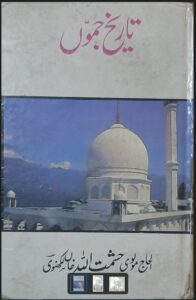
Cover of the later edition of the book (Verinag Publishers)
Although Nawab Wajid Ali Shah’s Lucknow was no more, its unique charm still lingered, and the sweetness of its language and literature, along with the light of knowledge, had not diminished.
He spent seven years in Lucknow, completed his studies in Islamic jurisprudence, and later joined the education department in Baltistan. But that is another story.
During his studies, he had to cook for himself, so he became familiar with the local grocers, bakers, and milk vendors. Whenever he bought sugar, salt, or tea from the grocery store, these items were wrapped in pieces of paper or newspaper. Over time, he developed a habit—after transferring the tea and sugar into glass jars, he would immediately examine the scrap paper to see what was written on it.
One day, as per his habit, he glanced at the paper, but what he saw left him in disbelief. He read it over and over again, yet he still couldn’t believe it. The words shimmered before his eyes—never in his wildest dreams had he imagined that in the streets of Lucknow, on a scrap of discarded paper, he would find something written about Skardu, Baltistan. But this miracle had indeed happened.
Turning the paper over, he realized that it had been torn from a book. A sudden realization struck him—this must be a book, and it had to be about Baltistan!
Leaving his tea-making unfinished, he ran towards the grocery store in the nearby alley. Out of breath, he waved the paper in front of the shopkeeper and anxiously asked where it had come from. Sensing his urgency, the shopkeeper promptly directed him to a junk dealer’s shop, just a street away.
The junk shop was filled with neatly stacked piles of paper—brown envelopes, newspaper clippings, bundles of magazines and journals tied with twine, loose pages torn from hardcover books, all forming a world of discarded literature. Near the entrance stood a weighing scale, used for measuring and selling the old paper by weight.
Ali Mumtaz showed the crumpled page to the shopkeeper and, with great persistence, demanded to see the book it came from, mentioning that the grocer had bought this scrap paper just that day.
The junk dealer walked towards a storage area attached to the shop and returned with a few books. Some were in terrible condition, their bindings falling apart, but one was intact. It was none other than Mukhtasar Tarikh-e-Jammu wa Kashmir wa Aqsa-e-Tibet (A Brief History of Jammu and Kashmir and the Tibetan Regions).
Ali Mumtaz developed a passion for religious education, but since there were no educational facilities in his village, he wandered from place to place until he reached Skardu. There, someone advised him to go to Rawalpindi if he truly wanted to pursue quality education. However, in those days, traveling to Rawalpindi was no easy task—it wasn’t as simple as hopping onto a bus and arriving at your destination amidst honking horns.
With great eagerness, Ali Mumtaz flipped through the pages of the book and scanned the table of contents. To his astonishment, the book contained a detailed history of Skardu, Khaplu, Rondu, Shingo, Shaghar, and Shigar, including the complete account of these regions up until the Dogra conquest in 1840. It was not just about Baltistan—the book also documented the history of Kargil, Ladakh, Dardistan, Kishtwar, and even the governance of Jammu, along with hand-drawn illustrations.
Ali Mumtaz explained to the junk dealer that this book held the history of his homeland and was of immense significance to him. When he asked for the price, he couldn’t believe his ears—the dealer was asking for 16 rupees. This amount exceeded even his three months’ expenses.
Mumtaz tried to reason with the shopkeeper, explaining that he was selling everything at the rate of scrap paper, and this book was part of the same lot. He even pointed out that the grocer had purchased the entire bundle of discarded paper, including this book, for a negligible price earlier that day. So why the contradiction in pricing now?
The junk dealer laughed heartily and responded, “Indeed, I sell everything at scrap value because, for most customers, these papers have no significance beyond being used as wrapping material. But,” he paused for a moment and then continued, “since you seem to have a deep love for books, and this particular one belongs to your homeland—making you its rightful stakeholder—the price must reflect its true worth.”
After some negotiation, Ali Mumtaz finally purchased Tareekh-e-Jammu for 14 rupees and brought it back with him to Skardu when he completed his education.
Thus, this book found its way to Baltistan. Later, Wary Nag Publishers reprinted it multiple times, while Lok Virsa Islamabad translated some chapters about Baltistan into English and published them in 1987.
According to Muhammad Ali Sahib, Maulvi Hashmatullah Khan of Lucknow had sent three copies of the book to Baltistan—one for the Raja of Skardu, another for Agha Ahmad Ali Shah, and the third for Minister Ghulam Mehdi. It is believed that these copies may still be in the possession of their respective families.
Ali Mumtaz became known as “Sheikh” and, after serving for many years in the education department, retired and eventually passed away. Since he had studied in Lucknow and was also a custodian of Baltistan’s intellectual and literary heritage, he wrote a few works in the Balti language, though many of his writings are now rare.
It is said that one of his masnavis contained 740 verses. He also translated the Holy Quran into Balti, but it never saw the light of day. It is rumored that his calligraphy and drawings were widely admired as well.
Kashmir’s pristine mornings offer a unique opportunity to embrace holistic wellness. Cultivating healthy morning routine habits isn’t just a trend it’s a way of life here, blending ancient traditions with modern science. Whether you’re a busy professional in Srinagar or a nature enthusiast in Gulmarg, starting your day right can transform your physical, mental, and emotional well-being.
1. Rise with the Sun: Embrace Kashmir’s Dawn for Optimal Energy
Healthy Morning Routine Habits In Kashmir, the adage “early to bed, early to rise” is woven into the culture. Waking up at dawn aligns your circadian rhythm with natural light, boosting serotonin levels and energy. Try these tips:
5:30 AM Kashmiri Chai Ritual: Sip on noon chai (salted pink tea) or green tea infused with saffron for antioxidants.
Fajr Prayer & Mindfulness: Many locals pair dawn prayers with 5 minutes of gratitude journaling.
Pro Tip: Open your windows to let the crisp mountain air invigorate your senses.
2. Hydrate Like a Local: Revive with Kashmir’s Herbal Elixirs
Morning hydration, Kashmiri wellness drinks Before reaching for caffeine, hydrate with:
Warm Lemon Water: Detoxifies and kickstarts metabolism.
Kahwa: This traditional Kashmiri brew—green tea with cardamom, cinnamon, and almonds boosts immunity and focus.
Did You Know? Dal Lake’s lotus flowers inspire locals to infuse water with rose petals for a calming start.
3. Move Your Body: Yoga and Walks Amidst Paradise
Healthy Morning Exercise Kashmir’s landscapes are a gym unlike any other:
Shalimar Bagh Strolls: A 20-minute walk here reduces stress and enhances creativity.
Yoga on Houseboats: Practice Surya Namaskar (sun salutations) on Dal Lake for alignment with nature.
Local Insight:“Movement is medicine in these valleys.” —Afaq, Srinagar-based yoga instructor.
4. Nourish with a Kashmiri Breakfast: Fuel for the Soul
Swap processed snacks with these staples:
Harissa: A slow-cooked meat and rice dish packed with protein (winter favorite!).
Phirni: Nutrient-rich rice pudding with saffron and nuts.
Fresh Apples from Sopore: Rich in fiber and vitamins.
Bonus: Pair with walnuts—Kashmir is Asia’s largest walnut producer!
5. Mental Wellness: Meditation and Kashmiri Craft Therapy
Morning Mindfulness Practices Kashmiris have mastered the art of mental calm:
Shikara Meditation: Visualize floating on Dal Lake while practicing deep breathing.
Pashmina Weaving: Spend 10 minutes knitting or crafting to reduce anxiety (a popular local stress-buster).
6. Plan Your Day: Channel the Efficiency of a Houseboat Artisan
Morning productivity, daily planning Kashmir’s artisans start early to craft intricate woodwork and carpets. Adopt their focus:
Prioritize 3 Tasks: Write them down with a kalam (traditional pen) for clarity.
Use a Samovar Timer: Work in 25-minute intervals, inspired by the patience of tea brewing.
7. Digital Detox: Unplug to Reconnect with Nature
Morning screen time, mental clarity Resist scrolling! Instead:
Listen to Sufi Music: Let the poetry of Habba Khatoon or Rashid Hafiz uplift your mood.
Garden with Saffron Crocus: Even 5 minutes of gardening lowers cortisol levels.
Why Kashmir’s Morning Wisdom Works Globally
Healthy Morning Routine Habits Kashmir’s rituals—rooted in nature, community, and mindfulness—are universally effective. Studies show that morning routines reduce anxiety by 40% and enhance productivity by 27% (Journal of Health Psychology, 2022). Whether in Srinagar or Sydney, these habits foster resilience in our fast-paced world.
Final Thought: “A Morning in Kashmir is a Blessing Don’t Waste It!”
As the sun rises over Hari Parbat, remember: your morning sets the tone for your day. Start small brew a cup of kahwa, take a deep breath of pine-scented air, and step into your best self.
Join the Conversation: Share your favorite morning habit with #KashmirMornings on social media!