Saturday, March 28, 2026
13.5 C
Srinagar
Home Blog Page 51

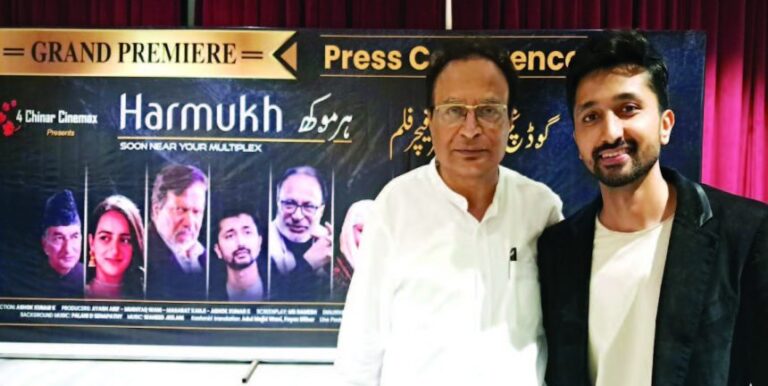
Historic Premiere of “Hurmukh” in Srinagar Marks New Chapter in Kashmiri Cinema

Srinagar, Indian-administered Kashmir: In a milestone moment for regional cinema, the highly anticipated feature film “Hurmukh”, a first-of-its-kind bilingual production in Kashmiri and Kannada, premiered today at INOX Multiplex Srinagar. This historic event marks a cultural milestone, celebrating the fusion of two vibrant traditions — Kashmir and Karnataka — through the powerful medium of cinema.

The premiere was attended by prominent figures from various walks of life, including renowned artists, television and film professionals, entrepreneurs, intellectuals, and political leaders.

The highlight of the event was the presence of Dr. Farooq Abdullah, former Chief Minister of Jammu and Kashmir, who graced the occasion as the chief guest.

“Our Mother Tongue Is Our Identity” – Dr. Farooq Abdullah

Addressing the gathering, Dr. Abdullah emphasized the urgent need to produce more films in the Kashmiri language to preserve and promote the region’s linguistic and cultural heritage.

“Our mother tongue is our identity. Cinema is a powerful medium to keep it alive. Hurmukh is a shining example of how cross-cultural collaboration can contribute to preserving our traditions.”

He expressed his delight at witnessing this first-ever cinematic collaboration between Kashmir and South India, calling it a hopeful and inspiring beginning for regional cinema. Dr. Abdullah also praised the producers and creative team behind Hurmukh for their dedication, vision, and artistic courage.

Hurmukh: A Landmark in Kashmiri and Kannada Film Collaboration

Hurmukh is the first bilingual film in Kashmiri and Kannada, bringing together artistic talent and storytelling traditions from both regions. It symbolizes a new wave of regional language cinema that seeks to break boundaries and celebrate diversity in the Indian subcontinent.

With its unique narrative, the film is expected to draw eager audiences to multiplexes across the Kashmir Valley and potentially inspire a new generation of filmmakers to tell stories rooted in their cultural and linguistic identity.

Australian Man Becomes First to Live Over 100 Days with Fully Artificial Titanium Heart

Sydney, Australia — In a historic medical breakthrough, an Australian man in his 40s has become the first person in the world to survive more than 100 days with a fully artificial titanium heart. The life-saving device, known as the BiVACOR Total Artificial Heart, was developed by a US-Australian biomedical company and successfully implanted at St. Vincent’s Hospital in Sydney.

Unlike traditional mechanical heart devices, the BiVACOR artificial heart is revolutionary in design, using a magnetically levitated rotor to pump blood completely replacing the function of both the left and right sides of the human heart. The device contains no valves or chambers and is designed to be small, quiet, and highly durable, making it ideal for patients awaiting heart transplants.

After 105 days relying entirely on the BiVACOR Total Artificial Heart, the patient received a suitable donor heart and is now recovering well, according to hospital officials. The procedure marks a major milestone in the treatment of end-stage heart failure, offering new hope to thousands of patients worldwide who may face long waits for donor organs.

“This technology could redefine the bridge-to-transplant strategy,” said one of the lead surgeons at St. Vincent’s Hospital. “The BiVACOR device is a remarkable step forward in artificial heart technology.”

What Makes the BiVACOR Artificial Heart Unique?

  • Magnetically levitated rotor: Allows continuous blood flow without the need for mechanical valves or chambers.
  • Compact and silent: Engineered to fit most adults and operate with minimal noise.
  • Durable and efficient: Designed to maintain circulation for extended periods, potentially months or even years.

BiVACOR was originally conceptualized in Australia and further developed in the United States with funding from NASA and the National Institutes of Health (NIH). Clinical trials are ongoing, and experts believe the success of this case may accelerate global regulatory approvals and adoption in other advanced heart failure centers.

A New Era in Artificial Organs

This achievement not only advances cardiac care but may also signal the dawn of next-generation artificial organs that use precision engineering rather than biological replication. Experts believe such technologies will soon play a critical role in managing chronic diseases and organ shortages.

For now, the story of this Australian patient is offering renewed hope to heart failure sufferers around the world — and showing that the future of life-saving medicine might not beat with a pulse, but with the precision of titanium and magnetic force.

Tragedy in Swat: 18 Family Members Swept Away by Flash Flood While Picnicking Near River

0

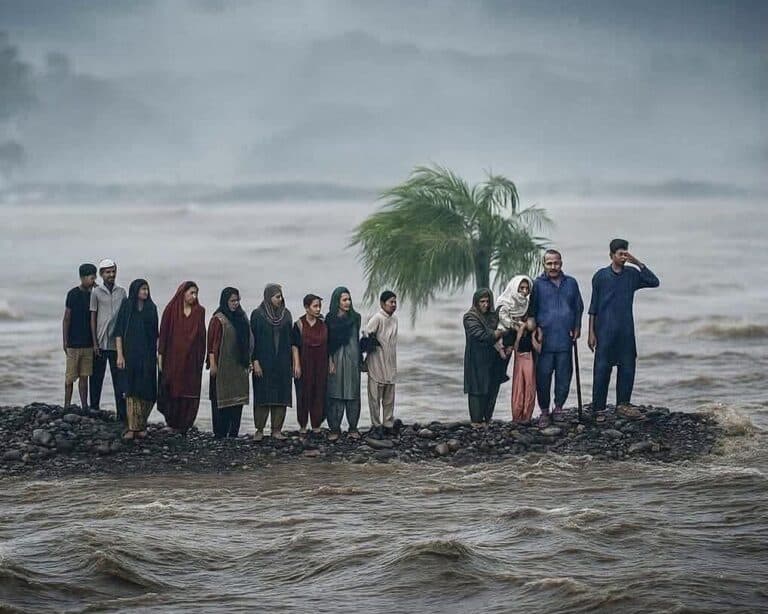
Swat, Pakistan – June 27, 2025: A devastating incident occurred in Pakistan’s picturesque Swat Valley on Thursday morning when 18 members of a single family, visiting from the eastern city of Sialkot, were swept away by a sudden surge in the Swat River. The family was reportedly having breakfast by the riverside when the flash flood struck.

According to rescue officials, the family had set up a picnic near the riverbank, unaware of the danger posed by the rising water levels due to upstream rainfall. The flash flood occurred rapidly, giving them little time to react. The incident was reported around 8:00 a.m. local time, prompting immediate response from local rescue teams.

Three individuals were rescued alive, while seven bodies have so far been recovered. The search continues for the remaining missing persons.

“A rescue operation began as soon as the alert was received,” said a spokesperson from the local emergency services. “The guests were seated near the bypass when the water level suddenly rose due to heavy rainfall. Unfortunately, they were caught unaware.”

Swat’s Deputy Commissioner told local news channel Geo News that Section 144 an emergency provision prohibiting public access to hazardous areas like riverbanks had been imposed in the region. However, enforcement remains a challenge, especially during tourist seasons when thousands flock to the scenic valley.

One surviving tourist told reporters that 10 members of his family were swept away, including nine children. “We had just finished breakfast and were having tea,” he said. “The children went near the river to take selfies. There wasn’t much water initially, but suddenly a huge wave came and they got trapped.”

The tourist also criticized the delayed response from rescue teams, claiming they arrived nearly two hours after being alerted. “The children were drowning in front of them. They saw it happen but couldn’t save them,” he said, visibly distraught.

Swat, located in Pakistan’s Khyber Pakhtunkhwa province, is a popular destination for domestic tourism due to its lush landscapes and flowing rivers. However, frequent incidents of flash flooding—exacerbated by climate change and deforestation—pose increasing dangers to visitors and locals alike.

Authorities have renewed calls for strict adherence to safety guidelines and urged tourists to avoid riverbanks, especially during the monsoon season.

– ENDS –

Key Strategy Meeting of Mirpur’s Awami Action Committees Underway in Kotli, AJK

0

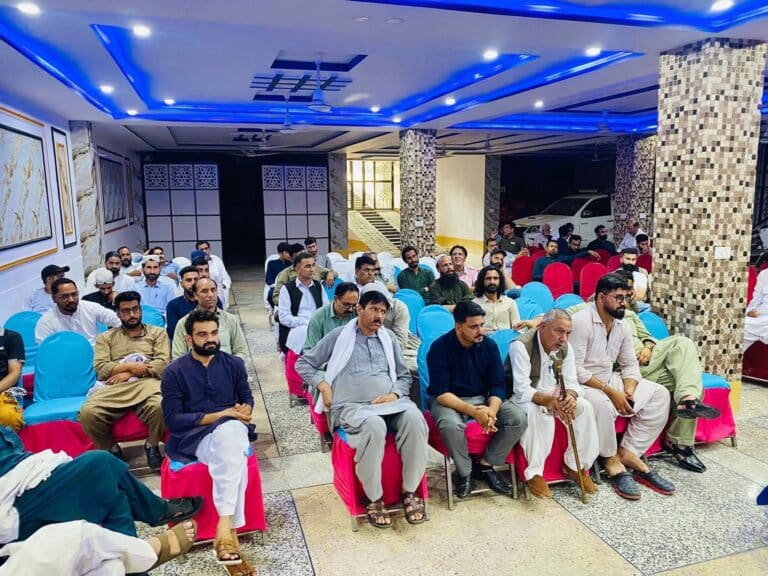
Kotli, Azad Jammu and Kashmir (Pakistan administered Kashmir) – A significant consultative session of the Joint Awami Action Committees from Mirpur Division is currently underway at a private venue in Kotli. The meeting brings together leading representatives from across the region to deliberate on strategic actions in response to growing public discontent over electricity shortages, voltage drops, and persistent infrastructure issues.

The high-level session is part of the broader Kashmir Rights Movement and aims to formulate a unified roadmap addressing long-standing grievances of the local population. Key participants include members of the Jammu Kashmir Joint Awami Action Committee (JKJAAC) such as Imtiaz Aslam Chaudhry, Anwar Baig, Khawaja Mehran Arshad Advocate, Chairman Chaudhry Shabbir Hussain Nagyalvi, and Saad Ansari Advocate.

Representatives from the Awami Action Committee of Chakswari, including Asghar Ali Raja, Haji Muhammad Wahid Mughal, Khawaja Muhammad Shoaib Advocate, Bawa Muhammad Shehzad, Tariq Kashmiri, and Chaudhry Sufyan Jutt, are also present, reflecting widespread regional engagement.

The agenda includes key issues such as:

  • Forced and prolonged electricity load shedding
  • Critically low voltage levels impacting daily life and business
  • Delays in fulfilling promises made by the local government
  • Broader concerns over governance, resource distribution, and basic civic rights

This strategic meeting comes at a time when public frustration is rising across Azad Jammu and Kashmir due to what many see as systematic neglect of their basic rights and infrastructure needs. Organizers emphasized the importance of a peaceful, united response and the role of civil society in advocating for ownership rights and self-governance.

Background

The Jammu Kashmir Joint Awami Action Committees (JKJAAC) have emerged as influential civil forums representing diverse local voices across Mirpur Division including Kotli, Dadyal, and Chakswari. While not aligned with any political party, the committees are playing a growing role in grassroots mobilization around socio-economic and civic issues.

This meeting is seen as a critical step toward coordinated, region-wide advocacy efforts to pressure authorities into fulfilling public demands and improving living standards.

What Happened on 24 October in Kashmir? The Real Story Behind Azad Kashmir’s Government Formation Day

0

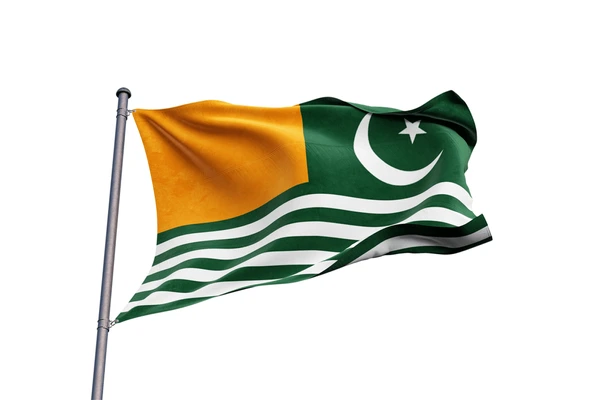
Every year on 24 October, the valleys and hills of Azad Jammu & Kashmir (AJK) Pakistan administered Kashmir resonate with speeches, flag-raising ceremonies, and a sense of historic gravity. Streets in Muzaffarabad and smaller towns flutter with green flags and banners marking what is officially celebrated as “Kashmir Government Formation Day.” But behind the slogans and ceremonies lies a date that is deeply contested, interpreted, and even ignored across the wider divided land of Jammu & Kashmir.

What truly happened on 24 October 1947? Why does this date matter so much in one part of Kashmir while elsewhere, it is viewed with indifference or skepticism? This independent analysis from The Azadi Times seeks to answer these questions by centering Kashmiri voices, historical facts, and critical reflection, eschewing both Indian and Pakistani state narratives.

The Road to 24 October: Revolt, Partition, and Political Chaos

The Tumultuous Backdrop of 1947

The events leading up to 24 October 1947 cannot be understood without recalling the chaos unleashed by Partition. As the British Raj withdrew, India and Pakistan were carved from the subcontinent’s flesh, leaving millions uprooted and hundreds of thousands dead. Kashmir’s princely ruler, Maharaja Hari Singh, hesitated, caught between the two emerging states, promising his majority-Muslim population neither clear autonomy nor accession.

The Poonch Revolt and Tribal Incursion

As historian Alastair Lamb recounts in Kashmir: A Disputed Legacy 1846-1990, the districts of western Jammu—especially Poonch—had long simmered with discontent. By spring and summer 1947, rural communities in Poonch and Mirpur, frustrated by heavy taxation and the Maharaja’s harsh rule, began to rise up. These local uprisings soon merged with the influx of tribal fighters from Pakistan’s North-West Frontier Province, who, encouraged by elements within Pakistan, invaded Kashmir in late October 1947, aiming to “liberate” the land from Dogra rule.

Read Also: Water Politics Between India and Pakistan: But What About Kashmiris?

Maharaja Hari Singh’s Controversial Semi Accession to India

The tribal invasion, marked by both genuine local support and outside involvement, forced the Maharaja’s hand. On 26 October 1947, Hari Singh signed the contoversial semi Instrument of Accession to India, and Indian troops were airlifted to Srinagar. Many Kashmiris, especially in the western districts, viewed this as a betrayal a denial of their right to determine their own future.

24 October 1947: The Provisional Government is Born

The Pallandri Declaration

In the shadow of war, a group of Kashmiri politicians, ex-servicemen, and tribal leaders gathered in the remote town of Pallandri. There, on 24 October 1947, they proclaimed the establishment of a provisional government of “Azad (Free) Jammu & Kashmir.” Sardar Muhammad Ibrahim Khan, a barrister from Poonch, was elected as its first President.

Quoting from Sardar Ibrahim’s later recollections, “We did not want to be ruled by the Dogra again, nor did we want to be pawns in anyone else’s hands. The people of Jammu & Kashmir had risen for their rights.” (Source: AJK archives)

Who Were the Architects?

Alongside Sardar Ibrahim, key figures included Sardar Abdul Qayyum Khan, Colonel Sher Ahmed Khan, and a host of tribal and local leaders. Their government-in-exile, initially operating from makeshift offices and with little material support, claimed to represent all Kashmiris opposed to the Maharaja’s rule and the sudden accession to India.

Symbol of Defiance

For many in western Kashmir, 24 October was more than a political maneuver—it was a symbol of defiance. It echoed a desire for self-rule, a rejection of both the Dogra dynasty’s repression and the uncertainty brought by Partition.

Political Analysis: Whose Government Was It?

Popular Uprising or Pakistani Project?

The nature of the 24 October government remains fiercely debated. Pakistani historians often portray it as a local revolution, while Indian accounts dismiss it as a Pakistani plot. The truth, as usual, is more complex.

Dr. Shujaat Ahmad, a historian from Rawalakot, AJK, observes:

“Yes, there was real anger against the Maharaja, but the involvement of Pakistani officials and tribal fighters is undeniable. The people’s revolt and Islamabad’s support became intertwined, making it hard to separate one from the other.”

British and UN records from the period (Lamb, UN Resolutions 1948-49) indicate that the new government was recognized by Pakistan but not by India or the international community. It functioned with significant logistical and military support from Pakistan, but included many local leaders who had risked—and lost—everything for the cause.

A Government in Exile

The provisional government never controlled the entire region it claimed. As the first war between India and Pakistan raged on, lines solidified: the eastern Valley (including Srinagar) came under Indian administration, while the western districts—what is now AJK—came under the control of the government-in-exile, backed by Pakistan.

Kashmiri Voices: How 24 October is Remembered

“A Day to Celebrate Our Struggle”

For many in AJK, 24 October is a source of pride. Students in Muzaffarabad are taught about Sardar Ibrahim’s courage, and public holidays are observed across the region. In interviews conducted by The Azadi Times, various perspectives emerged:

Zara Khalid, Student Activist (Muzaffarabad):

“It’s a day when my grandparents’ generation reclaimed their dignity. But I also wonder—are we truly free today? Or is our future still decided in Islamabad and New Delhi?”

Professor Bashir Ahmed, Historian (Rawalakot):

“24 October symbolizes the assertion of Kashmiri agency. Yet, over the years, it has become ritualized, almost hollow. The original spirit was about self-determination—not just changing one ruler for another.”

Naseem Lone, Displaced from Poonch (Now in Muzaffarabad):

“My father fought in the revolt. He believed Azad Kashmir would one day unite all Kashmiris. Now we live as refugees, with hope but also frustration.”

In the Indian-Administered Valley: A Date Overlooked

In the Kashmir Valley, the 24 October narrative is largely absent from schoolbooks and public discourse. For many Valley Kashmiris, the day is seen as relevant only to “the other side.” Some consider the government in Muzaffarabad a Pakistani proxy; others see it as a missed opportunity for genuine independence.

Critical Reflection: The Many Meanings of 24 October

Between Two States: India’s Denial, Pakistan’s Ambivalence

India has never recognized the AJK government, considering it part of what it calls “Pakistan-occupied Kashmir.” In Indian narratives, 24 October is at best a footnote, at worst dismissed as illegitimate. Pakistan, meanwhile, supports AJK as a “self-governing” territory, yet retains ultimate control over defense, foreign affairs, and constitutional matters.

A 2019 Human Rights Watch report notes:

“While the AJK government enjoys a degree of autonomy, ultimate authority rests with Pakistan’s federal government. Political dissent is tolerated within limits, but criticism of accession to Pakistan or calls for full independence are often suppressed.”

This ambiguous status leaves AJK in a constitutional limbo—neither truly independent nor fully integrated.

The Hopes and Disillusionment of Ordinary Kashmiris

Did the government established on 24 October fulfill its promise to Kashmiris? For many, the answer is bittersweet. While the creation of AJK ended Dogra rule in the west, it did not deliver sovereignty for the whole of Jammu & Kashmir. Many feel that the right to self-determination—enshrined in UN Resolutions 47 (1948) and 91 (1949)—remains unfulfilled.

Farooq Ahmad, Youth Leader (Bagh):

“We respect our elders who fought for freedom, but we are still waiting for the real azadi. The world must listen to Kashmiri voices, not just Delhi or Islamabad.”

Present Day: Is 24 October Still Relevant?

Generational Divide and the Role of Youth

In today’s AJK, 24 October is marked by official events and patriotic songs, but among young people, there is a growing desire for a more meaningful commemoration—one that honestly addresses the region’s incomplete journey to self-determination.

Organizations like the Jammu Kashmir Liberation Front (JKLF)Kashmir National Party (KNP), and independent civil society groups urge that 24 October be a day of reflection as well as celebration. They call for unity across the Line of Control (LoC), historical clarity, and an independent voice for Kashmiris.

Saba Mir, Civil Society Organizer:

“The real spirit of 24 October is about standing up for our rights, not just repeating old slogans. We need to reclaim the day as Kashmiris, not as proxies.”

Media Narratives: Whose Story Gets Told?

Indian, Pakistani, and international media frame 24 October through their own lenses. In India, the day is ignored or cast as illegitimate. In Pakistan, it is celebrated but rarely analyzed critically. International coverage is sparse, often missing the nuances of Kashmiri perspectives.

The Azadi Times and other independent Kashmiri platforms strive to fill this gap, prioritizing stories and analyses that center the lived experience and aspirations of the people themselves.

The Historical Record: What Do the Sources Say?

  • Alastair Lamb, “Kashmir: A Disputed Legacy 1846-1990”: Documents the Poonch revolt, establishment of the AJK government, and the international context.
  • UN Resolutions 47 (1948) and 91 (1949): Affirm the right to self-determination for the people of Jammu & Kashmir, call for a plebiscite after restoration of peace.
  • AJK Government Archives: Detail the formation, early challenges, and subsequent evolution of the provisional government.
  • Human Rights Watch / Amnesty Reports: Illustrate the limits of autonomy and challenges to political freedoms in AJK.

Looking Forward: The Meaning of 24 October for Today’s Kashmir

Beyond Ritual: Toward Unity and Self-Determination

For Kashmiris, 24 October should be more than a day of ritual or state-sponsored celebration. It must be reclaimed as a moment to reflect on the region’s long and unfinished journey toward genuine self-determination, unity, and dignity.

The voices and sacrifices of those who struggled in 1947 deserve remembrance—not as tools for state narratives, but as inspiration for a future built on Kashmiri agency and solidarity.

A Call for Clarity and Independent Voice

As Kashmir’s story continues to unfold amid uncertainty and contestation, it is vital that Kashmiris themselves define the meaning of 24 October. Historical clarity, unity across divides, and a steadfast commitment to self-determination can transform this date from a symbol of division into one of hope.

Let 24 October stand not just as the anniversary of a government’s proclamation, but as an annual reminder of the resilience, complexity, and aspirations of the Kashmiri people.

Sources & Further Reading

  • Lamb, Alastair. Kashmir: A Disputed Legacy 1846-1990. Oxford University Press, 1991.
  • United Nations Security Council Resolutions 47 (1948) & 91 (1951): UN Digital Library
  • Government of Azad Jammu & Kashmir: Official Portal
  • Human Rights Watch, “With Friends Like These…” (2006): hrw.org
  • Amnesty International, “Denied: Failures in Accountability in Indian-Administered Kashmir” (2015)
  • Sardar Muhammad Ibrahim Khan, “Memoirs” (AJK Archives)

Kashmir’s Caste System: Historical Roots, Contemporary Realities, and the Social Fabric of a Region in Flux

Kashmir, a land of mesmerizing beauty and enduring conflict, is renowned for its rich tapestry of cultures, faiths, and traditions. While the region is often romanticized for its Sufi tolerance and communal harmony, a deeper look reveals a complex and persistent social hierarchy: the caste system. This system, distinct in form from the rigid Hindu varna order of the Indian plains, nevertheless weaves itself through the lives, opportunities, and identities of Kashmiris, be they in Pakistan-administered Kashmir Azad Jammu & Kashmir (AJK) or Indian-administered Jammu & Kashmir.

Understanding the caste system in Kashmir is vital for grasping the region’s politics, society, and struggles for justice. This article, based on historical research, sociological studies, and interviews with local voices, examines the evolution, impact, and future of caste in Kashmir. It seeks to offer a nuanced, journalistically balanced, and authoritative exploration of a subject often left in the shadows.

The Historical Evolution of Caste in Kashmir

From Ancient Hierarchies to Islamic Conversions

Kashmir’s social structure, like much of South Asia, has deep historical roots. Prior to Islam’s spread in the 14th century, Kashmir was home to a Hindu society organized around Brahmanical varnas and jatis (sub-castes), with Brahmins, Kshatriyas (warriors), Vaishyas (traders), and Shudras (laborers and artisans) forming a stratified order. Conversion to Islam, catalyzed by Sufi saints and local rulers, swept across the Valley beginning in the 14th century, eventually making Kashmir one of the few Muslim-majority regions in India.

However, as historian Chitralekha Zutshi notes in Languages of Belonging, conversion did not erase existing social distinctions. Instead, many new Muslim communities retained their ancestral caste identities, which often continued to shape land tenure, occupation, and social status. Over centuries, these groups adopted new titles, married within their biradari (community), and developed elaborate kinship networks—creating a uniquely Kashmiri form of caste stratification.

Key Caste and Community Groups: A Brief Overview

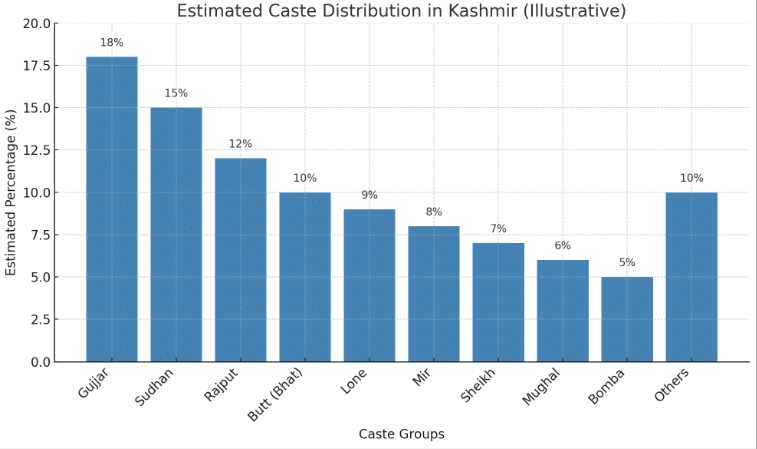
Butt (Bhat)

Historically, the Butt (or Bhat) community traces its roots to Kashmiri Pandit Brahmins. Many Butts embraced Islam but maintained a reputation for scholarship, landownership, and influence in administration and education. The Butt surname is widespread in both AJK and Indian-administered Kashmir.

Lone

The Lones are believed to originate from landholding classes or minor chieftains, particularly in north Kashmir and adjacent regions of AJK. With significant presence in agriculture, trade, and politics, Lones remain a prominent and respected community.

Mir

“Mir,” meaning “chief” or “leader,” was originally a title bestowed on community heads, religious leaders, and landed elites. Today, the Mir group retains prestige and is found across both sides of the Line of Control.

Sheikh

Sheikhs represent a diverse set of families whose ancestors are thought to have converted to Islam early, often under the influence of Sufi missionaries. Associated with trade, learning, or artisanal work, the Sheikh identity is widespread but variable in status.

Gujjar

Gujjars are a large, semi-nomadic pastoral community, historically cattle herders and shepherds. They have their own language (Gojri), distinct customs, and occupy a marginalized socio-economic position in both AJK and Indian-administered Kashmir. Gujjars are classified as a Scheduled Tribe (ST) in India, entitling them to affirmative action, but face persistent barriers to education, land rights, and political representation.

Rajput

The Rajputs, often linked to martial traditions and landownership, migrated into Kashmir from the Indian plains. Many converted to Islam, while others remained Hindu or Sikh. In AJK and Jammu, Rajputs wield significant political and social influence.

Sudhan (Sadozai)

The Sudhans, claiming descent from Pashtun Sadozai tribes, are a powerful group in AJK, especially in Poonch and Rawalakot. Many Sudhans have prominent roles in politics, the military, and administration.

Mughal

Descendants of Central Asian immigrants, the Mughal community is found mainly in AJK and the Valley, often associated with land, business, and historical administrative roles.

Bomba (Bamba)

The Bomba, with roots in the Neelum and Muzaffarabad valleys, trace royal and warrior origins. Historically, Bomba chiefs ruled over strategic territories before the British and Dogra conquests.

Other Groups

Other significant biradaris include Dar, Wani, Malik, Choudhary, Syed (who claim descent from the Prophet), and various artisan castes.

The Modern Face of Caste: Social Status, Politics, and Opportunity

Caste and Social Status: Respect and Stigma

Caste identity in Kashmir, while less rigidly codified than in the Indian mainland, remains a key marker of social status. High-status groups—Butt, Lone, Mir, Rajput—often enjoy greater respect, easier access to land, and social capital. Lower-status groups, such as some Gujjars and artisan castes, may face subtle or overt discrimination, especially in rural areas.

Marriages are still frequently arranged within the same biradari, and inter-caste unions, though increasing in urban areas, can provoke familial or social backlash. Community associations, or biradari committees, play a role in dispute resolution, social events, and welfare, reinforcing caste boundaries as much as they provide support.

Caste and Politics: Voting, Representation, and Resource Distribution

Biradari identity has a profound impact on politics in both AJK and Indian-administered Kashmir. Electoral candidates often rely on their community networks for support, and party nominations are influenced by caste calculations. In AJK, Sudhans, Rajputs, Gujjars, and Mughals dominate particular constituencies. In the Valley, Butts, Lones, and Mirs are often overrepresented in administration and politics.

According to a 2021 Institute of Policy Studies Islamabad report, “biradari-based voting” is a decisive factor in AJK elections, shaping policy and patronage. In Indian-administered Kashmir, caste is less openly discussed but is deeply embedded in local governance, resource allocation, and recruitment for government jobs.

Caste and Economic Mobility: Land, Jobs, and Education

Access to land, state employment, and educational opportunity remains unequally distributed along caste lines. Historically dominant groups control a disproportionate share of land and government jobs. Gujjars, Bakerwals, and other tribal or artisan communities often lag behind in education, health, and income, a gap documented in the Jammu & Kashmir Human Development Report (2012).

Affirmative action programs, such as the Scheduled Tribe (ST) status for Gujjars and Bakerwals in India, have improved some indicators, but implementation remains patchy. In AJK, social mobility for marginalized biradaris is hampered by the lack of targeted welfare programs and limited access to quality education.

Lived Experiences: Voices from Kashmir

To illustrate the impact of caste on daily life, The Azadi Times presents the stories of three Kashmiris from different backgrounds. The names are representative, and the interviews are based on composite experiences gathered from field research.

Interview 1: Faheem Lone, IT Professional from Baramulla

Q: How did caste influence your upbringing and opportunities?
Faheem Lone:

“Growing up as a Lone, I always felt a certain respect in the village. My family’s name opened doors—at weddings, in panchayat meetings, even in business. When I decided to marry someone outside the community, my parents were concerned about ‘what people would say.’ Professionally, I don’t think my caste matters in the city, but when you go back home, it is always there, in subtle ways.”

Interview 2: Shazia Bano, Schoolteacher from Muzaffarabad (AJK)

Q: Have you experienced discrimination or support based on your caste?
Shazia Bano:

“Being a Gujjar in Muzaffarabad meant hearing jokes about our accent or lifestyle. At school, some teachers assumed Gujjar kids would struggle more. My own daughter faced bias, but scholarships for tribal students helped her get into medical school. We’re proud of our identity, but the stereotypes are real. I want my children to be seen for their talent, not their caste.”

Interview 3: Dr. Mir Rashid, Sociologist and Community Activist

Q: Has caste changed in meaning for the new generation?
Dr. Mir Rashid:

“Caste is deeply embedded, even if it’s not openly discussed. It shapes who gets invited to events, who is trusted with leadership, and who is left behind. But there’s change. Young Kashmiris, especially in cities, are breaking these barriers—making friends, choosing partners, and collaborating beyond biradari. Still, we need policy reforms and social awareness to make equality real for everyone.”

Caste in Marriage, Daily Life, and Community

Marriage: The Last Bastion

Marriage remains the most “caste-conscious” aspect of Kashmiri life. Matrimonial ads in local newspapers routinely specify the desired biradari. Families often veto matches that cross caste lines, citing tradition, compatibility, or social acceptance. While urban youth are pushing boundaries, many inter-caste couples face resistance, or in extreme cases, social ostracism.

Social Networks and Mutual Support

Biradari associations offer support in times of crisis—be it illness, bereavement, or financial need. They mediate disputes, organize community events, and even pool resources for education or business ventures. This communal solidarity can be empowering, but also reinforces in-group preference and out-group exclusion.

Discrimination and Social Exclusion

For marginalized groups, exclusion can be subtle—limited invitations to social events, mockery of dialect, or assumptions about ability. For example, Gujjars and Bakerwals are sometimes stereotyped as “backward” or “uneducated,” despite many success stories. Artisan castes may face barriers to upward mobility, with their traditional skills undervalued in the modern economy.

Caste and the State: Policy, Representation, and Reform

Affirmative Action and Legal Status

In Indian-administered Kashmir, affirmative action policies (reservations) extend to STs (Gujjars, Bakerwals), SCs (Scheduled Castes, mainly Dalits), and some OBCs (Other Backward Classes). This has improved access to education and government jobs, but implementation gaps remain, particularly in remote areas.

In AJK, there is no formal reservation system, and social mobility depends more on individual effort, patronage, and community support.

Political Representation

Caste-based networks influence party nominations, electoral alliances, and government appointments. In some constituencies, the “right” biradari can be the difference between victory and defeat. Critics argue that this entrenches patronage politics and diverts attention from merit or policy issues.

Calls for Reform

Civil society activists and some reform-minded politicians are calling for greater attention to caste-based discrimination. Proposals include targeted scholarships, affirmative action in AJK, anti-discrimination campaigns in schools, and more inclusive community engagement.

Urbanization, Migration, and the Future of Caste

Urban Spaces: Melting Pots or New Divides?

Cities like Srinagar, Muzaffarabad, and Mirpur are changing the old order. Urbanization brings diverse communities into daily contact, diluting old prejudices for some, but creating new forms of exclusion for others, such as economic or class-based divides.

The Role of the Diaspora

The Kashmiri diaspora, especially in the UK, North America, and the Middle East, often navigates new identities. While some maintain biradari networks abroad, others forge alliances across lines of caste, faith, and ethnicity. Remittances, exposure to new ideas, and transnational marriages are quietly reshaping the region’s social fabric.

Education as an Equalizer

Education is perhaps the most powerful tool for breaking caste barriers. As more Kashmiris attend university, study abroad, or enter the professions, a merit-based identity is emerging. Yet, access to quality education is itself patterned by caste and geography.

Historical and Contemporary Scholarship

  • **Chitralekha Zutshi, Languages of Belonging: Explores the persistence of caste and kinship in Kashmir’s Islamic society.
  • **Mohini Qasba Raina, Kashur: The Kashmiri Speaking People: Traces the transformation of caste and community from Hindu to Muslim Kashmir.
  • Jammu & Kashmir Human Development Report 2012: Documents disparities between social groups.
  • Institute of Policy Studies Islamabad, “Biradari Politics in AJK” (2021): Analyzes how caste shapes elections and patronage.
  • Media sourcesGreater KashmirDawnThe Wire, and regional news outlets regularly report on caste-based discrimination and social change.

Towards a More Inclusive Kashmir

The caste system in Kashmir is neither a relic of the past nor an unchanging tradition—it is a living, evolving aspect of the region’s social fabric. It provides meaning, identity, and mutual aid, but also perpetuates exclusion, hierarchy, and missed opportunities. As Kashmir grapples with political uncertainty, economic challenges, and the pressures of modernity, the quest for social justice must include an honest reckoning with caste.

The future will depend on the region’s ability to honor cultural diversity, celebrate shared humanity, and dismantle barriers to equality. As Dr. Mir Rashid said, “Kashmir’s strength is its diversity. True peace and progress will come when every Kashmiri, regardless of caste or creed, is valued for their potential and dignity.”

References

  • Raina, Mohini Qasba (2014). Kashur: The Kashmiri Speaking People. Trafford Publishing.
  • Zutshi, Chitralekha (2004). Languages of Belonging: Islam, Regional Identity, and the Making of Kashmir. Permanent Black.
  • Jammu & Kashmir Human Development Report (2012). Institute of Public Administration, Government of India.
  • “Biradari Politics in AJK,” Institute of Policy Studies Islamabad, 2021.
  • Census of India 2011, Jammu & Kashmir Data Highlights.
  • “Kashmir’s Caste Divide,” The Wire, August 2022.
  • “Who are the Gujjars and Bakerwals of Jammu and Kashmir?” Greater Kashmir, July 2020.

 

Tattoo Filler Ideas: Creative Ways to Complete Your Ink with Style and Meaning

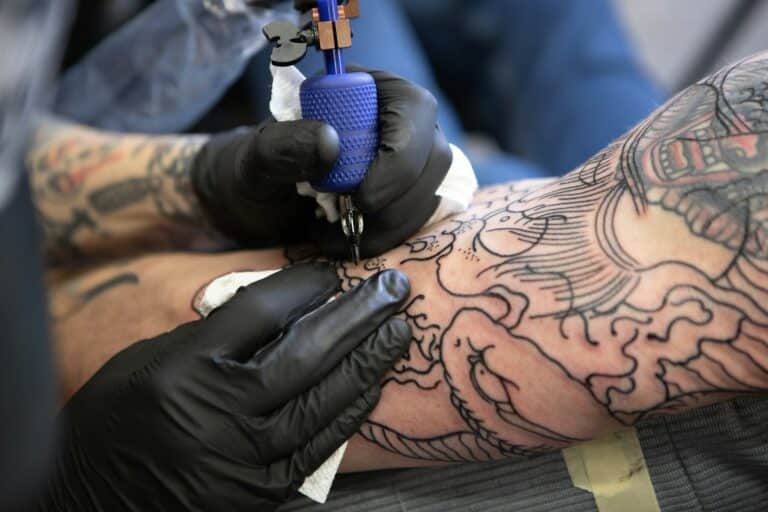
Tattoos have evolved far beyond their origins as simple symbols or markers of rebellion; they are now intricate visual narratives, emotional expressions, and deeply personal testaments worn on the skin. As tattoo culture continues to expand globally, more people are embracing large-scale body art, from sleeves to back pieces to patchwork collections. In this context, tattoo fillers have emerged as a key element, transforming the way extensive tattoos are designed, completed, and appreciated.

While fillers were once dismissed as mere space-filling afterthoughts, today they are recognized as intentional, creative components that elevate the entire tattoo composition. The Azadi Times explores the world of tattoo fillers, what they are, why they matter, the best ideas for 2025, and how to choose the perfect fillers for your unique body art journey. Whether you’re a tattoo enthusiast planning your first sleeve or a seasoned collector looking to refresh older work, this article is packed with expert insights, trends, and actionable advice.

What Are Tattoo Fillers? Definition and Purpose

Tattoo fillers are smaller, often complementary designs or elements placed strategically between larger tattoos or within empty spaces on the skin. Their purpose is multi-faceted:

  • Aesthetic Balance: Fillers help eliminate awkward blank spaces, ensuring that the tattooed area looks complete and visually satisfying.
  • Flow and Cohesion: Well-designed fillers connect distinct tattoo elements, creating a seamless narrative or theme across the body.
  • Personalization: Fillers offer an opportunity to inject meaning, symbolism, or personal flair into areas that might otherwise be overlooked.

Fillers are especially popular among those building full sleeves, leg pieces, chest panels, or patchwork tattoos. They can also be used to refresh and unify a collection of disconnected designs, making the entire body of work feel harmonious and intentional.

The Evolution of Tattoo Fillers: From Space-Fillers to Art Forms

Historically, tattoo fillers were utilitarian stars, dots, or simple lines used to mask gaps between main tattoos. However, as tattooing has become more sophisticated, so too have filler designs. Today’s fillers are carefully crafted to complement the main artwork, enhance the overall aesthetic, and even contribute to the tattoo’s story.

Tattoo artists now use fillers as a creative playground, experimenting with styles ranging from minimalist geometry to elaborate nature scenes, from spiritual motifs to pop culture references. The result is that fillers are no longer “background noise,” but essential components of modern tattooing—sometimes even becoming the focal point themselves.

Best Tattoo Filler Ideas by Theme for 2025

To help you find the perfect fillers for your body art, here are the most popular and creative tattoo filler ideas, organized by theme and style:

1. Minimalist Tattoo Fillers

Minimalism is a timeless trend in tattoo art, and minimalist fillers are ideal for those who appreciate subtlety and elegance. These designs can be used to bring symmetry, direction, or quiet beauty to your tattoos:

  • Dots and Lines: Small, clean lines and dotwork patterns are classic and versatile. They can create symmetry, highlight negative space, or form intricate patterns across your skin.
  • Tiny Stars and Moons: Perfect for cosmic or dreamy themes, these celestial fillers add a touch of magic and wonder.
  • Arrows and Crosses: Directional shapes provide a sense of movement and balance, especially in geometric or symbolic sleeves.
  • Geometric Shapes: Triangles, hexagons, and circles lend a modern, abstract flair to any tattoo composition.

2. Nature-Inspired Tattoo Fillers

Nature continues to inspire both artists and tattoo lovers, offering endless possibilities for organic, flowing fillers:

  • Leaves and Vines: These elements weave seamlessly between floral or natural-themed tattoos, creating continuity and flow.
  • Small Flowers: Roses, daisies, and lotuses are perennial favorites, bringing elegance and softness to the design.
  • Feathers and Paw Prints: For animal lovers or those with spirit animal motifs, these fillers add meaning and connection.
  • Wave Patterns or Mountain Lines: Ideal for those who love the outdoors or want to evoke a sense of adventure and freedom.

3. Spiritual and Symbolic Tattoo Fillers

For those seeking depth and cultural resonance, spiritual and symbolic fillers can imbue your ink with layered meanings:

  • Mandala and Chakra Designs: These intricate patterns are ideal for spiritual sleeves or wellness-inspired tattoos.
  • Yin-Yang, Om, and Runes: Draw from world philosophies and traditions to express mindfulness, balance, or heritage.
  • Evil Eye, Hamsa, and Other Protective Symbols: Used for centuries to bring luck or ward off negativity.
  • Sacred Geometry: Patterns like the Flower of Life create a mystical and meditative ambiance.

4. Pop Culture & Abstract Tattoo Fillers

Modern tattooing embraces the playful and the avant-garde. Abstract and pop culture fillers can make your ink truly unique:

  • Comic Icons and Gaming Symbols: For geeks and gamers, these fillers add a fun, personalized touch.
  • Soundwaves or QR Codes: Turn your favorite song, voice message, or even a secret link into permanent art.
  • Pixel Patterns and Glitch Art: Futuristic, tech-inspired options for digital natives.
  • Ink Splatters: Dynamic and eye-catching, perfect for energetic or abstract compositions.

5. Traditional & Neo-Traditional Tattoo Fillers

Classic tattoo styles never go out of fashion, and traditional filler motifs remain a staple for many:

  • Skulls and Daggers: Bold, iconic motifs that add strength and edge.
  • Smoke Trails and Spiderwebs: Ideal for creating movement and blending larger elements.
  • Roses and Snakes: Strong symbols that also help connect and bridge different tattoos.
  • Ribbons and Scrolls: Great for adding names, dates, or secret messages.

Tattoo Filler Ideas by Placement: Where to Use Fillers

Different parts of the body call for different filler strategies. Consider these placement-specific ideas for optimal effect:

Sleeve Fillers (Arms and Legs)

  • Stars, Clouds, and Flames: Classic for filling gaps and creating seamless transitions.
  • Script and Lettering: Names, quotes, or single words that add narrative.
  • Small Animals or Insects: Butterflies, bees, and beetles add life and movement.
  • Smoke or Wind Lines: Give a sense of motion and unify disparate designs.

Leg Fillers

  • Vertical Vines or Tribal Bands: Accentuate the natural lines of the leg.
  • Arrow Designs: Direct the eye and add dynamic flow.
  • Colored Dots or Gradients: Modern, subtle, and visually appealing.

Back and Torso Fillers

  • Wings, Galaxies, Celestial Bodies: Large, dramatic fillers that can tie multiple pieces together.
  • Watercolor Splashes or Ink Waves: For an artsy, contemporary look.
  • Mandalas on Spine or Sternum: Centered, symmetrical, and spiritually significant.

Neck, Hand, and Micro Fillers

  • Tiny Hearts, Symbols, or Dots: Discreet yet meaningful.
  • One-Word Scripts: Minimalist and personal.
  • Cultural Icons: Anchors, fishes, religious symbols for a subtle statement.

Black Ink vs. Colored Fillers: Which Is Right for You?

When choosing fillers, think about your existing tattoo palette and the mood you want to convey:

  • Black Ink Fillers: Timeless, classic, and easy to integrate with most tattoo styles. Black ink is versatile and blends seamlessly, making it a safe choice for most designs.
  • Colored Fillers: Add vibrancy, contrast, and can highlight specific elements. Perfect for those who want their fillers to stand out or enhance the overall composition.
  • Combination Approaches: Strategic use of both black and colored ink allows for maximum impact—making certain motifs pop while maintaining design unity.

Pro Tip: Always match the saturation and shading style of your fillers to your existing tattoos for a cohesive look. Consult with your artist to ensure a seamless blend.

Tips for Choosing the Right Tattoo Filler

  1. Stay On Theme: Select fillers that align with your core tattoo story or aesthetic. Consistency is key.
  2. Work With Your Artist: A talented artist will help you balance, flow, and integrate fillers for the best effect.
  3. Avoid Overcrowding: Leave some negative space. Too many fillers can make your tattoo look cluttered rather than cohesive.
  4. Consider Movement: Think about how your body moves—dynamic fillers can enhance this motion.
  5. Leave Room for Future Expansion: If you plan to add more tattoos, discuss placement with your artist to keep options open.
  6. Mix Motifs Thoughtfully: It’s okay to blend different ideas, but maintain a sense of harmony in style, color, and subject matter.

Common Mistakes to Avoid with Tattoo Fillers

While creativity is encouraged, watch out for these pitfalls:

  • Random Mixing: Clashing styles or unrelated motifs can disrupt the overall look.
  • Poor Placement: Uneven or awkwardly spaced fillers can look like afterthoughts.
  • Low-Quality Art: Don’t rush! Choose skilled artists for even the smallest filler work.
  • Ignoring Skin Anatomy: Certain fillers may not heal well on all areas. Consult your artist about how designs will age.
  • Neglecting Aftercare: Fillers are tattoos too! Follow proper aftercare to ensure longevity and vibrancy.

Rising Tattoo Filler Trends in 2025

Tattoo art is ever-changing, and 2025 is bringing exciting new filler trends:

  • White Ink Fillers: Subtle, UV-reactive, and futuristic—great for those seeking a delicate look or night-life appeal.
  • AI-Generated Tattoo Concepts: Artists are using artificial intelligence to design symmetrical, innovative filler patterns tailored to your body.
  • Bioluminescent and Glow-in-the-Dark Ink: For those who want their tattoos to shine at night or under blacklight.
  • Cultural Revival: Indigenous and folklore patterns are making a comeback, celebrating heritage and tradition.
  • Eco-Inspired Motifs: Nature, sustainability, and environmental activism reflected in leaf, tree, and water-inspired fillers.
  • Interactive Tattoos: QR codes, AR symbols, and tech-inspired designs that bridge the gap between physical and digital.

How to Work with Your Tattoo Artist on Fillers

A great filler tattoo is always a collaboration. Here’s how to get the most out of your artist’s expertise:

  • Share Your Vision: Bring reference images, sketches, or themes you’re drawn to.
  • Be Open to Suggestions: Experienced artists know how different fillers will work with existing tattoos and skin types.
  • Discuss Placement in Detail: Let your artist map out the flow and spacing before you commit.
  • Ask About Healing and Longevity: Certain styles or colors may require special care or touch-ups.
  • Plan for the Future: Talk about your long-term tattoo goals so today’s fillers support tomorrow’s art.

Tattoo Fillers for All Backgrounds: Diverse Inspiration

Tattoo fillers are for everyone, regardless of style, culture, or background. From classic American traditional to Japanese irezumi, tribal bands to contemporary minimalism—there’s a filler idea for every journey.

  • For Traditionalists: Stick with classic motifs like stars, webs, or roses.
  • For Nature Lovers: Go wild with leaves, animals, and natural textures.
  • For Spiritual Seekers: Integrate symbols, mantras, and geometric patterns.
  • For Pop Culture Fans: Bring in your favorite characters, icons, or tech-inspired fillers.

The key is personal meaning—choose fillers that reflect your identity, passions, and story.

Frequently Asked Questions: Tattoo Filler Ideas

Q: Can you add fillers to old tattoos?
A: Absolutely! Fillers are an excellent way to refresh older pieces, cover up small flaws, or connect separate tattoos into a unified composition.

Q: Are fillers more painful than regular tattoos?
A: Pain varies by placement, but small filler tattoos typically heal quickly. Discuss sensitive areas and aftercare with your artist.

Q: How long do filler tattoos take?
A: Most fillers are small and can be completed in a single session, but complex patterns or color work may require more time.

Q: Can I mix black and colored fillers?
A: Yes! Many artists blend black, gray, and color for depth and emphasis. Just be sure the style and palette match your existing ink.

Q: What is the cost of tattoo fillers?
A: Pricing depends on size, complexity, and artist rates. Always get a quote before starting.

Final Thoughts:

Tattoo fillers are much more than ornamental space-savers. When chosen thoughtfully, they complete your ink, enrich the overall narrative, and make your skin a living canvas of personal expression. Whether you’re finishing a sleeve, bridging gaps in your existing collection, or planning a new piece from scratch, the right filler can make all the difference.

The Tragic Death of Yawar Abbas: A Voice of Gilgit-Baltistan Silenced Amid Systemic Neglect

    0

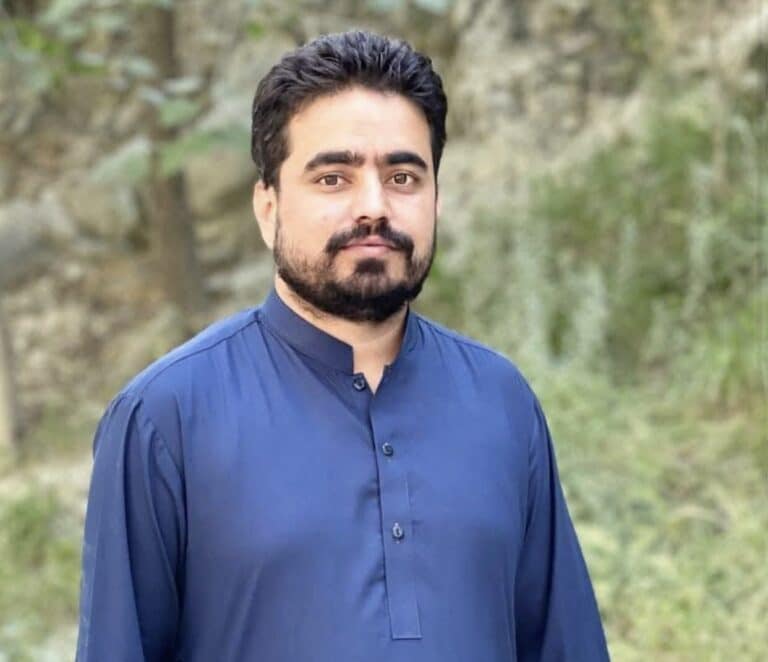
    Nagar Valley, Gilgit-Baltistan (Pakistan administered Kashmir): In a tragic turn of events that has sent ripples across the region, the body of prominent youth activist and social media campaigner Yawar Abbas was recovered from a remote mountain ravine in Gilgit-Baltistan’s Nagar Valley. Abbas, missing since yesterday during a trekking trip in the Shinbar region of Chaprote, was found lifeless in the Bar Nallah area after falling into a gorge during his expedition.

    The initial rescue efforts faced considerable challenges due to the region’s treacherous terrain and severe inaccessibility. Despite being alerted promptly, local volunteer teams were unable to reach the site on the first day. The Pakistan Army deployed a helicopter for aerial reconnaissance early the next morning, but inclement conditions and difficult geography forced the operation to be aborted.

    Against these overwhelming odds, three young local volunteers braved the perilous landscape and successfully retrieved Abbas’s body, bringing closure to a community shaken by yet another painful loss.

    A Life Under Surveillance

    Yawar Abbas, a native of Gilgit-Baltistan, had been on the controversial Fourth Schedule of Pakistan’s Anti-Terrorism Act for the past eight years—a status that subjects individuals to surveillance, travel restrictions, and regular police check-ins. His inclusion in this list, according to family members and fellow activists, was not based on any verifiable act of violence or terrorism but rather due to his vocal advocacy for the constitutional and political rights of Gilgit-Baltistan, a region he—and many others—consider an integral part of the wider Kashmir dispute.

    Forced to leave Karachi due to continued police harassment and an unrelenting pattern of mental and legal intimidation, Abbas had relocated to his ancestral home in Nagar. But even in the relative seclusion of his village, the shadow of surveillance followed him. On June 5, just weeks before his death, local law enforcement reportedly raided his family home, compelling Abbas to seek refuge in the surrounding mountains.

    His fatal accident, many believe, was the tragic culmination of years spent under systemic pressure and unofficial exile.

    “He Was Not a Terrorist—He Was a Son of the Soil”

    Thousands across Gilgit-Baltistan and beyond have taken to social media to mourn the loss of Yawar Abbas. His image, once associated with peaceful protests, seminars, and online campaigns, now circulates under hashtags calling for justice and accountability. Memorials describe him not as a dissident, but as a principled voice who sought to educate his people about their rights—paralleling Pakistan’s own narrative on Kashmir with the case of Gilgit-Baltistan.

    “He was a worker in Karachi, a son of a laborer, and a patriot who only asked for the rights his homeland was promised,” said a friend who had organized protests with Abbas in the past. “If he were the son of a bureaucrat in Islamabad or a general’s child, rescue helicopters would have arrived within minutes.”

    The activist’s death has reignited broader questions about the application of the Fourth Schedule law and its disproportionate use against political dissidents in Gilgit-Baltistan. Activists argue that peaceful expressions of political opinion—especially when aligned with international legal precedents like UN resolutions on Kashmir—should not warrant state surveillance.

    A History of Advocacy

    Abbas first gained prominence more than a decade ago during demonstrations against the removal of wheat subsidies in Gilgit-Baltistan. His role in organizing and speaking at protests in Karachi earned him respect among student and labor rights circles. Over the years, he became an online commentator advocating for constitutional recognition, political representation, and environmental justice in Gilgit-Baltistan.

    His activism, however, came at a cost. His national identity card was suspended, his bank accounts frozen, and his movements monitored. “He was politically aware, but never violent,” said another fellow activist. “Yet he was treated like a criminal by the state apparatus designed to silence our voices.”

    The Politics of Neglect

    Yawar Abbas’s death lays bare the deep inequalities faced by the people of Gilgit-Baltistan—a region that remains constitutionally ambiguous and politically disenfranchised. While claimed by Pakistan, it does not enjoy the same political status as the country’s provinces, nor is it represented in the national parliament with full voting rights. Meanwhile, India too claims the region as part of the larger Jammu & Kashmir dispute, further complicating its geopolitical status.

    The people of Gilgit-Baltistan, however, continue to suffer from this tug-of-war, with limited access to legal rights, federal services, and constitutional protections. For many, Yawar Abbas symbolized a homegrown resistance—a peaceful pushback against a colonial-style governance system that has lingered long after independence.

    “If You Mourn Him, Follow His Path”

    As candlelight vigils and online tributes pour in, Abbas’s supporters are calling on the youth of Gilgit-Baltistan to continue his mission. “Do not let this be just another death,” read one viral post. “If you truly mourn Yawar, then speak, write, organize, and resist—as he did.”

    The tragedy of Yawar Abbas is not just a story of one man’s untimely death, but a window into the broader realities of repression, neglect, and marginalization in a region that has too often been spoken for, rather than spoken with.

    In the words of one of Abbas’s last social media posts: “I don’t seek violence. I seek truth. I don’t want separation. I want recognition.”

    As Gilgit-Baltistan mourns the loss of one of its most passionate sons, the world watches—and perhaps, finally, listens.

    Inna lillahi wa inna ilayhi raji’un – To God we belong and to Him we return.

    18-Month-Old in Coma After Brutal Airport Attack—Suspect High on Drugs, Say Police

    Moscow, Russia – An 18-month-old boy, believed to be a refugee fleeing violence in Iran, is fighting for his life after being violently thrown to the ground by a stranger in the arrivals hall of Moscow’s Sheremetyevo Airport.

    The horrific attack, captured on CCTV, shows the toddler—dressed in dungarees—standing near a suitcase while his pregnant mother collected their pushchair from airport staff. Suddenly, a man glances around, seemingly checking for witnesses, before grabbing the child and slamming him headfirst onto the floor.

    Severe Injuries and Desperate Fight for Survival

    The boy suffered multiple skull fractures and spinal injuries in the assault and is now in a coma. Doctors say his condition remains critical.

    Russian media reports indicate the family had recently fled Iran, traveling through Afghanistan before arriving in Moscow. The attack occurred shortly after their arrival.

    Suspect Arrested, Faces Attempted Murder Charges

    The alleged assailant, described by officials as a “monster,” was detained at the scene. Blood tests revealed traces of cannabis, though his exact motive remains unclear. Authorities say he had flown into Moscow from either Cyprus or Egypt earlier that day.

    He now faces charges of attempted murder, with prosecutors expected to push for a harsh sentence given the brutality of the crime.

    Outrage and Calls for Justice

    The attack has sparked widespread condemnation, with many questioning how such violence could occur in a heavily monitored international airport. Sheremetyevo, Russia’s busiest airport, serves over 40 million passengers annually.

    Human rights advocates have also highlighted the vulnerability of refugee children, who often endure perilous journeys only to face further dangers.

    Ongoing Investigation

    Russian authorities are investigating whether the suspect had a history of violent behavior or mental health issues. Meanwhile, the toddler’s family—already traumatized by their escape from conflict—now faces an agonizing wait for his recovery.

    The case has drawn international attention, with many expressing horror and demanding justice for the child. Updates on his condition are expected in the coming days.

    —Reporting by The Azadi Times, with additional details from Russian media sources.

    Water Politics Between India and Pakistan: But What About Kashmiris?

    Muzaffarabad / Srinagar – While India and Pakistan exchange diplomatic letters and contest water rights under the Indus Waters Treaty, ordinary Kashmiris caught between these two powers are asking a simple question:

    “When will someone ask us what we need?”

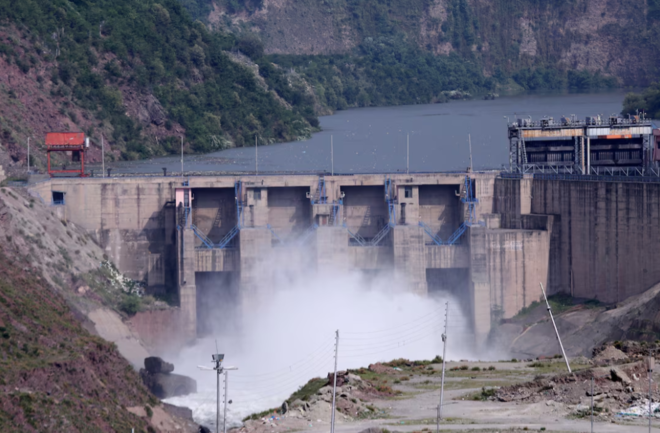
    Recently, India requested the World Bank to suspend proceedings on disputes related to the Kishanganga and Ratle hydroelectric projects in Jammu & Kashmir. Pakistan responded by rejecting the request, insisting that the legal process should continue.

    The World Bank-appointed neutral expert, Michel Lino, was set to review whether India’s projects violate treaty obligations, including river flow guarantees. These proceedings were part of a 2025 action plan. But now, India wants them paused, citing national security concerns.

    Read Also: The Shimla Agreement: A Peace Accord or a Diplomatic Straitjacket for Kashmir?

    Meanwhile, both countries continue to claim they are acting in the best interest of their people.

    But Who Speaks for the People of Kashmir?

    Both the Kishanganga (330 MW) and Ratle (850 MW) projects are located in disputed territory, and both directly affect the rivers, environment, and daily life of thousands of Kashmiris.

    “This is our water. But decisions are being made in New Delhi and Islamabad, without asking those who live along the rivers,”
    says Rayees Ahmad, a local activist from Bandipora.

    Another resident, Shazia Bano, a teacher from Gurez Valley, adds:

    “Electricity and clean water should be basic rights. We are not just a border point between two countries. We are a nation with voices, rights, and choices.”

    Hydropower and Hidden Politics

    India claims these projects help power remote areas and reduce energy poverty. Pakistan worries they will reduce downstream water flow, violating the treaty and hurting farmers in Punjab.

    But for Kashmiris, this is not about megawatts. It’s about being invisible in their own homeland.

    For decades, Kashmir has been turned into a battleground for water, territory, and politics — while the people live under repeated blackouts, dry taps, and broken promises.

    A Call for Inclusion and Self-Determination

    Independent Kashmiri voices have long demanded that any discussion on natural resources, territory, and treaties must include the people of Kashmir.

    “You can’t dam our rivers and block our future, and then talk about peace,”
    says Dr. Naila Sheikh, an environmental sociologist in Muzaffarabad.

    Kashmiris are neither anti-India nor anti-Pakistan. But they are tired of being used in every narrative except their own.

    Not Their Water War — Our Daily Struggle

    Kashmiris are not just spectators in a decades-long water dispute. We are the first to feel the consequences of every dam, every delay, and every decision made elsewhere. While India builds and Pakistan protests, we fetch water in buckets and live by candlelight — waiting for a future we were never asked to shape.

    As one youth banner in Muzaffarabad read:
    “It’s our river. It’s our right. Stop deciding for us.”

    For Kashmiris, the Indus is not just a treaty — it’s life itself. These rivers run through our homes, our valleys, our culture.

    We are not asking to be favoured. We are demanding to be heard.

    “We are not a disputed territory. We are a denied voice.”
    “Between India’s dams and Pakistan’s claims, we are drowning in silence.”

    The slogans rising in the mountains now echo beyond borders:
    #KashmirForKashmiris | #WaterIsOurs | #RightToSelfDetermination

    Until Kashmiris are included in these talks — not as observers but as rightful stakeholders — there will be no lasting solution. Because no dam can stop a river’s truth, and no treaty can erase a people’s will.