
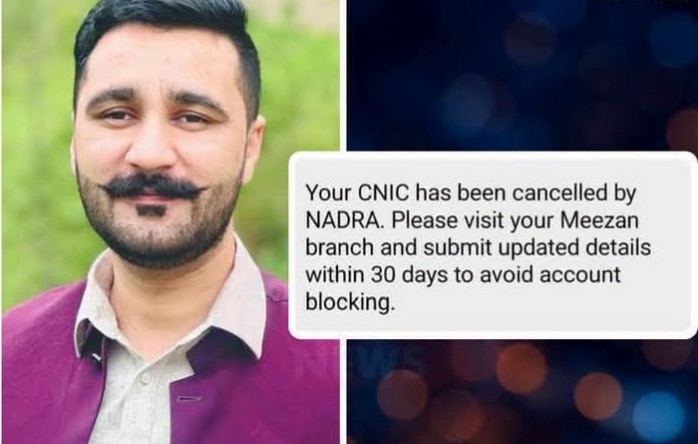

MUZAFFARABAD, Pakistan-administered Kashmir — A new wave of restrictions is reportedly targeting activists, lawyers and social media voices associated with the ongoing rights movement in Pakistan-administered Kashmir, with Kashmiri travel vlogger Hamza Naseer among those whose national identity card is reported to have been blocked.
Local reports and statements circulating among rights activists say several people, including Advocate Nabila Irshad, social media activist Hamza Naseer, Azra Alam, Qaiser Kaleem and Nabeel Tabassum, have been placed on or added to Schedule IV, alongside other individuals who were reportedly subjected to similar restrictions.
The reports further allege that bank accounts have been restricted and identity documents blocked in some cases.
The Azadi Times has not independently verified the individual Schedule IV orders or the reported blocking of Hamza Naseer’s identity card through official documents. The allegations therefore remain attributed reports rather than independently established facts.
Who is Hamza Naseer?
Hamza Naseer is known primarily as a travel vlogger and digital creator from Rawalakot. His earlier work has focused on Kashmir’s landscapes, communities and everyday life.
His presence during the recent Rawalakot unrest, however, gave his social media platforms a different role.


As communications restrictions and internet disruptions made independent information increasingly difficult to obtain, local digital creators became an important source of on-the-ground footage.
Independent fact-checking organisation Soch Fact Check has previously identified Hamza Naseer as one of the individuals whose videos were being circulated from Rawalakot during periods of unrest. It also noted that some footage attributed to him was from earlier protests, highlighting both the importance of local digital reporting and the need to verify the date and context of protest footage before publication.
From travel videos to documenting a rights movement
For years, Naseer’s content largely focused on Kashmir’s mountains, rivers, valleys and local communities. His videos also highlighted people earning a livelihood through their own labour.
During the 2026 rights movement, his camera increasingly became a tool for documenting events on the ground.
Supporters of Naseer say his continuous social media coverage of the Rawalakot sit-in helped people obtain information at a time when conventional communication channels were severely disrupted. Some supporters have gone further, describing his coverage as having helped people make urgent decisions and potentially saving lives.
These claims, however, require independent verification and should not be presented as established fact without supporting evidence.
Rawalakot became a centre of the wider Kashmir unrest
The developments surrounding Naseer come against the backdrop of a much broader crackdown that began in June.
On June 5, authorities in Pakistan-administered Kashmir designated the Jammu Kashmir Joint Awami Action Committee (JKJAAC) as a proscribed organisation under the region’s anti-terrorism framework. The move was followed by arrests, an internet shutdown and clashes between protesters and law-enforcement personnel.
Amnesty International said authorities carried out a sweeping crackdown involving mass arrests, restrictions on communications and deadly use of force. The organisation also raised concerns about the targeting of people reporting on the protests.
On June 7, deadly clashes took place in Rawalakot after people gathered around the Combined Military Hospital in connection with the death of activist Shahzaib Habib. Human rights organisations and fact-checking reports documented deaths and injuries among both protesters and law-enforcement personnel, although casualty figures and responsibility for individual deaths have remained contested.
The information environment was further complicated by communications restrictions. Amnesty International said the internet shutdown made the flow of information from the region extremely difficult, while journalists and activists also faced pressure.
Why Schedule IV matters
The reported inclusion of activists and digital voices on Schedule IV has therefore raised wider questions about how authorities are responding to political dissent and public documentation of the movement.
Being placed under restrictive security-related measures can have consequences beyond physical movement. Restrictions on banking, identity documents and other basic administrative services can place significant pressure on individuals and their families.
For that reason, any such action should be accompanied by clear legal grounds, due process and an opportunity for those affected to challenge the decision.
At present, The Azadi Times has not located publicly available official orders confirming the individual cases named in the reports. Authorities should therefore clarify who has been placed under such restrictions, under which legal provisions, and what evidence forms the basis of those decisions.
A wider question for independent journalism
The case of Hamza Naseer also highlights a broader transformation taking place in Kashmir’s information landscape.
When internet services are restricted and access to protest sites becomes difficult, local citizens with cameras and mobile phones can become de facto witnesses to events that might otherwise remain undocumented.
That role comes with responsibilities.
Digital creators must verify footage, avoid publishing old or misleading material and distinguish eyewitness information from unverified claims. At the same time, authorities have a responsibility not to treat legitimate documentation or peaceful expression as a security threat without transparent and lawful justification.
Recent fact-checking of Rawalakot footage has demonstrated why verification is essential: videos from earlier protests have circulated online as though they showed events from June 2026.
The camera, the protest and the right to be heard
Hamza Naseer’s story has consequently moved beyond that of a travel vlogger.
His cameras once introduced audiences to Kashmir’s mountains, rivers and villages. During the Rawalakot movement, those same cameras became part of a much wider citizen-led information network.
As the situation continues to develop, The Azadi Times will continue to distinguish verified facts from allegations and political claims while following the cases of those reportedly affected by the latest restrictions.