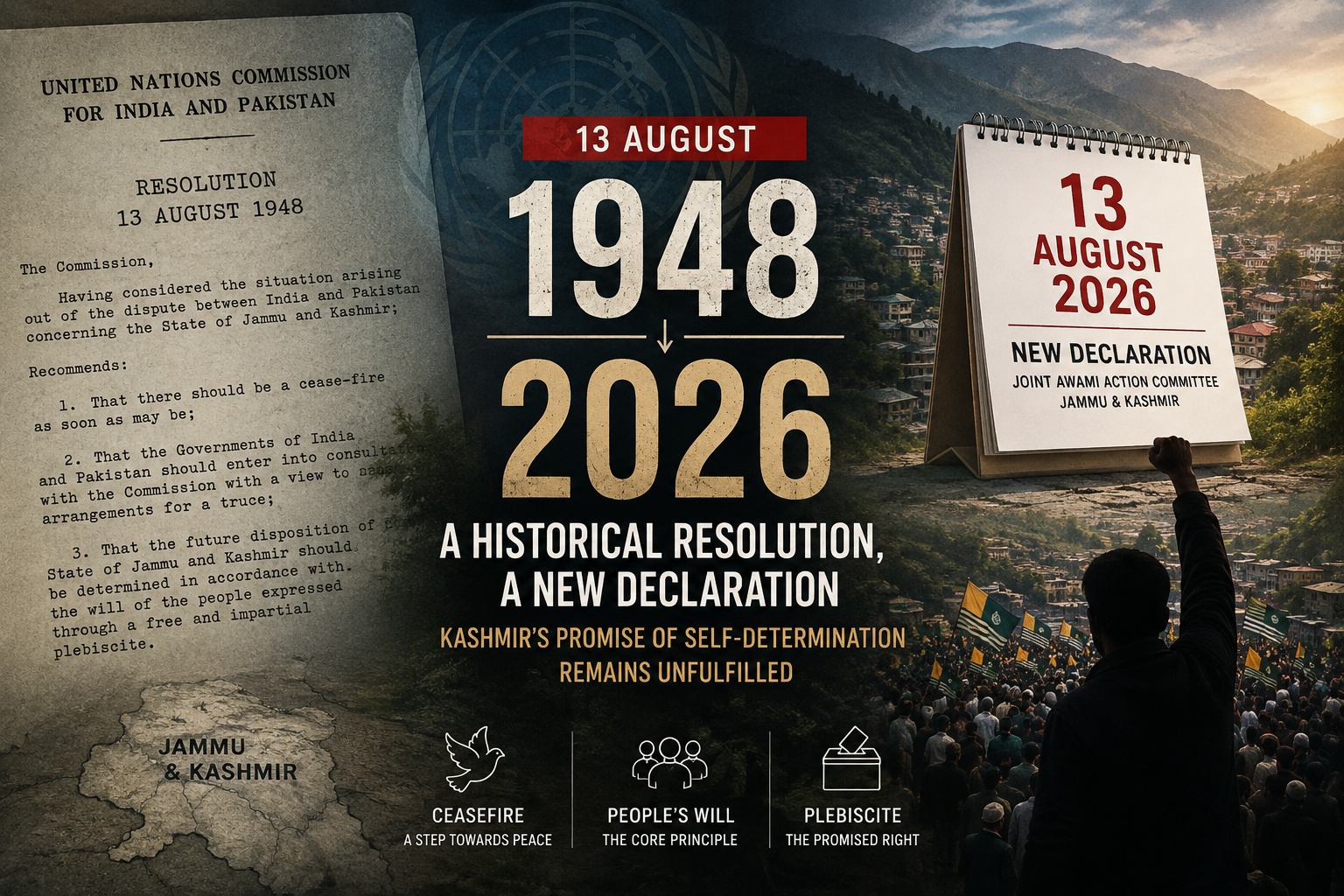

The Jammu Kashmir Joint Awami Action Committee (JKJAAC) has announced that a new declaration will be issued on 13 August 2026. This date is not merely symbolic — it marks 78 years since the United Nations Commission for India and Pakistan (UNCIP) adopted a historic resolution that promised the people of Jammu and Kashmir the right to determine their own future through a free and impartial plebiscite. As this date returns to the forefront of Kashmir’s political discourse, the question remains: Has the international community honored its commitment to the Kashmiri people?
On 13 August 1948, the United Nations Commission for India and Pakistan (UNCIP) adopted a landmark resolution that remains the foundational framework for resolving the Kashmir dispute. The resolution was structured in three parts, each carrying profound implications for the region’s future.
Part I: Ceasefire

Both India and Pakistan were called upon to immediately cease hostilities and bring an end to military operations on Kashmiri soil.
Part II: Truce Agreement
Pakistan was required to withdraw its troops, tribal fighters, and irregular forces from the territory. Following this, India was to begin the withdrawal of the bulk of its forces, leaving only a minimal presence necessary for maintaining law and order.
Part III: The Will of the People
The most critical component of the resolution was the reaffirmation by both governments that “the future status of the State of Jammu and Kashmir shall be determined in accordance with the will of the people.” This established the principle that Kashmir’s destiny could not be decided by force, coercion, or the unilateral will of either party — but solely through the free and impartial expression of the Kashmiri people.
The resolution explicitly stated that a plebiscite would be conducted under UN auspices to allow the people of Jammu and Kashmir to choose their political future. This commitment was later reinforced by the 5 January 1949 resolution, which laid down the detailed conditions for holding the plebiscite.


78 Years of Broken Promises
Nearly eight decades have passed since that historic commitment. The plebiscite promised to the people of Kashmir has never materialized. Instead, the region has witnessed prolonged military occupation, political suppression, and the systematic erosion of fundamental rights.
On 5 August 2019, the Indian government unilaterally revoked the special autonomous status of Jammu and Kashmir, bifurcated the state into union territories, and imposed one of the longest internet shutdowns in history. Thousands of political leaders, activists, and ordinary citizens were detained. The move was widely condemned by international human rights organizations and legal experts as a violation of both bilateral agreements and UN resolutions.
On the other side of the Line of Control, in Pakistan administered Kashmir (commonly referred to as Azad Kashmir), the situation has also seen concerning developments. Peaceful protests demanding basic rights have been met with restrictions, and civil society voices have faced increasing pressure.
The JKJAAC Declaration: Reclaiming a Historical Mandate
Against this backdrop, the Jammu Kashmir Joint Public Action Committee (JKJAAC) has announced that a new declaration will be issued on 13 August 2026. This announcement carries significant weight because it directly invokes the historical and legal framework established by the 13 August 1948 UNCIP resolution.
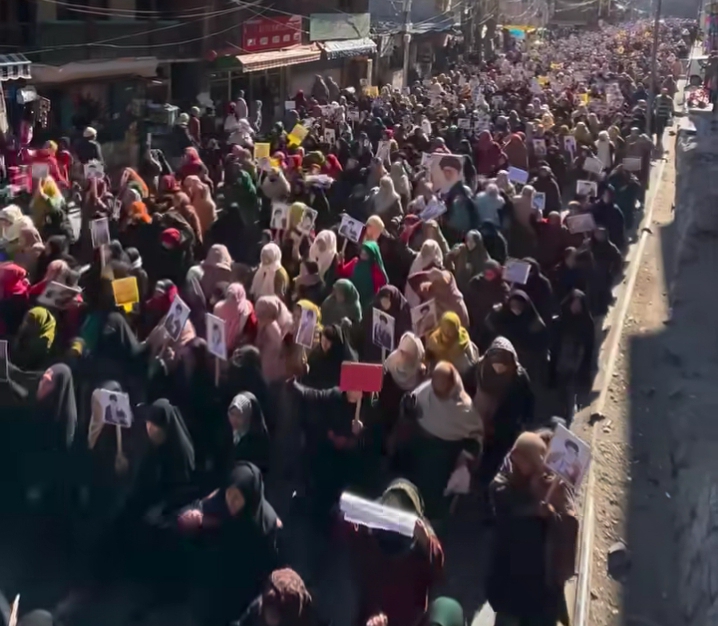
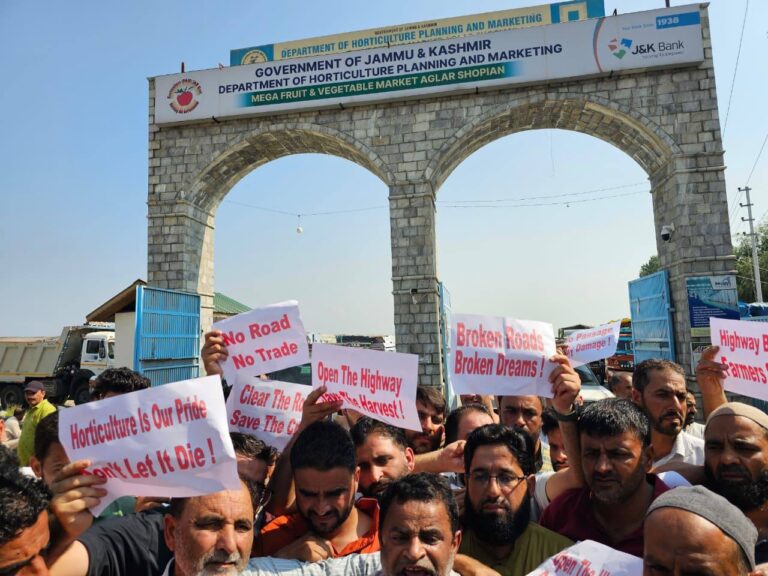
The JKJAAC has been at the forefront of a mass movement in Azad Kashmir demanding fundamental rights, economic justice, and an end to the privileges enjoyed by the political elite. Their 38-point charter of demands includes calls for affordable electricity, fair taxation, and genuine representation for the people of the region.
The organization’s decision to link its upcoming declaration to the 13 August 1948 resolution is a deliberate and powerful statement. It signals that the Kashmiri people have not forgotten the promises made to them by the international community. It is a reminder that the principles of self-determination, ceasefire, and demilitarization remain as relevant today as they were 78 years ago.
Kashmir: A Distinct Entity, Not a Disputed Territory Alone
Kashmir is not merely a territorial dispute between two nuclear-armed neighbors. It is a question of the fundamental rights of a people who have never been given the opportunity to exercise their right to self-determination. The UNCIP resolutions recognized this reality by placing the will of the Kashmiri people at the center of any final settlement.
The people of Kashmir — on both sides of the Line of Control and beyond — have maintained a distinct cultural, linguistic, and political identity. Their aspirations cannot be subsumed under the national narratives of either India or Pakistan. The international community’s failure to implement its own resolutions has not diminished the legitimacy of the Kashmiri people’s struggle; it has only deepened the crisis.
The International Community’s Responsibility
The United Nations Security Council has adopted multiple resolutions on Kashmir, all of which reaffirm the right of the Kashmiri people to determine their future through a democratic process. The principle of self-determination is enshrined in the UN Charter and is considered a fundamental human right under international law.
Yet, the Security Council has remained largely silent in recent years. Great power politics, strategic alliances, and economic interests have consistently trumped the organization’s moral and legal obligations toward the people of Kashmir. This silence has emboldened occupying forces on both sides and has left the Kashmiri people in a state of perpetual uncertainty.
The 13 August 1948 resolution was not a mere suggestion — it was a binding commitment made by the international community to the people of Kashmir. The failure to implement it represents one of the most significant unresolved injustices in modern history.
What the 13 August 2026 Declaration Could Mean
While the full text of the JKJAAC’s declaration is yet to be released, its timing and historical reference point suggest several key themes:
Reaffirmation of Self-Determination: The declaration is expected to renew the demand that the Kashmiri people’s right to self-determination be recognized and implemented in accordance with UN resolutions.
Call for Demilitarization: Drawing from Part II of the 1948 resolution, the declaration may call for the withdrawal of military forces from the region as a prerequisite for any meaningful political process.
Protection of Civil and Political Rights: The declaration will likely emphasize the protection of fundamental rights, including freedom of expression, peaceful assembly, and political participation.
Unity of the Kashmiri People: By invoking a date that predates the division of Kashmir, the declaration may seek to remind the world that the Kashmiri people are one nation, regardless of which side of the Line of Control they reside on.
The 13 August 1948 UNCIP resolution is not a dead letter. It is a living commitment that the international community made to the people of Kashmir. The announcement of a new declaration on 13 August 2026 by the Jammu Kashmir Joint Public Action Committee is a powerful reminder that the Kashmiri people have not abandoned their struggle for justice.
Editor’s Note: This article is based on historical records, UN documents, and independent sources. The Azadi Times is not affiliated with any government or political party. Our sole objective is to amplify the voices of the Kashmiri people on the international stage.