
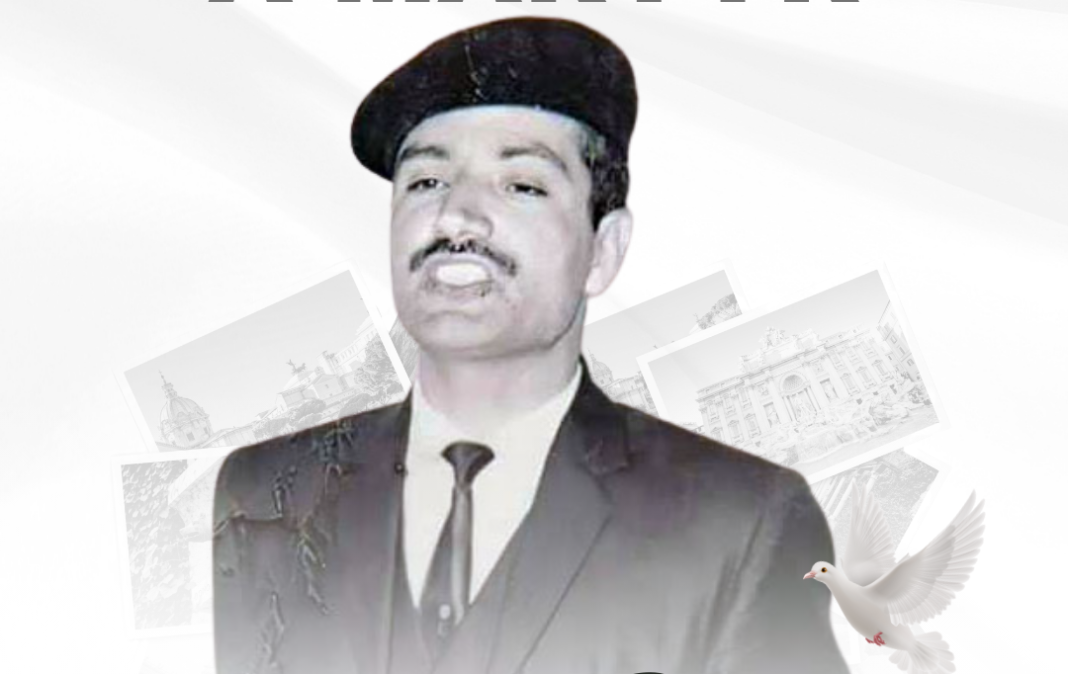

On February 11, 1984, Muhammad Maqbool Butt was executed in New Delhi’s Tihar Jail, becoming the first Kashmiri political prisoner to be hanged in independent India. Forty-two years later, his legacy continues to expose the starkly contrasting political realities that define life on either side of the Line of Control (LoC). While thousands gathered at Maqbool Butt Shaheed Chowk in Mirpur, Pakistani-administered Kashmir, to honor the revolutionary leader through public rallies, seminars, and processions, Indian-administered Kashmir remained under an undeclared prohibition—where even whispered tributes risked surveillance, detention, or worse.
This divergence is not merely administrative; it is deeply political, revealing how the memory of Kashmiri self-determination is simultaneously celebrated and suppressed, depending on which side of the militarized divide one stands.
The Commemoration in Pakistani-Administered Kashmir
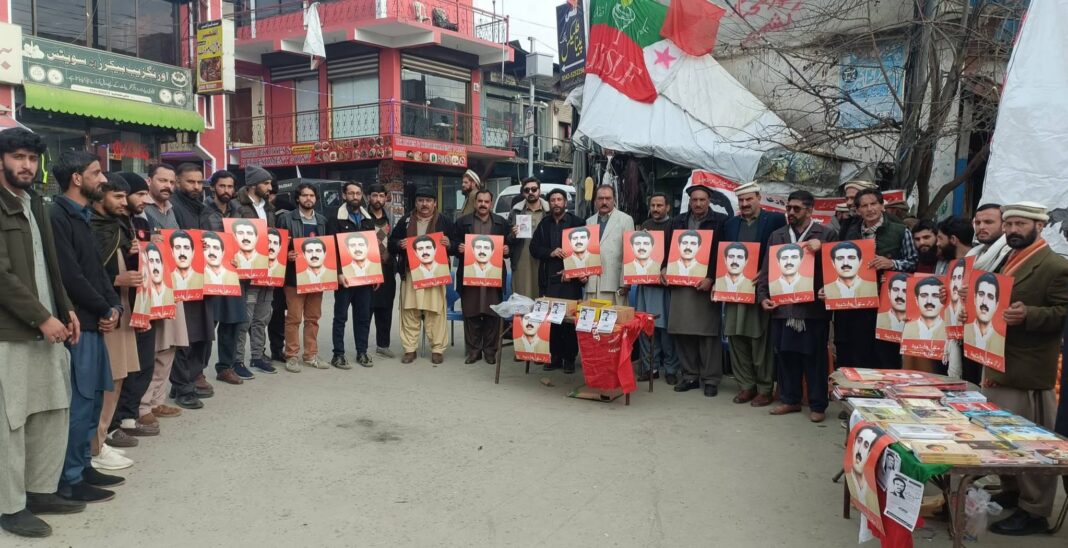
In Mirpur, the atmosphere was electric with political consciousness. At Maqbool Butt Shaheed Chowk, Rahat Hafeez Baber delivered a tribute that resonated with the gathered crowds, framing Butt’s execution not as an ending, but as the ignition of a “living resistance.” The event was not isolated. Across Azad Jammu and Kashmir (AJK), from Muzaffarabad to Bagh, Kotli to Khuiratta, similar commemorations unfolded—organized by the Jammu Kashmir Liberation Front (JKLF), National Students Front (NSF), Jammu Kashmir Plebiscite Front, and various civil society coalitions.
The scale of these observances is significant. In Mirpur district alone, the National Events Organizing Committee coordinated processions that marched through major city streets, converging at central Shaheed Chowk at 11:00 AM. These were not clandestine gatherings but public assertions of political identity, facilitated—if not officially endorsed—by local administrative structures that permit such expressions within defined parameters.
Former President of the Jammu Kashmir Plebiscite Front, Azeem Dutt Advocate, articulated the trans-LoC nature of the commemoration, noting that memorandums demanding Kashmir’s resolution under UN resolutions would be submitted to UN observer missions on both sides. This rhetorical unity, however, masks a critical asymmetry: while AJK allows public mourning and political organization, the Indian-administered side enforces silence.
The Silence from Srinagar to Shopian
Since August 5, 2019, when the Indian government unilaterally revoked Article 370 and bifurcated the erstwhile state into union territories, the space for political expression in Indian-administered Kashmir has undergone what legal experts and human rights monitors describe as “systematic asphyxiation.” The anniversary of Maqbool Butt’s martyrdom falls within this broader context of intensified repression.
According to documentation by Reporters Without Borders (RSF) and the International Press Institute (IPI), the region has been transformed into what journalists now call an “information black hole.” Since 2019, at least 20 journalists have been arrested for their reporting, with several charged under the draconian Unlawful Activities (Prevention) Act (UAPA). The Kashmir Press Club was forcibly closed in January 2022, eliminating a critical space for professional solidarity and collective defense.
For the followers of Maqbool Butt’s ideology—particularly those aligned with pro-independence frameworks—the anniversary presents an impossible choice: observe in silence and erase historical memory, or risk the consequences of public commemoration. The Indian state’s surveillance apparatus, which includes routine phone tapping, digital monitoring, and “informal interrogations” by security forces, leaves little room for the kind of public mourning witnessed in Mirpur.
The Politics of Recognition—Why Institutional Silence Matters
The disparity in commemoration has ignited significant debate within Kashmiri civil society, particularly on social media platforms where diaspora communities and activists engage in cross-border dialogue. A recurring question emerges: Why does Maqbool Butt, a figure of trans-LoC reverence, lack official institutional recognition even in Pakistani-administered Kashmir?
This critique is not without merit. While public gatherings are permitted, the absence of official state-level commemoration—through educational curricula, state-sponsored memorials, or formal political statements—suggests a hesitancy to fully embrace the revolutionary implications of Butt’s ideology. Maqbool Butt was not merely a nationalist; he was a proponent of independent, unified Kashmir, a vision that complicates the geopolitical calculations of both India and Pakistan.
Followers from JKLF, NSF, National Awami Party (NAP), and other ideological groups argue that reducing Butt’s legacy to annual rallies without institutional embedding represents a “managed forgetting”—a way to contain his radical potential within acceptable, performative boundaries. Social media discussions reveal palpable frustration: if smaller political initiatives receive platforms, why does a figure of Butt’s historical magnitude remain outside formal state narrative?
Legal Repression and the Criminalization of Memory
The Indian state’s approach to Kashmiri political memory extends beyond physical restrictions into the legal and digital domains. In 2025, the Jammu and Kashmir Home Department ordered the banning of 25 books on Kashmiri conflict, history, and politics, including journalist Anuradha Bhasin’s “A Dismantled State: The Untold Story of Kashmir After Article 370.” This censorship regime creates what scholars term “epistemic violence”—the systematic erasure of historical knowledge that might sustain resistance.
The Kashmir Times, one of the few independent media outlets covering the region since 1954, has faced repeated raids, advertisement bans, and legal harassment. Its editor-in-chief, Anuradha Bhasin, currently lives abroad after being named in FIRs alleging activities “inimical to the state.” The newspaper’s offices in Srinagar were sealed in October 2020; its staff evicted without due process.
Against this backdrop, the absence of Maqbool Butt commemorations in Indian-administered Kashmir is not passive oversight but active enforcement of historical amnesia. The state understands, as the philosopher Walter Benjamin observed, that “memory is not an instrument for exploring the past but its theater.” By closing this theater, the Indian state attempts to sever the generational transmission of political consciousness.
The Ideological Resilience of the Independence Narrative
Despite these constraints, Maqbool Butt’s ideology persists—not through state sanction but through what anthropologist James C. Scott calls “hidden transcripts”: the quiet conversations, the private observances, the digital whispers that evade surveillance. The Jammu Kashmir Liberation Front, though fragmented and operating under severe constraints, continues to articulate a vision of independent Kashmir that draws directly from Butt’s 1970s revolutionary framework.
This resilience challenges conventional analyses that frame the Kashmir conflict solely through the India-Pakistan binary. Maqbool Butt’s legacy represents a third narrative: one that refuses both Indian integration and Pakistani accession in favor of self-determination. It is this third space that both states find most threatening, as it undermines the foundational assumptions of their respective territorial claims.
The National Students Front (NSF) and Jammu Kashmir Plebiscite Front, active in AJK, embody this continuity. Their commemoration programs include not only rallies but educational initiatives, historical documentation, and international advocacy—efforts to embed Butt’s legacy in institutional memory despite political hesitancy.
International Law and the Unfulfilled Promise
Maqbool Butt’s trial and execution remain contentious under international legal standards. He was denied consular access, his defense was systematically obstructed, and the charges—primarily related to the 1968 bank robbery and the 1976 murder of Indian diplomat Ravindra Mhatre—were never subjected to independent judicial review. The Working Group on Arbitrary Detention and various UN special rapporteurs have raised concerns about the fairness of political trials in Kashmir.
The UN Military Observer Group in India and Pakistan (UNMOGIP), established in 1949, continues to maintain offices in both Srinagar and Muzaffarabad. Yet its mandate has been progressively constrained, and its reports remain classified, denying Kashmiris access to international documentation of their own history. The memorandums submitted by Kashmiri groups on Butt’s anniversary highlight this gap between international commitment and operational reality.
The Generational Transmission of Resistance
Perhaps the most significant aspect of this year’s commemorations is the evident generational continuity. In Mirpur’s rallies, young activists—many born decades after Butt’s execution—carried his portraits and chanted slogans from the 1970s. This is not nostalgia but active political socialization, where historical memory becomes the foundation for contemporary mobilization.
The Kashmir conflict, now in its eighth decade, faces the challenge of maintaining relevance among youth who have known only militarization, digital surveillance, and political impasse. Maqbool Butt’s anniversary serves as a critical node in this transmission, offering a narrative of sacrifice and vision that transcends the immediate frustrations of the present.
Social media has transformed this transmission. Despite platform censorship—The Kashmir Walla, Maktoob Media, and Free Press Kashmir have all faced blocking on X (formerly Twitter)—Kashmiri activists utilize encrypted channels, diaspora networks, and international solidarity platforms to maintain visibility. The global webinar held this year, bringing together scholars, activists, and survivors from multiple continents, demonstrates this adaptive resilience.
Memory as Resistance, Silence as Strategy
The 42nd anniversary of Shaheed Maqbool Butt reveals that in Kashmir, memory itself is a battlefield. On one side, public commemoration—however contained—allows for collective mourning and political reaffirmation. On the other, enforced silence attempts to sever the historical thread that connects past sacrifice to present struggle.
Yet silence, too, can speak. The empty streets of Srinagar on February 11, the absent processions, the muted mosques—these absences are themselves testimonies to the persistence of what the state fears. As the philosopher Jacques Derrida noted, “hauntology”—the presence of absent specters—defines political spaces where official memory has failed.
Maqbool Butt’s legacy, forty-two years after his execution, continues to illuminate this fundamental truth. His sacrifice remains not merely a historical event but an ongoing demand—for justice, for self-determination, for the right of Kashmiris to remember, mourn, and dream of freedom without fear.