
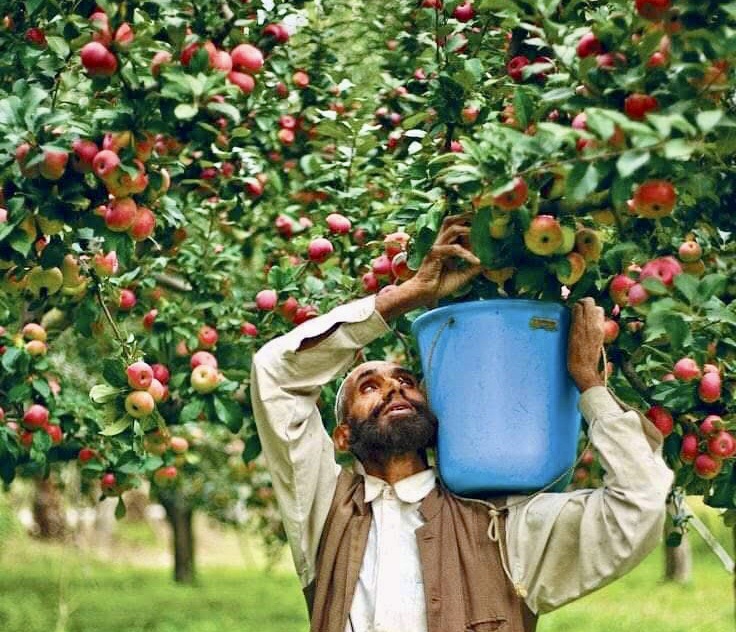

In the lush, scenic valleys of Kashmir, where paddy fields once rippled alongside the seasons, an invisible transformation is reshaping the countryside. Traditional rice fields are increasingly being replaced by lucrative apple orchards, often enclosed by barbed wire fences. Hidden within these fences, isolated pockets of rice land now stand as symbols of loss, deprivation, and legal helplessness. This is not just a story of changing land use, but a profound crisis affecting farmers’ livelihoods, economic independence, and fundamental land rights.
The Silent Spread of Apple Orchards in Kashmir
Over the past two decades, Kashmir’s apple economy has witnessed unprecedented growth. Driven by market profits, government subsidies, and soaring land values, many landowners have shifted from growing rice to cultivating apple orchards. While agricultural diversification is often seen as a positive trend, the widespread fencing of these orchards with barbed wire is creating a new rural crisis.
Barbed Wire Fences: Cutting Off Farmers from Their Own Land
Imagine a farmer with a small rice plot once connected to open rural pathways. Now, as neighbors convert their fields into orchards and fence them off, old access routes disappear. To reach his own field, the farmer must take long detours, navigate barbed wire, or trespass on someone else’s property, risking social conflict and legal trouble. What was once a shared landscape is now a patchwork of exclusion.
The Azadi Times
No state grants. No corporate lobby. Just ground‑truth reporting from Kashmir & beyond
You make this possible.
The Destruction of Kashmir’s Traditional Irrigation Network
Rice cultivation in Kashmir has always depended on koohl, traditional irrigation channels that carried glacial water to distant fields, maintained by a collective community effort. Today, many of these channels are either locked inside fenced orchards or diverted to prioritize the needs of apple trees. As a result, rice fields dry up, not due to drought, but because human-made barriers block the water. With no official records of these ancient channels, farmers are often denied the right to maintain or access them.
Legal Irony: Land Ownership Without Access
At the heart of this crisis is a striking legal paradox: farmers may own their land, but often cannot reach it. This is not only a violation of the Indian Easements Act of 1882—which guarantees a right of way for landlocked property—but also contravenes basic principles of natural justice. In rural Kashmir, most traditional paths were never formally recorded, making it nearly impossible for farmers to prove their rights in court. Without detailed land surveys (“Tatima Shajra”), government officials often refuse to acknowledge these access routes, pushing farmers into costly and uncertain legal battles.
Failure of Government and Local Administration
The revenue department, responsible for safeguarding land access rights, often turns a blind eye. Local officials rarely investigate or document the blocking of paths and irrigation channels, and courts frequently dismiss such cases as “civil matters,” leaving farmers powerless. As land use changes rapidly, legal and administrative protections have not kept pace—further marginalizing small landholders.


Social Breakdown and Erosion of Rural Community
This crisis is not just about land or water—it strikes at the heart of Kashmir’s rural social fabric. For centuries, village life revolved around shared responsibility: maintaining irrigation channels, providing access routes, and supporting each other through collective effort. Barbed wire fences have shattered these traditions, replacing cooperation with conflict. Minor disputes over water or access now escalate to police complaints and long-standing feuds, fracturing once-close communities.
A Roadmap for Solutions: Restoring Rights and Justice
This agricultural crisis in Kashmir is not inevitable. With timely, sensitive, and locally-driven interventions, the damage can be reversed. Key steps include:
- Mapping and Recording Traditional Routes: All rural pathways and irrigation channels should be officially surveyed and entered into government records, ensuring no land is made inaccessible.
- Legal Recognition of Historical Access: Where traditional access existed, authorities must formally acknowledge easement rights, as per the law.
- Restoration of Traditional Irrigation Channels: Departments of irrigation and local governance should work together to reopen blocked channels and prevent future closures.
- Regulation of Barbed Wire Fences: Local governments should prohibit any fencing that blocks another’s access to their own land.
- Legal Awareness and Free Assistance: Farmers should be educated about their rights, and given access to free legal help to defend them.
Why Land, Water, and Access Rights Must Be Protected in Kashmir
While apple cultivation has brought prosperity and growth to some, it cannot come at the expense of basic human and legal rights. The right to farm, to water, and to access one’s land are fundamental and non-negotiable. Ignoring these rights risks not only the last remaining rice fields, but also the very roots of Kashmir’s rural society. True progress must be inclusive, just, and rooted in the protection of all especially the most vulnerable.