
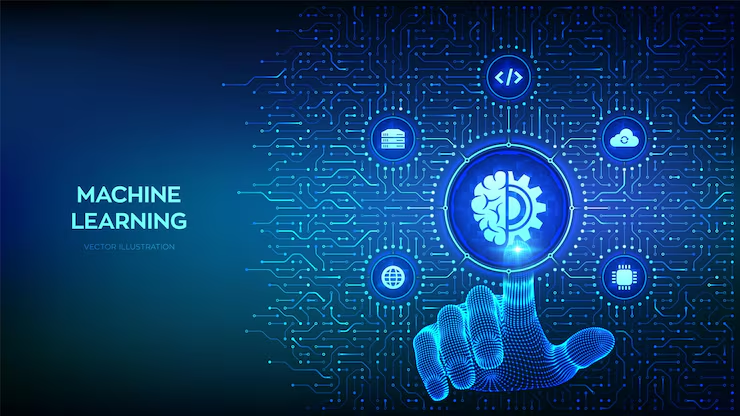

Machine learning is a subset of artificial intelligence in which computer systems improve their performance on a task by analyzing data—without being explicitly programmed with step-by-step rules.
In simpler terms: instead of telling a computer how to recognize a cat (pointy ears, whiskers, fur pattern), you show it thousands of cat photos. The computer learns the patterns itself. Then it can identify cats it has never seen before.
That is the core. But the implications are anything but simple.

The Azadi Times
No state grants. No corporate lobby. Just ground‑truth reporting from Kashmir & beyond
You make this possible.
“Machine learning is not magic,” says Dr. Alia Khan, a computational ethics researcher at the London School of Economics, in a 2023 interview with MIT Technology Review. “It is statistical pattern recognition at massive scale. The danger is when we forget that patterns from the past do not guarantee justice in the future.”
The Three Engines: Supervised, Unsupervised, and Reinforcement
To understand what machine learning can and cannot do, one must understand its three primary architectures. Each serves a different master.
Supervised Learning: The most common. You feed the algorithm labeled examples (emails marked “spam” or “not spam”). The algorithm learns the boundary. It then labels new, unlabeled emails. This powers your Gmail spam filter, credit scoring algorithms, and facial recognition systems—including those used at border checkpoints in India-administered Kashmir and elsewhere, according to Amnesty International reports.


Unsupervised Learning: No labels are provided. The algorithm finds hidden structures or clusters in data on its own. Retailers use it to segment customers without knowing what segments exist. Intelligence agencies use it to detect anomalous communications—a method widely documented in whistleblower disclosures.
Reinforcement Learning: The algorithm learns by trial and error, receiving rewards or penalties. This is how DeepMind’s AlphaGo defeated world champions. It is also how autonomous drones are being trained for surveillance and strike missions—a fact confirmed by multiple UN reports on emerging weapons systems.
The Global Data Divide: Who Really Trains the Machines?
Here is the content gap that most explainers ignore: machine learning models do not learn from abstract “data.” They learn from human-labeled information. And that labeling work is overwhelmingly performed by low-wage workers in the Global South.

How to Spot AI-Generated Fake Videos Flooding Social Media: An Expert Guide
A 2023 study by the Oxford Internet Institute found that an estimated 8.2 million people in Kenya, Uganda, India, and the Philippines work as “data labelers”—clicking on images, transcribing audio, or drawing bounding boxes around pedestrians for autonomous vehicles. Average pay: $1.50 to $3.00 per hour. Many report psychological trauma from labeling violent or pornographic content with no mental health support.
“We are building the most powerful technology in human history on the backs of invisible workers,” said Dr. Sasha Costanza-Chock, a researcher at Harvard’s Berkman Klein Center, in testimony to the US Congress in 2024. “Calling it ‘machine’ learning erases the human labor at its core.”
This is not an accident. Major tech companies subcontract labeling to firms in countries with weak labor laws. The machine learning industry has created a new form of digital colonialism—one that The Azadi Times will continue to investigate.
The Economic Promise and Peril: Jobs, Wages, and Regions Left Behind
Economists are divided on what machine learning means for global employment. A 2024 working paper from the International Monetary Fund estimated that 40% of global jobs are exposed to AI and ML, with higher risks in advanced economies (60% of jobs) but also significant disruption in emerging markets (25–30%).
Unlike previous automation waves that primarily affected manufacturing, machine learning is penetrating white-collar work: translation, legal document review, medical imaging analysis, and even journalism.
However, the same technology enables new industries. Small farms in Pakistan-administered Kashmir, for example, are beginning to use ML-based weather prediction apps to optimize crop planting—a rare positive application noted by the UN Development Programme.
The key variable is not the technology itself, but who controls it. Open-source models are democratizing access. But proprietary models from Google, Microsoft, and OpenAI concentrate power in Silicon Valley.
The Accountability Crisis: When Machine Learning Gets It Wrong
Machine learning systems are not neutral. They inherit and amplify biases present in their training data. A healthcare algorithm used by US hospitals was found to systematically favor white patients over sicker Black patients—because it was trained on past healthcare spending, not actual health needs.
Facial recognition systems from leading vendors have error rates 10 to 100 times higher for darker-skinned faces, leading to wrongful arrests. In 2023, a Black man in Detroit spent 30 hours in jail because an ML-based facial recognition system falsely matched his driver’s license photo to a shoplifter.
Who is held accountable? Currently, no one. Most jurisdictions treat ML models as trade secrets, exempt from discovery. The European Union’s AI Act (expected full enforcement 2026) is the first major law to require transparency and risk assessments for high-stakes ML systems. The United States has no federal AI accountability law as of April 2026.
What Machine Learning Is Not (A Crucial Clarification)
To conclude this explainer, The Azadi Times offers three clarifications:
Machine learning is not general intelligence. It cannot reason about morality, understand cause and effect, or experience consciousness. It finds correlations, not causation.
Machine learning is not objective. It is only as unbiased as the data and the humans who label it. Garbage in, garbage out—with amplification.
Machine learning is not inevitable in its current form. Regulatory choices, open-source alternatives, and labor organizing can reshape the industry. The technology is not a force of nature; it is a product of human decisions.
For readers of The Azadi Times, the question is not merely “what is machine learning” but “who benefits, who pays, and who decides?” That is the story we will continue to follow.