
No state backing. No paywalls. Just truth. Support Kashmir's independent voice. Join 2,400+ patrons who fund independent voices.
Zero Paywalls
Reader Funded
Award Winning
Secure Payment
Encrypted
By Energy & Technology Correspondent
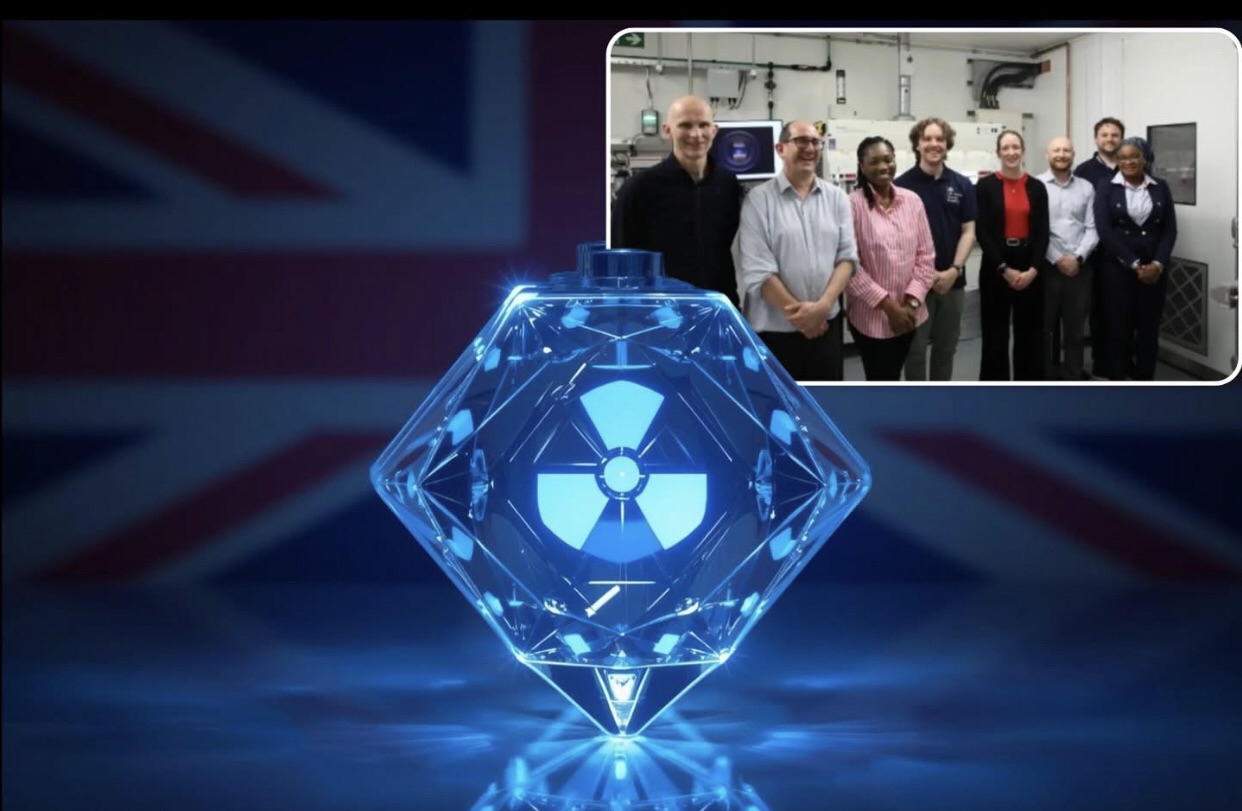
LONDON – British researchers have achieved a breakthrough in sustainable energy with the creation of a “diamond battery” that harnesses recycled nuclear waste to generate continuous power for millennia. This innovation could redefine long-term energy storage for space exploration, medical implants, and critical infrastructure.
The revolutionary power source combines:
✔ Repurposed nuclear graphite (from decommissioned reactors)
✔ Lab-grown diamond layers that convert radiation into electricity
✔ Betavoltaic technology generating current through radioactive decay
No state backing. No paywalls. Just truth. Support Kashmir's independent voice. Join 2,400+ patrons who fund independent voices.
Unlike conventional batteries, this system requires no recharging—just gradual decay of carbon-14 isotopes over 5,700 years (equivalent to carbon’s half-life).
Early prototypes demonstrate:
“We’re turning a global liability into clean energy,” explains Dr. Oliver Scott, lead researcher at the University of Bristol. “One gram of recycled nuclear material could power a pacemaker for 28,000 years.”
The technology could transform:
Space exploration: Powering probes for interstellar missions
Medical devices: Enabling lifetime implantable electronics
Remote sensors: Maintaining infrastructure monitoring for centuries
Disaster zones: Providing permanent backup power sources
While promising, scaling faces hurdles:
The UK Atomic Energy Authority has invested £4.2 million to advance the technology, with pilot production expected by 2026.
Stay updated on revolutionary energy solutions—follow The Azadi Times for cutting-edge science reporting.
Trending Topics


The Azadi Times is an independent digital news platform based in Muzaffarabad, Kashmir, dedicated to credible journalism, in-depth reporting, and global analysis. We cover Kashmir, South Asia, and international affairs with a commitment to truth, editorial integrity, and public accountability.
Get important news delivered directly to your inbox and stay connected!
© 2026 The Azadi Times. All Rights Reserved.