No state backing. No paywalls. Just truth. Support Kashmir's independent voice. Join 2,400+ patrons who fund independent voices.
Zero Paywalls
Reader Funded
Award Winning
Secure Payment
Encrypted

No state backing. No paywalls. Just truth. Support Kashmir's independent voice. Join 2,400+ patrons who fund independent voices.
No state backing. No paywalls. Just truth. Support Kashmir's independent voice. Join 2,400+ patrons who fund independent voices.
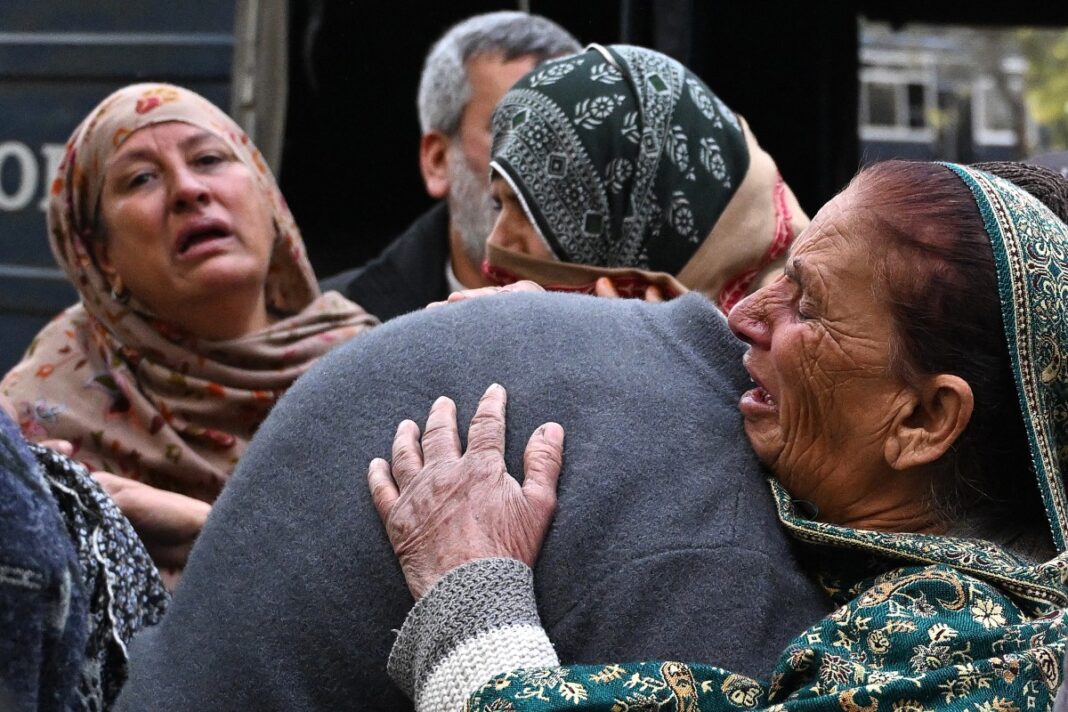
At least 32 people were killed and more than 160 others injured after a suicide bombing struck a Shia Imambargah during Friday prayers in Pakistan’s federal capital, Islamabad, officials confirmed. The attack took place at Imambargah Khadijat-ul-Kubra in the Tralai Kalan area, marking one of the deadliest incidents in the city in recent years.
Federal Health Minister Mustafa Kamal confirmed late Friday that the death toll had risen to 32. According to officials, 28 bodies were brought to the Pakistan Institute of Medical Sciences (PIMS) while four were transferred to the Polyclinic Hospital. Authorities stated that 149 injured victims were shifted to PIMS and 13 to the Polyclinic Hospital, with at least 29 individuals reported to be in critical condition.
Emergency measures were imposed across major hospitals in Islamabad following the attack, though hospital administrations reportedly struggled to manage the large number of casualties and distressed relatives seeking information about their loved ones.

No state backing. No paywalls. Just truth. Support Kashmir's independent voice. Join 2,400+ patrons who fund independent voices.
Witnesses said the attacker first opened fire on private security personnel stationed at the entrance of the Imambargah before moving deeper into the premises. According to eyewitnesses, the assailant managed to pass multiple security checkpoints and detonated explosives near the rear prayer rows, where worshippers had gathered for Friday congregational prayers.
Local residents claimed that no police officers were stationed outside the religious site at the time of the attack, with security largely managed by local volunteers.
Scenes outside the Imambargah reflected grief and uncertainty, as families gathered in search of missing relatives. One local resident, identified as 26-year-old Rifat Hussain, said his father had arrived at the Imambargah for prayers but had not been located since the explosion.
“My father’s motorcycle is still parked outside, but we cannot find him,” he said, adding that he planned to search hospitals in hopes of finding information.
Pakistan’s Minister of State for Interior, Talal Chaudhry, said authorities had gathered initial information about the attacker. He stated that while the suspect was not an Afghan national, there were indications of cross-border movement between Pakistan and Afghanistan.
Chaudhry added that militant groups are increasingly targeting “soft targets,” including religious and civilian gatherings. He also said that a detailed investigation report would be presented by the Ministry of Interior within 72 hours.
Pakistan’s Defence Minister Khawaja Asif condemned the attack and suggested possible regional militant linkages, though no independent confirmation of such claims has been made.
President Asif Ali Zardari described the attack as “a crime against humanity,” while Prime Minister Shehbaz Sharif ordered a comprehensive investigation and directed authorities to take strict action against those responsible.
Afghanistan’s Ministry of Foreign Affairs also condemned the bombing, stating that attacks on places of worship and civilians violate religious and humanitarian principles.
Security has been significantly increased around the attack site, with elite security forces deployed across surrounding areas and senior police officials collecting forensic evidence. Businesses in nearby markets reportedly remained closed amid fears of further attacks.
Authorities continue rescue operations and investigations, while concerns over the safety of religious sites and public spaces remain high. The Interior Ministry is expected to release further details about the incident in the coming days.
Hot this week

The Azadi Times is an independent digital news platform based in Muzaffarabad, Kashmir, dedicated to credible journalism, in-depth reporting, and global analysis. We cover Kashmir, South Asia, and international affairs with a commitment to truth, editorial integrity, and public accountability.
Get important news delivered directly to your inbox and stay connected!