
No state backing. No paywalls. Just truth. Support Kashmir's independent voice. Join 2,400+ patrons who fund independent voices.
Zero Paywalls
Reader Funded
Award Winning
Secure Payment
Encrypted

The World’s Best Airports 2026 rankings, based on global passenger experiences and voting, have once again highlighted the growing dominance of Asian aviation hubs. The latest global survey, conducted by Skytrax World Airport Awards, evaluated airports on key criteria including cleanliness, facilities, security procedures, immigration efficiency, and overall passenger satisfaction.
The results reveal a continued trend: Asia’s major international airports are not only maintaining high standards but also redefining the modern travel experience through technological innovation, passenger comfort, and efficient services.
For travellers from regions such as Pakistan-administered Kashmir, India-administered Kashmir, and the broader South Asian region, these global rankings offer insight into the evolving standards of international air travel and the increasing competitiveness among major aviation hubs.
No state backing. No paywalls. Just truth. Support Kashmir's independent voice. Join 2,400+ patrons who fund independent voices.
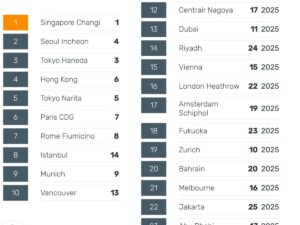
Singapore’s Changi Airport has once again secured the top position, continuing its long-standing reputation as one of the most advanced and passenger-friendly airports in the world. Known for its seamless immigration processes, extensive entertainment options, and modern infrastructure, Changi has consistently remained a benchmark for global aviation standards.
Its integrated leisure facilities, including gardens, shopping centres, and rest zones, provide travellers with a unique airport experience that extends beyond transit convenience.
Industry observers say Changi’s success is closely linked to long-term investment in infrastructure and passenger-centric innovation, positioning it as a model for emerging aviation hubs worldwide.
Hamad International Airport in Doha ranked second globally, recognised for its luxury environment, spacious terminals, and efficient passenger processing systems. The airport has become a major transit hub connecting Asia, Europe, and the Middle East.
Tokyo Haneda Airport secured third place, praised for punctuality, operational efficiency, and well-organised passenger services. Japan’s consistent performance in global aviation rankings reflects a strong focus on precision, cleanliness, and customer satisfaction.
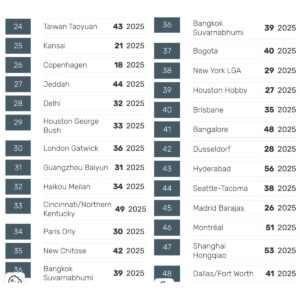
Several other Asian airports featured prominently in the global top 10 list, including:
These airports are recognised for integrating smart technologies, automated systems, and improved passenger navigation tools that simplify travel processes.
Experts note that Asian airports have invested heavily in digital infrastructure, biometric systems, and environmentally sustainable facilities, contributing to improved efficiency and passenger satisfaction.
Despite Asia’s strong showing, major European aviation hubs also retained positions among the world’s best. Paris Charles de Gaulle Airport and Munich Airport were included in the top 10 list, reflecting continued investment in infrastructure modernisation and improved passenger services.
European airports are increasingly focusing on sustainability initiatives, including carbon reduction strategies and green terminal designs, aligning with broader environmental goals in the aviation sector.
Airports across the Middle East have also demonstrated strong performance in the latest rankings. Major aviation hubs in Saudi Arabia, Qatar, and the United Arab Emirates have expanded facilities and enhanced services to accommodate growing international passenger demand.
These airports have positioned themselves as key transit points connecting Asia, Europe, and Africa, benefiting from strategic geographic locations and significant government investment in aviation infrastructure.
According to aviation analysts, increasing competition among international airports is driving improvements in passenger experience, operational efficiency, and technological innovation.
The emphasis on smart technologies, automation, and sustainability is expected to shape the next phase of airport development globally. Many airports are exploring artificial intelligence-based passenger management systems, biometric identification, and eco-friendly terminal designs.
For travellers from South Asia, including those from Kashmir travelling internationally for education, tourism, or employment, improvements in airport standards can significantly enhance transit experiences and reduce travel stress.
The 2026 rankings demonstrate that the global aviation sector continues to evolve rapidly, with airports competing not only on efficiency but also on comfort, convenience, and innovation.
As international travel continues to recover and expand, future rankings are expected to reflect even greater integration of digital services and environmentally responsible infrastructure.
Trending Topics


The Azadi Times is an independent digital news platform based in Muzaffarabad, Kashmir, dedicated to credible journalism, in-depth reporting, and global analysis. We cover Kashmir, South Asia, and international affairs with a commitment to truth, editorial integrity, and public accountability.
Get important news delivered directly to your inbox and stay connected!
© 2026 The Azadi Times. All Rights Reserved.