
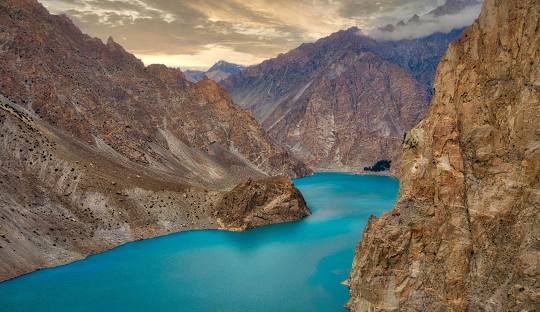

HUNZA, Gilgit-Baltistan — Authorities in Gilgit-Baltistan, a region within the disputed territory of Jammu and Kashmir administered by Pakistan, have fined a hotel Rs1.5 million and sealed a portion of its premises following allegations of sewage dumping into Attabad Lake, a major tourist attraction in the mountainous valley of Hunza.
The action came after George Buckley, a foreign tourist and environmental vlogger, shared a viral video on Instagram, claiming that the hotel was pumping untreated wastewater directly into the lake.
“We found out some information through a local that the sewage is actually being pumped into the water,” Buckley says in the video, standing at the lakeside, pointing to murky water mixing with the lake’s otherwise turquoise flow.

The video rapidly gained traction across social media platforms, triggering widespread outrage among environmental advocates and tourists, and prompting the Gilgit-Baltistan administration to initiate an immediate investigation.
Hotel Denies Allegation, Cites Natural Runoff
The hotel in question rejected the claims in a social media post, stating that the murky water seen near its site was a natural confluence of glacial streams with high turbidity.
“To dump sewage water into the lake would be like desecrating our own house. We have never, nor will we ever, dump a single litre of wastewater into Attabad Lake,” the hotel’s statement read.

They claimed that the video misrepresented the situation and that the muddy appearance was caused by nearby natural streams depositing mud, rocks, and minerals into the lake—an occurrence known as “confluence.”
Tourist Demands Transparency
Buckley, however, was not convinced. Responding in the comment section of the hotel’s post, he wrote:
“The only document you have provided… was from July 2021. I’ve asked three times to see an inspection report conducted after that date… yet nothing has been shared over the last 17 hours.”


He also alleged the presence of a strong sewage odor at the property, which he said could not have resulted from natural runoff alone.
Administration Confirms Pollution, Seals Hotel Section
Speaking to Dawn.com, GB Environment Department Director Khadim Hussain confirmed that the foreign tourist’s complaint triggered immediate administrative action.
A 15-member inspection team was dispatched to Attabad Lake, and following their investigation, pollution was confirmed. Hussain stated:
“There is evidence that human waste from the hotel entered the lake. While the hotel was repairing its sewage line, negligence led to waste leaking into the water.”
As a result, 30 rooms of the hotel were sealed, and a fine of Rs1.5 million was imposed.
Hussain added that a detailed report will be sent to the GB Chief Secretary and that legal proceedings are likely to follow in a magistrate’s court.
Previous Complaints and Inaction Alleged
Local journalist Alamgir Hussain told Dawn that this was not the first time the hotel had come under scrutiny for environmental violations.
“Locals have protested several times against the hotel for causing severe pollution in the lake,” he said, accusing the administration of inaction due to the hotel’s influence.
He also stated that construction of hotels on the lake’s banks violates environmental laws.
“If foreign tourists had not pointed it out, there would have been no action,” he alleged.
Broader Context: Environment and Geopolitics in Disputed Kashmir
The incident has renewed conversations around environmental governance in Gilgit-Baltistan, a region that lies at the heart of the long-standing Kashmir conflict between India and Pakistan.
While administered by Pakistan, Gilgit-Baltistan is internationally recognized as part of the broader disputed territory of Jammu and Kashmir. This complicates regulatory oversight and long-term environmental planning, especially as the region opens up to foreign tourism and investment.
Environmentalists argue that tourism in fragile ecosystems such as Attabad Lake—formed by a massive landslide in 2010—must be balanced with rigorous environmental safeguards, which are often lacking or poorly enforced.
A Wake-Up Call for Sustainable Tourism?
The viral nature of the incident underscores how digital platforms are giving travelers—and ordinary citizens—a powerful voice in demanding accountability and transparency in tourism-heavy regions.
The episode serves as a warning for other hospitality businesses in Gilgit-Baltistan and throughout the Himalayas: the era of silent pollution is over, especially in territories that attract both geopolitical interest and environmental concern.
As legal proceedings move forward, activists and local residents are urging the GB administration to tighten environmental regulations, enforce construction bans on lakefronts, and publish inspection reports transparently.