

Dateline: ISLAMABAD/KABUL – The rugged, porous border between Pakistan and Afghanistan, a landscape historically defined by tribal dynamics and insurgency, is now the focal point of a volatile new chapter in bilateral relations. Recent days have seen a dramatic spike in tensions, with Pakistan confirming it has conducted targeted airstrikes inside Afghan territory—a operation it has codenamed “Operation Ghazab-ul-Haq” (The Wrath of the Truth).
Clashes along the border have reportedly led to casualties on both sides, with each capital issuing starkly different accounts of the skirmishes. While the United Nations and regional powers like Turkey and Saudi Arabia have called for immediate de-escalation, the rhetoric from military and political circles in both Islamabad and Kabul suggests a dangerous hardening of positions.
This is not merely another border flare-up. It represents a fundamental collision between two very different military doctrines: Pakistan’s modern, nuclear-armed, conventional war machine and the Taliban-led Afghanistan’s battle-hardened but technologically limited insurgent force.
The Context: Why Now?
The immediate trigger for Pakistan’s operation, according to official statements, was the dismantling of a militant training camp allegedly responsible for attacks on Pakistani security personnel. This speaks to Islamabad’s long-standing frustration with what it perceives as safe havens for the Tehrik-i-Taliban Pakistan (TTP) on Afghan soil.
For the Taliban interim government in Kabul, however, these strikes are a violation of sovereignty and a repeat of the “mistakes” of the past. The Durand Line—the disputed 19th-century border—remains a festering wound, unrecognized by Afghan governments but administered by Pakistan. This historical grievance provides the backdrop for every military exchange.
To understand the potential trajectory of this crisis, one must look beyond the fog-of-war reports and examine the stark asymmetry in military capabilities.


Pakistan’s Military Machine: A Regional Heavyweight
Pakistan’s military is structured for high-intensity conflict, primarily deterring its larger eastern neighbor, India. This strategic orientation has resulted in a formidable, technology-driven force that casts a long shadow over its western frontier.
According to the 2025 Global Firepower index, Pakistan ranks as the 12th most powerful military in the world, a position reinforced by a defense budget of approximately $9 billion for the fiscal year 2025-26. It is a force of over 1.3 million active personnel, backed by a nuclear deterrent that fundamentally alters the risk calculus of any large-scale conflict.
1. The Decisive Edge: Air Power
The Pakistan Air Force (PAF) is the single greatest military asset in this standoff. With approximately 1,400 aircraft—including over 400 combat-capable platforms like the American F-16 and the Chinese-Pakistani JF-17 Thunder—the PAF can project power at will.

Afghanistan, in stark contrast, has no functional air force. The fleet of U.S.-supplied Black Hawks and Mi-17s left behind after the 2021 withdrawal is largely grounded due to a lack of maintenance, spare parts, and trained pilots. In any aerial confrontation, the Taliban would be unable to contest Pakistani air superiority, leaving their ground forces exposed.
2. Ground Forces: Armor vs. Mobility
On the ground, the imbalance is equally pronounced. Pakistan deploys a mechanized army centered around:
2,600+ Main Battle Tanks: Domestically produced Al-Khalid tanks form the spearhead of its armored divisions.
5,000+ Armored Vehicles: Providing mobility and protection for infantry.
3,200+ Artillery Pieces: A mix of self-propelled, towed, and multiple-launch rocket systems capable of saturation bombardment.
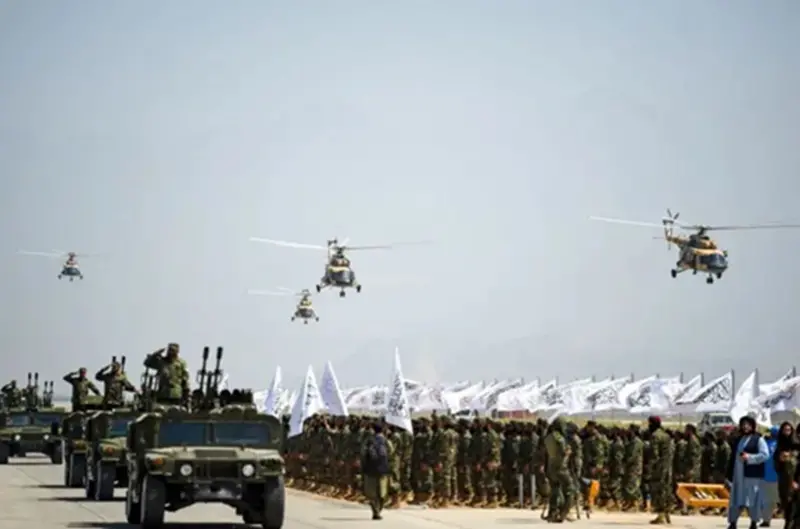
The Taliban’s ground forces, conversely, are an irregular army. Their arsenal is a patchwork of captured U.S. equipment (M4 rifles, Humvees) and Soviet-era hardware. While they possess heavy weapons like D-30 howitzers, they lack the command, control, and logistics to fight a sustained conventional battle against a combined-arms force.
3. Strategic Depth: Missiles and Drones
Pakistan’s military edge extends deep into its strategic assets. Its missile program—featuring the Shaheen, Ghaznavi, and Babur systems—is designed for strategic deterrence. More tactically relevant is Pakistan’s rapidly expanding drone program. Indigenous systems like the Shahpar-III and Burraq, along with imported Turkish Bayraktar TB2s, provide persistent surveillance and precision-strike capabilities, effectively allowing Pakistan to conduct operations with minimal risk to its pilots.
The Afghan Taliban’s Forces: From Insurgency to Governance
The Taliban’s military power is best understood not through tank counts, but through the lens of asymmetric warfare. After two decades of resisting the world’s premier superpower, they possess an unmatched expertise in guerrilla tactics—ambushes, infiltration, and improvised explosive devices (IEDs).
Manpower: The Taliban can mobilize tens of thousands of fighters, though estimates vary widely. Their strength lies in their motivation and knowledge of the terrain.
Captured Weaponry: The windfall of U.S. equipment in 2021 was significant. The Taliban now possess modern small arms, night-vision goggles, and some artillery. However, operating and maintaining this complex gear without foreign technical support is a critical vulnerability.
No Air Defense: This is Afghanistan’s single greatest weakness. They lack an integrated air defense system, meaning Pakistani jets and drones can operate with near-impunity, as the recent airstrikes likely demonstrated.
The “War of the Flea” vs. The War Machine
This standoff encapsulates a classic military dichotomy: the conventional army versus the guerrilla force. Pakistan’s military is optimized to win battles quickly through firepower and maneuver. The Taliban’s strategy, forged in decades of conflict, is to survive, inflict costs, and outlast.
If the conflict remains limited to airstrikes and border shelling, Pakistan holds all the cards. However, a ground invasion would be a different proposition entirely. It would mire the Pakistani army in the same treacherous, hostile terrain that bogged down the Soviet Union and the United States. The Taliban would revert to their insurgent roots, turning villages into strongholds and supply lines into killing zones.
Regional Implications and the Path Forward
The international community watches with deep concern. A prolonged conflict would destabilize an already fragile region, creating a vacuum that transnational militant groups like ISIS-K could exploit. For Pakistan, a quagmire in the west would distract from its primary strategic focus on India. For Afghanistan, it would derail any hope of economic stability and international recognition.
For now, the status quo favors Pakistan’s technological superiority. But military power does not always translate to political victory. As history has shown on countless occasions, the mountains of the Pashtun belt have a way of grinding down even the most advanced armies. The question is whether Islamabad will use its undeniable military advantage to seek a political solution, or find itself drawn into a long and bloody conflict that no amount of firepower can easily win.