
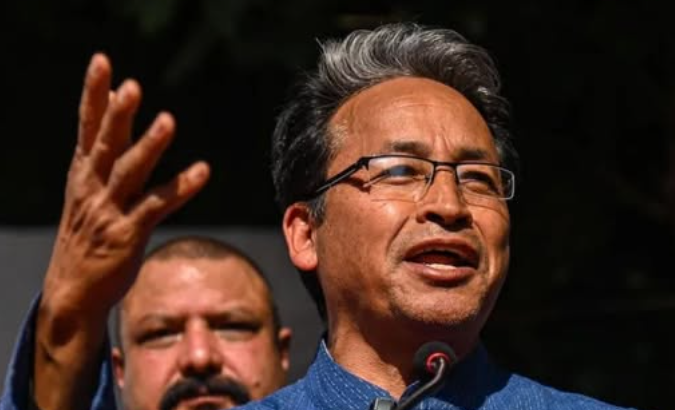

Srinagar/Leh – The Indian Ministry of Home Affairs announced on Saturday the immediate revocation of the detention of renowned social activist Sonam Wangchuk under the National Security Act (NSA). The ministry stated that the decision aims to foster an environment of peace, stability, and mutual trust in Ladakh and to facilitate meaningful dialogue with all stakeholders.
In a formal statement, the Ministry emphasized that the revocation came after thorough consideration of all aspects, reaffirming its commitment to provide necessary security measures for Ladakh.
Background: NSA Detention Amid Law and Order Concerns
Sonam Wangchuk, a prominent figure known for his advocacy on education and environmental issues in Ladakh, was detained on 26 September 2025 by order of the District Magistrate of Leh. This followed serious public order disturbances in the peaceful town of Leh on 24 September 2025, prompting authorities to invoke the NSA to maintain law and order.


According to the Home Ministry, Wangchuk had served nearly half of the period stipulated under the Act. The detention sparked concerns among civil society members and local communities about its potential impact on social cohesion and regional stability.
Government Perspective and Local Stakeholder Engagement
The Ministry highlighted that it remains in ongoing consultation with various stakeholders and community leaders in Ladakh to address the aspirations and concerns of the local population. Officials emphasized the importance of constructive engagement to mitigate tensions that have affected students, job-seeking youth, business communities, tourism operators, and the broader economy.
“The recent environment of closures and protests has had a tangible impact on the peaceful social fabric and economic activities in the region,” the statement said, underlining the government’s intent to encourage dialogue and cooperative problem-solving.
Observers note that Ladakh has faced intermittent unrest due to local grievances over governance, environmental concerns, and regional development policies. Analysts suggest that the revocation of Wangchuk’s NSA detention could signal a willingness by authorities to pursue dialogue over coercive measures, potentially creating openings for negotiation through high-powered committees and other consultative platforms.
Local community leaders have welcomed the move cautiously, expressing hope that this step will enable more transparent and meaningful discussions between authorities and citizens. However, concerns remain regarding long-term solutions and the need for sustained engagement rather than temporary measures.
The Home Ministry expressed hope that issues affecting Ladakh will be addressed through constructive consultation and negotiation. While emphasizing security, authorities indicated a preference for dialogue-driven conflict resolution, with a focus on long-term regional stability and public confidence.
This development is seen as part of a broader effort to balance governance, security, and citizen engagement in Ladakh—a region with unique strategic and cultural significance in India-administered Kashmir.