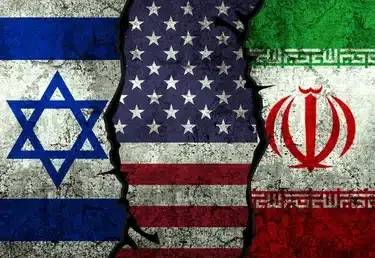

On the 34th day of the US-Israel war on Iran, the conflict has moved beyond military exchanges into a complex web of diplomacy, economic warfare, and regional realignments. While US President Donald Trump declared from Washington that American forces had “destroyed the Iranian military” and were close to achieving their strategic goals, the ground reality across the Middle East tells a story of spiraling violence, stalled negotiations, and mounting civilian tolls.
Iran has launched a fresh wave of missiles at Israel, its military confirmed early Thursday, challenging Trump’s assertion that Washington had neutralized Tehran’s offensive capabilities. Israeli air defense systems were activated across the country, with emergency services reporting 14 wounded near Tel Aviv, including an 11-year-old girl.
Yet the battlefield extends far beyond Israeli and Iranian skies.
In Tehran, US-Israeli strikes have hit a century-old medical research centre, a key bridge near the capital, and multiple steel plants. Iranian President Masoud Pezeshkian, in an open letter shared by state broadcaster PressTV, appealed directly to the American public: “Is Trump’s ‘America First’ policy truly among the priorities of the US government today?” He insisted Iran holds no hostility toward the people of the United States, Europe, or neighboring countries.
Diplomacy, however, appears frozen. Iranian Foreign Minister Abbas Araghchi stated that while Iran has received messages from the US, trust remains “at zero” for any potential negotiations. Tehran described Washington’s demands as “maximalist and irrational” and denied any ceasefire talks were underway.
The Gulf Walk a Tightrope
For Gulf Arab states, the war presents an impossible balancing act. The United Arab Emirates confirmed it has been intercepting incoming missiles and drones launched by Iran—a direct acknowledgment that the conflict has already spilled beyond Iranian and Israeli borders.
Trump, in his primetime address, specifically thanked Gulf allies, pledging that the US “will not let them get hurt or fail in any way, shape or form.” But on the water, the danger is real. A tanker was struck by a projectile off the coast of Doha, Qatar’s capital, according to a British maritime security agency. No casualties were reported, but the attack underscores the vulnerability of the world’s most critical energy shipping lanes.
The Gulf Cooperation Council (GCC) has urged the UN Security Council to “take all necessary measures” to protect the Strait of Hormuz from Iranian attacks. Meanwhile, a UK-led meeting of some 40 countries called for the immediate reopening of the strategic waterway.


Strikes Beyond Iran: Lebanon, Iraq, and the Shadow War
The war is no longer contained to Iranian soil. In Lebanon, an Israeli strike killed a senior Hezbollah commander in Beirut, with Lebanon’s Ministry of Public Health reporting at least seven dead. In Iraq, an aerial attack on a military base in western Anbar province killed seven fighters and wounded 13 others, according to the country’s Ministry of Defence. The strikes hit a military healthcare clinic at the Habbaniyah base.
Iraq’s foreign ministry said it is exerting “maximum effort” to prevent any escalation on its territory, following a warning from the US embassy in Baghdad about possible attacks by pro-Iran armed groups.
China, the UN, and a Warning of ‘Wider War’
International reaction has been swift and divided. China’s Foreign Minister Wang Yi, as reported by state media, condemned US and Israeli attacks on Iran as a violation of international law. He held calls with his EU, German, and Saudi counterparts, signaling Beijing’s intent to play a mediating role.
UN chief Antonio Guterres warned that the Middle East conflict risks spiraling into a wider war, calling for an immediate halt to US-Israeli strikes on Iran and Iranian attacks on its neighbours.
World Bank Raises Alarm Over Food and Inflation
Perhaps most concerning for the Global South—including Kashmir—is the economic fallout. The World Bank told AFP it is “extremely concerned” about the impact the conflict will have on inflation, jobs, and food security. Talks are underway with member states on how to address immediate needs.
Italy’s foreign minister went further, calling for the establishment of a “humanitarian corridor” for fertilizer and other essentials through the Strait of Hormuz to avoid a food disaster, particularly among vulnerable nations in Africa.
Analysis: Trump’s ‘No Clear Plan’
Despite the president’s confident tone, analysts remain skeptical. Trita Parsi of the Quincy Institute for Responsible Statecraft told Al Jazeera that Trump’s primetime address offered little new and largely repeated his recent statements. “It was essentially a summary of all the tweets he has issued over the last 30 days,” Parsi said, adding that the lack of new details suggests the president does not have a clear plan.
According to Al Jazeera’s Rob McBride in Amman, Trump’s timeline for the war appears to align closely with Israeli Prime Minister Benjamin Netanyahu’s own assessment of the campaign. Trump has pledged to “finish the job” within weeks.