
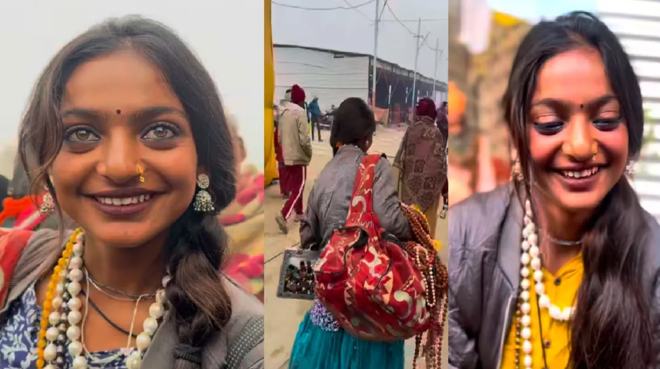

Kochi, India — In a move that legal scholars say exposes deepening fractures in India’s federal structure, a police team from the central state of Madhya Pradesh has launched an unprecedented cross-state operation to seize a 16-year-old tribal woman whose interfaith marriage has become a flashpoint in the country’s culture wars.
Monalisa Bhosle—whose striking appearance at the 2025 Kumbh Mela religious festival made her an overnight social media sensation—married Muslim actor Farman Khan on March 1 in a Hindu temple ceremony in Kerala, India’s southernmost state. What began as a private union has since erupted into a national controversy testing the boundaries of state autonomy, religious freedom, and the rights of women from marginalized communities.
The four-member police squad employed surveillance techniques typically reserved for counter-terrorism operations, tracing the couple through mobile phone data to a location in Thrikkakara before demanding their appearance before authorities.
Upon the team’s arrival in Kochi, the couple immediately sought protection from local police, with Bhosle submitting a formal complaint requesting she not be forcibly returned to her home state where she alleges facing threats from right-wing groups.
Kerala Police Commissioner C.H. Nagaraju confirmed that his officers had provided the visiting team with a copy of the Kerala High Court order staying any arrest until May 20.
Yet sources within the investigation suggest the Madhya Pradesh team’s objectives include taking Bhosle into custody—despite Kerala having independently verified her documents and recognized the marriage as legally valid.
“This represents a direct challenge to state jurisdiction,” says Dr. Priya Sharma, a constitutional law expert at Delhi University. “When one state disregards another’s judicial processes, we enter dangerous territory for federal governance.”
The Age Question: Documentary Chaos
At the heart of the dispute lies a bureaucratic nightmare emblematic of India’s fragmented identity systems. Bhosle and Khan submitted Aadhaar cards and birth certificates to Kerala authorities showing her date of birth as December 30, 2006—making her 18 at marriage.
Her family, however, claims she is 16, citing school records.
The National Commission for Scheduled Tribes (NCST), conducting a parallel investigation, determined her birth date as December 30, 2009—making her 16 at marriage—and directed police to file charges under the Protection of Children from Sexual Offences (POCSO) Act.
Notably, police have only registered an abduction case under Section 137(2), stopping short of the more severe charges.
The discrepancy highlights a systemic issue: in India’s tribal communities, where birth registration remains inconsistent, multiple official documents often exist for the same individual. “The state is essentially choosing which document to believe based on political convenience,” notes tribal rights advocate Dr. Ananya Roy. “This selective enforcement disproportionately targets interfaith couples.”
When Marriages Become National Security Threats
The wedding drew national attention not for the couple’s union, but for the political machinery that descended upon it. Senior Communist Party of India (Marxist) leaders attended the ceremony—a presence that immediately triggered accusations of “Love Jihad” from Hindu nationalist groups.
The term—describing an alleged conspiracy by Muslim men to marry and convert Hindu women—has been repeatedly debunked by India’s own National Investigation Agency (NIA), yet remains a potent political weapon.
At least 11 Indian states have enacted anti-conversion laws since 2020, with the United Nations Special Rapporteur on Freedom of Religion calling them “tools of persecution” that violate international human rights standards.


At a press conference, Bhosle rejected these allegations: “We got married according to Hindu rites at a temple. Everyone in the country knows that… I respect all religions”. She and Khan have also accused filmmaker Sanoj Mishra—who had signed Bhosle for a film project—of harassment and death threats.
The case highlights an alarming erosion of state autonomy in India’s federal structure. Kerala authorities, having independently verified the couple’s documents, recognize the marriage as legally valid. Yet Madhya Pradesh’s continued investigation—spanning over 1,500 kilometers—suggests a determination to override local jurisdiction.
“This is not about one marriage,” says Dr. Sharma. “It’s about whether states in India retain any meaningful sovereignty over matters within their territorial jurisdiction, or whether political agendas in ruling-party states can override local legal processes.”
The Kerala High Court’s interim protection order expires on May 20, creating a window for potential confrontation. For now, the couple remains in legal limbo—married in one state, potentially criminalized in another.
International Law vs. Domestic Practice
India’s treatment of interfaith couples stands in stark contrast to its international obligations. Article 16 of the Universal Declaration of Human Rights guarantees the right to marry “without any limitation due to race, nationality or religion,” while Article 18 protects freedom of religion, including the right to change one’s faith.
The International Covenant on Civil and Political Rights (ICCPR)—to which India is a party—similarly prohibits religious discrimination in marriage. Yet India’s domestic anti-conversion laws require government registration for religious changes, effectively criminalizing personal spiritual decisions.
“The Special Marriage Act of 1954 was meant to provide a secular route for interfaith couples,” explains legal researcher Samriddhi Chatterjee. “But its 30-day public notice requirement exposes couples to societal interference, effectively turning marriage bureaus into surveillance tools for vigilante groups”.
The Human Cost
Beyond the legal technicalities lies a stark reality: a young woman from the Pardhi tribal community—a historically marginalized group often classified as “criminal tribes” under British colonial law—whose moment of viral fame has made her a target.
The same media ecosystem that celebrated her “Mona Lisa eyes” at the Kumbh Mela now scrutinizes her personal choices, her religious identity, and her right to self-determination. The case serves as a barometer for India’s democratic health—testing whether constitutional protections for minorities, women, and federal principles can withstand majoritarian political pressures.