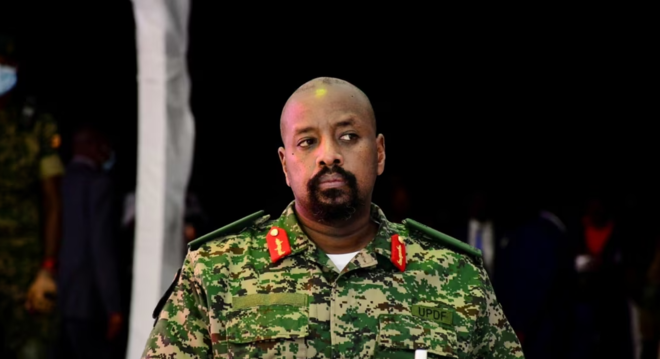


Kampala, Uganda — In an extraordinary diplomatic episode that has left foreign policy experts scrambling for explanations, Uganda’s army chief has issued a 30-day ultimatum to Turkey demanding $1 billion in cash and the hand of the country’s “most beautiful woman” in marriage, threatening to sever all diplomatic ties if his demands are not met .
General Muhoozi Kainerugaba, who also happens to be the son of Uganda’s long-serving President Yoweri Museveni, posted the demands on X (formerly Twitter) over the weekend, sparking a firestorm of international condemnation and social media ridicule while raising serious questions about the stability of one of Africa’s most strategically important military partnerships.
The Ultimatum: Cash and a Bride
In a series of now-deleted posts that nonetheless went viral, Kainerugaba demanded the payment as a “security dividend” for Uganda’s nearly two-decade military presence in Somalia, where Ugandan troops have been deployed under African Union missions combating the Al-Qaeda-affiliated militant group Al-Shabaab .
“On top of the $1 billion from Turkey, I want the most beautiful woman in that country for a wife!” the general wrote in one post that garnered over 2.6 million views within hours .
The threat was explicit: comply within 30 days or face the closure of Turkey’s embassy in Kampala, the suspension of Turkish Airlines operations in Ugandan airspace, and a complete termination of diplomatic relations . “For Turkey it’s a really simple deal… Either they pay us or I close their embassy here,” Kainerugaba wrote .
From Ally to Antagonist
The bizarre demands mark a dramatic deterioration in relations between two countries that have historically maintained close military and economic ties. Turkey has invested heavily in Ugandan infrastructure and maintains significant commercial interests in the region.
Kainerugaba accused Turkey of profiting from infrastructure deals in Somalia—including ports and airports in Mogadishu—while Uganda shouldered the security burden . “Who needs a friend who keeps stabbing you in the back,” he wrote, advising Ugandan citizens to “avoid all travel to Turkey. For your own safety” .
The Turkish Foreign Ministry has remained conspicuously silent on the matter, while social media users in Turkey responded with a mixture of mockery and outrage. One Turkish user noted that Uganda’s entire GDP is smaller than that of Izmir, Turkey’s third-largest city . Another suggested the general should “ask for a brain” from Turkish doctors .
Pattern of Provocation
This is far from the first time Kainerugaba has triggered diplomatic crises through social media. The general has developed a reputation for what observers call “Twitter diplomacy”—a series of increasingly erratic online statements that have repeatedly forced his father to issue formal apologies to foreign governments.
In October 2022, he offered 100 Ankole cows—described as “the most beautiful cows on earth”—in exchange for the hand of Italian Prime Minister Giorgia Meloni, threatening to “capture Rome” if his offer was refused . President Museveni was forced to publicly rebuke his son for interfering “in the internal affairs of brother countries” .
That same year, Kainerugaba threatened to invade neighboring Kenya, boasting that “it wouldn’t take us, my army and me, two weeks to capture Nairobi” . The remarks led to his temporary removal as Chief of Defence Forces and another formal apology from his father.
Other controversial posts have included homophobic threats of violence, offers to deploy 100,000 Ugandan soldiers to defend Israel, and bizarre declarations about nuclear powers .
The Succession Question
The incidents have fueled speculation about Kainerugaba’s political ambitions. As the son of one of Africa’s longest-serving leaders—Museveni has ruled Uganda since 1986—the general is widely seen as a potential successor in a country where power has never changed hands through free elections.
His behavior raises troubling questions about what a Kainerugaba presidency might look like. “This isn’t just about one man’s Twitter account,” says Dr. Angela Okello, a Kampala-based political analyst. “It’s about whether Uganda’s military establishment is being primed for a dynastic transition that could destabilize the entire Horn of Africa.”
International Implications
Uganda’s military partnership with Western powers, particularly the United States, has come under increasing scrutiny. The country receives significant security assistance and maintains troops in Somalia as part of counter-terrorism operations. Yet Kainerugaba’s erratic behavior and apparent affinity for authoritarian strongmen—including his expressed admiration for former U.S. President Donald Trump’s social media style—complicate these relationships .
The Turkey incident also highlights the growing phenomenon of “social media diplomacy”—where military and political leaders bypass traditional diplomatic channels to make inflammatory statements that can trigger real-world consequences. In an era of heightened global tensions, such unfiltered communications pose significant risks to international stability.
The Silence from Kampala
As of publication, neither President Museveni nor the Ugandan Foreign Ministry has issued any statement clarifying whether Kainerugaba’s demands represent official government policy or personal opinion. The silence has been deafening.
For Turkey, the episode presents a diplomatic dilemma: respond and risk elevating the situation, or ignore it and potentially embolden similar behavior from other actors. For now, Ankara appears to have chosen the latter course, hoping the 30-day deadline passes without incident.
But the incident serves as a stark reminder that in an age of social media and authoritarian consolidation, the line between personal delusion and state policy has never been thinner. As one Turkish social media user noted: “We have an expression in Turkish—the most accurate translation is ‘A dog whose death is due realises it, urinates on the mosque wall'” .
The world will be watching to see whether Uganda’s military establishment chooses restraint—or whether the general’s 30-day clock becomes a countdown to diplomatic disaster.