
In the disputed territory of Kashmir, a piece of cloth is never just a piece of cloth. It is a declaration of allegiance, a political statement, and often, a flashpoint. The flags that fly over India-administered Kashmir and Pakistan-administered Kashmir tell two very different stories — of contested sovereignty, lost autonomy, and enduring identity.
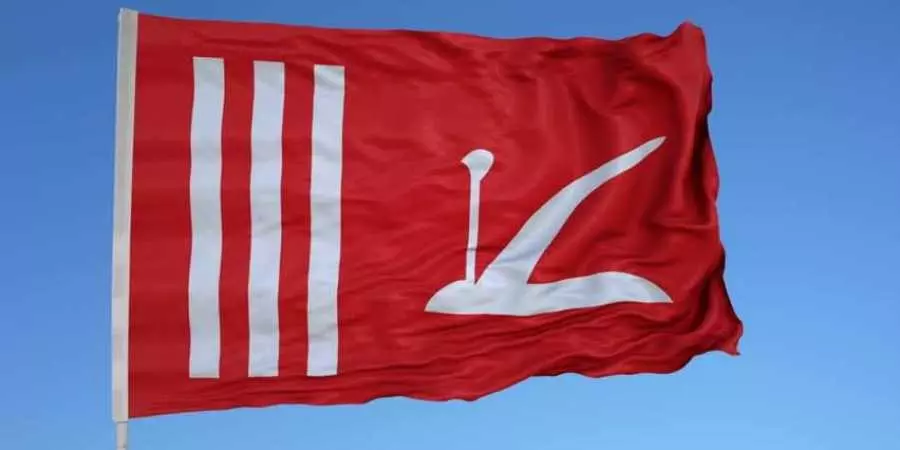
For 67 years, the former princely state of Jammu and Kashmir enjoyed a unique status under India’s Constitution, complete with its own state flag that flew alongside the Indian tricolour. That flag — a red banner with three white vertical stripes and a plough — was quietly lowered in August 2019, a casualty of the abrogation of Article 370. Across the Line of Control, the flag of Azad Kashmir — a green field with four white stripes, a saffron canton, and a star and crescent — continues to flutter over government buildings in Muzaffarabad, symbolising the region’s unresolved quest for self-determination.
This article traces the visual history of Kashmir’s flags — from the Dogra Maharajas to the present day — exploring their origins, meanings, and the political earthquakes that have shaped their fate.
The Azadi Times
No state grants. No corporate lobby. Just ground‑truth reporting from Kashmir & beyond
You make this possible.
The Princely Standard: Flags Under the Maharajas (1846–1947)
Before the partition of British India in 1947, Jammu and Kashmir was an independent princely state, ruled by the Dogra dynasty under the suzerainty of the British Crown. The Maharajas had their own army, currency, postal service — and flags.
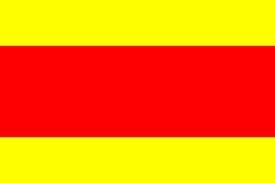
From 1846 to 1936, the Maharaja of Jammu and Kashmir used a saffron-red flag with a rounded tail — a design reflecting the Dogra court’s aesthetic preferences and the region’s distinct sovereignty.
In 1936, a significant change occurred: a white plough was added to the Maharaja’s standard. The plough symbolised the state’s predominantly agricultural economy and its connection to the land. Meanwhile, the Dogra ruler flew a personal standard — a red flag with a yellow stripe at the top and bottom.

These princely flags, however, were not symbols of popular sovereignty. They represented the autocratic rule of the Maharaja, whose authority was increasingly challenged by a rising tide of popular discontent.
The Birth of a People’s Flag: The 1931 Uprising
The most iconic element of Kashmir’s flag history — the red-and-white design — did not originate in a royal palace. It was born in blood.
On 13 July 1931, Kashmiri Muslims protesting outside the Srinagar Central Jail against the Dogra Maharaja’s repressive rule were fired upon by state forces. Dozens were killed. According to historical accounts, the crowd hoisted the blood-stained shirt of a martyr as a defiant symbol of resistance.

That red banner became the rallying flag of the Jammu & Kashmir National Conference (NC) , the political party founded by Sheikh Abdullah. On 11 July 1939, the NC formally adopted a red flag with three white vertical stripes as its party flag.
The symbolism was potent:
Red represented the blood of the martyrs of 13 July 1931 — later reinterpreted as the colour of workers and labourers.
Three white stripes symbolised the three regions of the princely state: Jammu, the Kashmir Valley, and Ladakh.
This flag was not merely a political emblem. It became a banner of popular aspiration — a rejection of Dogra autocracy and a demand for representative government.
The State Flag (1952–2019): A Symbol of Autonomy
When the Constitution of India came into effect in 1950, Jammu and Kashmir was granted special status under Article 370, allowing it to retain its own constitution, flag, and autonomy over all matters except defence, foreign affairs, finance, and communications.
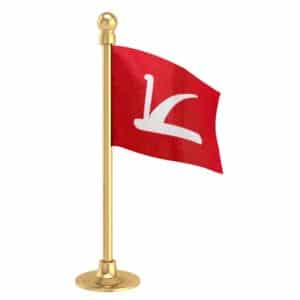
On 7 June 1952, the Constituent Assembly of Jammu and Kashmir passed a resolution formally adopting a state flag. Article 144 of the state’s constitution described it as “rectangular in shape and red in colour with three rectangular white vertical strips of equal width next to the staff and white plough in the middle with its handle facing the strips”.
The official specifications were:
Proportion: 2:3
Colour: Red
White stripes: Three vertical stripes near the hoist (the side closest to the flagpole)
Central emblem: A white plough
The symbolism was carefully layered:
Red — originally the blood of 1931 martyrs, later reinterpreted as representing labour and the working class.
White plough — symbolising the peasantry and the state’s agricultural foundation.
Three white stripes — representing the three regions of Jammu, Kashmir, and Ladakh.
For 67 years, this state flag flew alongside the Indian tricolour atop the Civil Secretariat in Srinagar, on government buildings, and on vehicles of constitutional authorities. In December 2015, the Jammu and Kashmir High Court even ordered the government to hoist the state flag alongside the national flag on official buildings and vehicles.
To many Kashmiris, particularly those sympathetic to the National Conference, the state flag was a cherished emblem of their region’s unique identity within the Indian Union. It represented a constitutional bargain that had preserved a degree of autonomy and protected the region’s distinct culture.
5 August 2019: The Flag Comes Down
Everything changed on 5 August 2019. The Indian government, in a surprise move, abrogated Article 370, stripped Jammu and Kashmir of its special status, and bifurcated the state into two Union Territories: Jammu and Kashmir and Ladakh.
With the state’s constitution rendered defunct, the state flag also lost its official status.
On 25 August 2019, three weeks after the abrogation, the state flag was quietly removed from the Civil Secretariat in Srinagar and replaced with the Indian tricolour. Only the national flag now flies over the seat of government. It had been expected to remain until 31 October, when the bifurcation was to take effect, but the removal came earlier on orders from the Centre.
The Home Ministry made the position unequivocal: “There will be no separate flag of Jammu and Kashmir and the tricolour will be the only national flag for the entire country”.
The removal was part of a broader erasure of symbols of Kashmir’s special status. The phrase “One Nation, One Flag” became a rallying cry for supporters of the move, while critics saw it as the final humiliation of a region whose autonomy had been negotiated at the time of accession in 1947.
Even today, in 2026, the question of the state flag remains politically sensitive. During the 79th Independence Day celebrations in August 2025, Chief Minister Omar Abdullah unfurled the national flag at Bakshi Stadium in Srinagar — the first elected chief minister to do so in eight years — even as the loss of statehood and its symbols continued to rankle.
The Flag of Azad Kashmir: A Competing Vision
On the other side of the Line of Control, a different flag tells a different story. The flag of Azad Jammu and Kashmir (AJK) , the Pakistan-administered territory, was adopted on 24 September 1975 via the Azad Jammu and Kashmir State Flag Ordinance.
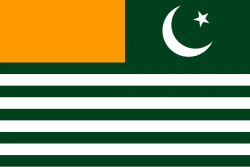
But its origins go back to 1948, when it was designed by Colonel Abdul Haq Mirza, a mujahid working at the Rawalpindi headquarters of the Azad Kashmir rebellion, as the “Kashmir Liberation Flag”.
The design is complex and layered:
Green background (three-fourths of the flag) — represents the 75 percent Muslim majority population of the erstwhile princely state of Jammu and Kashmir.
Saffron/gold canton (one-fourth, upper hoist) — represents the 25 percent religious minorities, including Hindus, Sikhs, and Buddhists.
Four white horizontal stripes alternating with green — symbolise the four major rivers flowing through Kashmir: the Indus, Jhelum, Chenab, and Ravi.
Star and crescent on the upper fly — represents the Islamic heritage of the region and its strong ties with the Federation of Pakistan.
An alternative interpretation from the AJK government itself states that the green stripes represent the Kashmir Valley, the white stripes represent the snow-covered mountains, and the crescent is the “usual semblance of the State of Jammu and Kashmir”.
The proportions of the flag are 23:31 — an unusual ratio that distinguishes it from the standard 2:3 of the Pakistani national flag.
Crucially, Pakistan considers Azad Kashmir to be the legitimate government of independent Kashmir, with its own president and prime minister, while Pakistan handles its defence and foreign relations under a 1949 treaty.
The AJK flag remains a powerful symbol of Kashmiri identity on the Pakistani side of the Line of Control, flown on government buildings, during official ceremonies, and by the Kashmiri diaspora worldwide. It represents not merely administrative autonomy but the unresolved demand for self-determination — a demand rooted in the UN Security Council resolutions of 1948, 1951, and 1957, which called for a plebiscite to determine the region’s permanent status.
The Flag of Gilgit-Baltistan
Further north, the autonomous territory of Gilgit-Baltistan — also part of Pakistan-administered Kashmir — has its own provincial flag, adopted on 28 June 2011.
The flag displays the Pakistani national colours of white and dark green, with a crescent and star to represent the Muslim majority, and features the provincial emblem prominently.
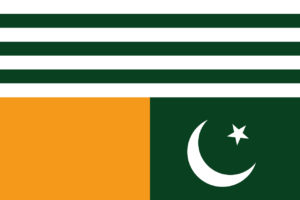
The emblem incorporates symbols of Gilgit-Baltistan’s unique geography and heritage:
The Markhor — the national animal of Pakistan
The Deodar cedar — the national tree
K2 — the world’s second-highest mountain, described as Pakistan’s “national mountain”
The flag reflects Gilgit-Baltistan’s status as a region that, while part of Pakistan-administered Kashmir, maintains a distinct identity rooted in its mountainous landscape. The territory’s history is also marked by a dramatic break from Dogra rule: on 1 November 1947, the people of Gilgit-Baltistan raised their flag of freedom against the Kashmiri Maharaja, declaring an independent state and joining Pakistan.
A Banner of Independence
Beyond the official flags of India and Pakistan-administered territories, there exists a third banner — one that has no official recognition but carries immense symbolic weight. The separatist flag of Kashmir, often seen at protests in the valley, typically features variations of the red, green, and white colour scheme, sometimes incorporating a star or crescent.
This flag is associated with movements demanding independence from both India and Pakistan — a “third option” rooted in the original vision of a sovereign Kashmir that was briefly declared by Maharaja Hari Singh before he acceded to India in 1947.
The red-and-white design of the former state flag is sometimes repurposed by separatists as a symbol of resistance, particularly during protests and shutdowns. In Lal Chowk, Srinagar’s historic square, a giant red flag once fluttered as a gathering point for political expression. Today, the square is dominated by the Indian tricolour, illuminated at night in its colours — a powerful visual metaphor for the changed political landscape.
The Disappearance of Ladakh’s Representation
One subtle but significant change following the 2019 bifurcation was the erasure of Ladakh from the symbolism of the state flag. The three white stripes that once represented Jammu, Kashmir, and Ladakh now refer only to the two regions of the newly formed Union Territory of Jammu and Kashmir.
Ladakh, now a separate Union Territory, has no official flag of its own — only the Indian tricolour. The region’s distinct Buddhist-majority identity, so different from the rest of Kashmir, is no longer reflected in any territorial banner.
Legal Status Today: What Flags Fly, and Where
As of April 2026, the legal landscape regarding Kashmir’s flags is as follows:
| Territory | Official Flag(s) | Status |
|---|---|---|
| India-administered Kashmir (Union Territory) | Indian tricolour only | Former state flag abolished August 2019 |
| Ladakh (Union Territory) | Indian tricolour only | No separate territorial flag |
| Azad Kashmir (Pakistan-administered) | AJK flag and Pakistani flag | Both flags fly; AJK flag adopted 1975 |
| Gilgit-Baltistan | GB provincial flag and Pakistani flag | Provincial flag adopted 2011 |
The principle of “One Nation, One Flag” now applies uniformly across all Indian-administered territories, including Kashmir. There is no legal provision for the revival of the state flag, even if full statehood is restored to Jammu and Kashmir — a demand that the Indian government has signalled may be addressed in the future.
What the Future Holds
The flags of Kashmir are not mere historical artefacts. They are living symbols whose meaning continues to evolve with the region’s turbulent politics. In India-administered Kashmir, the disappearance of the state flag remains a source of resentment for those who valued the region’s special status. In Pakistan-administered Kashmir, the AJK flag serves as a daily reminder of the unresolved dispute — a banner of a state that exists in constitutional limbo, recognised by Pakistan but not by the international community.
Meanwhile, the separatist flag — unofficial, unacknowledged, but not forgotten — continues to appear in protests and on social media, a ghost banner of a dream that refuses to die.
As the 2020s progress, the question of Kashmir’s future remains as open as ever. Whether through the restoration of statehood, a resolution of the broader dispute, or the emergence of new political realities, the flags of Kashmir will continue to be raised, lowered, and contested — each piece of cloth carrying the weight of history, identity, and hope.