

Kashmir — with its valleys stretching from Srinagar to Gilgit and Leh — has long been celebrated as a paradise by outsiders. For decades, Indian and Pakistani filmmakers projected the region as a romantic or tragic backdrop to their own stories. But the people of Kashmir themselves were rarely given the opportunity — or the space — to tell their own stories on their own screens.
Today, despite decades of conflict and cultural suppression, Kashmir’s own film industry is quietly rebuilding. What was once silenced by war and state control is now beginning to speak again — cautiously, creatively, and on its own terms.
Kashmir’s relationship with cinema is older than most realize. In 1903, British filmmakers shot some of the earliest travelogues in the region. By 1932, Srinagar’s Palladium Talkies opened in Lal Chowk, offering locals a glimpse of the world through a projector’s light. By the mid‑20th century, multiple cinemas dotted the valley, including Broadway, Regal, and Shah Cinema.
The Azadi Times
No state grants. No corporate lobby. Just ground‑truth reporting from Kashmir & beyond
You make this possible.
During the 1960s and 1970s, Kashmir became a favourite shooting location for Bollywood and Lollywood directors alike. Films like Junglee (1961) and Henna (1991) painted it as a romantic, idyllic backdrop — a paradise without politics, without pain.
But this romanticism collapsed in 1989, when the insurgency erupted. Cinemas were targeted, bombed, or simply shut down under threat. The Palladium was occupied by troops and turned into a military bunker. Cinema culture in Kashmir died overnight.
A difficult return: the modern context
In the decades since, the big screen never truly returned to the people. While Bollywood continued to use Kashmir’s landscapes as a backdrop for its own narratives, Kashmiris themselves were excluded from shaping these stories.

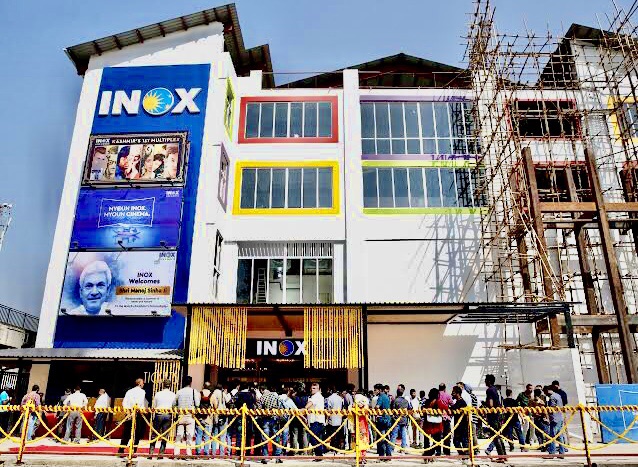
When a modern multiplex opened in Srinagar in 2022, reactions were mixed. While some hailed it as a symbol of normalcy, others criticized it as an instrument of the state narrative — screening Bollywood blockbusters, but not offering space to local stories.
Mini‑theatres have since appeared in Pulwama, Shopian, and Handwara — but they too largely serve outside narratives. The fear of censorship and political interference still looms over filmmakers and audiences alike.
In spite of these challenges, a new generation of Kashmiri filmmakers is beginning to carve out a space. Their works focus on lived experiences, loss, memory, and resilience — themes too inconvenient for mainstream cinema.

Some milestones include:
Harud (2010), by Aamir Bashir: a quiet, meditative feature about life in a militarized landscape.
Jashn‑e‑Azadi (2007), a documentary by Sanjay Kak, exploring grief and resistance in Kashmir.
Inshallah Football (2010), about a young footballer denied a passport due to his father’s political past.
No Fathers in Kashmir (2019), by Ashvin Kumar, dealing with disappearances and trauma.
Qouluf, The Ensorcelled (2024), by Ali Emran: the first Kashmiri‑language color feature film in 60 years.
Baand (upcoming in 2025), also by Emran, celebrating Kashmir’s traditional folk theatre.
Festivals like the Verité Film Festival, hosted annually in Awantipora since 2011, have become crucial for showcasing independent student films — often tackling social and political issues otherwise ignored.
Beyond Bollywood and Lollywood
For too long, Kashmir’s cinema was defined by outsiders — Bollywood in India, Lollywood in Pakistan — each projecting their narratives of paradise or war. Both ignored the depth of Kashmiri society and culture, flattening it into a prop for their respective national myths.
Today’s independent filmmakers reject this. They see cinema not just as entertainment, but as a form of cultural resistance — a way to document their truths, outside of Indian and Pakistani state narratives. Films like Qouluf and Baand are significant because they are made by Kashmiris, in their own language, about their own lives.
Despite the growing interest, Kashmir’s film industry still faces daunting challenges:
Infrastructure: Lack of funding, professional studios, and equipment limits production.
Censorship: Filmmakers risk harassment or bans if their stories contradict official narratives.
Distribution: Few local theaters are willing to screen independent films.
Audience trust: After decades of propaganda, many viewers remain skeptical of cinema as a medium.
Why it matters
Reviving Kashmiri cinema is not just about art. It is about reclaiming identity, challenging imposed narratives, and documenting a reality that is otherwise erased. By creating spaces for independent cinema — both on screen and behind the camera — Kashmiris can tell stories of their own choosing.
For international audiences, supporting these films means hearing voices that mainstream media often silences. For Kashmiris, it means a step toward self‑representation and dignity.
From the ruins of abandoned theaters, a new era of storytelling is beginning — one that refuses to be defined by Indian or Pakistani narratives, but instead insists on Kashmiri authenticity.