
Sost, Hunza (Gilgit-Baltistan) — July 2025:
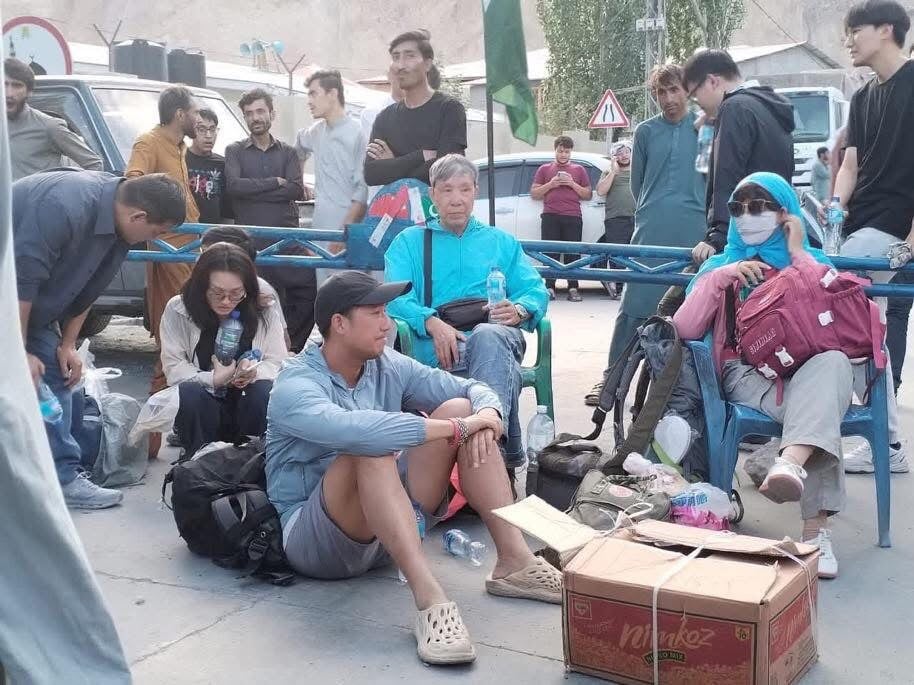
A deepening crisis is unfolding at the strategic Pakistan–China border in Sost, where a traders’ protest has now triggered an unexpected backlash this time from Chinese nationals themselves. Stuck at the closed immigration gate, dozens of Chinese citizens are now chanting: “Let us go to China”, voicing frustration over being stranded for days amid an escalating sit-in led by local Gilgit-Baltistan traders.
Border Closed, Trade Paralyzed, and Tensions Rising
The protest, now entering its eighth day, is being led by the local trading community against what they call “unjust and unconstitutional” taxes — specifically income tax and a controversial “slash tax” imposed by the Federal Board of Revenue (FBR) and Pakistan Customs.
“Gilgit-Baltistan has no clear constitutional status within Pakistan,” said one protester. “So how can federal taxes be applied here as if we’re a regular province?”
In protest, traders have shut down the immigration gate at Sost — the key border point for China-Pakistan trade — halting all movement across the Khunjerab Pass. As a result, multiple Chinese citizens and cargo vehicles are now stuck on both sides, with no timeline for reopening.
Chinese Nationals Stage Rare Protest
Amid growing uncertainty, several Chinese citizens have staged their own protest at the border, demanding immediate permission to return home.
“We are Chinese nationals. We should not be caught up in another country’s internal political and economic crisis,” said one visibly distressed traveler.


The rare demonstration by Chinese citizens has added a new layer of tension to the already volatile situation, raising concerns in diplomatic circles. Sources suggest that Chinese authorities have quietly reached out to Islamabad seeking clarity.
The Sost Dry Port and Karakoram Highway — both part of the China–Pakistan Economic Corridor (CPEC) — are vital links in China’s Belt and Road Initiative (BRI). The suspension of trade and movement not only threatens billions in cross-border commerce but also undermines trust in the stability of Pakistan’s northern routes.
With trade typically peaking from April to November via the Khunjerab Pass, the current shutdown is more than a logistical issue — it is a strategic flashpoint.


This is not the first time protests have erupted in Gilgit-Baltistan over federal taxes. But this time, the issue has become deeply symbolic. Many locals argue that the region’s unresolved constitutional status means it is legally and morally wrong to impose federal taxes without representation or autonomy.
The protest has found quiet support among pro-Kashmiri political voices. Recently, Abid Gilgiti, a member of the Awami Action Committee Gilgit-Baltistan, was invited to Muzaffarabad by the Jammu Kashmir Joint Awami Action Committee, where discussions on shared self-determination struggles were held.