
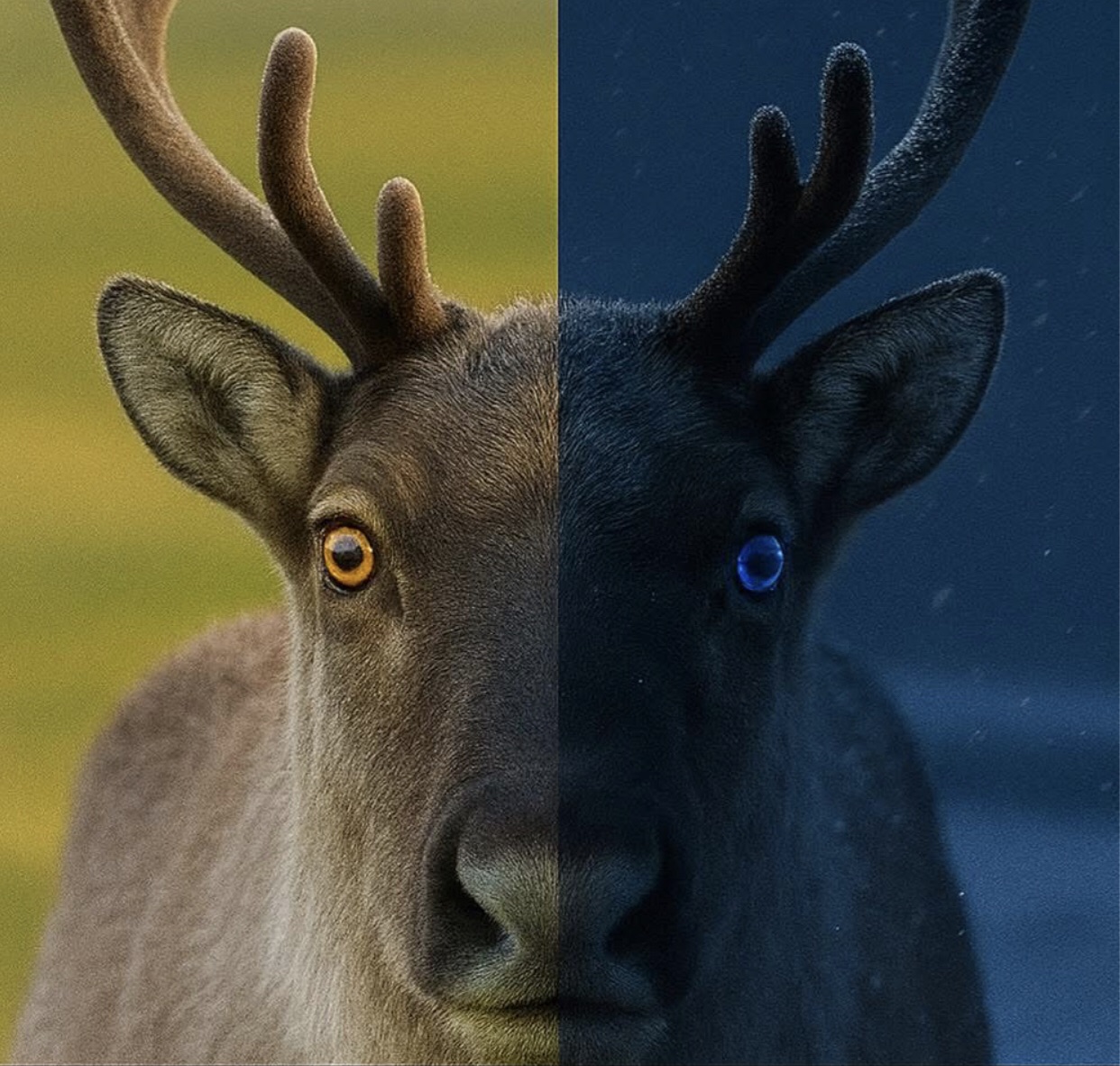

Arctic Circle – Scientists have uncovered an extraordinary adaptation in Arctic reindeer: their eyes change color with the seasons. This biological phenomenon, unique among mammals, equips the animals to handle the extreme shifts between summer’s midnight sun and winter’s prolonged darkness in their harsh northern habitat.
A Survival Mechanism Unlike Any Other
Researchers have found that the reindeer’s tapetum lucidum—a light-reflecting layer behind the retina—alters its hue depending on the season.
- In summer, when daylight lasts nearly 24 hours, the tapetum reflects golden-yellow light, enhancing vision in bright conditions.
- In winter, as darkness dominates, the reindeer’s pupils remain dilated for extended periods, increasing pressure within the eye. This shifts the tapetum’s reflection to a deep blue, making their vision up to 1,000 times more sensitive in low light.
This adaptation is crucial for reindeer survival. Their ability to detect predators and forage efficiently in near-total darkness gives them a critical edge in one of Earth’s most extreme environments. The discovery also offers insights into human vision research, particularly in understanding how eyes adapt to varying light conditions.
Scientific Implications
Dr. Glen Jeffery, a neuroscientist at University College London who has studied this phenomenon, explains: “This is an extraordinary example of evolution fine-tuning an animal’s biology to its environment. The reindeer’s eyes essentially recalibrate themselves to make the most of available light, whether it’s the glare of summer or the gloom of winter.”
Future Research
Scientists are now investigating whether other Arctic species possess similar adaptations. The findings could inspire new technologies in low-light vision enhancement, from night-vision equipment to medical treatments for vision disorders.
Key Takeaways:



- Only known mammal with seasonally shifting eye color.
- Adaptation maximizes vision in both constant daylight and near-total darkness.
- Potential applications in optics and human eye research.